Typical tendencies
Energy level
Needs a real outlet most days.
Good with children
Gentle and tolerant around children.
Good with other dogs
Selective; careful introductions needed.
Trainability
Picks up cues with steady, short sessions.
Shedding
Barely a hair on the sofa.
Apartment friendly
Can manage in a flat with plenty of outings.
More traits
Exercise needs
Adaptability
Grooming needs
Drooling
Intelligence
Family friendly
Good with cats
Friendly with strangers
Sociability
Protectiveness
Prey drive
Overview
The Airedale Terrier is the largest of the terriers and behaves like it: confident, busy, clever and convinced it has a job. It suits active households that enjoy training, want a dog for hiking and games, and can live with a terrier's independence and a prey drive that notices every squirrel. Airedales are affectionate and playful with their own family, patient with children who treat them well, and naturally watchful of the house, yet they are not a dog you can leave to amuse itself in a yard. They need an owner who keeps them busy, and a grooming budget or the willingness to learn hand-stripping.
People who want instant obedience, a dog that is easy with other dogs, or a quiet companion for a small apartment should look elsewhere. For the right home, the King of Terriers is a loyal, funny, versatile dog that will try anything you try.
History & Origin
The Airedale took shape in the mid-1800s in the valley of the River Aire in Yorkshire, England, where mill and factory workers wanted one dog for everything: ratting along the riverbanks, hunting otters, retrieving, guarding and the occasional spot of poaching. They crossed the local rough-coated black-and-tan terriers with the Otterhound, which added size, a nose and a love of water. Early dogs went by several names, including Waterside, Bingley and Broken-haired Terrier, before the name Airedale Terrier was adopted in 1879; the Kennel Club recognized the breed in 1886.
The breed reached America with early importers in the 1880s and was recognized by the AKC in 1888. Airedales served as police dogs in Germany and, through Lt. Col. Edwin Richardson's British War Dog School, as messengers and sentries in the First World War; one dog, Jack, delivered a message through heavy fire despite fatal wounds. The breed was among the most popular in the United States in the early 1920s, and President Warren Harding's Laddie Boy made it a White House fixture.
Appearance
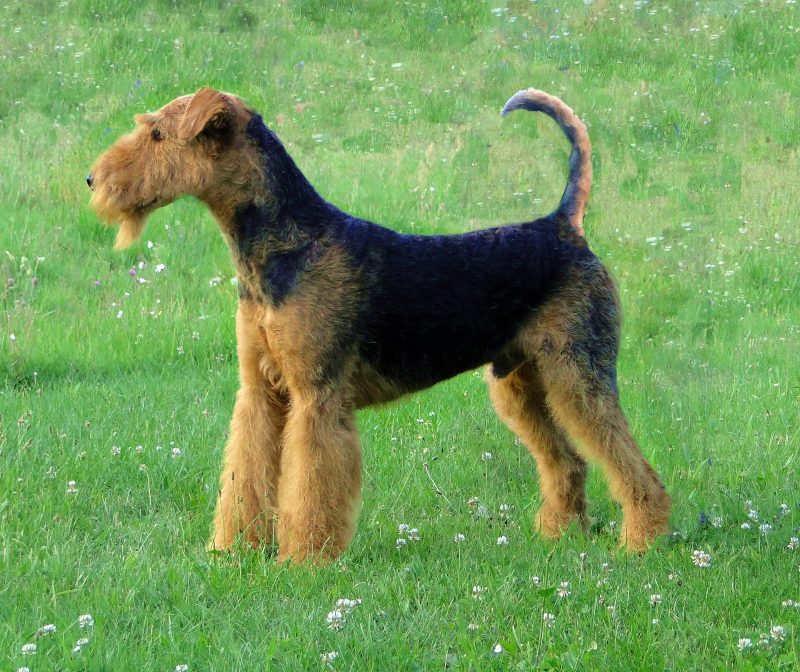
An Airedale is a square, upstanding dog, with males 23 to 24 inches at the shoulder and females 22 to 23, and weights of roughly 55 to 70 pounds for males and 50 to 60 for females. The head is long and flat with a strong muzzle, small V-shaped ears that fold forward, and a beard and eyebrows that give a thoughtful expression. The neck and back are level, the chest deep rather than wide, and the tail carried up.
The coat is hard, dense and wiry over a soft undercoat, lying close with a slight wave. The pattern is always tan with a black or grizzle saddle over the back and sides, with tan head, ears, legs and chest. Look-alikes are its smaller relatives: the Welsh Terrier and Lakeland Terrier wear the same pattern at half the size, and the Irish Terrier is solid red. Nothing else in the Terrier Group reaches an Airedale's height.
Temperament & Personality
Airedales are confident, outgoing and endlessly interested. At home they are affectionate and like to be close to their people, often with a toy in their mouth, and they stay playful well into old age. They are alert watchdogs with a deep bark, polite but not gushing with strangers, and quick to decide whether a visitor is welcome. With children they are usually tolerant and fun, though a bouncy adolescent can flatten a toddler.
The terrier side shows with other animals: many Airedales are fine with dogs they grew up with but do not back down if challenged, and same-sex scuffles are common. Cats and small pets are at risk unless raised together and supervised. Indoors a well-exercised Airedale is calm and companionable; outdoors it switches on, follows its nose and its eyes, and will chase. They are independent thinkers rather than defiant, and they have a well-developed sense of humor.
Exercise & Activity
Plan on 60 to 90 minutes a day for an adult Airedale, split between brisk walks, free running in a safely fenced area and something that uses the brain. They make good jogging and hiking partners once mature, love swimming, and enjoy fetch, scent games, agility, obedience and barn hunt. A long on-leash walk alone is not enough; they need to run and to think. Off-leash recall near wildlife or roads is unreliable in many Airedales because the prey drive is strong, so use a long line in open areas.
Puppies should get short, frequent play rather than forced distance until the growth plates close at around 14 to 18 months. The wiry coat sheds rain and cold well, but Airedales tolerate heat only moderately, so exercise early or late in summer. An under-exercised Airedale digs, chews, barks and invents its own entertainment.
60 to 90 minutes daily, including real running
Daily mental work: training, nose games, puzzle toys
Long line in unfenced areas because of prey drive
Training
Airedales learn fast and get bored just as fast. They will do a thing perfectly three times and then ask why you need a fourth, so keep sessions short, vary the exercises and make rewards worth having: food, tug and praise all work. Harsh handling backfires; the breed shuts down or argues. Start socialization early and keep it going through adolescence, when many Airedales test rules and get pushier with other dogs.
Teach a solid leave-it, a reliable drop and a settle on a mat, because mouthiness and grabbing are normal puppy behaviors that persist without direction. Recall needs years of practice around distractions. Loose-leash walking is worth investing in early, since a 60-pound terrier that lunges at squirrels is hard on shoulders. Airedales shine in obedience, rally, agility, tracking and even hunting tests when the handler stays upbeat and creative. Think of training as a lifelong conversation, not a course you finish.
Grooming & Care
The Airedale coat does not shed much, but it does not maintain itself either. Brush two or three times a week with a slicker and a comb, paying attention to the beard, leg furnishings and armpits where mats start. The traditional approach is hand-stripping, pulling out the dead wiry hair by hand or with a stripping knife every few months, which keeps the hard texture and rich color. Many pet owners instead have the coat clipped every six to eight weeks; it softens and fades but is much less work. Either way, budget for a professional groomer or learn yourself.
Bathe only as needed, as frequent bathing softens the coat. Wipe the beard after meals and drinks, since it holds food and water. Check the folded ears weekly, trim nails every two to three weeks, and brush teeth several times a week.
Brush 2 to 3 times a week; strip or clip every 6 to 8 weeks
Beard needs a daily wipe
Low shedding, high maintenance
Health
Airedales generally live 11 to 14 years and are a sturdy breed, but a few conditions run in it. The parent club's recommended screening covers hips (for hip dysplasia), a cardiac exam, an eye exam and kidney screening, because juvenile renal dysplasia and other kidney disease appear in some lines. Hypothyroidism is fairly common and easy to test for with blood work; signs include weight gain, lethargy and a thinning coat. Allergic skin disease and hot spots show up in the breed, and the folded ears can trap moisture.
Dilated cardiomyopathy and congenital heart defects are reported, which is why a vet should listen carefully to the heart at every checkup. Von Willebrand disease, a bleeding disorder, has a DNA test. Cancer, especially lymphoma, is the leading cause of death in breed health surveys. Like other deep-chested dogs, Airedales can bloat, so a swollen, painful belly with unproductive retching is an emergency. Ask your vet about screening results when buying a puppy.
Nutrition
Feed an Airedale a complete diet suited to its life stage and activity. Puppies grow quickly and do best on a large-breed growth food with controlled calcium, fed three times a day until about six months and then twice daily, to protect developing joints. Adults usually need two measured meals; split feeding also lowers bloat risk, as does avoiding hard exercise for an hour either side of meals and skipping raised bowls unless your vet advises them.
Many Airedales are keen eaters and will gain weight quietly under the dense coat, so run your hands over the ribs every week and adjust portions rather than trusting the bag. Training treats count toward the daily total. Dogs with skin or thyroid problems may benefit from a specific diet; discuss options with your vet rather than guessing. Fresh water should always be available, especially after exercise.
Living With This Breed
Airedales do best in a house with a securely fenced yard and people who are home a reasonable amount. They can live in an apartment only with a very committed owner, because they need daily running and will bark at hallway noises. Most tolerate a workday alone if exercised first, but a bored Airedale is destructive. They are good family dogs with children old enough to respect them, and they are watchful without being aggressive. Introduce other dogs carefully and expect caution around cats and small pets. Fences should be solid; Airedales dig and some climb.
A sitter should know the dog's reliability off leash (assume none), where the prey drive is strongest, how the dog greets strange dogs, and that the beard needs wiping. Daycare suits sociable individuals, but not every Airedale enjoys group play; a solo walker is often the better fit.
House and fenced yard preferred; apartments only with real commitment
Supervise around cats, small pets and unfamiliar dogs
Tell sitters: leash on, prey drive high, loves a job
Interesting Facts
Airedales carried messages for the British Army in the First World War; one named Jack is said to have completed his run despite mortal wounds.
President Warren Harding's Airedale, Laddie Boy, had his own hand-carved chair at cabinet meetings and was covered by the press like a celebrity.
After the First World War the Airedale became one of the most popular breeds in the United States, peaking in the early 1920s.
The name Bingley Terrier was dropped in the 1870s because it gave too much credit to a single Yorkshire town; Airedale, for the whole valley, won out.
An Airedale named Kitty belonged to the Astor family and was lost in the sinking of the Titanic.
The nickname King of Terriers refers to size; Airedales are too big to go to ground after prey like smaller terriers, so they were bred to be generalists instead.
What Airedale Terrier owners say
Real pets, photos, stories and tips from the SitterNation community — separate from the editorial guide above.
Log in to add your pet, photos, stories and tips.
Meet Airedale Terriers on SitterNation
No Airedale Terriers have joined yet. Owners can show their pet here from the pet's profile.
Airedale Terrier community photos
No Airedale Terriers photos yet — be the first to share one.
Stories from Airedale Terrier owners
No stories yet. What is life with yours really like?
Tips from Airedale Terrier owners
No tips yet. One practical thing that works for you is enough.
Ask Airedale Terrier owners
No questions yet. Ask the people who live with the breed.