Typical tendencies
Energy level
Needs a real outlet most days.
Good with children
Gentle and tolerant around children.
Good with other dogs
Gets along with known, polite dogs.
Trainability
Lives for the lesson; a trainer's dream.
Shedding
Fur on everything, all year round.
Apartment friendly
Can manage in a flat with plenty of outings.
More traits
Exercise needs
Adaptability
Grooming needs
Drooling
Intelligence
Family friendly
Good with cats
Friendly with strangers
Sociability
Protectiveness
Prey drive
Overview
The German Shepherd Dog is the thinking person's working dog: intelligent, trainable, courageous and intensely loyal to its family. It suits experienced or committed owners who want a partner for training, sport or long active days, who can give it structure and a job, and who do not mind a dog that watches strangers with reserve. A well-bred, well-socialized Shepherd is steady with children, polite with guests once introduced and a calm presence at home. The breed is a poor fit for people who are away all day, who want a dog friendly with everyone on sight, or who are unprepared for heavy shedding and a strong will. Buy from a breeder who screens hips and elbows and proves temperament, or adopt an adult whose personality you can see, and expect to invest in training and exercise for the dog's whole life.
History & Origin
Germany's regional sheepdogs varied widely in the 1800s until a cavalry officer, Max von Stephanitz, set out to standardize them into a single working breed. At a show in April 1899 he bought a wolf-gray dog named Hektor Linksrhein, renamed him Horand von Grafrath and registered him as the first German Shepherd Dog in the stud book of the Verein für Deutsche Schäferhunde (SV), the club he founded that same month. Von Stephanitz insisted on utility over looks and, as sheep herding declined, steered the breed into police and military work. The AKC registered its first Shepherd in 1908 and the German Shepherd Dog Club of America formed in 1913. Anti-German feeling during the First World War led Britain to rename the breed the Alsatian, a name it kept until 1977, and the AKC briefly dropped 'German' too. Film stars Rin Tin Tin and Strongheart made the breed hugely popular in the 1920s, and it has remained near the top of popularity rankings ever since.
Appearance
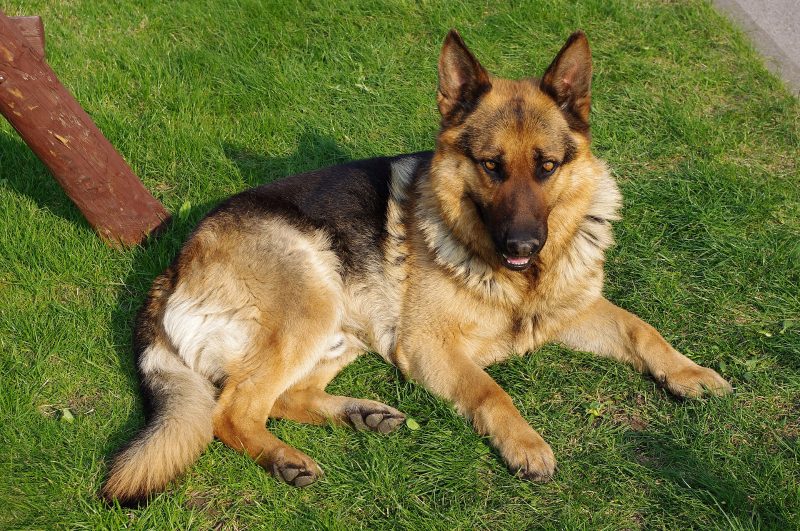
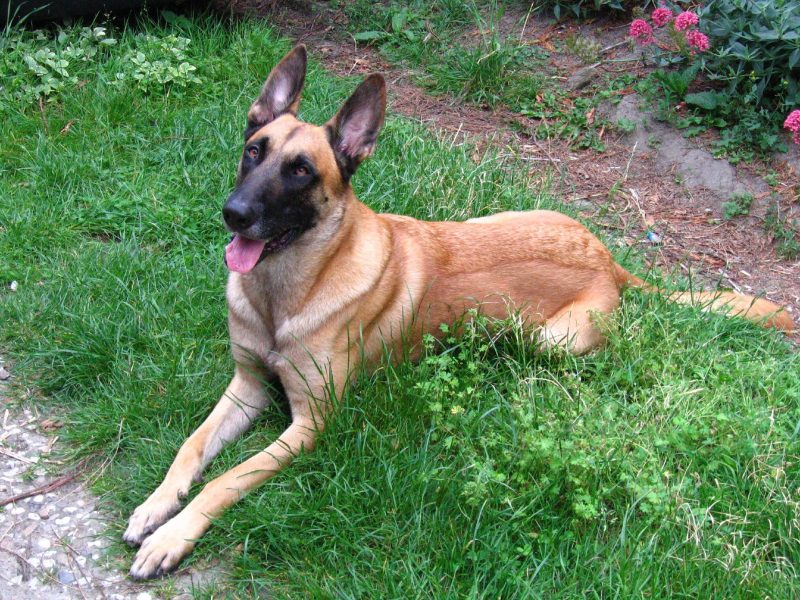
A German Shepherd is a large, muscular, slightly long-bodied dog built for trotting tirelessly. Males stand 24 to 26 inches and weigh 65 to 90 pounds; females are 22 to 24 inches and 50 to 70 pounds. The head is noble and wedge-shaped with erect, pointed ears and dark, intelligent eyes. The back slopes gently from high withers to a lower croup, with a bushy tail carried low in a slight curve. The double coat is dense and medium length in most dogs, with a thick undercoat; long-coated Shepherds exist and are recognized in Europe. Black and tan is classic, with sable, black and red, bi-color and solid black also recognized; white dogs are disqualified in the AKC ring and form the separate White Shepherd breed elsewhere. Show lines, especially American ones, often show a more pronounced rear angulation than working lines, which tend to be straighter-backed. Next to a Belgian Malinois, a Shepherd is heavier, longer and more angulated.
Temperament & Personality
The classic Shepherd is confident, self-assured and a little aloof. It bonds deeply with its family, often choosing one person as its own, and treats strangers with polite reserve until introduced; outright shyness or aggression are faults. The breed is a natural guardian that reads situations rather than reacting to everything, and barking at genuine oddities is normal. Energy is moderate indoors in an adult that has had its exercise and high outdoors. Shepherds are good with children in their own family and protective of them, which means supervising play with visiting kids who may be mistaken for threats. With other dogs they range from sociable to indifferent to pushy, and same-sex tension is not rare; cats are fine when raised together. Working lines carry more drive and intensity than pet or show lines. Poorly bred or under-socialized Shepherds can be nervous and reactive, the opposite of the breed's intended character.
Exercise & Activity
Plan on 90 minutes to two hours of activity a day for an adult German Shepherd, combining physical exercise with mental work; a tired body with a bored brain is still a problem dog. Long walks, hiking, jogging or biking once the dog is mature at about 18 to 24 months, swimming and fetch cover the physical side. Training sessions, scent work, tracking, obedience, herding trials, agility and protection sports such as IGP (formerly Schutzhund) give the breed the job it was bred for. Puppies need play and short walks, not forced mileage, because their joints are developing. Shepherds handle cold well and heat moderately; the dense coat means summer exercise should happen at cool times. An under-stimulated Shepherd barks, paces, digs, chews door frames and may become reactive on walks.
Daily: a long walk plus a training or scent session
Weekly: a sport, class or a new environment to explore
Training
German Shepherds learn faster than most handlers can teach, which is why they dominate police, military, guide and search-and-rescue work. They thrive on structure, clear communication and having a job; a Shepherd without training invents its own rules. Start socialization the day the puppy comes home and continue it through adolescence, introducing people of all kinds, calm dogs, traffic and surfaces, because the breed's natural suspicion hardens into reactivity without it. Reward-based training with food, toys and especially tug works well; the breed is sensitive to its handler's mood and does not need force. Teach impulse control early, since an 80-pound dog that lunges at the door is dangerous. Common sticking points are leash reactivity toward other dogs, guarding behavior toward visitors and nipping at running children, a leftover of herding. Recall is usually good. Sports such as obedience, tracking, agility and IGP channel the drive productively.
Grooming & Care
The nickname 'German shedder' is deserved: this breed sheds every day of the year and blows its undercoat heavily in spring and fall. Brush two or three times a week with an undercoat rake and a slicker, daily when the coat is blowing, and expect fur in the house regardless. Bathe only every couple of months or when dirty; frequent bathing dries the skin. Never shave a Shepherd, since the double coat insulates against heat and sun and regrows unevenly. Long-coated dogs need extra attention behind the ears and on the breeches to prevent mats. Check the upright ears weekly and clean only if dirty. Nails grow fast and should be trimmed every three to four weeks if daily exercise does not wear them down. Brush teeth several times a week. Check the hindquarters and tail of older dogs regularly, since mobility problems make self-grooming harder.
Brush: 2–3 times weekly, daily during seasonal shedding
Bath: every 6–8 weeks or as needed
Nails: every 3–4 weeks
Health
German Shepherds live about 9 to 13 years. Hip and elbow dysplasia are the best-known issues; roughly one in five Shepherds evaluated by OFA has dysplastic hips, and both conditions are screened by radiographs. Degenerative myelopathy is a progressive spinal cord disease of older dogs that causes hind-limb weakness; a DNA test identifies dogs at risk. The deep chest predisposes to bloat (gastric dilatation-volvulus), an emergency. Exocrine pancreatic insufficiency, in which the pancreas stops producing digestive enzymes, is more common in this breed than almost any other, and perianal fistulas, pannus (an immune eye disease), epilepsy, allergies, lumbosacral stenosis and panosteitis in growing puppies all appear regularly. Hemangiosarcoma is a leading cancer. Responsible breeders use OFA or PennHIP hip evaluations and OFA elbow radiographs, and many add the DM DNA test, a cardiac exam and a temperament evaluation. See your vet for a dog that drags its toes, eats ravenously but loses weight, has a swollen or hard belly, or shows sudden lameness.
Nutrition
Shepherd puppies grow fast and should eat a large-breed puppy formula with controlled calcium and calories until 12 to 18 months, then switch to adult food on your vet's advice; over-feeding a puppy to make it big strains joints that are already vulnerable. Adults need portions scaled to their work; a sport dog and a companion of the same size may need very different amounts. Because of the bloat risk, feed two or three smaller meals rather than one large one, avoid vigorous exercise for an hour before and after eating, and use a slow-feeder bowl if the dog gulps; ask your vet about a preventive gastropexy at the time of spaying or neutering. Shepherds have more than their share of sensitive stomachs and food allergies, so changes in diet should be gradual, and persistent loose stool or weight loss warrants a visit to the vet rather than another new food. Keep fresh water available and treats modest.
Living With This Breed
A German Shepherd does best in a house with a securely fenced yard and a family that is around much of the day, but an apartment is possible for an owner who commits to the exercise. They are not dogs for long solitary days; boredom and separation stress produce barking, destruction and anxiety. They shed heavily and will supervise everything that happens at home. Most are excellent with their own children and reserved with visitors, so introductions should be managed. Hot climates require care. For sitters and daycare staff: meet the dog with the owner first, let it approach on its own terms, follow the household's routine closely and respect the dog's tendency to guard the home and car. A calm, confident handler gets a calm, confident Shepherd.
Introduce visitors formally; do not let strangers walk in unannounced
Keep the daily routine and exercise the same
Watch group play closely; herding nips and pushiness are common
Interesting Facts
Every German Shepherd descends from Horand von Grafrath, the dog Max von Stephanitz bought in 1899 and registered as number one in the breed's stud book.
Rin Tin Tin was a real puppy rescued from a bombed kennel in France in 1918 by an American soldier; he went on to star in more than two dozen Hollywood films and received thousands of fan letters a week.
Buddy, the first guide dog in the United States, was a German Shepherd trained in Switzerland for Morris Frank in 1928, leading to the founding of The Seeing Eye.
Britain called the breed the Alsatian, after the Alsace region, from 1919 until 1977 to avoid the word German after the First World War.
Shepherds make up a large share of police and military working dogs worldwide, although the Belgian Malinois has overtaken them in some services.
Strongheart, the German Shepherd who starred in The Silent Call in 1921, has a star on the Hollywood Walk of Fame, as does Rin Tin Tin.
Breeds similar to the German Shepherd Dog
What German Shepherd Dog owners say
Real pets, photos, stories and tips from the SitterNation community — separate from the editorial guide above.
Log in to add your pet, photos, stories and tips.
Meet German Shepherd Dogs on SitterNation
No German Shepherd Dogs have joined yet. Owners can show their pet here from the pet's profile.
German Shepherd Dog community photos
No German Shepherd Dogs photos yet — be the first to share one.
Stories from German Shepherd Dog owners
No stories yet. What is life with yours really like?
Tips from German Shepherd Dog owners
No tips yet. One practical thing that works for you is enough.
Ask German Shepherd Dog owners
No questions yet. Ask the people who live with the breed.