Typical tendencies
Energy level
Needs a real outlet most days.
Good with children
Gentle and tolerant around children.
Good with other dogs
Gets along with known, polite dogs.
Trainability
Picks up cues with steady, short sessions.
Shedding
Fur on everything, all year round.
Apartment friendly
Can manage in a flat with plenty of outings.
More traits
Exercise needs
Adaptability
Grooming needs
Drooling
Intelligence
Family friendly
Good with cats
Friendly with strangers
Sociability
Protectiveness
Prey drive
Overview
The Norwegian Elkhound is a sturdy gray spitz that has hunted moose in Scandinavian forests for a very long time and has not forgotten it. It is bold, hardy, loyal to its family and equipped with a bark it was bred to use for hours at a time. At 45 to 60 pounds it is a manageable size, and the breed is affectionate at home, fond of children and a dependable watchdog without being aggressive.
What it asks for is an owner who enjoys an independent, energetic dog. Elkhounds need a good hour of exercise, a secure fence because the prey drive is strong, firm and patient training because they think for themselves, and tolerance for serious seasonal shedding. They live a long 12 to 15 years and stay vigorous for most of it. If you want a dog that will hike all day, guard the porch and still curl up by the fire, the Elkhound is a classic choice; if you want quiet and obedience, look elsewhere.
History & Origin
Spitz-type dogs of Elkhound shape have lived in Norway since well before recorded history, and the breed's supporters like to point to skeletons found alongside Stone Age tools and Viking artifacts. Whatever the exact age, these dogs rode in longships, guarded farms, herded and, above all, hunted. The Norwegian word elg means moose, and the dog's job was to track a moose across miles of forest, then hold it at bay by circling, dodging and barking until the hunter arrived. The same courage was used on bear and lynx.
Norway held its first shows for moose and bear dogs in 1877 and 1880, the Norwegian Hunters' Association took up the breed and a standard followed. Gray and black Elkhounds were separated in 1900. The first Elkhound shown in America appeared in 1913 and the breed entered the AKC stud book that year; the Norwegian Elkhound Association of America was admitted as the parent club in 1935 and adopted the Norwegian standard. Elkhounds still hunt moose in Norway, where about a thousand are registered each year, and the breed is regarded as the national dog.
Appearance
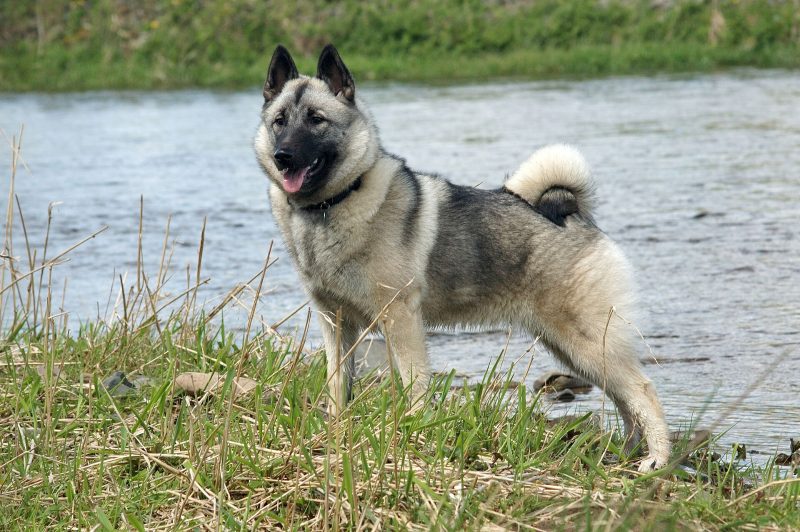
An Elkhound is a square, medium-sized spitz with a broad head, a wedge-shaped muzzle, erect pointed ears and a tail curled tightly over the back. Males stand 20 to 21 inches and weigh 50 to 60 pounds; females are 19 to 20 inches and 45 to 52 pounds. The chest is deep, the back short, the bone substantial, and the whole dog gives an impression of compact strength built for stamina rather than speed. Dark brown eyes and a bold expression finish the picture.
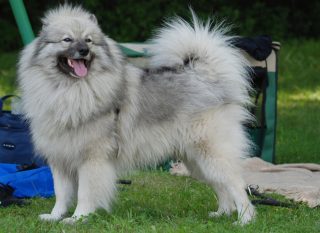
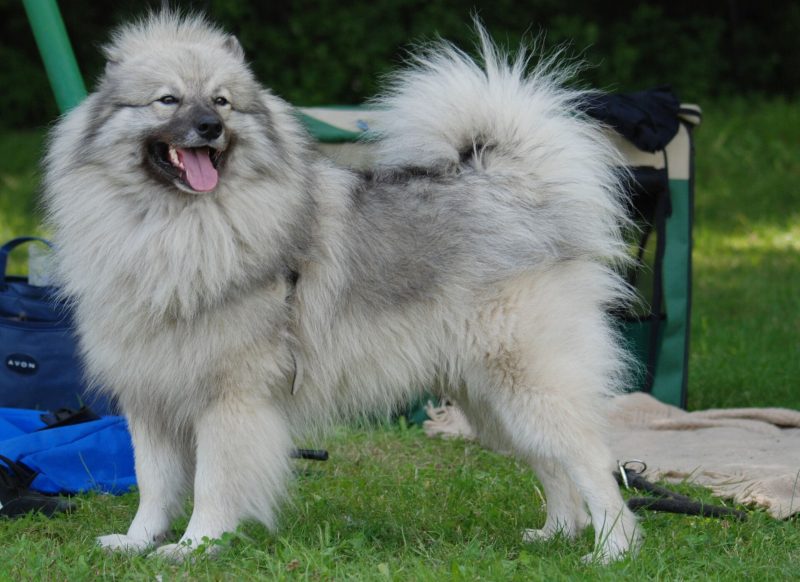
The coat is thick, coarse and weather-resistant, with a straight outer layer over a soft, woolly undercoat that is pale, almost white, at the base. The color is a shaded gray with black-tipped guard hairs, darkest on the saddle, with a black muzzle, ears and tail tip and lighter gray on the chest, belly and legs. The Elkhound can be confused with a Keeshond, which has a longer coat and spectacles, and with the larger Swedish Elkhound, or Jämthund, and the red Finnish Spitz. The Black Norwegian Elkhound is a separate, rarer breed.
Temperament & Personality
The Elkhound was bred to work far from its hunter and make its own decisions, and the modern dog keeps that independence. It is deeply loyal and affectionate with its family, playful with children it has grown up with and sensitive to moods despite its rugged look. With strangers it is reserved and alert: an Elkhound announces every visitor and watches them until the family relaxes, but it is not quarrelsome. The breed makes an excellent watchdog and a poor attack dog.
The bark is the trait to understand. It was selected to carry across a forest and to continue for as long as the moose stood still, so Elkhounds are vocal by nature and need to learn a quiet cue early. Prey drive is strong; cats raised in the home are usually fine, but squirrels, rabbits and the neighbor's cat are fair game. Same-sex dog aggression crops up in some lines, so early socialization matters. Indoors a well-exercised Elkhound is calm and companionable.
Exercise & Activity
An Elkhound needs about an hour of real exercise a day, and more is welcome. Long walks, hikes over rough ground, snowshoe outings and jogging once the dog is grown all suit a breed built for stamina in the Norwegian forest. Scent games, tracking and barn hunt use the nose and the brain, and both need using. Off-leash running should be in a fenced area, because an Elkhound on a scent trail is not listening.
Cold weather is where the breed is happiest; snow and sub-freezing temperatures do not bother it. Heat is the problem. In summer, walk early and late, provide shade and water and keep an eye on panting, since the dense undercoat holds warmth. Puppies should have free play and short walks rather than forced exercise until about a year old.
Boredom shows up as barking, digging and escape attempts.
A well-exercised Elkhound is a quiet house dog; an under-exercised one is not.
Training
Elkhounds are intelligent and learn fast, but they weigh every request against their own judgment, which is what a hunting dog working alone needs and what an obedience trainer finds frustrating. Reward-based training with food and play gets far better results than force, which this breed simply resists. Keep sessions short and varied, be consistent about rules and expect the dog to test them now and then throughout its life.
The sticking points are recall, barking and pulling. Practice recall constantly with high-value rewards and still use a long line or a fence in open country, because a fresh scent will override training. Teach a quiet cue in puppyhood and reward silence, since the alarm bark is wired in. Loose-leash walking takes patience with a strong, forward dog. Socialize early with people and other dogs to soften the breed's reserve. Elkhounds do well in tracking, scent work, rally and agility when the handler makes it a game rather than a drill.
Grooming & Care
The Elkhound coat is close to self-cleaning: dirt dries and brushes out, and the dog rarely smells. Weekly brushing with a slicker or an undercoat rake keeps it in order most of the year. Twice a year the undercoat lets go all at once, usually in spring and fall, and for a few weeks the dog needs daily raking and the house needs daily vacuuming. A professional de-shedding bath and blow-out during those weeks saves a great deal of effort.
Bathe only a few times a year or when the dog has rolled in something; frequent washing strips the protective oils. Never shave an Elkhound, since the coat insulates against both cold and heat. The erect ears are low-maintenance but should be checked weekly. Clip nails every few weeks, trim hair between the pads and brush teeth regularly.
Check the skin for lumps during brushing; the breed is prone to harmless sebaceous cysts.
Start the grooming routine in puppyhood so the adult accepts it calmly.
Health
Elkhounds are hardy and typically live 12 to 15 years, but there are inherited problems to screen for. Eye disease is the main one: the breed has its own form of primary open-angle glaucoma, which raises pressure in the eye and causes pain and blindness in middle age, and progressive retinal atrophy, which causes night blindness and then total loss of sight. DNA tests exist for both, and an annual eye exam by a veterinary ophthalmologist catches early changes. Hip dysplasia occurs at moderate rates. Kidney problems appear in the breed, including Fanconi syndrome and a juvenile renal dysplasia, which show up as excessive thirst and urination; a yearly urinalysis is a simple check. Hypothyroidism, sebaceous cysts and obesity round out the list.
The Norwegian Elkhound Association of America recommends that breeding stock have an OFA or PennHIP hip evaluation, an eye exam, urinalysis, blood chemistry and thyroid testing, and many breeders add the glaucoma and PRA DNA tests. See your vet promptly if your Elkhound's eye looks red, cloudy or painful, or if it starts drinking much more than usual.
Nutrition
Elkhounds were bred to work hard on little food in a cold climate, and that thrifty metabolism makes them prone to weight gain in a warm house with a full bowl. Feed a complete, balanced diet suited to age and activity, measure meals and adjust to body condition; the coat hides extra pounds, so feel for the ribs every week. Most adults do well on two meals a day, and a dog that hunts or hikes seriously needs more than one that walks around the block.
Puppies should grow slowly on a food formulated for medium-breed growth rather than being pushed to bulk up. Use part of the daily ration for training treats and keep table scraps off the menu. Because kidney disease occurs in the breed, keep fresh water available at all times and mention any change in thirst to your vet. Seniors often need fewer calories and may benefit from a diet suited to older dogs; ask your vet before making changes.
Living With This Breed
An Elkhound does best in a house with a securely fenced yard and a family that is outdoors a lot. It can live in an apartment only with an owner committed to long daily outings and barking control, and thin walls will test that commitment. Cold and snowy climates are ideal; hot ones require air conditioning and summer caution. The breed is good with children it knows, reserved with strangers and usually fine with cats it has been raised with, but small outdoor animals are at risk. Fences need to be solid because an Elkhound on a scent will go under, over or through.
Time alone is tolerated better than in many breeds as long as the dog has been exercised first, but a lonely Elkhound barks, and the neighbors will tell you. For sitters and daycare, the key points are the leash strength, the prey drive and the heat sensitivity.
Always leash outside a fence.
Expect alarm barking when anyone comes to the door.
Shedding season means hair on everything.
Interesting Facts
The name means moose dog, not elk dog: the Norwegian word elg refers to the animal Americans call a moose.
Elkhound remains have been found with Viking-age artifacts in Norway, and the breed is often called the Dog of the Vikings.
By 2017 an Elkhound had won the Hound Group at Westminster 12 times, most of them dogs bred by Pat Trotter's Vin-Melca kennel.
The breed is Norway's national dog, and the first Elkhound shows were held there in 1877, before the breed had a written standard.
Ch. Tortasen's Bjonn II was the first Elkhound to win the Hound Group at Westminster, in 1959.
An Elkhound holds a moose by barking and dancing just out of reach of its hooves, a job that calls for courage, agility and a very loud voice.
Breeds similar to the Norwegian Elkhound
What Norwegian Elkhound owners say
Real pets, photos, stories and tips from the SitterNation community — separate from the editorial guide above.
Log in to add your pet, photos, stories and tips.
Meet Norwegian Elkhounds on SitterNation
No Norwegian Elkhounds have joined yet. Owners can show their pet here from the pet's profile.
Norwegian Elkhound community photos
No Norwegian Elkhounds photos yet — be the first to share one.
Stories from Norwegian Elkhound owners
No stories yet. What is life with yours really like?
Tips from Norwegian Elkhound owners
No tips yet. One practical thing that works for you is enough.
Ask Norwegian Elkhound owners
No questions yet. Ask the people who live with the breed.