Typical tendencies
Energy level
Always on; boredom turns into mischief.
Good with children
Gentle and tolerant around children.
Good with other dogs
Enjoys most canine company.
Trainability
Lives for the lesson; a trainer's dream.
Shedding
Barely a hair on the sofa.
Apartment friendly
Can manage in a flat with plenty of outings.
More traits
Exercise needs
Adaptability
Grooming needs
Drooling
Intelligence
Family friendly
Good with cats
Friendly with strangers
Sociability
Protectiveness
Prey drive
Overview
The Portuguese Water Dog is a medium-sized, curly or wavy-coated working dog that once crewed fishing boats along the Algarve coast, herding fish into nets, retrieving lost gear and carrying messages between boats. The modern Portie keeps the athleticism, the love of water and the quick, problem-solving mind, wrapped in a coat that sheds very little. It is affectionate, playful and intensely attached to its people.
The breed suits active families and individuals who want a smart, trainable dog for hiking, swimming, dog sports or simply a busy household, and who can commit to daily exercise and regular grooming. It is less suited to people who are out all day, who want a calm couch dog or who would rather not spend time training. Porties are mouthy, enthusiastic and clever enough to get into trouble when bored. Typical lifespan is 11 to 13 years.
History & Origin
Dogs of this type worked the Portuguese coast for centuries, most famously in the Algarve, where fishermen took them aboard to drive fish toward the nets, dive for broken tackle and swim messages from boat to boat or boat to shore. They were part of the crew and often shared the catch as wages. As fishing modernized in the early twentieth century the dogs lost their jobs, and by the 1930s the breed was close to vanishing.
A wealthy Lisbon shipping magnate, Vasco Bensaude, took up the cause in the 1930s. He bought a fisherman's dog named Leao, built a kennel around him and had the first written standard based on him; about half of today's pedigreed Porties trace back to that one dog. Deyanne and Herbert Miller brought the first dogs to the United States in 1968 and bred the first American litter in 1971, and the Portuguese Water Dog Club of America formed in 1972. The American Kennel Club admitted the breed to its Stud Book in 1983 and to the Working Group at the start of 1984.
Appearance
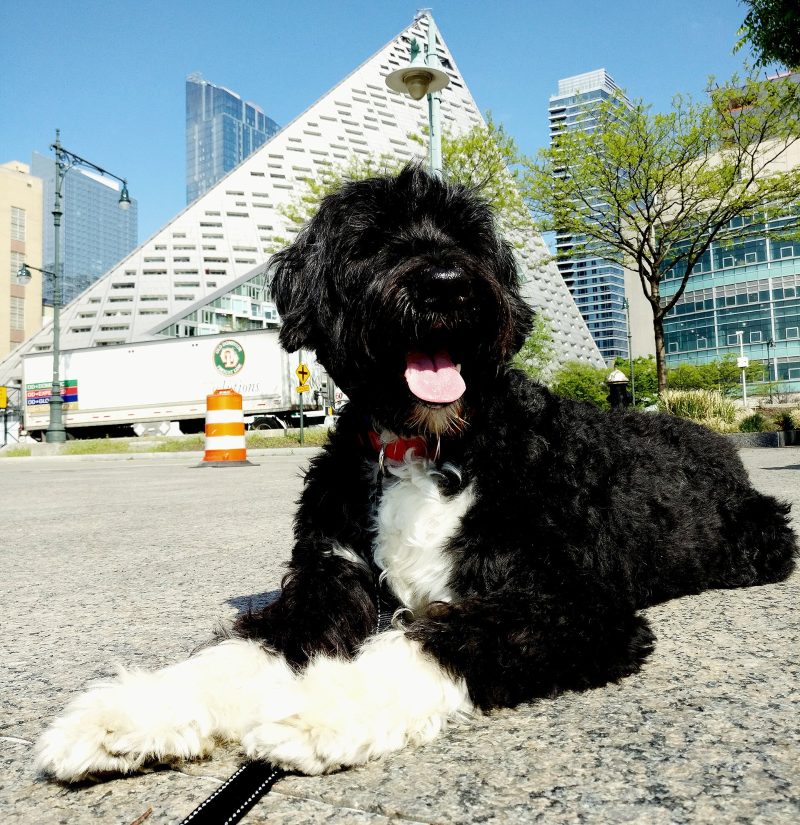
A Portuguese Water Dog is a robust, medium-sized dog built for swimming: slightly longer than tall, with a broad chest, strong loin and a thick tail carried in a ring when alert. Males stand 20 to 23 inches at the shoulder and weigh 42 to 60 pounds; females are 17 to 21 inches and 35 to 50 pounds. The head is large and broad with a well-defined stop, heart-shaped drop ears and round, dark eyes with an intelligent, attentive look. The feet are webbed.
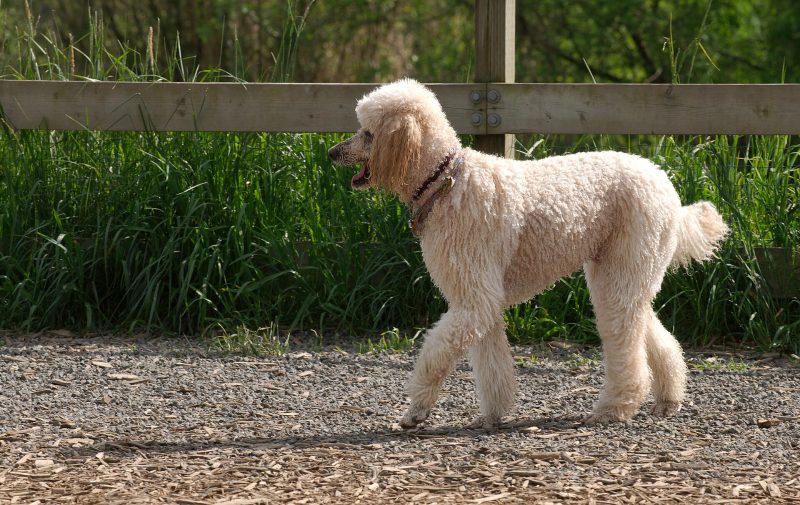
The single coat comes in two textures, either tight curls or loose waves with a slight sheen, and it has no undercoat. Colors are black, brown or white, often with white on the chest, chin and feet, and sometimes parti-colored. Two clips are traditional: the lion clip, with the hindquarters and muzzle shaved short, and the retriever clip, with the whole coat trimmed to about an inch. A Poodle is squarer with a longer muzzle; a Spanish Water Dog is smaller with a corded coat; a Lagotto is smaller and usually brown or orange.
Temperament & Personality
Porties are bright, biddable and full of energy, with a sense of humor that owners either adore or find exhausting. They bond closely with their families and want to be involved in everything, following people from room to room and carrying objects around in their mouths as a form of greeting. They are playful well into adulthood and usually excellent with children who can match their energy, though adolescents can be too boisterous for toddlers.
With strangers the breed is friendly but a little reserved at first, and it makes a good alarm dog without being aggressive. Most Porties get on well with other dogs and can live with cats they are raised with, though some retain a retrieving interest in small animals. The breed is vocal, with a range of whines and barks, and famously mouthy as a puppy. It is sensitive and responds poorly to harsh handling. Left alone and under-stimulated, a Portie invents its own entertainment, usually involving counters, cushions or shoes.
Exercise & Activity
A Portuguese Water Dog needs one to two hours of vigorous activity a day and does not thrive on less. Swimming is the ideal outlet, and most Porties will retrieve from water until they are physically stopped. Running, hiking, fetch and dog sports such as agility, dock diving, obedience and the breed club's own water trials all suit the breed. A walk around the block is a warm-up, not a workout.
Mental exercise matters just as much. Trick training, scent games and food puzzles tire a Portie in a way that mileage alone does not. Puppies should get free play and short walks rather than forced running until their joints mature at 12 to 18 months. The coat handles cold water well but the breed can overheat in hot weather if the coat is long.
Boredom shows as counter-surfing, chewing, digging and barking.
Rinse the coat after swimming in salt or chlorinated water.
Dry ears thoroughly after swims to prevent infection.
Training
Porties are among the most trainable of the working breeds: quick, eager and keen to work with a person. They pick up new behaviors in a few repetitions and enjoy learning for its own sake, which makes them stars in obedience, rally, agility and water work. Reward-based methods suit them perfectly; they are sensitive enough that harsh corrections damage the partnership and clever enough to exploit inconsistency.
The sticking points are mouthiness and exuberance. Puppies grab hands, clothes and anything within reach, and need consistent redirection onto toys rather than punishment. Jumping up and counter-surfing should be managed early. Socialize thoroughly so the adult's slight reserve with strangers stays polite. Teach a reliable settle, because a Portie that never learns to switch off is tiring to live with. Recall is usually good for the breed but should still be proofed around water, where excitement overrides everything. Channel the retrieving instinct into fetch and water retrieves, and give the dog a job; a bored Portie trains itself in the wrong direction.
Grooming & Care
The Portie coat does not shed in the normal sense, which is why it is often recommended to allergy sufferers, but it grows continuously and mats if neglected. Brush and comb thoroughly two or three times a week, working to the skin in the armpits, behind the ears and on the legs, and daily if the coat is kept long. Most owners have the dog professionally clipped every six to eight weeks in a retriever clip; the lion clip is mainly seen in the show ring. Wavy coats tangle a little less than curly ones.
Bathe every few weeks or after swimming in salt or chlorine, and dry thoroughly so the coat does not stay damp against the skin. Clean the ears weekly and after every swim. Nails grow fast and need trimming every two to three weeks, and teeth should be brushed regularly.
Teach the puppy to stand for grooming early; an adult that fights the dryer is hard work.
Hair between the pads needs trimming to prevent slipping and mats.
Health
The Portuguese Water Dog has a small founding population, and the breed community has worked hard on inherited disease, so several conditions now have DNA tests. Progressive retinal atrophy of the prcd type causes gradual blindness and was the first PRA to get a commercial test; a newer early-onset form has its own test. Juvenile dilated cardiomyopathy causes sudden death in puppies between about five weeks and seven months and is identified by a DNA test. GM1 gangliosidosis, a fatal storage disease, has been almost eliminated through testing. Hip dysplasia occurs, as does Addison's disease, an adrenal disorder that typically appears in young to middle-aged adults with vague signs such as lethargy, vomiting and weakness. Microphthalmia, allergies, inflammatory bowel disease and hypothyroidism also appear.
The parent club asks breeders for OFA hip evaluations after two years, annual eye exams by a veterinary ophthalmologist and DNA testing or clearance by parentage for PRA, JDCM, GM1 and microphthalmia. Typical lifespan is 11 to 13 years. Ask your vet about any dog that seems weak, off its food or intermittently unwell, since Addison's is easy to miss.
Nutrition
Porties are active dogs with good appetites and do well on a complete and balanced food matched to their life stage and workload. Puppies should eat a large- or medium-breed growth formula so they grow steadily rather than fast. Adults usually need two measured meals a day, with portions adjusted to the season; a dog swimming every day in summer may need a third more food than the same dog in a quiet winter. Judge condition by hand, since the coat hides both ribs and extra padding. You should feel ribs easily and see a waist from above once the coat is clipped.
The breed is a determined counter-surfer and food thief, so storage matters more than with most dogs. Dogs diagnosed with Addison's disease need lifelong medication rather than a special diet, but your vet may adjust feeding during treatment. Dogs with allergies or inflammatory bowel disease sometimes benefit from a supervised diet trial. Avoid feeding right before hard swimming or running. Fresh water should always be available, especially after exercise.
Living With This Breed
A Portuguese Water Dog can live in an apartment with a committed athlete, but it is far happier in a house with a yard and, ideally, somewhere to swim. It sheds very little and has little odor, which makes it a clean housemate, though it tracks in water and sand with enthusiasm. It needs company; a Portie left alone all day becomes destructive and vocal, and this is not a breed for long working hours without a walker or daycare.
The breed is good with active children, generally fine with other dogs and workable with cats. It will announce visitors, then want to greet them with something in its mouth.
Sitters should expect a dog that needs a real workout, not a stroll, and that will bring them toys constantly.
Keep counters clear and lids on bins.
Dry ears after any water, and brush out the coat before mats form.
Daycare is usually a great fit; most Porties love a busy group.
Interesting Facts
Bo and Sunny, the Obama family's dogs, were Portuguese Water Dogs chosen partly because the coat suits people with allergies; Bo was a gift from Senator Ted Kennedy, himself a devoted Portie owner.
Roughly half of all pedigreed Porties descend from Leao, the fisherman's dog that Vasco Bensaude bought in the 1930s.
Fishermen used the dogs as couriers, swimming messages and small items between boats and back to shore.
The breed's Portuguese name, Cao de Agua, simply means water dog.
The Portuguese Water Dog was the first breed to have a commercial DNA test for prcd progressive retinal atrophy.
Webbed feet and a rudder-like tail let the breed dive and swim for long stretches in cold Atlantic water.
Breeds similar to the Portuguese Water Dog
What Portuguese Water Dog owners say
Real pets, photos, stories and tips from the SitterNation community — separate from the editorial guide above.
Log in to add your pet, photos, stories and tips.
Meet Portuguese Water Dogs on SitterNation
No Portuguese Water Dogs have joined yet. Owners can show their pet here from the pet's profile.
Portuguese Water Dog community photos
No Portuguese Water Dogs photos yet — be the first to share one.
Stories from Portuguese Water Dog owners
No stories yet. What is life with yours really like?
Tips from Portuguese Water Dog owners
No tips yet. One practical thing that works for you is enough.
Ask Portuguese Water Dog owners
No questions yet. Ask the people who live with the breed.