Typical tendencies
Energy level
Needs a real outlet most days.
Good with children
Gentle and tolerant around children.
Good with other dogs
Selective; careful introductions needed.
Trainability
Learns, but on its own schedule.
Shedding
Fur on everything, all year round.
Apartment friendly
Needs space and a garden to be happy.
More traits
Exercise needs
Adaptability
Grooming needs
Drooling
Intelligence
Family friendly
Good with cats
Friendly with strangers
Sociability
Protectiveness
Prey drive
Overview
The Alaskan Malamute is the heavyweight of the sled dogs, bred by the Mahlemut people of northwest Alaska to haul heavy loads slowly over long distances and to live as part of the family. It suits active, experienced owners in cool climates who want a big, affectionate, playful dog and can offer serious daily exercise, a secure yard and consistent leadership. Malamutes love people, including strangers, which makes them poor guard dogs, but they are strong-willed, prone to same-sex dog aggression, hard on cats and wildlife, and world-class diggers and escape artists.
They shed enormously and howl rather than bark. They are not for apartments, hot climates, first-time owners or anyone who wants off-leash hikes. For someone who hikes, skijors, pulls carts or simply walks for miles in winter and enjoys a dog with a big personality and a sense of humor, a Malamute is a joyful partner.
History & Origin
The Malamute is one of the oldest Arctic breeds, descended from dogs that crossed from Siberia into Alaska with the ancestors of today's Inuit thousands of years ago. It takes its name from the Mahlemut, an Inupiaq-speaking people of the Kotzebue Sound region who bred large, powerful dogs to haul sleds, pack supplies, help hunt seals and stand off bears, and who were known for treating their dogs well. The gold rush of the 1890s brought a flood of outsiders who crossed native dogs with anything that could pull, and the pure type nearly vanished except in isolated villages.
In the 1920s and 1930s New England breeders, notably Eva and Milton Seeley of Chinook Kennels, rebuilt the breed from Alaskan stock; their dogs served on Admiral Byrd's Antarctic expeditions. The AKC recognized the Alaskan Malamute in 1935, the same year the parent club formed. Heavy losses of registered dogs during the Second World War led the AKC to reopen the studbook in the late 1940s, admitting the M'Loot and Hinman lines that, with the Kotzebue dogs, form today's breed.
Appearance
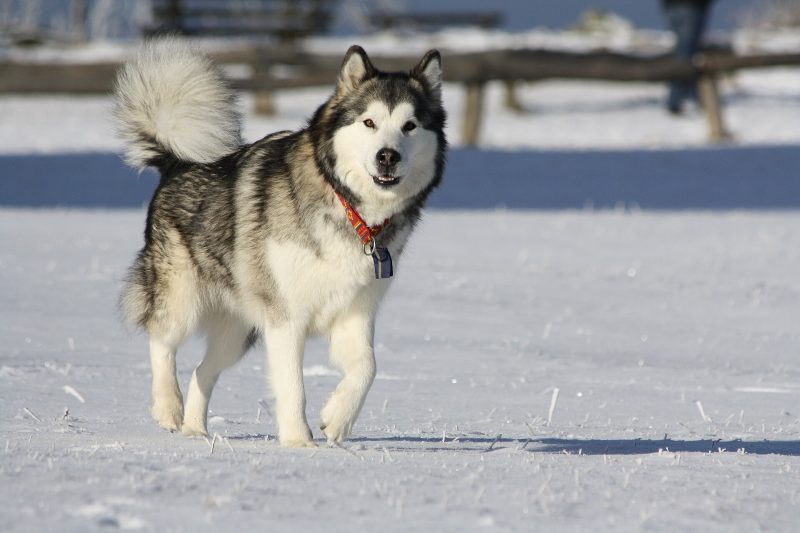
The Malamute is a large, powerfully built dog, with males around 24 to 26 inches and 80 to 95 pounds and females 22 to 24 inches and 70 to 85 pounds, though many pets run bigger. Everything about it says freight rather than speed: heavy bone, a deep chest, a broad head, strong legs and large snowshoe feet. The ears are medium, triangular and set wide, the eyes are almond-shaped and always brown, never blue, and the plumed tail waves over the back like a flag.
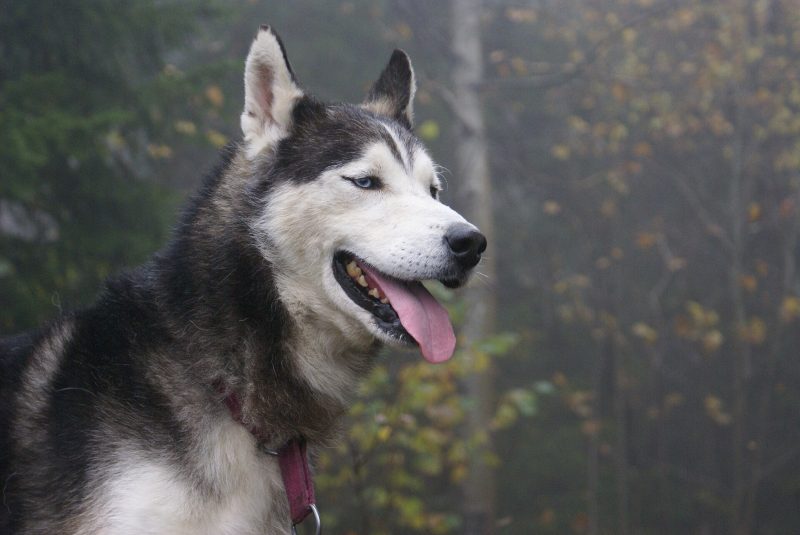
The coat is a thick, coarse double coat with a woolly undercoat and a stand-off outer coat, longer at the shoulders, neck and breeches. Colors range from light gray through sable and black to red, all with white underparts, legs and face, or solid white. The face carries a cap and often a mask or bar. The Siberian Husky is the usual confusion: it is much smaller and lighter, often blue-eyed, and built to run fast rather than pull hard.
Temperament & Personality
Malamutes are friendly, playful and affectionate with people, including people they have never met, and they adore the children of the family, though their size and exuberance need supervision around small ones. They are not watchdogs; a burglar would be greeted and shown the kitchen. With other dogs they are a different story: many are dominant and will fight with dogs of the same sex, and they do not back down. Cats, rabbits, chickens and local wildlife are prey, and the drive is extremely strong.
Indoors a well-exercised Malamute is calm and pleasantly lazy; outdoors it is powerful, curious and determined to go somewhere. They are intelligent and independent, inclined to negotiate, and they express themselves with woo-woos and howls rather than barking. They dig craters, counter-surf and open gates. They are sensitive under the bravado and respond badly to harsh handling, but they also take advantage of inconsistent owners.
Exercise & Activity
A Malamute needs at least 90 minutes of real exercise a day and was designed to work for hours. Long walks, hiking with a backpack, pulling a cart, scooter or skier, and weight-pull or sledding sports all suit the breed; brisk leash walking counts only as a baseline. Off-leash running is rarely safe because recall evaporates when a deer appears, so use a long line or a fenced field. Mental work matters: nose games, training and food puzzles take the edge off.
Heat is the hard limit. In warm weather exercise only early and late, provide shade, water and a cool floor, and never leave a Malamute in a car or a sunny yard; they overheat quickly and quietly. In cold weather they come alive and can go all day. Puppies should have free play rather than forced distance until 18 months. An under-exercised Malamute digs up the yard, howls, chews walls and escapes.
90 minutes or more daily, more in winter
Pulling sports and hiking are ideal outlets
No exercise in heat; shade, water and air conditioning in summer
Training
Malamutes are intelligent and learn quickly, then decide whether to comply. Training works when it is fair, consistent and rewarding: good food, play and the chance to pull or run are powerful motivators. Harsh corrections produce a dog that resists harder. Start early with a solid foundation of loose-leash walking, since an adult can pull a sled and will pull you, and teach a strong wait at doors and gates.
Socialize intensively with other dogs as a puppy and aim for a dog that is neutral rather than one that loves every dog it meets; manage same-sex interactions for life. Teach a leave-it and never trust the dog with cats or small pets unsupervised. Crate training helps with house manners and the digging phase. Keep sessions short and end on a win; Malamutes get bored with repetition. Most do well in obedience, rally, weight pull and backpacking with a handler who has a sense of humor and a long-term view.
Grooming & Care
The Malamute coat sheds moderately all year and spectacularly twice a year, when the entire undercoat comes out over two or three weeks. Brush two or three times a week with an undercoat rake and a slicker, and daily during the coat blow; a bath followed by a high-velocity dryer at that point removes bags of hair. Never shave a Malamute; the double coat insulates against heat as well as cold and protects the skin, and shaved coats often grow back poorly.
Bathe every two to three months or when dirty; the coat is fairly self-cleaning. Check the ears weekly, trim the nails every two to three weeks and keep the hair between the pads trimmed for traction. Brush teeth several times a week. Some Malamutes develop dry, crusty skin around the muzzle and eyes that can signal a zinc problem; show this to your vet rather than treating it at home.
Brush 2 to 3 times a week, daily during coat blow
Never shave
Report crusty skin on the face to the vet
Health
Alaskan Malamutes usually live 10 to 14 years and are a generally sound breed, but several inherited conditions are known. The parent club asks breeders to certify hips for dysplasia, have eyes examined by a veterinary ophthalmologist, and run the DNA test for Alaskan Malamute polyneuropathy, a nerve disease that causes hind-limb weakness and a changed bark in young dogs; elbow, cardiac and thyroid screening and DNA tests for cone degeneration (day blindness) and primary ciliary dyskinesia are recommended. Chondrodysplasia, a form of dwarfism, is tracked through pedigrees.
Zinc-responsive dermatosis, a crusting skin disease of northern breeds, needs a vet diagnosis. Hypothyroidism, cataracts, progressive retinal atrophy and epilepsy occur. Like other deep-chested dogs, Malamutes can bloat, which is an emergency. Heatstroke is a real risk in warm climates. Ask breeders for OFA numbers and the polyneuropathy result for both parents, and ask your vet about weight, since extra pounds on a heavy frame bring early arthritis.
Nutrition
Malamutes were bred to work hard on little food, and most pets need far less than their size suggests; overfeeding is the most common nutritional mistake. Feed a complete diet in two measured meals a day and adjust portions to the season and the work: a dog pulling sleds in January may need twice what the same dog needs lounging in July. Puppies should eat a large-breed growth food with controlled calcium, three meals a day until six months, to protect developing joints.
Watch body condition by feel, since the coat hides everything; you should find ribs easily and see a waist from above when the dog is wet. Because bloat is a risk, avoid hard exercise around meals and discourage gulping. Dogs with skin problems may have a zinc absorption issue that your vet can assess; do not add supplements on your own. Fresh water is essential, especially in warm weather, and many Malamutes drink a lot.
Living With This Breed
A Malamute needs a house with a tall, dig-proof fence and a cool climate or reliable air conditioning. Apartments are a poor fit. They can be left alone for a workday if exercised first, but a bored Malamute will redecorate the house and sing to the neighborhood. They are wonderful with children of the family and generally friendly with visitors. Other dogs should be of the opposite sex and introduced carefully; cats and small pets are not safe unless raised together, and even then need supervision. Fences need to be six feet high with wire buried at the base; gates need latches a clever dog cannot work.
A sitter should know that the dog is never off leash, is strong enough to pull them over, may not be friendly with other dogs on walks, must not be exercised in heat, and has a repertoire of escape tricks. Daycare suits some Malamutes and is a disaster for others.
House, tall secure fence, cool climate
Same-sex dog aggression and high prey drive are the rule
Sitters: leash always, no heat, check gates
Interesting Facts
Malamutes communicate with a distinctive woo-woo and will carry on long conversations, but they rarely bark.
The breed became the official state dog of Alaska in 2010 after a campaign led by schoolchildren.
Malamutes served on Admiral Byrd's Antarctic expeditions and as search-and-rescue and freight dogs in the Second World War.
A Malamute's feet are large, tough and furred between the toes, working like natural snowshoes.
The breed is built for hauling heavy loads at a trot, not for speed; it is a freight truck to the Siberian Husky's sports car.
Blue eyes are a disqualification in the Malamute, which is one quick way to tell a Malamute from a Husky.
Breeds similar to the Alaskan Malamute
What Alaskan Malamute owners say
Real pets, photos, stories and tips from the SitterNation community — separate from the editorial guide above.
Log in to add your pet, photos, stories and tips.
Meet Alaskan Malamutes on SitterNation
No Alaskan Malamutes have joined yet. Owners can show their pet here from the pet's profile.
Alaskan Malamute community photos
No Alaskan Malamutes photos yet — be the first to share one.
Stories from Alaskan Malamute owners
No stories yet. What is life with yours really like?
Tips from Alaskan Malamute owners
No tips yet. One practical thing that works for you is enough.
Ask Alaskan Malamute owners
No questions yet. Ask the people who live with the breed.