Typical tendencies
Energy level
Needs a real outlet most days.
Good with children
Gentle and tolerant around children.
Good with other dogs
Selective; careful introductions needed.
Trainability
Quick to learn and keen to please.
Shedding
A light scatter, easy to keep up with.
Apartment friendly
Fine in a flat if exercise is kept up.
More traits
Exercise needs
Adaptability
Grooming needs
Drooling
Intelligence
Family friendly
Good with cats
Friendly with strangers
Sociability
Protectiveness
Prey drive
Overview
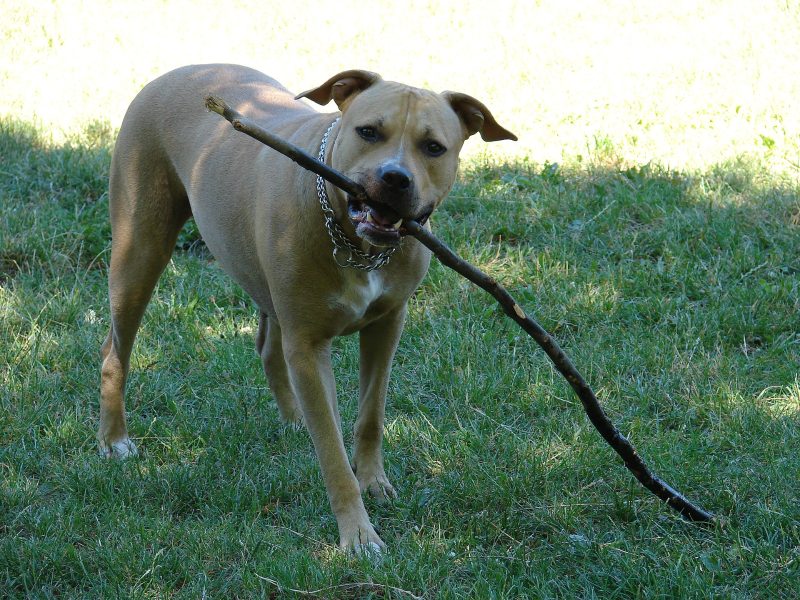
The American Staffordshire Terrier, or AmStaff, is a stocky, confident, good-natured dog that thrives on human attention and a clear routine. Males stand 18 to 19 inches and weigh 55 to 70 pounds, females a little less, and under the muscle is a dog that wants nothing more than to lie against its person on the couch. AmStaffs are smart, trainable and playful, patient with children they know and devoted to their family. They need an owner who will socialize early, exercise daily and manage introductions to other dogs, because many AmStaffs are not keen on strange dogs and have a strong prey drive. Breed-specific laws and insurance exclusions affect this breed in some areas. It is a rewarding choice for active, committed owners, and a poor fit for people who want a casual dog-park regular or who leave a dog alone all day.
History & Origin
The AmStaff's ancestors were the bull-and-terrier dogs of early 1800s England, bred from Bulldogs and game terriers for the fighting pits after bull baiting was banned in 1835. These dogs reached the United States around 1870 under names such as Pit Dog, Pit Bull Terrier, American Bull Terrier and Yankee Terrier, and on farms they became all-purpose workers and family guardians. The United Kennel Club began registering them in 1898 as American Pit Bull Terriers. American breeders developed a taller, heavier dog than the English Stafford, and in 1936 the AKC accepted the breed into its stud book as the Staffordshire Terrier. To distinguish it clearly from the English breed, the AKC renamed it the American Staffordshire Terrier effective January 1, 1972. Dogs of this type were American icons in the early 1900s, among them Pete the Pup of the Our Gang comedies.
Appearance
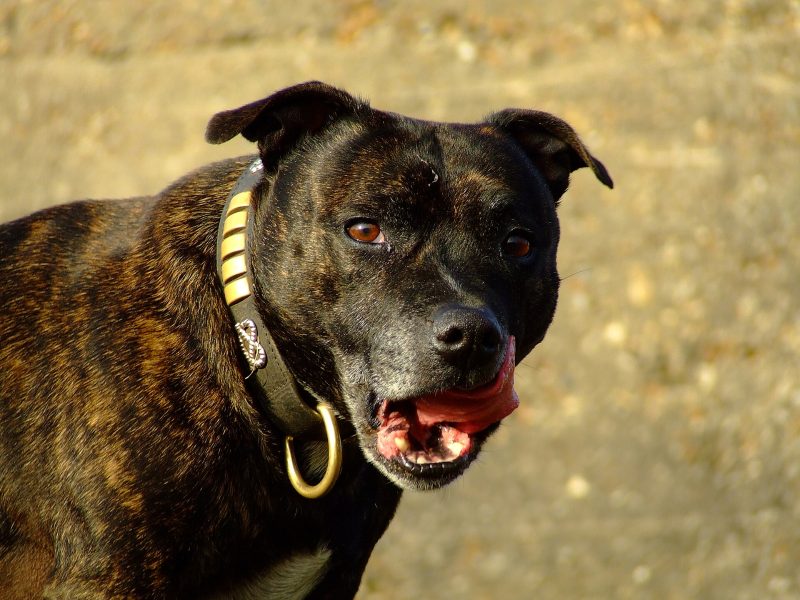
An AmStaff should give the impression of strength without bulk: a muscular, well-knit dog that is agile and graceful rather than heavy. The head is broad with pronounced cheek muscles, a distinct stop and a medium-length muzzle, and the ears are set high, either natural rose or half-prick, or cropped in some countries where that is still legal. The eyes are dark and round, set wide apart. The chest is deep and broad, the back short, and the tail tapers to a point and is carried low. The coat is short, stiff and glossy and comes in any color, solid, patched or parti-color, though all-white, mostly white, black-and-tan and liver are discouraged in the show ring. Next to a Staffordshire Bull Terrier it is noticeably taller and heavier, and it is longer-legged and more athletic in outline than most American Bulldogs.
Temperament & Personality
A well-bred, well-raised AmStaff is confident, outgoing and affectionate, with a courage the standard calls proverbial. These dogs are famous for their attachment to people: they follow family members from room to room, lean, cuddle and want to be part of every activity. They are playful and patient with children, although their size and enthusiasm call for supervision with small kids. With strangers they are usually friendly after a moment of assessment, and they are alert enough to bark at unusual noises. Other dogs are the sticking point. Many AmStaffs are selective, and once a fight starts they do not back down, so introductions need care. Prey drive is strong and cats, rabbits and chickens are at risk unless the dog is raised with them. AmStaffs are prone to separation anxiety and do best with company and a steady routine.
Exercise & Activity
An AmStaff needs at least 60 minutes of real exercise a day, and a young adult will happily take more. Brisk walks, jogging, hiking, fetch, tug and flirt-pole games all work, and the breed shines in weight pull, agility, dock diving, scent work and obedience. Mental work matters as much as mileage; a dog that trains for ten minutes and then plays is calmer than one that only runs. The breed tolerates cold reasonably well on the move but should not live outdoors, and its short coat and muscular build make it prone to overheating, so take summer exercise in the cool hours with water on hand.
Exercise on leash or in a secure yard; recall around other dogs is unreliable
Dog parks are a poor fit for most AmStaffs
A bored AmStaff chews, digs and escapes
Training
AmStaffs are intelligent and eager to please, and they learn quickly with positive, consistent training. They are also strong-willed and resist force, so reward-based methods with clear rules produce the best results. Begin socialization the week the puppy comes home and keep it broad: people of all kinds, calm dogs, traffic, surfaces, handling. Teach loose-leash walking early because an adult AmStaff that pulls can take an adult off their feet, and build a rock-solid leave-it and recall. Many AmStaffs are mouthy puppies, so redirect to toys and reward calm. Crate training helps with the breed's tendency toward separation anxiety. Vary sessions to prevent boredom; hand signals and tricks keep them engaged. Sitters should learn the dog's cues and how the owner handles other-dog encounters before the first outing.
Grooming & Care
The AmStaff's short, glossy coat needs little more than a weekly brush with a rubber mitt or bristle brush to lift loose hair and spread skin oils. Shedding is moderate, heavier in spring and fall. Bathe every month or two or when dirty, using a gentle shampoo, because the breed is prone to dry, itchy skin and allergies. Check the skin, feet and ear flaps for redness during brushing. Clean ears every week or two and watch for head shaking. Nails grow fast on a dog that mostly walks on grass, so trim every two to three weeks, and brush teeth several times a week.
Weekly brushing, bath every four to eight weeks
Watch for itching, hot spots and ear trouble
Eyes: squinting or tearing can signal distichiasis, an extra eyelash problem
Health
AmStaffs generally live 12 to 16 years. The parent club recommends several screenings before breeding: hip evaluation by OFA or PennHIP, an optional elbow evaluation, a cardiac exam by a cardiologist, annual thyroid testing for autoimmune thyroiditis, and two DNA tests. The first identifies carriers of NCL-A, a form of cerebellar ataxia that causes progressive loss of balance and coordination in middle age; the second is a linked-marker test for juvenile laryngeal paralysis and polyneuropathy. An eye exam by a veterinary ophthalmologist is also encouraged, since progressive retinal atrophy and distichiasis occur. Allergies and skin disease are the most common day-to-day problems, along with demodectic mange in young dogs. Hypothyroidism may show up as weight gain, lethargy and a thinning coat. Ask the breeder for OFA results and ask your vet about any wobbliness, limping or persistent itching.
Nutrition
Feed a complete diet appropriate for a medium-to-large breed and the dog's life stage, in two measured meals a day for adults and three or more for puppies. Large-breed puppy food helps growing AmStaffs mature at a steady pace, which may reduce the risk and severity of hip problems. Adults are easy keepers and some gain weight quickly, so measure portions and adjust for activity; a lean AmStaff shows a clear waist and ribs that are easy to feel. Because skin allergies are common, your vet may suggest a limited-ingredient or prescription diet if itching persists. Avoid vigorous exercise right before and after meals. Sitters should feed the owner's portions, skip rich treats and keep fresh water available after play.
Living With This Breed
An AmStaff can live in an apartment if it is exercised well and is generally quiet, but a house with a securely fenced yard is easier. It needs to live indoors with its people and should not be left alone for long days; many develop separation anxiety and destructive habits. It is good with respectful children and can live with other pets it is raised with, but new dogs and small animals need careful management. Breed-specific legislation is a practical issue: some cities, counties, military housing providers and landlords restrict bull-and-terrier breeds, and some insurers exclude them, so check local rules and your policy before adopting or moving.
Sitters: always use a secure harness, avoid other dogs, no exercise in the heat
Check gates and fences; AmStaffs are capable jumpers and diggers
Daycare suits only well-socialized individuals; solo walks are safer for most
Interesting Facts
Pete the Pup, the ring-eyed dog of the Our Gang comedies, was a dog of this type, and Sergeant Stubby, the decorated World War I mascot, is often claimed by AmStaff fans too.
The breed was registered as the Staffordshire Terrier from 1936 until the name changed on January 1, 1972.
The same dogs are registered as American Pit Bull Terriers by the United Kennel Club, and some individuals carry both registrations.
Early American names for the breed included Yankee Terrier and American Bull Terrier.
In the early 1900s the breed appeared on posters and magazine covers as a symbol of American grit.
Weight pulling is a favorite sport; a fit AmStaff can pull many times its own body weight on a wheeled cart.
Breeds similar to the American Staffordshire Terrier
What American Staffordshire Terrier owners say
Real pets, photos, stories and tips from the SitterNation community — separate from the editorial guide above.
Log in to add your pet, photos, stories and tips.
Meet American Staffordshire Terriers on SitterNation
No American Staffordshire Terriers have joined yet. Owners can show their pet here from the pet's profile.
American Staffordshire Terrier community photos
No American Staffordshire Terriers photos yet — be the first to share one.
Stories from American Staffordshire Terrier owners
No stories yet. What is life with yours really like?
Tips from American Staffordshire Terrier owners
No tips yet. One practical thing that works for you is enough.
Ask American Staffordshire Terrier owners
No questions yet. Ask the people who live with the breed.