Typical tendencies
Energy level
Needs a real outlet most days.
Good with children
Patient with kids when well supervised.
Good with other dogs
Selective; careful introductions needed.
Trainability
Learns, but on its own schedule.
Shedding
A light scatter, easy to keep up with.
Apartment friendly
Fine in a flat if exercise is kept up.
More traits
Exercise needs
Adaptability
Grooming needs
Drooling
Intelligence
Family friendly
Good with cats
Friendly with strangers
Sociability
Protectiveness
Prey drive
Overview
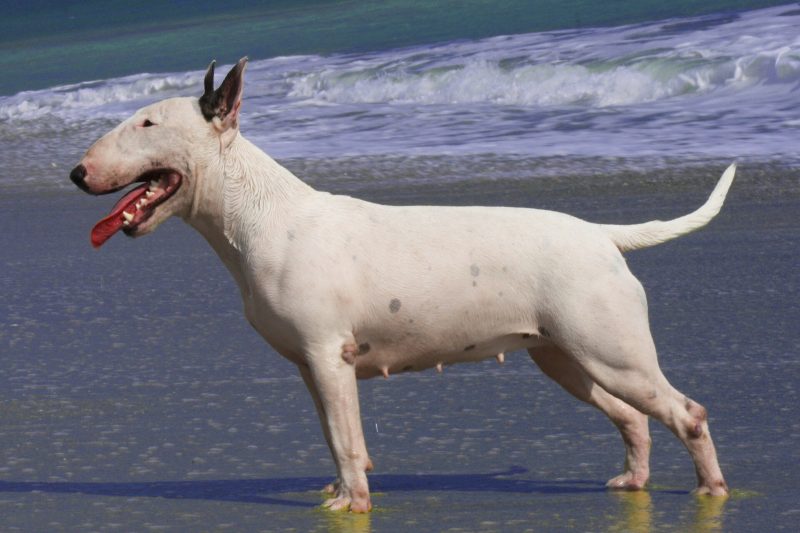
The Bull Terrier is the egg-headed clown of the terrier world: a barrel-bodied, muscular dog of 21 to 22 inches and 50 to 70 pounds with a one-of-a-kind profile and a sense of humor to match. Bull Terriers are affectionate, playful and endlessly entertaining, and they bond hard with their families. They are also stubborn, mischievous and physically strong, and they need an owner with patience, consistency and a tolerance for a dog that treats every rule as a suggestion. Many are not reliable with other dogs or cats, and some develop compulsive habits if under-stimulated. This is a breed for experienced, active owners who enjoy a big personality and will put in training time; it is not a good fit for first-time owners, people who want an easy off-leash companion, or homes with small pets.
History & Origin
The Bull Terrier grew out of the bull-and-terrier fighting dogs of early 1800s England, but its modern form is the work of one man. James Hinks, a Birmingham dog dealer, crossed the bull-and-terrier with the now-extinct white English Terrier and, by some accounts, the Dalmatian to produce an elegant, all-white dog, and he showed his New Bull Terrier in Birmingham in May 1862. The breed's good manners and white coat earned it the nickname White Cavalier. The AKC recognized the breed in 1885, among its earliest. Around 1900 breeders in England crossed back to Staffordshire Bull Terriers to bring in color, and in 1936 the AKC made Colored Bull Terriers a separate variety. Over the twentieth century breeders developed the distinctive downward-curving egg head that no other breed shares. The Miniature Bull Terrier, once a size within the breed, is now recognized separately.
Appearance
Nothing else looks like a Bull Terrier. The head is long, deep and egg-shaped when seen from the front, curving smoothly from the top of the skull to the tip of the nose with no stop at all, and the small, triangular eyes are set deep and oblique. The ears are small, thin and erect. The body is strongly built and rounded, with a short, strong back, a deep chest and a tail carried horizontally. The coat is short, flat and harsh to the touch. White Bull Terriers are pure white, sometimes with markings on the head; Colored Bull Terriers come in brindle, red, fawn, black-and-tan or tricolor, usually with white markings, and brindle is preferred in the ring. Standard Bull Terriers have no weight limit in the standard, but most fall between 50 and 70 pounds. The Miniature is the same dog in a package under 14 inches tall.
Temperament & Personality
Bull Terriers are exuberant, affectionate and comical, and life with one is rarely dull. They are known for the Bully run, a sudden burst of joyful laps around the house, and for a playful, pushy style of interaction that includes leaning, nudging and stealing. With their own family they are devoted and often demanding of attention; with strangers they are usually friendly once introduced. They are good with children who respect them but can be too rough for small ones. Other dogs are a problem for many individuals, especially of the same sex, and cats and small pets are usually unsafe. The breed has a documented tendency toward compulsive behaviors such as tail chasing and spinning, which can appear in bored, under-exercised or anxious dogs and sometimes needs veterinary attention. Bull Terriers need company; isolation makes everything worse.
Exercise & Activity
Give a Bull Terrier 60 minutes or more of daily exercise and plenty of play. Brisk walks, jogging, fetch with a tough toy, tug and flirt-pole games are all welcome, and the breed enjoys agility, Fast CAT sprints, nose work and obedience. Mental stimulation is essential because an under-worked Bull Terrier invents its own games, which usually involve destruction or spinning. The breed tolerates heat better than cold; the thin white coat offers little insulation, and sunburn on pink skin is a real risk in summer. Keep exercise on leash or in a secure area, since recall is unreliable and prey drive is high.
Two walks plus hard play every day
A sweater in cold weather, sunscreen or shade for white dogs
Supervise with toys; Bull Terriers swallow things
Training
Bull Terriers are smart but famously stubborn, and training one is a matter of motivation. They work well for food, toys and attention and tune out quickly when bored or pushed, so keep sessions short, playful and frequent. Start as a puppy and never let bad manners slide, because an adult Bull Terrier is too strong to muscle around. Priorities are loose-leash walking, a solid leave-it, a reliable settle and polite greetings; recall should be taught but never fully trusted around animals. Socialize widely and early with calm dogs and many people. Mouthiness and object stealing are typical puppy problems; trade for treats rather than chasing. Consistency across the household matters, since the dog will find the softest person. Sitters should be told the dog's rules and what it tends to grab.
Grooming & Care
Grooming is simple. Brush weekly with a soft bristle brush or rubber mitt to remove dead hair; shedding is moderate and heavier at the change of seasons. Baths are rarely needed and a wipe-down with a damp cloth handles most dirt. White dogs show grime and are prone to skin problems, so check for redness, rashes and sunburn during grooming, and look between the toes and inside the thighs where allergic itching often starts. Clean the erect ears every week or two with a vet-approved cleaner, trim nails every two to three weeks because a heavy, active dog wears them unevenly, and brush teeth several times a week. Handle the feet, ears and mouth from puppyhood so that an adult Bull Terrier tolerates grooming without a wrestling match.
Weekly brushing, occasional bath
Watch skin for allergy flare-ups, especially on feet and belly
Protect pale skin from strong sun
Health
Bull Terriers typically live 12 to 13 years. The parent club recommends four screenings: BAER hearing testing, because inherited deafness in one or both ears is common in white and some colored dogs; a urine protein-to-creatinine ratio to detect hereditary nephritis, a kidney disease that can progress to failure; a cardiac exam, since mitral valve dysplasia and other heart defects occur; and a patella evaluation for luxating kneecaps. DNA tests are available for lethal acrodermatitis, a fatal zinc-metabolism disorder of white Bull Terriers, and for primary lens luxation. Polycystic kidney disease, atopic skin disease and shoulder osteochondrosis are also documented in the breed. Compulsive spinning and tail chasing may need a veterinary behaviorist. Bull Terriers also swallow objects and are frequent surgery patients for intestinal blockage. Ask your vet about annual urine checks and about any new murmur, limp or change in behavior.
Nutrition
Feed a complete, balanced diet for the dog's life stage in two measured meals a day. Bull Terriers gain weight readily and extra pounds strain the joints and heart, so measure portions, limit treats and keep a visible waist. Because kidney disease runs in the breed, your vet may suggest a diet with moderate protein and phosphorus for dogs that show early changes in urine tests; follow their guidance rather than changing food on your own. Skin allergies are common and some dogs do better on a limited-ingredient diet. Supervise feeding and play because Bull Terriers eat things they should not, from socks to toy parts. Sitters should feed only what the owner provides, pick up anything chewable and make sure fresh water is always available.
Living With This Breed
A Bull Terrier can manage an apartment if it is well exercised, but a house with a secure yard is easier, and it must live indoors with its family. It handles a workday alone only with exercise before and company after; long isolation leads to destruction and compulsive habits. It is fun for older children and risky for toddlers and small pets. Breed-specific legislation is a practical issue: the Bull Terrier is sometimes caught up in restrictions written for bull-and-terrier breeds, and some landlords and insurers exclude it, so check local rules and your policy before adopting or moving.
Sitters: walk on a secure harness, no dog parks, keep chewables out of reach
Expect leaning, nudging and toy theft as signs of affection
Report any spinning, tail chasing or sudden head shaking to the owner
Interesting Facts
Spuds MacKenzie, the beer-advertising party dog of the 1980s, was a female Bull Terrier named Honey Tree Evil Eye.
Bullseye, the Target mascot with the red ring around one eye, is a white Bull Terrier played by a series of dogs since 1999.
General George S. Patton's Bull Terrier Willie stayed at his side from 1944 to the end of the Second World War, and President Theodore Roosevelt also owned the breed.
The breed was called the White Cavalier for its chivalrous habit of defending itself without starting fights.
James Hinks debuted his New Bull Terrier at a Birmingham show in May 1862, and the egg-shaped head came decades later.
A Bull Terrier famously ran for Best in Show at Westminster in 2006 with Rufus, the first Colored Bull Terrier to win.
Breeds similar to the Bull Terrier
What Bull Terrier owners say
Real pets, photos, stories and tips from the SitterNation community — separate from the editorial guide above.
Log in to add your pet, photos, stories and tips.
Meet Bull Terriers on SitterNation
No Bull Terriers have joined yet. Owners can show their pet here from the pet's profile.
Bull Terrier community photos
No Bull Terriers photos yet — be the first to share one.
Stories from Bull Terrier owners
No stories yet. What is life with yours really like?
Tips from Bull Terrier owners
No tips yet. One practical thing that works for you is enough.
Ask Bull Terrier owners
No questions yet. Ask the people who live with the breed.