Typical tendencies
Energy level
Always on; boredom turns into mischief.
Good with children
Patient with kids when well supervised.
Good with other dogs
Selective; careful introductions needed.
Trainability
Quick to learn and keen to please.
Shedding
Noticeable, with heavier seasonal blows.
Apartment friendly
Needs space and a garden to be happy.
More traits
Exercise needs
Adaptability
Grooming needs
Drooling
Intelligence
Family friendly
Good with cats
Friendly with strangers
Sociability
Protectiveness
Prey drive
Overview
The Australian Cattle Dog, known as the Blue Heeler or Red Heeler, is a compact, speckled herding dog bred to drive half-wild cattle across vast outback stations. It is tough, clever, tireless and devoted to one person or family, and it suits owners with serious outdoor lives: ranchers, runners, hikers, dog-sport competitors and anyone who can promise two hours of hard work for the brain and body every day. Heelers are wary of strangers, protective, inclined to nip at moving heels, and bored to destruction by a quiet life.
They are a poor choice for apartments, first-time owners, families with toddlers, or homes with cats and small pets unless carefully raised. Grooming is minimal and health is generally excellent, with one of the longest lifespans of any medium breed. For the right person, a Cattle Dog is the most loyal, capable and entertaining partner imaginable, and it will never let you sit still.
History & Origin
The breed was born of necessity in New South Wales in the 1840s. Imported British droving dogs barked too much and wilted in the heat, so cattleman Thomas Hall of the Hunter Valley crossed smooth blue-merle collie types from northern England with tamed dingoes, producing silent, hardy, heel-nipping dogs known as Hall's Heelers. After Hall's death in 1870 the dogs spread, and Sydney breeders including the Bagust brothers refined them, reputedly adding Dalmatian for steadiness with horses and Kelpie for working drive. Robert Kaleski wrote the first standard in the early 1900s, and the breed was known variously as the Queensland Heeler, Blue Heeler and Australian Heeler.
American servicemen encountered the dogs in Australia during the Second World War and imports followed. The AKC admitted the Australian Cattle Dog to the Working Group in 1980 and moved it to the new Herding Group in 1983. It remains the working cattle dog of choice across Australia and much of the American West.
Appearance
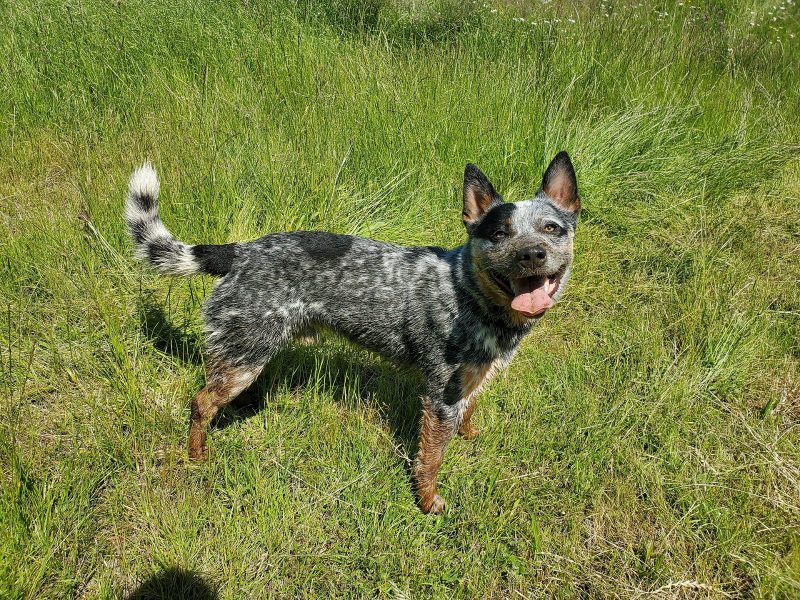
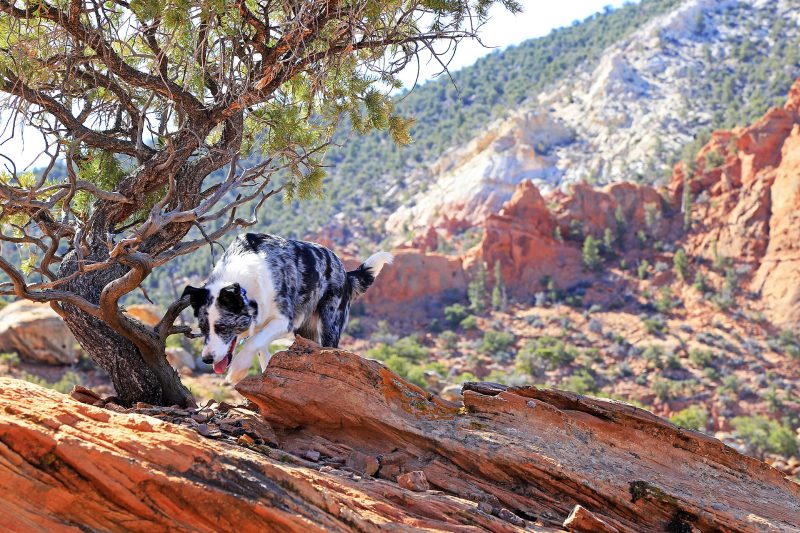
The Australian Cattle Dog is a compact, muscular dog, with males 18 to 20 inches and females 17 to 19 inches at the shoulder and both weighing 35 to 50 pounds. The outline is slightly longer than tall with a strong, level back, a deep chest and a low-set tail carried in a slight curve. The head is broad with a strong muzzle, dark oval eyes with a suspicious glint, and pricked, moderately pointed ears.
The coat is a smooth, hard, weather-resistant double coat, short on the head and legs and slightly longer at the neck and breeches. Color is either blue, blue mottled or blue speckled, with or without black, blue or tan markings on the head and tan on the legs and chest, or red speckled or red mottled with or without darker red head markings. Puppies are born white and color in over the first weeks. The Australian Stumpy Tail Cattle Dog is similar but leggier and tailless; the Kelpie is finer and solid-colored.
Temperament & Personality
Cattle Dogs are intensely loyal, forming a bond with one person or family that borders on devotion, and they like to be close enough to touch. With strangers they are reserved and watchful; they do not seek attention from people they do not know and will guard the house, the car and the yard with conviction. They are alert, confident and quick to act. The herding instinct is strong and specific: Heelers control movement by nipping at heels, and running children, bicycles and other dogs trigger it.
They can be excellent with older children who are part of their pack and are usually too intense for toddlers. With other dogs they are often bossy and may be aggressive with the same sex; with cats and small animals the prey drive is high. Indoors a tired Heeler is calm and affectionate; an untired one is a loaded spring. They are serious, intelligent dogs with a mischievous streak and remarkable problem-solving skills.
Exercise & Activity
Plan on two hours a day for an adult Cattle Dog, and make it count: running, hiking, biking, herding, agility, flyball, disc, obedience, nose work and tracking all suit the breed, and most Heelers will take all of them. A leash walk around the block is a joke to a dog bred to cover dozens of miles behind cattle. Mental work is as important as mileage; teach tricks, use food puzzles, hide toys and give the dog jobs around the house.
Off-leash running is possible with a well-trained dog in safe areas, but the chase instinct is strong, so proof recall carefully. They tolerate heat better than most breeds, having been bred for it, but still need water and shade. Puppies should play freely without forced running or repetitive jumping until the growth plates close at 12 to 14 months. Boredom in this breed looks like chewed furniture, dug lawns, obsessive behaviors and heel nipping.
Around 2 hours daily of running and work
Daily training, puzzles and jobs for the mind
A tired Heeler is a good Heeler
Training
Australian Cattle Dogs are among the most trainable dogs alive and among the most demanding, because they learn everything, including things you did not intend to teach. They are motivated by work, play, tug and food, in roughly that order, and they thrive on clear rules applied consistently. Start early with impulse control: waiting at doors, settling on a mat, leaving things alone and a rock-solid recall. Redirect heel nipping onto toys from the first week and never let it become a game with children.
Socialize deliberately and widely with people, dogs and environments, because the breed's natural suspicion hardens into reactivity without it. Harsh corrections create a dog that fights back or shuts down; firm, fair and upbeat works. Teach an off switch, since Heelers do not come with one. They excel in herding trials, obedience, rally, agility and anything that rewards precision and drive. Expect a dog that tests boundaries and needs a job for life.
Grooming & Care
The Cattle Dog coat is as low-maintenance as a working coat gets. Brush weekly with a rubber curry or a bristle brush to remove dead hair and distribute oils, increasing to a few times a week during the spring and fall shed, when the undercoat comes out in handfuls. Bathing is rarely needed; the hard coat sheds dirt once dry, and a bath every couple of months or after a swim in something unpleasant is plenty.
Check the upright ears weekly and clean only if dirty. Trim nails every two to three weeks, though active dogs often wear them down. Brush teeth several times a week. Examine the dog after outdoor work for ticks, burrs and foxtails, especially between the toes and in the ears, and check the pads for wear. Dogs with a lot of white and pink skin on the nose and ears may need sun protection in summer.
Weekly brushing, more during seasonal sheds
Baths only when needed
Check for ticks and foxtails after work
Health
Australian Cattle Dogs are hardy and often live 12 to 16 years, but a few inherited conditions are well documented. Congenital deafness in one or both ears affects roughly one dog in ten in some studies, so breeders BAER-test puppies before placement. Two eye diseases have DNA tests that the parent club requires: progressive rod-cone degeneration, a late-onset form of progressive retinal atrophy that causes gradual blindness, and primary lens luxation, in which the lens slips out of place and can lead to painful glaucoma. Breeders also certify hips and elbows for dysplasia and have eyes examined by a veterinary ophthalmologist; patellar luxation, cardiac screening and a second PRA test are optional.
Portosystemic shunt, a liver blood-vessel defect, and dermatomyositis occur. Working dogs suffer cruciate injuries and tooth wear from chewing rocks and sticks. Mast cell tumors and other cancers appear in older dogs. Ask breeders for BAER, OFA and DNA results for both parents, and ask your vet about joint care in active dogs.
Nutrition
Feed an Australian Cattle Dog a complete diet in two measured meals a day and adjust the amount to the work. A dog running cattle or training for sports every day may need a performance food and far more calories than a pet getting two walks, and the gap between the two is the main reason Heelers get fat. Keep the dog lean; a visible waist and easily felt ribs protect joints that take a pounding. Puppies grow fast and do well on a quality medium-breed growth food, three meals a day until about six months, with no extra calcium.
Treats are powerful training tools for this breed, so use tiny pieces and count them toward the daily ration. Active dogs need water available at all times and a drink after every work session. Senior Heelers often stay active into their teens and may benefit from a joint-support diet; ask your vet rather than adding supplements on your own.
Living With This Breed
Cattle Dogs belong on acreage, a farm or at least a house with a secure yard and an owner who treats exercise as a daily appointment. They cope with heat and cold, are generally quiet indoors when tired, and will guard the property with a sharp bark. Left alone and bored they are destructive. They do best as the only dog or with an opposite-sex companion, and they need supervision around cats, small pets and visiting children. Fences must be secure; Heelers climb and dig when motivated.
A sitter should be introduced before the first stay and should understand that the dog may try to herd them, will test rules on day one, needs the full exercise routine and should not be taken to dog parks. Experienced, active sitters and structured daycare with small groups work; casual group play often does not.
Needs acreage or a house with a fence and a committed owner
Supervise around children, cats and other dogs
Sitters: full exercise, structure, no dog parks
Interesting Facts
Bluey, a Cattle Dog from Rochester, Victoria, lived from 1910 to 1939 and holds the Guinness record as the oldest dog ever verified, at 29 years and 5 months.
Cattle Dog puppies are born white and develop their blue or red speckling over the first weeks, a trait usually credited to the Dalmatian cross.
Dingo blood is credited with the breed's silence while working; heelers bite and duck without barking.
The blue coat is really black hairs evenly mixed with white, which is what produces the speckled or mottled look.
The dog in the Mad Max films was a Blue Heeler, and the animated series Bluey features a family of them.
Many Heelers fixate on one object, a ball or a frisbee, and will present it to visitors for hours in the hope of a throw.
Breeds similar to the Australian Cattle Dog
What Australian Cattle Dog owners say
Real pets, photos, stories and tips from the SitterNation community — separate from the editorial guide above.
Log in to add your pet, photos, stories and tips.
Meet Australian Cattle Dogs on SitterNation
No Australian Cattle Dogs have joined yet. Owners can show their pet here from the pet's profile.
Australian Cattle Dog community photos
No Australian Cattle Dogs photos yet — be the first to share one.
Stories from Australian Cattle Dog owners
No stories yet. What is life with yours really like?
Tips from Australian Cattle Dog owners
No tips yet. One practical thing that works for you is enough.
Ask Australian Cattle Dog owners
No questions yet. Ask the people who live with the breed.