Typical tendencies
Energy level
Always on; boredom turns into mischief.
Good with children
Patient with kids when well supervised.
Good with other dogs
Gets along with known, polite dogs.
Trainability
Lives for the lesson; a trainer's dream.
Shedding
Keep the lint roller within reach.
Apartment friendly
Needs space and a garden to be happy.
More traits
Exercise needs
Adaptability
Grooming needs
Drooling
Intelligence
Family friendly
Good with cats
Friendly with strangers
Sociability
Protectiveness
Prey drive
Overview
The Belgian Tervuren is the long-coated, fawn-and-black member of the Belgian shepherd family, an elegant, intensely intelligent herding dog that wants a job and a person to do it with. Tervs are devoted to their families, quick to learn anything, naturally protective and reserved with strangers. They are athletes with the stamina to herd all day and the brains to get bored in an afternoon, which makes them superb in obedience, agility, herding and search work and a poor fit for a casual owner.
At 45 to 75 pounds the Terv is a manageable size, and the coat, while it sheds heavily twice a year, is easier than it looks. Lifespan is a solid 12 to 14 years. This is a dog for experienced, active people who enjoy training and can give it an hour or two of real work every day. Give a Tervuren that, and you get a loyal, sensitive, endlessly capable partner; deny it, and the dog will invent work of its own.
History & Origin
Belgium's shepherd dogs were a varied lot until 1891, when veterinary professor Adolphe Reul gathered more than a hundred of them near Brussels and concluded that a distinct national type existed in several coat varieties. The club formed that year wrote a standard, and the varieties settled into the long-haired black Groenendael, the short-haired Malinois, the rough-coated Laekenois and the long-haired fawn Tervuren, named for the village east of Brussels where a brewer named Corbeel bred the founding pair, Tom and Poes. Their descendant Milsart, born in 1896, became the variety's first champion in 1907. Belgian shepherds served as messengers and ambulance dogs in World War I.
In America the AKC registered all varieties as Belgian Sheepdogs from 1912, but interest collapsed in the Depression and the Tervuren all but vanished here. Breeding imports resumed in 1953, and in 1959 the AKC split the Belgians into separate breeds, giving the Tervuren its own name; the American Belgian Tervuren Club followed in 1960. Elsewhere in the world, under the FCI, the Tervuren remains one variety of a single Belgian Shepherd Dog breed.
Appearance
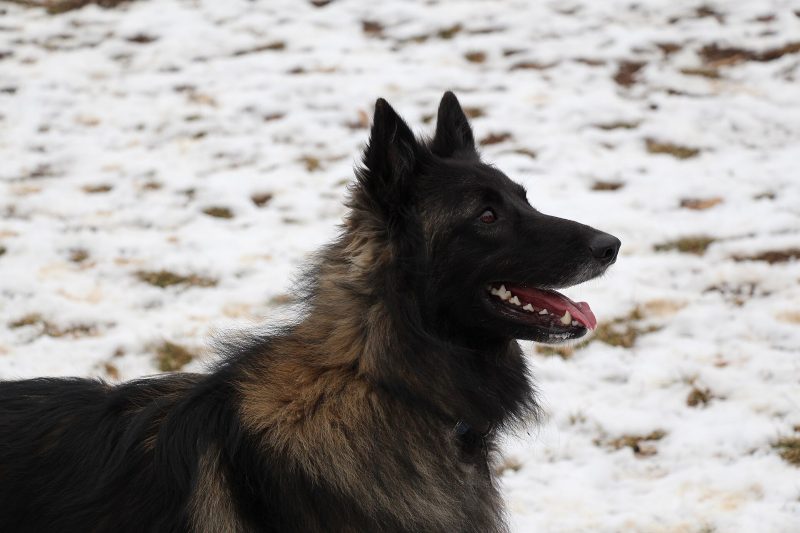
A Tervuren is a square, medium-to-large dog of elegant outline, built for tireless movement rather than bulk. Males stand 24 to 26 inches at the shoulder and weigh 55 to 75 pounds; females are 22 to 24 inches and 45 to 60 pounds. The head is long and finely chiseled, with erect triangular ears, a moderate stop and dark almond eyes that give an alert, questioning expression. The neck is arched, the chest deep and the tail carried low with a slight curve at rest.
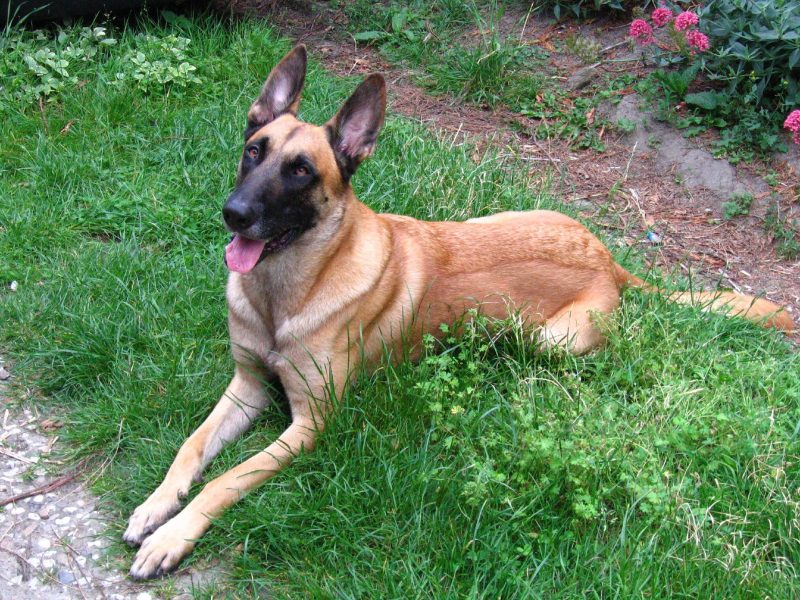
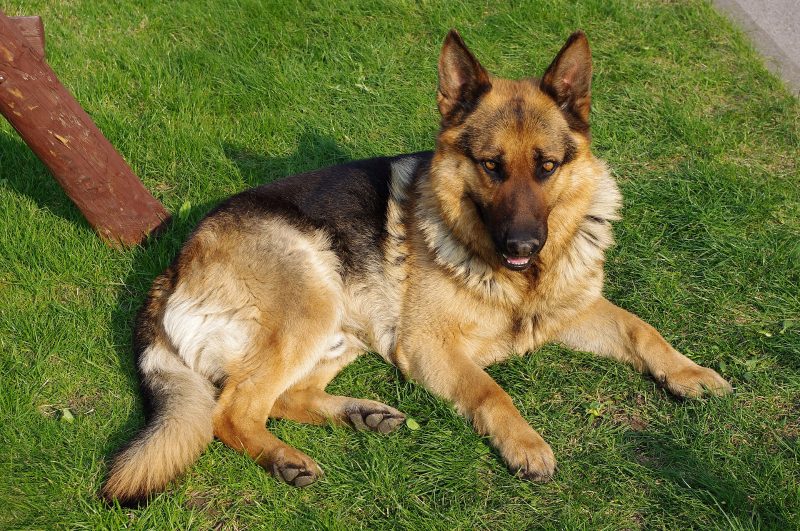
The coat is long, straight and abundant, with a dense undercoat, a pronounced ruff around the neck that is heavier on males, feathering on the legs and tail and shorter hair on the head and lower legs. The classic color is rich fawn to mahogany with a black overlay, where the tips of the hairs are blackened, plus a black mask and black ears; gray with black overlay also occurs. Blackening deepens with age. The Groenendael is the same dog in solid black, the Malinois has a short coat, and a German Shepherd is longer-bodied, heavier and sloped in the back.
Temperament & Personality
Tervs bond deeply, often to one person above the rest, and want to be involved in everything that person does. They are affectionate at home, playful well into old age and famous for a sense of humor that shows up in games of their own devising. With strangers they are watchful and reserved, taking their cue from the family; a Terv that has been well socialized is polite but not effusive, and a poorly socialized one can become shy or suspicious. The protective instinct is strong and does not need encouragement.
Herding instinct runs close to the surface: a Terv may circle and nudge children at play, chase bikes and try to manage the cat. The breed is intense and sensitive, reads the handler's mood instantly and does not forgive rough treatment. With other dogs most Tervs are fine when socialized, though same-sex rivalry occurs. Indoors a well-exercised Terv is calm and watchful from a spot with a view of the door; an under-exercised one paces, barks and chews.
Exercise & Activity
A Tervuren needs at least 60 to 90 minutes of real activity a day, and the activity must involve its brain as well as its legs. A walk around the block is a warm-up. Running, hiking, bike-joring once the dog is grown, fetch and swimming cover the physical side; obedience, agility, herding lessons, tracking, scent work and trick training cover the mental side, and a Terv that gets both is a different animal from one that gets only a walk. Many owners find that two short training sessions a day settle the dog more than extra mileage.
The breed handles cold well and moderate heat reasonably, though the dark coat warms up in the sun; exercise early and late in summer. Puppies should play freely and learn rather than run on hard surfaces until their joints mature.
Boredom shows up as barking, spinning, fence-running and herding the children.
A Terv with a sport or a job is a calm house dog.
Training
Tervurens are among the most trainable dogs there are: they learn new behaviors in a few repetitions, remember them for life and love the process. That speed cuts both ways, because they learn unwanted habits just as fast, and a Terv that figures out it can open the gate will open it. Reward-based training with food, toys and praise works beautifully; the breed is sensitive, and harsh methods produce avoidance or anxiety rather than compliance. Keep sessions short, challenging and varied.
Socialization is the single most important job in puppyhood. Expose the young Terv to many people, places, surfaces and friendly dogs so the breed's natural reserve becomes polite confidence rather than suspicion. The common sticking points are herding behaviors such as nipping at heels, chasing moving things and barking; redirect them early into sanctioned games. Recall is usually strong. The parent club's motto is that a well-balanced Tervuren has a championship on one end and an obedience title on the other, and most Tervs can earn both.
Grooming & Care
The Tervuren coat is long but straight and harsh enough to resist mats, so weekly brushing with a pin brush and a slicker keeps it in shape most of the year. Work through the ruff, the pants and the feathering, and lift the coat to reach the undercoat. Twice a year, usually spring and fall, the undercoat lets go in sheets and brushing becomes a daily job for a few weeks, with a professional blow-out a welcome shortcut. Never shave a Terv; the coat insulates in both directions.
Bathe every month or two, or as needed, and dry the dense ruff fully. Tidy the feet and the hair between the pads, and trim the whiskers only if you like the look. The erect ears need only a weekly check and the occasional cleaning. Clip nails every few weeks and brush teeth regularly.
Male Tervs carry a much heavier ruff and shed more dramatically than females.
Brushing is a good time to check for ticks after fieldwork.
Health
Tervurens are a generally healthy breed with a lifespan of 12 to 14 years, but one inherited problem stands out. Idiopathic epilepsy occurs in the Belgian Tervuren at a rate well above that of most breeds, is strongly heritable, and usually begins between one and five years of age; researchers at the University of California, Davis have identified risk genes, though no single test predicts it. Ask breeders directly about seizures in their lines. Hip and elbow dysplasia occur at moderate rates. Eye conditions including progressive retinal atrophy and cataracts are screened by annual exams. Hypothyroidism is seen, and a stomach cancer is common enough in the breed that the parent club supports research into it. Bloat is a risk in a deep-chested dog.
The American Belgian Tervuren Club asks breeders to have OFA hip and elbow evaluations at two years and an annual eye exam registered with the OFA, with thyroid testing commonly added. If your Terv has a seizure, drinks more than usual, limps or has a distended belly, see your vet promptly. Ask your vet about a preventive gastropexy if bloat worries you.
Nutrition
A Tervuren is an athlete and should look like one: lean, with a visible waist and easily felt ribs under the coat. Feed a complete diet suited to life stage and activity, measure meals and adjust to condition, because the coat hides weight gain and extra pounds load the joints. Working and sporting Tervs need noticeably more food in competition season than in a quiet winter, and some high-drive dogs are picky eaters that need a routine more than a tempting menu.
Puppies should grow on a large-breed growth formula that keeps calories and calcium moderate so the skeleton develops slowly. Feed adults two meals a day rather than one, keep hard exercise an hour away from mealtimes and consider a slow feeder for a gulper, all of which reduce bloat risk. Treats used in training add up fast with a dog that trains daily; use part of the kibble ration. Fresh water should always be available. Ask your vet about diet if your dog has epilepsy, since some owners manage it alongside medication.
Living With This Breed
A Tervuren does best in a house with a securely fenced yard and an active owner who trains as a hobby. Apartment life is possible only with serious daily commitment and is rarely ideal. The breed tolerates cold well and moderate heat reasonably. Tervs are good with children in their own family when raised with them, though herding nips at running kids need managing, and the breed's reserve means visiting children should be introduced calmly. Other dogs and cats are usually fine with early socialization; small pets are at risk from the prey drive.
Time alone is tolerated for a few hours after exercise, but a lonely Terv barks, chews and plans. The breed is a committed watchdog and announces every arrival. For sitters and daycare staff, the key points are the reserve with strangers, the herding instinct and the need for mental work.
Introduce yourself calmly and let the dog approach.
Keep the fence gate latched; Tervs learn gates.
A training game is worth more than an extra lap.
Interesting Facts
The breed is named for the village of Tervuren near Brussels, where brewer M.F. Corbeel's dogs Tom and Poes founded the variety; Tom also pulled the beer cart.
Only the AKC and a few other registries treat the Tervuren as a separate breed; the rest of the world sees it as one variety of the Belgian Shepherd Dog.
The parent club's motto says a well-balanced Terv has a Ch. on one end and a UDT on the other, meaning a conformation championship and an advanced obedience-and-tracking title.
The first dog recorded as an AKC Herding Champion was a Belgian Tervuren.
Belgian animal painter Alexandre Clarys featured a Tervuren in one of his best-known works in the early 1900s.
The black overlay on a Terv's coat darkens with each year, so an older dog is often noticeably darker than it was at two.
Breeds similar to the Belgian Tervuren
What Belgian Tervuren owners say
Real pets, photos, stories and tips from the SitterNation community — separate from the editorial guide above.
Log in to add your pet, photos, stories and tips.
Meet Belgian Tervurens on SitterNation
No Belgian Tervurens have joined yet. Owners can show their pet here from the pet's profile.
Belgian Tervuren community photos
No Belgian Tervurens photos yet — be the first to share one.
Stories from Belgian Tervuren owners
No stories yet. What is life with yours really like?
Tips from Belgian Tervuren owners
No tips yet. One practical thing that works for you is enough.
Ask Belgian Tervuren owners
No questions yet. Ask the people who live with the breed.