Typical tendencies
Energy level
Ready to go when you are, settles after.
Good with children
Patient with kids when well supervised.
Good with other dogs
Enjoys most canine company.
Trainability
Picks up cues with steady, short sessions.
Shedding
Barely a hair on the sofa.
Apartment friendly
A natural fit for city living.
More traits
Exercise needs
Adaptability
Grooming needs
Drooling
Intelligence
Family friendly
Good with cats
Friendly with strangers
Sociability
Protectiveness
Prey drive
Overview
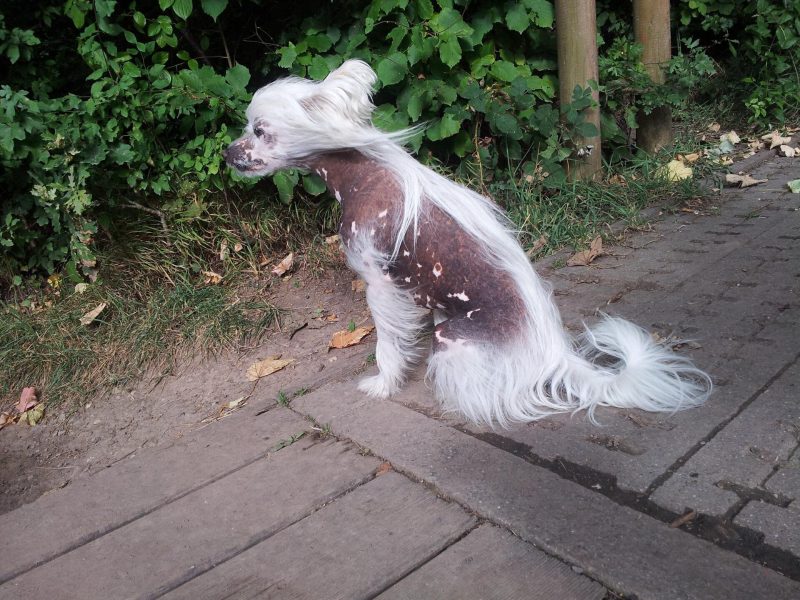
The Chinese Crested is a fine-boned toy dog that comes in two very different outfits: the Hairless, with silky hair only on the head, feet and tail and soft, warm skin everywhere else, and the Powderpuff, covered head to toe in a long, soft double coat. Both can be born in the same litter. Cresteds are gentle, playful, clingy companions that live to be on a lap or under a blanket, and they suit apartment dwellers, older adults, allergy-conscious homes and anyone who wants a small dog that is content with short walks and lots of cuddling.
They are less suited to rough-and-tumble families with toddlers, to cold climates without a wardrobe, or to owners who dislike skin care, since hairless dogs need sunscreen, moisturizer and regular baths. With a lifespan of 13 to 18 years, a Crested is a long, affectionate commitment.
History & Origin
Despite the name, the Chinese Crested almost certainly did not originate in China. The hairless mutation it carries is the same one found in the Xoloitzcuintli and the Peruvian hairless dogs, pointing to an origin in the Americas or Africa, and Spanish explorers recorded hairless dogs in Mexico and Central and South America in the 1500s. The breed's story holds that Chinese sailors carried the dogs on trading ships as ratters and companions and traded puppies in ports around the world, which is how the Chinese name attached itself.
The breed as we know it was shaped in the United States. New York journalist Ida Garrett promoted hairless dogs from the 1880s, and Debra Woods of Florida bred and recorded Cresteds from the 1920s, founding the Crest Haven line. In the 1950s the burlesque star Gypsy Rose Lee became a devoted breeder, and most modern Cresteds descend from the Woods and Lee lines. The FCI recognized the breed in 1987, and the AKC admitted it to the Toy Group in 1991.
Appearance
The Chinese Crested is a small, elegant, fine-boned dog standing 11 to 13 inches at the shoulder and weighing 8 to 12 pounds, with a slightly rectangular outline, a long neck and large, erect ears. Eyes are almond-shaped and dark, the muzzle tapers, and the tail is long and carried up in motion. The Hairless has smooth, soft skin, often pink, slate, blue, mahogany or spotted, with a flowing crest on the head, socks on the feet and a plume on the tail; the amount of body hair varies and hairy-hairless dogs are common. The Powderpuff is entirely coated in a soft, silky double coat that is usually kept long. Any color or combination is allowed.
Hairless dogs often have fewer teeth, especially missing premolars, which the standard accepts. The Xoloitzcuintli is larger with a sturdier build and no crest; the Peruvian Inca Orchid has a similar look but is sighthound-shaped.
Temperament & Personality
Cresteds are sweet, affectionate and almost cat-like in their habits: they perch on the back of the couch, bask in sunny spots, use their paws to hold things and climb into laps uninvited. They are playful indoors and happy to zoom around the house, but their favorite activity is being with their person, and they can become clingy or anxious when ignored or left alone too much. With strangers most are friendly after an initial pause, though some are shy and need gentle socialization; the breed is alert and will bark at the door without being a nuisance.
They are usually good with other dogs and cats and enjoy canine company. Children need to be old enough to handle a fine-boned dog gently, since rough play can injure one. Hairless dogs seek warmth and will burrow under blankets, and all Cresteds have a surprisingly athletic, bouncy side.
Exercise & Activity
A Crested needs only 30 minutes or so of activity a day: a short walk or two and some play indoors. They enjoy fetch, tug, chasing a ball down the hall and learning tricks, and despite their delicate look many excel at agility, lure coursing for small breeds, rally and scent work, where their speed and eagerness shine. Mental games keep a bright, clingy dog from fretting. Weather is the main limit. Hairless dogs sunburn quickly and need dog-safe sunscreen or a shirt for summer walks, and they chill fast, so sweaters and coats are essential in cool weather and walks should be short in winter. Powderpuffs tolerate cold better but still prefer comfort to hardship. Cresteds are escape artists through small gaps and jump surprisingly high, so check fences.
Daily short walks plus indoor play
Sun protection in summer, layers in winter
Boredom shows as anxious whining, barking and chewing
Training
Cresteds are willing, bright and sensitive, and they train best with gentle, consistent, reward-based methods; harsh corrections make them shut down. Keep treats tiny, since calories add up fast on an 8-pound dog, and mix in play and praise. Housetraining is the breed's usual sticking point, partly because small dogs hate going out in cold or rain, so use a strict schedule, lots of praise and a sheltered potty spot, and expect it to take months. Socialize puppies early and widely with people, dogs and handling, because the breed can be timid without it. Some Cresteds are born deaf, so hand signals alongside verbal cues are worth teaching from the start. Work on calm departures and short alone-time sessions to prevent separation anxiety. Teach the dog to accept bathing, nail trims and skin care as a matter of routine. Trick training, agility and rally are rewarding outlets for their quick minds.
Grooming & Care
Grooming depends on the variety. Hairless dogs need skin care rather than brushing: bathe every week or two with a gentle dog shampoo, dry thoroughly and apply a light, unscented moisturizer if the skin is dry; watch for blackheads and acne, which are common, and never squeeze them. Use dog-safe sunscreen or clothing outdoors in sun and avoid wool and rough fabrics that irritate the skin. The crest, socks and plume are brushed every few days, and many owners trim or shave the face and ears to show the outline. Powderpuffs need a thorough brush-out to the skin every day or two with a pin brush and comb to prevent mats, a bath every few weeks and a trim every six to eight weeks, or a shorter pet cut. For both, clean the ears weekly, trim nails often, since indoor dogs rarely wear them down, and brush teeth daily, because this breed loses teeth early.
Health
Chinese Cresteds are generally healthy and typically live 13 to 18 years. Eye disease is the main inherited concern: primary lens luxation, which can cause sudden painful glaucoma, and progressive retinal atrophy both have DNA tests, and dry eye also occurs. Patellar luxation and Legg-Calve-Perthes disease of the hip are seen in this fine-boned breed. Hairless dogs are prone to early tooth loss and gum disease because of their altered dentition, as well as sunburn, blackheads and skin irritation; Powderpuffs have normal teeth. Some puppies are born deaf, and a rare movement disorder, canine multiple system degeneration, has been described.
The American Chinese Crested Club recommends that breeding dogs have an OFA patella evaluation, a cardiac exam, an eye exam by a veterinary ophthalmologist and DNA tests for primary lens luxation and PRA; many breeders add BAER hearing tests. Ask your vet about dental cleanings and to look at any persistent skin lesion on a hairless dog, since sun damage can become cancerous.
Nutrition
Feed a complete, balanced diet formulated for small or toy breeds and matched to the dog's life stage. Puppies need three or four small meals a day to keep blood sugar steady; adults do well on two measured meals. At 8 to 12 pounds, a Crested's calorie needs are small and treats add up quickly, so count training rewards as part of the daily ration and watch for a thickening waist. Hairless dogs with missing teeth may find large or very hard kibble awkward; a small-kibble or softened food helps, and dental health matters because loose or missing teeth can affect eating. Dogs with the breed's skin and allergy issues may benefit from omega-3 supplementation or a diet trial, but ask your vet first. Fresh water should always be available, and warm, sun-loving dogs may drink more than you expect.
Living With This Breed
The Crested is one of the best apartment dogs: small, quiet, low-shedding and content with short walks. It needs a warm home and a wardrobe of sweaters and coats, and in summer it needs shade, sunscreen and air conditioning. It hates being alone and does best with someone home much of the day or with a canine companion. Adults and families with gentle, older children suit it well; toddlers can injure a fine-boned dog. Cresteds generally coexist happily with other small dogs and cats and enjoy burrowing into shared beds.
A sitter should know the sunscreen, moisturizer and clothing routine
Hairless dogs get cold fast; keep the home warm and provide blankets
Check fences and screens; Cresteds squeeze through and jump
Handle gently and lift with support under the chest and hindquarters
Interesting Facts
A hairless Crested named Sam won the World's Ugliest Dog Contest three years running, from 2003 to 2005, and became an international celebrity.
Hairless and Powderpuff puppies can be born in the same litter; the hairless gene is dominant, and a double dose is not viable, so every hairless dog carries one Powderpuff gene.
The burlesque performer Gypsy Rose Lee was one of the breed's most important early breeders, and her line helped found the modern Crested.
The hairless gene also affects tooth development, which is why Hairless Cresteds often have missing premolars and forward-pointing canines.
Cresteds carry the same hairless mutation as the Mexican Xoloitzcuintli, which suggests their ancestors came from the Americas, not China.
Breeds similar to the Chinese Crested
What Chinese Crested owners say
Real pets, photos, stories and tips from the SitterNation community — separate from the editorial guide above.
Log in to add your pet, photos, stories and tips.
Meet Chinese Cresteds on SitterNation
No Chinese Cresteds have joined yet. Owners can show their pet here from the pet's profile.
Chinese Crested community photos
No Chinese Cresteds photos yet — be the first to share one.
Stories from Chinese Crested owners
No stories yet. What is life with yours really like?
Tips from Chinese Crested owners
No tips yet. One practical thing that works for you is enough.
Ask Chinese Crested owners
No questions yet. Ask the people who live with the breed.