Typical tendencies
Energy level
Always on; boredom turns into mischief.
Good with children
A famously patient playmate for kids.
Good with other dogs
Enjoys most canine company.
Trainability
Lives for the lesson; a trainer's dream.
Shedding
Noticeable, with heavier seasonal blows.
Apartment friendly
Can manage in a flat with plenty of outings.
More traits
Exercise needs
Adaptability
Grooming needs
Drooling
Intelligence
Family friendly
Good with cats
Friendly with strangers
Sociability
Protectiveness
Prey drive
Overview
The English Springer Spaniel suits active people who want a dog that joins in everything. Built to quarter the field all day and flush birds for the gun, it brings that stamina and enthusiasm home, where it becomes a cheerful, affectionate family member that adores children and welcomes guests. It learns quickly, loves water and retrieving, and does well in obedience, agility and scent work. In return it needs real exercise, ideally an hour or more a day with some of it off leash, and it does not thrive shut in an apartment or left alone for long days. The medium-length coat needs weekly brushing and periodic trimming, and the long ears need routine care. Be aware that the breed exists in two types, field and show, with noticeably different looks and energy levels. For runners, hikers, hunters and busy families with time to give, few dogs are as willing.
History & Origin
Spaniels have worked alongside hunters in Britain for many centuries, flushing birds into nets and later for falcons and guns. Until the 1800s the larger and smaller dogs often came from the same litters: the big ones that sprang game were called springers, and the small ones used on woodcock were called cockers. Breeders in Shropshire and Norfolk began fixing a consistent springer type around 1800, and the Kennel Club in Britain recognized the English Springer Spaniel as a separate breed in 1902. The American Kennel Club registered its first Springer in 1910, and the English Springer Spaniel Field Trial Association, the breed's American parent club, was founded in 1924 and ran its first trial that autumn. Through the twentieth century the breed split into two strains: compact, lightly feathered field dogs bred for trials and hunting, and heavier-coated show dogs. Springers have won Best in Show at Westminster six times.
Appearance
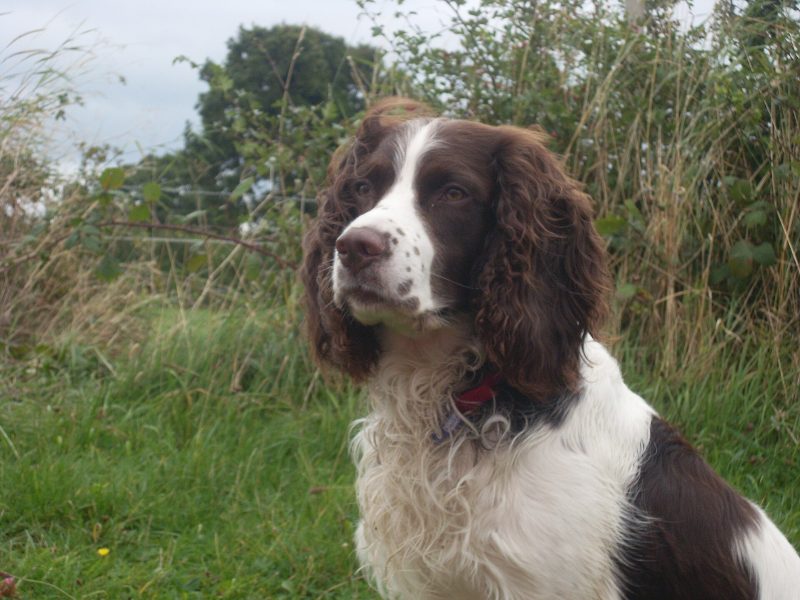
A Springer is a medium-sized, well-balanced dog, a little longer than tall, with a deep chest, a level back and a moderately long neck that lets it carry a bird easily. The head is handsome rather than heavy, with a fairly long muzzle, a defined stop, soft oval eyes and long, wide drop ears that hang close to the cheeks. The tail is carried roughly level and wags constantly. The coat is medium length, flat or slightly wavy, with a dense undercoat and longer feathering on the ears, chest, legs and belly. Most dogs are liver and white or black and white; tricolor and blue or liver roan also occur, often with ticking in the white. Compared with a Welsh Springer it is larger and never red and white; compared with an English Cocker it is taller with a longer muzzle. Field-bred Springers are typically lighter, shorter-coated and have more white.
Temperament & Personality
Springers are outgoing, affectionate and almost tirelessly enthusiastic. They bond closely with the whole family, are reliably gentle with children, and treat strangers as new friends, which makes them poor guard dogs but excellent companions. With other dogs they are usually sociable; with cats and small pets they can be fine if raised together, though the instinct to chase birds and squirrels is strong. Indoors a well-exercised Springer settles happily on the sofa, but an under-exercised one is restless and vocal. They are sensitive and emotionally tuned in, so they take correction hard and may develop separation anxiety if left alone too often. Some bark more than their owners would like. Rarely, dogs of this breed have shown sudden unprovoked aggression, sometimes called rage syndrome; it is uncommon, but it is one more reason to buy from breeders who prioritize stable temperament.
Exercise & Activity
Plan on at least an hour of real exercise every day, and more for field-bred dogs. A leash walk around the block is a warm-up, not a workout. Springers want to run, swim, retrieve and use their noses, so off-leash time in a safe area, fetch sessions, swimming and hikes are ideal. They make excellent jogging and cycling partners once their joints have matured at around 18 months. Mental work matters as much as mileage: nose work, hunting games, agility and retrieving drills tire them in a way that pounding pavement does not. They cope well with cold and wet but can overheat in hot weather, so shift activity to morning and evening in summer. A bored Springer will find its own entertainment.
Digging, chewing and counter surfing
Pacing, whining and barking at windows
Obsessive behaviors such as shadow or light chasing
Training
Springers are among the easiest sporting dogs to train. They are eager to please, quick to understand what you want, and highly motivated by both food and retrieving games. Keep sessions upbeat and reward-based; this is a soft breed that wilts under harsh handling. The common sticking points are excitability and distraction. A young Springer may know the cue perfectly in the kitchen and forget it entirely when a bird flies past, so build reliability gradually in increasingly distracting places. Recall deserves early and constant practice because the nose and the eyes will pull the dog toward anything that moves. Teach a calm greeting early, since many Springers jump up in their enthusiasm. Socialize puppies broadly so their natural friendliness does not tip into over-arousal. Channeling instincts into formal retrieving, nose work, agility or hunt tests gives the dog a job and makes the rest of training easier.
Grooming & Care
A Springer's coat is manageable but not maintenance free. Brush and comb once or twice a week, paying attention to the feathering on the ears, legs, chest and belly where mats and burrs collect. Show dogs are trimmed and thinned regularly; pet owners usually book a tidy-up with a groomer every two to three months to neaten the ears, feet and feathering, and many field dogs are simply kept short. Shedding is moderate and heavier in spring and fall. Bathe as needed, more often for a dog that swims in ponds. The long, heavy ears trap moisture and limit airflow, making ear infections the breed's most common complaint; check and clean the ears weekly and dry them after swimming. Trim nails every few weeks, brush teeth regularly, and check between the toes for grass seeds after walks in summer.
Brushing: 1 to 2 times a week
Professional trim: every 8 to 12 weeks
Ears: weekly checks, dry after water
Health
Springers typically live 12 to 14 years and are a reasonably healthy breed, but several inherited conditions are well documented. Hip and elbow dysplasia occur, and the parent club asks breeders to radiograph both. Eye disease is a priority: progressive retinal atrophy of the cord1 type has a DNA test, retinal dysplasia is checked in young puppies, and glaucoma and entropion are also seen, so annual exams by a veterinary ophthalmologist are standard. Phosphofructokinase deficiency, an enzyme disorder causing anemia and weakness, has a DNA test and has become rare through screening; fucosidosis, a fatal storage disease, can be screened the same way. Ear infections, skin allergies and seborrhea are frequent day-to-day problems. Immune-mediated hemolytic anemia, epilepsy and Ehlers-Danlos syndrome are reported at above-average rates. A breeder should be able to show OFA hip and elbow results, a current eye certificate and PRA status for both parents. Ask your vet about any sudden weakness, pale gums or head shaking.
Nutrition
Springers are enthusiastic eaters and will gain weight if portions are not measured, so feed a complete diet in two measured meals a day and adjust to body condition rather than to appetite. A working or very active dog may need considerably more food in season than a pet that walks an hour a day, so expect to change amounts through the year. Puppies should eat a diet formulated for medium-breed growth until about a year old; avoid supplements that push rapid growth, which can stress developing joints. Although Springers are not as deep-chested as some breeds, bloat does occur, so avoid vigorous exercise in the hour after a meal. Many Springers have food sensitivities that show up as itchy skin or recurrent ear trouble; if that is your dog, ask your vet about a structured elimination diet before switching foods at random. Treats used in training add up quickly, so count them in the daily total.
Living With This Breed
A house with a securely fenced yard and people who are home a fair amount is the natural setting for a Springer. Apartments can work only with a serious daily exercise commitment. They tolerate cold and rain well and need shade and water in heat. They are excellent with children and other dogs, and with early introduction many live peacefully with cats, though birds and small pets should be protected. They do not like being alone and may bark or chew after a few hours; daycare or a midday walker helps. Fences should be checked, as a Springer following a scent will push through gaps.
For sitters: this dog will want to retrieve something, so bring a ball
Expect mud; keep a towel by the door and dry the ears
Keep food and trash out of reach
Confirm the recall before any off-leash time
Interesting Facts
The breed's name describes its job: a springer springs, or flushes, game birds from cover.
English Springers have won Best in Show at Westminster six times, more than any other sporting breed.
Two American presidents, George H. W. Bush and George W. Bush, kept Springers in the White House; Millie even had a best-selling book written in her name.
Springers and Cocker Spaniels were once born in the same litters and sorted by size.
Springers serve widely as detection dogs with police and the military, sniffing out explosives, drugs and even electronics.
The field and show strains have diverged so far that experienced fanciers can tell them apart at a glance.
Breeds similar to the English Springer Spaniel
What English Springer Spaniel owners say
Real pets, photos, stories and tips from the SitterNation community — separate from the editorial guide above.
Log in to add your pet, photos, stories and tips.
Meet English Springer Spaniels on SitterNation
No English Springer Spaniels have joined yet. Owners can show their pet here from the pet's profile.
English Springer Spaniel community photos
No English Springer Spaniels photos yet — be the first to share one.
Stories from English Springer Spaniel owners
No stories yet. What is life with yours really like?
Tips from English Springer Spaniel owners
No tips yet. One practical thing that works for you is enough.
Ask English Springer Spaniel owners
No questions yet. Ask the people who live with the breed.