Typical tendencies
Energy level
Always on; boredom turns into mischief.
Good with children
Gentle and tolerant around children.
Good with other dogs
Enjoys most canine company.
Trainability
Lives for the lesson; a trainer's dream.
Shedding
Noticeable, with heavier seasonal blows.
Apartment friendly
Can manage in a flat with plenty of outings.
More traits
Exercise needs
Adaptability
Grooming needs
Drooling
Intelligence
Family friendly
Good with cats
Friendly with strangers
Sociability
Protectiveness
Prey drive
Overview
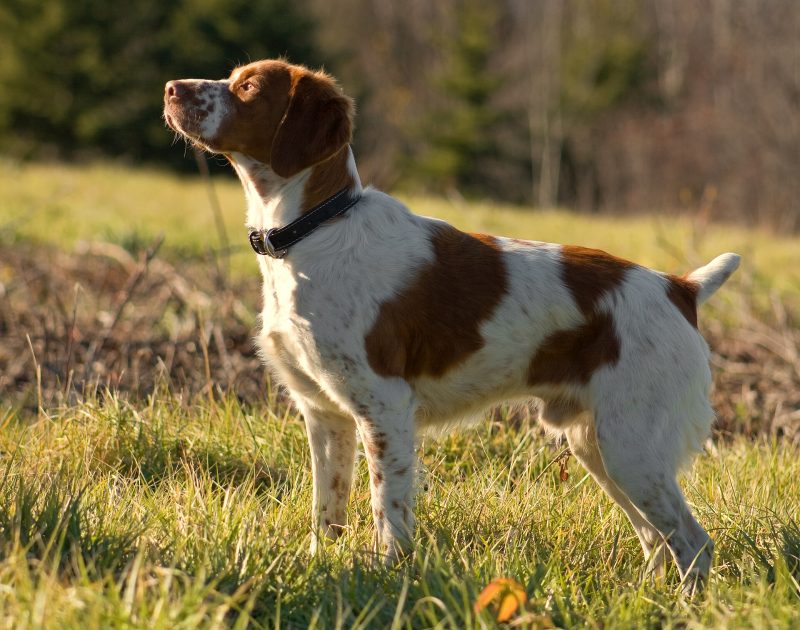
The Brittany is a compact, leggy bird dog from northwestern France that packs the drive of a much larger pointer into a 30 to 40 pound frame. It suits people who are genuinely active: hunters, trail runners, hikers and families who spend their weekends outdoors and want a dog that can keep up all day and still curl up on the couch at night. Brittanys are affectionate, sensitive and eager to please, which makes them easy to train with a gentle hand and quick to shut down under a harsh one. Grooming is light, the coat is modest, and the breed is usually healthy and long-lived. The catch is energy. A Brittany that does not get an hour or more of real exercise every day will become anxious, noisy or destructive. If you can give it work for its nose and legs, it is one of the most rewarding sporting dogs there is.
History & Origin
Dogs of this type have hunted in the hedgerow country of central Brittany for centuries, where farmers and poachers valued a small, close-working dog that could point, flush and retrieve woodcock and partridge on foot. In the 1800s local spaniels were crossed with pointers and setters brought over by visiting British sportsmen, which sharpened the pointing instinct and produced the orange and white color that remains typical. A breed standard was drafted in Nantes in 1907 and adopted at the club's first general assembly in Loudeac in 1908; the early club's name reflected the breed's naturally short tail. The first Brittanys reached North America in the late 1920s, and the American Kennel Club recognized the breed as the Brittany Spaniel in 1934. The American Brittany Club, founded in 1942, set out to keep it a dual dog for field and show. In 1982 the AKC dropped the word Spaniel, since the dog points rather than flushes.
Appearance
A Brittany is a square, cobby dog with long legs for its size, standing 17.5 to 20.5 inches and weighing 30 to 40 pounds. The impression is of a quick, athletic dog built to cover ground efficiently rather than to look elegant. The head is rounded and wedge-shaped with a moderate stop, a fairly short muzzle, expressive amber to dark eyes, and short triangular ears set high and lying close, with a little wavy fringe. Many Brittanys are born with a bobtail or no tail at all; others are traditionally docked to about four inches where that is permitted. The coat is dense, flat or wavy, never curly, with light feathering on the ears and legs. Orange and white is most common, with liver and white, roan patterns and tricolor also accepted. The Brittany is lighter and squarer than an English Springer, smaller than any other pointing breed, and has a shorter muzzle and higher-set ears than a setter.
Temperament & Personality
Brittanys are warm, eager and emotionally attached to their people. They are happy, bouncy dogs that greet strangers with a wagging stump and get along well with children and other dogs, though a careless toddler and a dog this exuberant should be supervised. They are sensitive; a raised voice can wound a Brittany, and timid dogs can appear in poorly socialized lines, so choose a breeder who prioritizes confident temperaments and expose puppies to plenty of people and places. Indoors a well-exercised Brittany is calm and affectionate, often leaning against a leg or claiming a lap despite its size. Outdoors the hunting instinct takes over: the nose goes down, birds and small animals are noticed instantly, and the dog ranges with purpose. Cats raised with the dog are usually accepted; pet birds and rabbits are a different matter. Some Brittanys are prone to submissive urination when excited or scolded.
Exercise & Activity
This is a high-energy breed built for hours of field work, and it needs a minimum of an hour of vigorous activity daily, with more for young adults and field-bred dogs. Running free in a safely fenced area or on a long line is far more valuable than leash walks, because a Brittany exercises its mind through its nose. Ideal outlets include hiking, trail running once the dog is mature, retrieving games, swimming, scent work, agility and, of course, bird work or hunt tests. The breed handles cold and wet well and copes with heat better than heavier dogs, but still needs shade and water in summer. A Brittany without an outlet becomes anxious rather than merely bored.
Pacing, whining and inability to settle in the evening
Chewing and digging
Fence running and barking at birds and squirrels
Training
Brittanys learn fast and want to work with you, which makes them one of the easier pointing breeds for a first-time sporting dog owner. They are motivated by praise, play and food, and they take instruction best when it is cheerful and clear. The most important thing to know is that they are soft: harsh corrections, shouting or heavy-handed leash work produce a worried, shut-down dog rather than a compliant one. Reward-based methods, short sessions and patience with adolescent distraction get far better results. Recall needs early, careful work because a Brittany on a scent can be a hundred yards away before you notice. A reliable whistle recall is worth the investment. Socialize generously in puppyhood to build confidence. Giving the dog a formal job, whether field training, rally, agility or nose work, channels the instinct and makes everyday manners easier.
Grooming & Care
The Brittany is a low-maintenance breed to groom. The coat is dense but not profuse, with only light feathering, so a brush and comb once a week keeps it tidy and removes dead hair. Shedding is moderate year-round with heavier periods in spring and fall. Bathe only when the dog is dirty or smelly, which for a dog that loves ponds and mud may be fairly often. After walks in the field, check the feathering, ears and between the toes for burrs, ticks and grass seeds, which can work into the skin. The drop ears need a weekly look and a wipe; they are less heavy than a spaniel's but still trap moisture after swimming. Trim nails every few weeks, as active dogs on soft ground do not wear them down, and brush teeth regularly.
Brushing: once a week
Professional grooming: rarely needed; a light tidy of feet and ears
Shedding: moderate
Health
Brittanys are generally a hardy breed with a typical lifespan of 12 to 14 years. The most common inherited concern is hip dysplasia; the Orthopedic Foundation for Animals has found a meaningful share of evaluated Brittanys to be dysplastic, and the American Brittany Club asks its breeders to obtain hip certification, with elbow and eye evaluations recommended. Idiopathic epilepsy occurs in the breed, often appearing between one and five years of age, and buyers should ask whether seizures are known in the pedigree. Hypothyroidism, which can cause weight gain, lethargy and coat changes, is diagnosed with a blood test. Eye problems, including cataracts, are seen, and a current ophthalmologist exam for both parents is a reasonable expectation. Discoid lupus, an immune-mediated skin condition affecting the nose, and cleft palate in puppies are reported less often. Ear infections follow swimming and field work. If your Brittany has a seizure, becomes lame, or slows down unexpectedly, ask your vet.
Nutrition
A Brittany's food needs swing widely with its workload. A dog hunting several days a week in autumn may need almost twice the calories of the same dog in a quiet midsummer, so feed a complete diet in two measured meals and adjust portions to body condition every few weeks. You should see a defined waist from above and feel ribs easily. Puppies should eat a growth diet formulated for medium breeds until around a year; avoid overfeeding or calcium supplementation, which can stress developing hips. Active adults often do well on performance formulas with higher fat during the working season and a maintenance diet off-season. Feed after exercise rather than before it, and allow an hour of rest afterward. Treats are useful in training but count toward the daily total. Fresh water should always be available, particularly for a dog working in warm weather. Ask your vet about diet if your dog is on epilepsy or thyroid treatment.
Living With This Breed
A Brittany belongs in a home with a securely fenced yard and people who are outside a lot. It is not a good apartment dog unless the owner runs or hikes daily. It tolerates most climates, though it should sleep indoors; this is a people dog, not a kennel dog. It is excellent with children old enough to handle an exuberant dog and generally friendly with other dogs. Cats can work with early introduction; small pets and backyard chickens need secure protection. Brittanys do not like long days alone and may become vocal or destructive after four or five hours. Fences should be at least five feet and checked for gaps, because a Brittany on a bird will not stop at a property line.
For sitters: a long walk is not enough; plan fetch or a run
Keep the dog leashed near roads; recall fails when a bird flies
Check ears and feet after outdoor time
Expect a shadow that follows you everywhere
Interesting Facts
The Brittany is the smallest of all the pointing breeds, yet it is the most numerous sporting dog in France.
The AKC dropped the word Spaniel from the name in 1982 because the breed points like a setter rather than flushing like a spaniel.
Many Brittanys are born with a natural bobtail; the breed's first club in 1908 was named for its short tail.
The Brittany has produced more dual champions, dogs titled in both field trials and the show ring, than any other AKC sporting breed.
Its orange and white coat is said to trace to crosses with setters and pointers that British sportsmen brought to Brittany for the woodcock season in the 1800s.
Owners call them Brits, and the French name is Epagneul Breton.
Breeds similar to the Brittany

What Brittany owners say
Real pets, photos, stories and tips from the SitterNation community — separate from the editorial guide above.
Log in to add your pet, photos, stories and tips.
Meet Brittanys on SitterNation
No Brittanys have joined yet. Owners can show their pet here from the pet's profile.
Brittany community photos
No Brittanys photos yet — be the first to share one.
Stories from Brittany owners
No stories yet. What is life with yours really like?
Tips from Brittany owners
No tips yet. One practical thing that works for you is enough.
Ask Brittany owners
No questions yet. Ask the people who live with the breed.