Typical tendencies
Energy level
Always on; boredom turns into mischief.
Good with children
Gentle and tolerant around children.
Good with other dogs
Enjoys most canine company.
Trainability
Quick to learn and keen to please.
Shedding
Noticeable, with heavier seasonal blows.
Apartment friendly
Needs space and a garden to be happy.
More traits
Exercise needs
Adaptability
Grooming needs
Drooling
Intelligence
Family friendly
Good with cats
Friendly with strangers
Sociability
Protectiveness
Prey drive
Overview
The German Shorthaired Pointer is the dog for people who are already outdoors most days and want a partner who can keep up. Developed as an all-round hunting dog that points, retrieves on land and in water and tracks wounded game, the GSP has stamina that seems bottomless and a cheerful, people-focused temperament that makes it a genuine family dog once the energy is spent.
Runners, hikers, hunters and anyone with a fenced yard and a love of training will find this breed rewarding. People who work long hours, live in a small apartment or prefer a sedentary routine should look elsewhere, because an under-exercised Shorthair invents its own entertainment and it is rarely the kind you want. The short, easy-care coat and biddable nature are bonuses; the daily mileage is the price of admission.
History & Origin
German hunters of the mid-1800s wanted one dog that could do everything a growing middle class of sportsmen needed: find birds and point them, retrieve from water, trail a wounded deer and guard the game bag on the way home. Starting from the old German Bird Dog, itself descended from Spanish pointers, breeders added scent hounds for nose and tracking ability, and then English Pointers in the 1860s for speed and style. Prince Albrecht zu Solms-Braunfels pushed breeders to judge dogs on how they worked rather than how they looked.
A German studbook opened in the 1870s, and two dogs named Nero and Treff, standouts at early German field trials, anchor most modern pedigrees. Dr. Charles Thornton of Montana imported the first dogs to America in 1925, the AKC admitted the breed to its studbook in 1930 and the German Shorthaired Pointer Club of America became the parent club in 1938. In Germany the breed is still called the Deutsch Kurzhaar.
Appearance
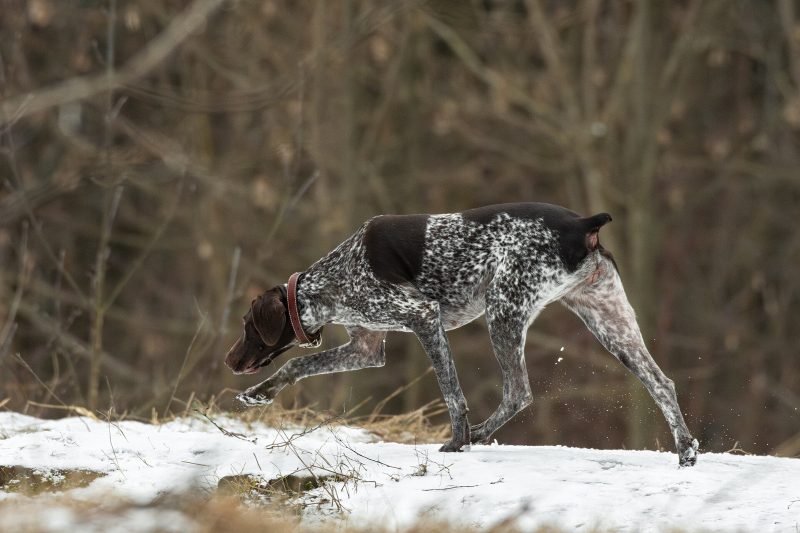
The GSP is a clean-lined, athletic dog that looks like it could run all day because it can. Males stand 23 to 25 inches and weigh 55 to 70 pounds; females are 21 to 23 inches and 45 to 60 pounds. The head is long with a slightly rounded skull, a broad nose, almond-shaped brown eyes and ears that hang flat against the cheeks. The chest is deep, the back short and strong, and the tail is traditionally docked where that is still legal.
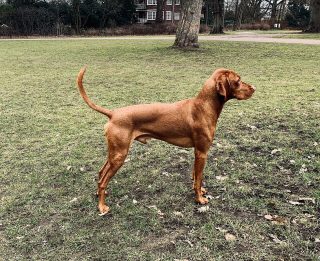
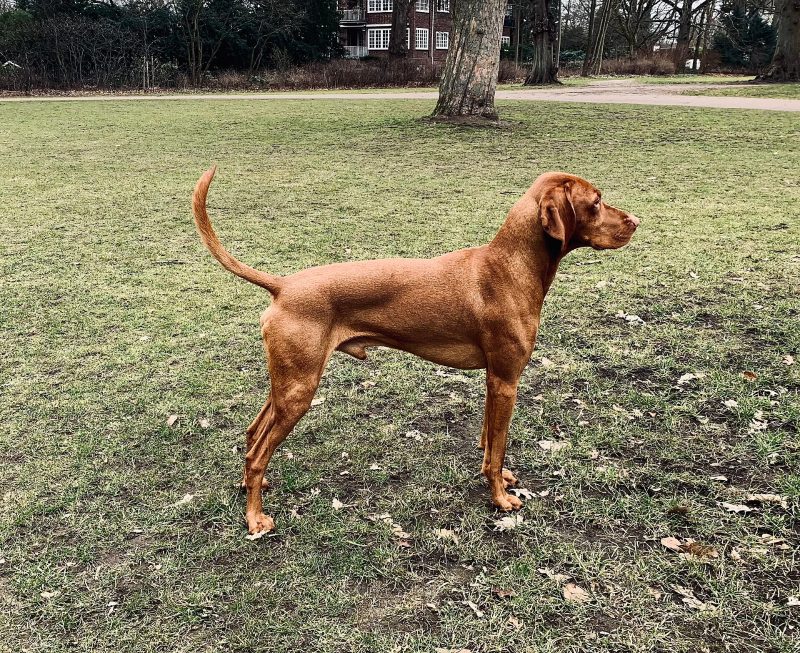
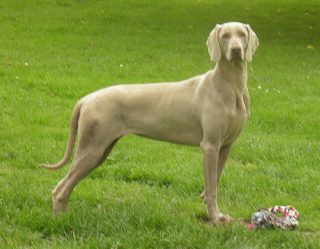
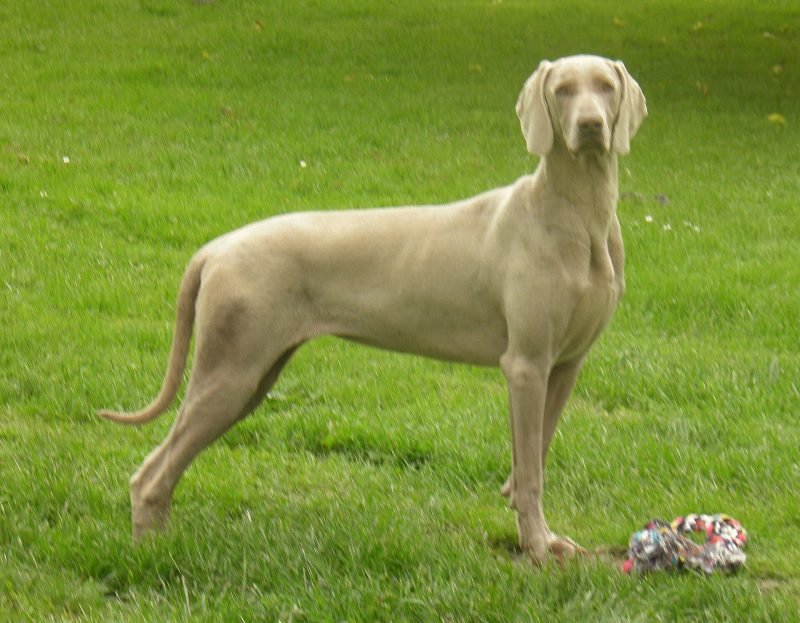
The coat is short, dense and slightly coarse, shedding water easily. Colors are solid liver, liver and white in patches, ticked or roan patterns, and combinations of all three; the typical dog has a liver head with a speckled white body. A Weimaraner is gray and larger, a Vizsla is solid rust and a little lighter, and the German Wirehaired Pointer has a harsh, bearded coat. Black is accepted by the FCI but not by the AKC.
Temperament & Personality
Shorthairs are friendly, enthusiastic and almost always in motion until they are about three years old. They adore their people, follow them from room to room and will press their whole body against your legs for attention. Most are open and waggy with strangers, which makes them poor guard dogs but good company, though they will bark to announce arrivals. With children they are gentle but boisterous, and a happy GSP can bowl over a toddler without meaning to.
They usually get on well with other dogs and love a playmate. Cats and other small pets are a harder sell: the prey drive is strong, and even a dog raised with the family cat may chase the neighbor's. Outdoors the breed is focused and driven; a scent can switch it from companion to hunter in a second. Some are vocal, whining or barking when excited or left out. Separation anxiety is not unusual in dogs that spend too much time alone.
Exercise & Activity
Plan on at least 90 minutes of real exercise every day for an adult GSP, and more for a young dog. A leash walk around the block does not count. Running, cycling with a dog attachment, swimming, fetch in a field and off-leash time in a securely fenced area are what the breed needs, plus training that engages the brain: nose work, retrieving drills, agility or hunt tests. Puppies should build up gradually to protect growing joints, with free play rather than forced running until about 18 months.
The short coat offers little insulation, so provide a jacket in freezing weather and avoid long outings in high heat and humidity; carry water. Signs of too little exercise include pacing, counter surfing, digging, chewing furniture and barking at nothing.
90 minutes or more daily, mostly off leash or at speed
Swimming and retrieving tap into natural instincts
Daily mental work: scent games, training, puzzle feeders
Training
GSPs are intelligent, eager and quick to learn, which makes them a pleasure for an active trainer and a handful for a passive one. They respond best to reward-based methods built around food, toys and the chance to run; they are sensitive to harsh handling and can become anxious or evasive if corrected roughly. Start early, because a 60-pound adolescent who pulls on the leash and jumps on guests is hard to live with.
Recall is the priority skill: teach it on a long line, reward it lavishly and never punish a dog for eventually coming back. Impulse control around birds, squirrels and cats needs ongoing work. Many Shorthairs mouth hands and carry objects everywhere; channel it into retrieving games. Socialize puppies widely with people, dogs, surfaces and noises, and introduce the crate as a calm resting place. The breed excels in field trials, agility, dock diving, obedience and scent sports, all of which also burn off energy.
Grooming & Care
The Shorthair is one of the easiest breeds to keep tidy. A weekly rub with a rubber curry or hound glove lifts dead hair and spreads skin oils, and a bath every month or two, or after a muddy swim, is plenty. Shedding is moderate but constant, and the short, stiff hairs weave into fabric, so a quick brush outdoors several times a week during spring and fall helps.
The drop ears trap moisture, especially in dogs that swim, so check and dry them after water and clean them with a vet-approved solution when needed. Trim nails every two or three weeks; active dogs may wear them down naturally. Brush teeth a few times a week. After hunting or hiking, run your hands over the whole dog to find burrs, cuts, ticks and grass seeds between the toes.
Weekly brushing, baths as needed
Dry and check ears after swimming
Post-hike tick and paw checks
Health
German Shorthaired Pointers are generally robust and live 10 to 12 years, but breeders screen for several inherited problems. Hip and elbow dysplasia are evaluated by radiographs at two years. Cardiac disease, including subaortic stenosis, is checked by a veterinary cardiologist at or after 24 months. An annual eye exam by a veterinary ophthalmologist is recommended through age six, and a DNA test identifies carriers of cone degeneration, a form of day blindness; these tests make up the parent club's CHIC requirements.
The breed also sees von Willebrand disease, a bleeding disorder, hypothyroidism, a breed-specific skin disease known as lupoid dermatosis, and lymphedema. Because the chest is deep, gastric dilatation-volvulus, or bloat, is a life-threatening emergency to recognize: a swollen abdomen, unproductive retching and restlessness mean go to a vet immediately. Cancers such as mast cell tumors and hemangiosarcoma appear in older dogs. Ask your vet about lumps, limping or any drop in stamina.
Nutrition
A working-weight GSP should show a visible waist and easily felt ribs. Feed a complete diet that matches the dog's activity: a weekend hunting dog needs more calories in season and fewer on the couch in July. Puppies grow fast and benefit from a large-breed puppy formula fed three times a day until around six months, which supports steady rather than rapid growth. Adults usually do best on two meals rather than one large one.
Because the breed is deep-chested and prone to bloat, avoid vigorous exercise for an hour before and after meals, discourage gulping with a slow feeder, and talk to your vet about whether a preventive gastropexy makes sense for your dog. High-energy dogs working in cold water may need extra fat in their diet; ask your vet or a veterinary nutritionist rather than guessing. Fresh water should be available at all times, especially after a run.
Living With This Breed
This is a house dog that needs a yard, not a yard dog. Shorthairs want to be with their family and do not do well kenneled or left outside; a securely fenced area for daily sprints is the practical requirement, and a six-foot fence is wise because they jump. Apartments only work for owners who run twice a day. The short coat means they feel cold and should sleep indoors.
They are affectionate with children but too bouncy for toddlers unless supervised, and homes with cats or pocket pets need careful management. Most tolerate four to six hours alone once mature, but they do better with a midday walk. A sitter or daycare should know this dog needs a long run, not a stroll, will chase anything that moves, may try to escape a casual gate and should never be let off leash in an unfenced area.
Secure, tall fencing
Daily hard exercise is non-negotiable for a sitter
Keep leashed near roads and wildlife
Interesting Facts
The breed's first American litter was whelped on the Fourth of July, 1925, at Dr. Charles Thornton's kennel in Montana.
A GSP named CJ won Best in Show at Westminster in 2016, and Carlee had done the same in 2005.
GSPs are prized by customs and military units as detection dogs because of their nose and work ethic.
The breed's liver pigment extends to its nose, which should never be black on an AKC show dog.
Many Shorthairs are natural swimmers with webbed feet that help them retrieve ducks from icy water.
Author Robert B. Parker gave his detective Spenser a series of German Shorthaired Pointers, all named Pearl.
Breeds similar to the German Shorthaired Pointer
What German Shorthaired Pointer owners say
Real pets, photos, stories and tips from the SitterNation community — separate from the editorial guide above.
Log in to add your pet, photos, stories and tips.
Meet German Shorthaired Pointers on SitterNation
No German Shorthaired Pointers have joined yet. Owners can show their pet here from the pet's profile.
German Shorthaired Pointer community photos
No German Shorthaired Pointers photos yet — be the first to share one.
Stories from German Shorthaired Pointer owners
No stories yet. What is life with yours really like?
Tips from German Shorthaired Pointer owners
No tips yet. One practical thing that works for you is enough.
Ask German Shorthaired Pointer owners
No questions yet. Ask the people who live with the breed.