Typical tendencies
Energy level
Always on; boredom turns into mischief.
Good with children
Gentle and tolerant around children.
Good with other dogs
Gets along with known, polite dogs.
Trainability
Quick to learn and keen to please.
Shedding
Noticeable, with heavier seasonal blows.
Apartment friendly
Needs space and a garden to be happy.
More traits
Exercise needs
Adaptability
Grooming needs
Drooling
Intelligence
Family friendly
Good with cats
Friendly with strangers
Sociability
Protectiveness
Prey drive
Overview
The Weimaraner is a sleek, silver-gray German gundog with pale eyes, a restless engine and an attachment to its people that borders on dependence. Bred by nobility to hunt big game and later birds all day, it is a 55-to-90-pound athlete that needs serious daily exercise and real companionship, and it repays both with affection, intelligence and a striking presence.
It suits active owners who run, hike, hunt or compete in dog sports, who are home a good deal and who can give the dog structure and a job. It does not suit apartment life, long workdays, households with cats or small pets, or anyone hoping the Gray Ghost will be a decorative couch dog. An under-exercised, under-occupied Weimaraner is one of the most destructive and anxious dogs you can own; a well-run one is a joy.
History & Origin
The breed takes its name from Weimar, the court of Grand Duke Karl August in the German state of Thuringia, where in the early 1800s the nobility developed an all-round hunting dog with the nose, speed and courage to run down deer, boar and even bear. Bloodhound-type trailing hounds and early pointing breeds are thought to be behind it; the origin of the gray coat is unknown but was present from the start. As big game dwindled the dog was refined into a versatile bird dog that could point, flush and retrieve. The German club recognized it as a distinct breed in 1891 and kept it rare, selling dogs only to members and restricting exports.
American sportsman Howard Knight finally imported breeding stock in 1929 after years of effort. The American Kennel Club recognized the Weimaraner in 1943, the FCI accepted it in 1954, and postwar fame, helped by President Eisenhower's Heidi and Grace Kelly's dogs, made the Gray Ghost a fashionable pet.
Appearance
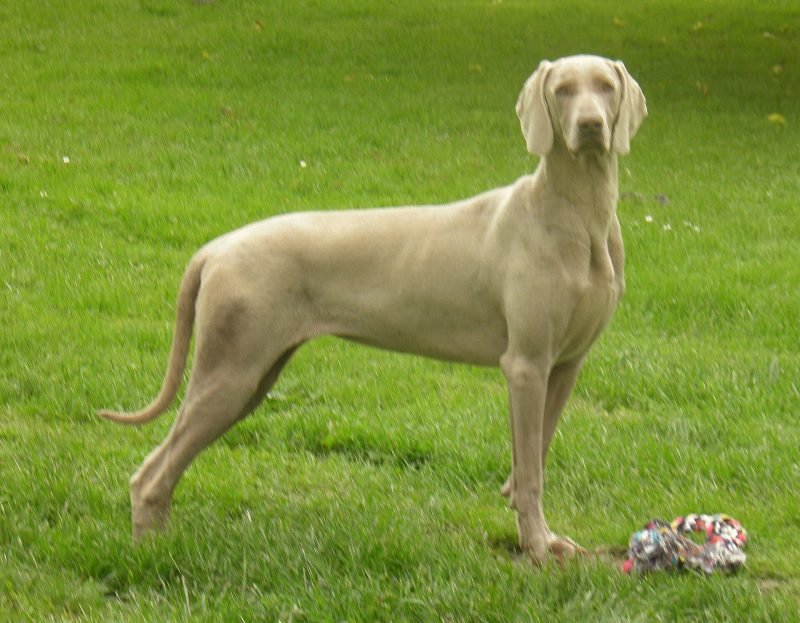
A Weimaraner is a picture of aristocratic athleticism. Males stand 25 to 27 inches and weigh 70 to 90 pounds; females are 23 to 25 inches and 55 to 75 pounds. The dog is moderately long with a deep chest, a straight topline, long muscular legs and a tail traditionally docked in the United States. The head is long with a moderate stop, a prominent occiput and long, slightly folded ears set high. The eyes are the breed's most arresting feature: light amber, gray or blue-gray, set in a face whose nose and lips are gray rather than black.
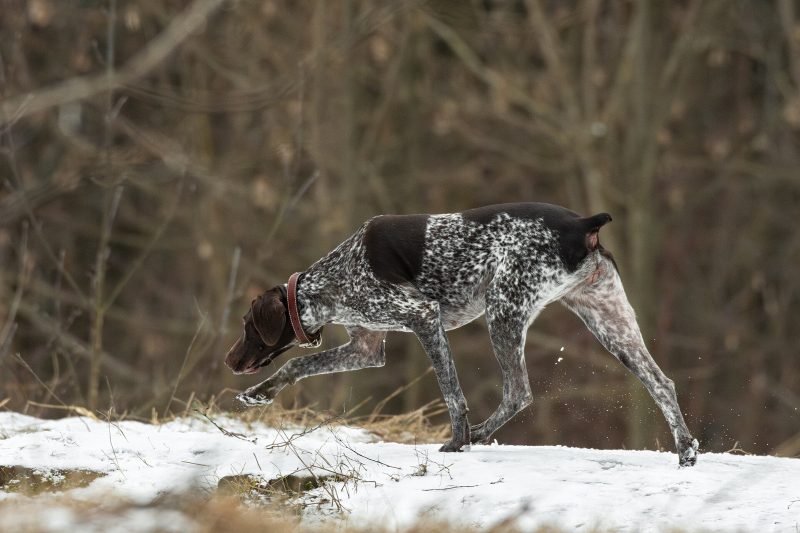
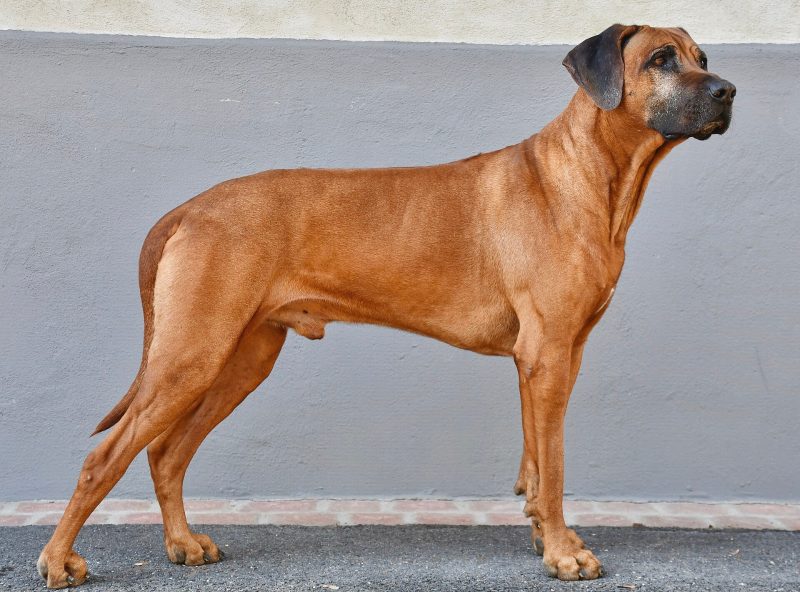
The coat is short, sleek and smooth, in shades of silver gray, mouse gray and charcoal gray, often lighter on the head and ears; a small white chest mark is allowed. A rare longhaired variety is recognized outside the AKC. A Vizsla is rust-red with similar lines; a German Shorthaired Pointer is liver or liver and white with a heavier head.
Temperament & Personality
Weimaraners are affectionate to the point of being clingy. They bond intensely with their family, want to be in the same room, often on the same furniture, and follow their person from room to room; the breed has one of the highest rates of separation anxiety among popular dogs. Indoors a well-exercised adult is calm and watchful; an under-exercised one paces, whines, counter-surfs and takes the house apart. Outdoors the hunting drive is strong, with a high prey instinct toward cats, rabbits, squirrels and birds.
They are generally good with children they live with but can be too boisterous for small ones. With strangers they are moderately reserved and make alert watchdogs; some are protective. Many are fine with familiar dogs but pushy or quarrelsome with strange ones, and cats and small pets are usually unsafe. The breed is intelligent, sensitive and occasionally manipulative, and it needs an owner who is consistent without being harsh.
Exercise & Activity
Plan on two hours of exercise a day for an adult Weimaraner, and make much of it fast: running alongside a bike, long off-leash runs in safe country, swimming, retrieving and hunting or field training. A leash walk is a warm-up, not a workout. Mental exercise matters just as much, and the breed excels at tracking, scent work, agility, rally, obedience, dock diving and field trials. A Weimaraner that has worked its nose and body is a different, calmer dog in the evening.
The short coat gives little protection, so the breed chills in cold rain and winter water and needs a coat in freezing weather. Heat is managed with water and shade.
Puppies need shorter, lower-impact sessions until about 18 months to protect joints.
Boredom looks like digging, fence jumping, chewing furniture and howling.
A secure, tall fence is essential; Weimaraners climb and leap.
Training
Weimaraners learn fast and think for themselves, a combination that rewards a confident, consistent trainer and runs rings around an inconsistent one. Reward-based training with food, retrieving games and praise works best; the breed is sensitive and resents heavy-handed corrections, but it also tests boundaries constantly and needs clear rules enforced calmly every time. Start obedience the week the puppy comes home and keep going for life.
The common sticking points are over-exuberance, including jumping on people and mouthing, pulling on leash, a recall that dissolves when a rabbit appears, and anxiety when left alone. Teach a solid recall with a long line and high-value rewards, and teach being alone in small increments from puppyhood, using a crate and a routine. Socialize broadly with people, dogs and environments. Many owners find a weekly class or a sport is the easiest way to keep this breed's mind busy.
Grooming & Care
Coat care could not be simpler. The short, sleek coat needs a weekly rub-down with a rubber curry or grooming mitt to lift dead hair and bring up the shine, and shedding is moderate and fairly even through the year. Bathe every month or two, or when the dog has rolled in something, with a gentle shampoo; the coat dries in minutes. The light skin can sunburn on the nose and ears in strong sun.
The folded ears trap moisture after swimming and need a check and dry each week. Nails grow fast on dogs that run on grass and need trimming every two to three weeks; the breed is often touchy about its feet, so start handling early.
Brush teeth several times a week.
After field work, check for ticks, burrs and cuts on the pads and in the ears.
Keep a towel by the door; a wet Weimaraner heads straight for the sofa.
Health
Weimaraners are generally robust, with a typical lifespan of 10 to 13 years, but the breed has a distinct list of concerns. Gastric dilatation-volvulus, or bloat, is the most dangerous: know the signs of a swollen, painful abdomen and unproductive retching, and ask your vet about preventive gastropexy. Hip dysplasia is screened by OFA or PennHIP evaluation, and the Weimaraner Club of America also requires an eye exam by a veterinary ophthalmologist for entropion, distichiasis and other eyelid and retinal problems, an autoimmune thyroiditis panel, and DNA tests for hyperuricosuria, hypomyelination and spinal dysraphism for its CHIC program; cardiac and elbow evaluations are optional.
Hypertrophic osteodystrophy, a painful bone inflammation of fast-growing puppies, is reported more in this breed than most and has been linked in the breed's literature to vaccination timing, which is a conversation for your vet. Von Willebrand's disease, mast cell and other tumors, and immune-mediated problems also occur. Keep the dog lean and fit; injuries in the field are a practical risk.
Nutrition
Weimaraners are lean, hard-working dogs and should look it; a visible waist and easily felt ribs are the goal. Feed a complete diet matched to life stage and workload, and expect intake to swing with the season for a dog that hunts or competes. Puppies should eat a large-breed growth food that supports steady rather than rapid growth, which also matters in a breed prone to hypertrophic osteodystrophy; avoid calcium or other supplements unless your vet prescribes them. Ask when to move to adult food, usually around 12 to 18 months.
Bloat precautions are not optional in this deep-chested breed: two or three measured meals a day rather than one, a slow-feeder bowl for gulpers, no hard exercise for an hour before and after eating, and quiet after meals. Some Weimaraners have sensitive stomachs, and food-stealing from counters is a breed habit, so secure the kitchen. Keep water available during and after work and on hot days.
Living With This Breed
A Weimaraner belongs in a house with a large, securely fenced yard and owners who treat exercise as a daily commitment. Apartments and long workdays are a poor fit; the breed's separation anxiety is real and expresses itself through walls, doors and furniture. It must live indoors with its people, tolerates heat reasonably and cold poorly, and will claim the sofa and the bed if permitted.
Older children who enjoy an active dog are good company; toddlers get knocked over. Cats, rabbits and other small pets are generally unsafe. Expect counter-surfing, a dog that leans on you, and a loud, mournful protest when you leave.
Sitters should be fit, experienced with strong sporting dogs and briefed on the separation-anxiety routine.
In-home sitting usually beats boarding for this breed; daycare suits sociable individuals.
Note bloat precautions and the exercise plan in writing.
Interesting Facts
The nickname Gray Ghost comes from the coat color and the breed's habit of appearing silently at your elbow.
Photographer William Wegman has built a career on portraits of his Weimaraners, starting with Man Ray in the 1970s and continuing with Fay Ray and her descendants, dressed and posed as people.
President Dwight Eisenhower's Weimaraner, Heidi, lived at the White House and was eventually sent to the family farm after soiling a valuable rug.
Grace Kelly received a Weimaraner as a wedding gift and took the breed to Monaco.
The German breed club once limited membership and refused to sell dogs abroad; early American imports were reportedly sterilized before shipping to protect the monopoly.
Weimaraner puppies are born with striking pale blue eyes and faint tabby-like stripes that fade within weeks.
Breeds similar to the Weimaraner



What Weimaraner owners say
Real pets, photos, stories and tips from the SitterNation community — separate from the editorial guide above.
Log in to add your pet, photos, stories and tips.
Meet Weimaraners on SitterNation
No Weimaraners have joined yet. Owners can show their pet here from the pet's profile.
Weimaraner community photos
No Weimaraners photos yet — be the first to share one.
Stories from Weimaraner owners
No stories yet. What is life with yours really like?
Tips from Weimaraner owners
No tips yet. One practical thing that works for you is enough.
Ask Weimaraner owners
No questions yet. Ask the people who live with the breed.