Typical tendencies
Energy level
Needs a real outlet most days.
Good with children
Gentle and tolerant around children.
Good with other dogs
Gets along with known, polite dogs.
Trainability
Picks up cues with steady, short sessions.
Shedding
A light scatter, easy to keep up with.
Apartment friendly
Can manage in a flat with plenty of outings.
More traits
Exercise needs
Adaptability
Grooming needs
Drooling
Intelligence
Family friendly
Good with cats
Friendly with strangers
Sociability
Protectiveness
Prey drive
Overview
The Rhodesian Ridgeback is a large, athletic hound from southern Africa, instantly recognizable by the stripe of backward-growing hair along its spine. It was developed to track big game, hold lions at bay and guard the farmstead, and the modern dog is still a serious athlete with a strong protective instinct and a mind of its own. At home it is quiet, clean and affectionate with its family, often more cat-like than clingy.
This is a breed for active, experienced owners. A Ridgeback needs real exercise, a securely fenced yard, early socialization and consistent, fair training from someone it respects. Its prey drive is high, so small pets and off-leash walks in open country are risky. In exchange you get a low-maintenance coat, a dog that can run or hike all day, and a calm, watchful companion that rarely barks without reason. Typical lifespan is 10 to 13 years.
History & Origin
The ridge came from the dogs of the Khoikhoi people of the Cape, who kept ridged hunting and guard dogs long before Europeans arrived. From the 1600s Dutch and other settlers crossed those dogs with the mastiffs, greyhounds, pointers and terriers they brought with them, producing a tough, versatile farm hound. In the 1870s the missionary Charles Helm brought two ridged females north to what became Southern Rhodesia, and the big-game hunter Cornelius van Rooyen bred from them for decades, selecting dogs that could track a lion, harass it from a safe distance and keep it occupied until the hunter arrived.
In 1922 fanciers meeting in Bulawayo under Francis Barnes drew up the first standard, leaning on the Dalmatian standard for its wording, and the South African Kennel Union approved it in 1926. The breed reached Britain in 1928 and the United States in 1950; the American Kennel Club recognized it in 1955. Today the country of origin is Zimbabwe, and the breed is one of the most popular hounds in America.
Appearance
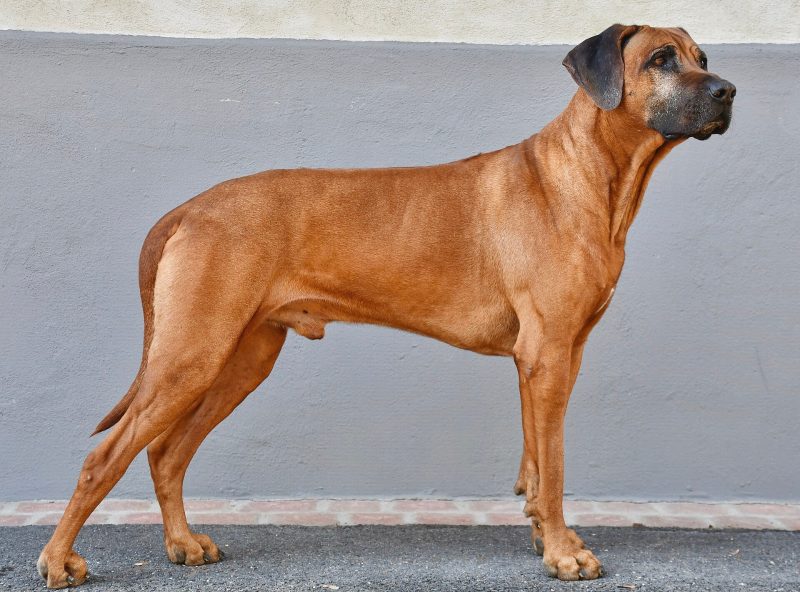
A Ridgeback is a strong, clean-lined hound built for endurance rather than sprinting. Males stand 25 to 27 inches at the shoulder and weigh 80 to 90 pounds; females are 24 to 26 inches and 65 to 75 pounds. The head is flat and fairly broad between the ears, with a long, deep muzzle, a black or liver nose and round eyes that match the coat. Ears are set high and hang close to the head. The chest is deep, the back is strong and the tail tapers to a slight upward curve.
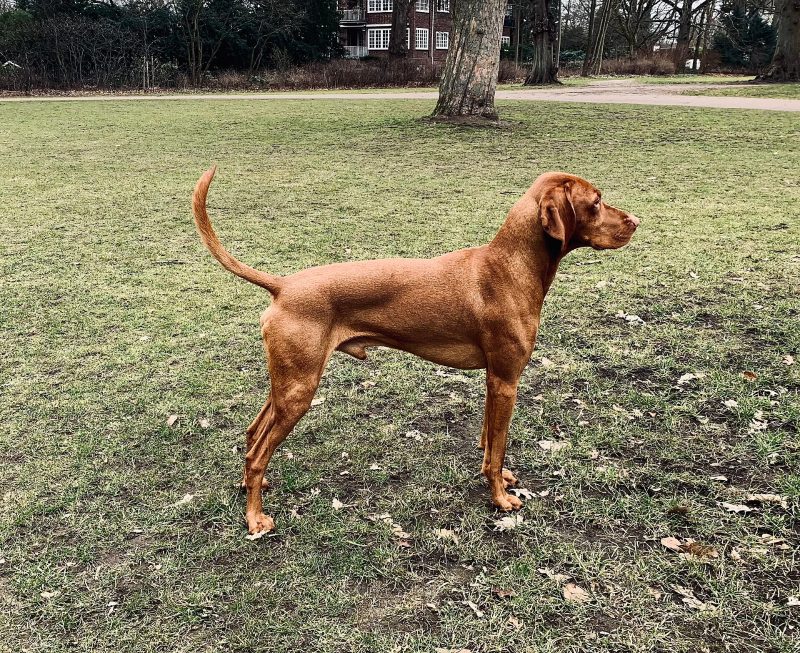
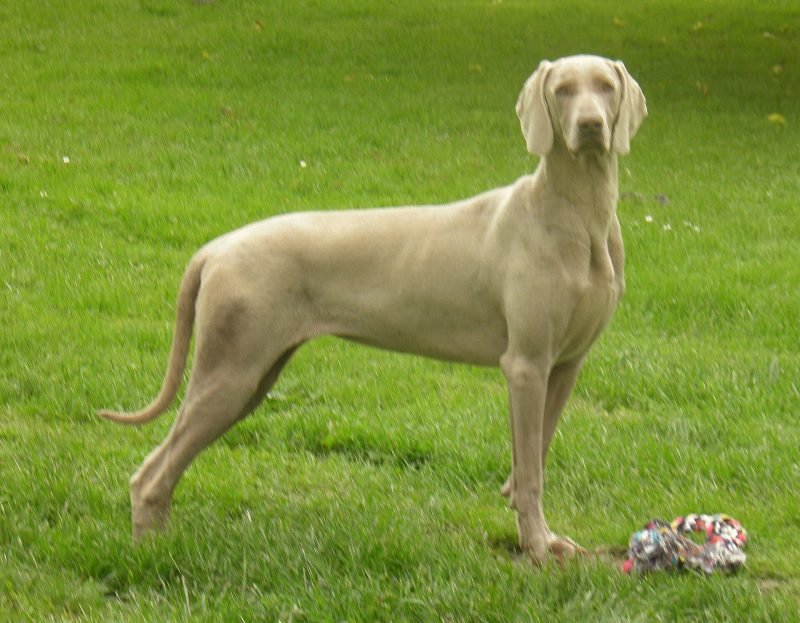
The coat is short, dense and glossy, in shades from pale wheaten to deep red wheaten, sometimes with a dark mask and a little white on the chest and toes. The ridge runs from behind the shoulders to the hips, with two matching whorls, called crowns, at its start. A Vizsla is smaller, rusty-gold and has no ridge; a Weimaraner is gray; a Thai Ridgeback is smaller, square and comes in blue and black.
Temperament & Personality
Ridgebacks are dignified, even-tempered dogs that save their affection for their own people. With family they are loyal and surprisingly cuddly, often leaning against legs or climbing onto laps that are far too small. Indoors they are quiet and clean, happy to sleep for hours once exercised. Outdoors the hound comes out: alert, fast and prone to following a scent or a running animal without looking back.
With strangers the breed is reserved and watchful rather than friendly, and it will guard its home and people with conviction. That protectiveness is an asset only when paired with thorough socialization; an unsocialized Ridgeback can become suspicious and difficult. They are usually fine with children they grow up with, though their size and boisterousness suit older kids better than toddlers. Same-sex dog scuffles are not unusual, and cats and small animals are often treated as prey unless raised together from puppyhood. They are sensitive and resent harsh treatment.
Exercise & Activity
A Ridgeback is an endurance athlete and needs at least an hour of real exercise every day, more as a young adult. Brisk walks are the minimum; what the breed really wants is running, whether alongside a bike, on a trail run or at full stretch in a large, securely fenced area. Lure coursing, agility and tracking all suit it well and give the mind something to do. A Ridgeback that only gets a stroll around the block becomes restless, destructive and hard to live with.
Off-leash exercise in open country is risky because of the breed's prey drive and selective hearing when something is running. Keep puppies to free play and short walks until their joints mature at around 18 months, then build mileage slowly. The thin coat offers little insulation, so the dog needs a coat in cold weather and shade and water in heat.
Boredom shows as digging, counter-surfing and chewing furniture.
Avoid heavy exercise for an hour after meals to reduce bloat risk.
Training
Ridgebacks are intelligent and learn quickly, but they are independent hounds that see no point in repeating an exercise they have already mastered. Training works best when it is short, varied and rewarding, with food, play and praise rather than force; the breed is thin-skinned under its tough exterior and shuts down or digs in when pushed. Establish house rules early and keep them, because a 90-pound dog that has learned to ignore you is a real problem.
Socialization is the other half of the job. Expose puppies calmly to visitors, children, other dogs, traffic and handling, and keep it up through adolescence, so the adult's natural reserve becomes polite indifference rather than suspicion. Recall is the classic sticking point: practice it relentlessly with high-value rewards and still use a long line in open spaces. Adolescent males can test boundaries around 12 to 24 months. A patient, consistent owner ends up with a dog that is calm, mannerly and a pleasure to take anywhere.
Grooming & Care
This is one of the easiest coats to keep. A weekly rub-down with a rubber curry or hound glove lifts dead hair and leaves the coat gleaming, and most owners do a little extra during the modest spring and fall sheds. Bathe only when the dog is actually dirty; the short coat holds little odor. Ridgebacks are fastidious and often clean themselves like cats.
The ridge needs no special care, but run your fingers along it occasionally to check for lumps, which can indicate a dermoid sinus in a young dog. Check the hanging ears weekly and clean them if waxy. Nails grow fast and wear down only on hard surfaces, so expect to trim every two to three weeks. Brush teeth a few times a week.
Shedding is light but the short hairs weave into fabric.
Thin coat and little body fat mean a jacket in cold weather.
No professional grooming needed beyond nails if you prefer not to do them.
Health
Ridgebacks are generally robust, but a few conditions are closely tied to the breed. Dermoid sinus is a tube-like skin defect along the neck or spine, present at birth and linked to the same gene that produces the ridge; good breeders check every puppy by hand and remove affected sinuses surgically. Hypothyroidism caused by autoimmune thyroiditis is common enough that the parent club recommends a full thyroid panel every year through middle age. Hip and elbow dysplasia occur, as in most large breeds. Three recessive disorders now have DNA tests: juvenile myoclonic epilepsy, early-onset adult deafness and degenerative myelopathy. Bloat is a risk in any deep-chested dog.
The Rhodesian Ridgeback Club of the United States recommends hip and elbow radiographs, annual eye exams, thyroid testing, BAER hearing tests after one year of age and the DNA panel for breeding stock. Typical lifespan is 10 to 13 years. See your vet promptly for a swollen, painful belly, seizures, unexplained weight gain or hearing loss in a young dog.
Nutrition
A Ridgeback should look lean and muscular, with the last ribs just visible when the dog moves and easy to feel at rest. Puppies belong on a large-breed growth food that moderates calcium and calories so the skeleton develops at a sensible pace. Keep growing dogs slim; extra weight on a fast-growing puppy loads joints that are not yet ready for it.
Adults are efficient converters of food, and many gain weight easily once they are neutered or slow down, so measure meals and adjust for activity. Two meals a day are better than one, and because the breed is deep-chested, avoid feeding right before or after hard exercise. Ask your vet whether a slow-feed bowl or a preventive gastropexy is worth considering. Ridgebacks are notorious counter-surfers, so keep food out of reach. Dogs diagnosed with hypothyroidism may need calorie adjustments alongside their treatment, which your vet will manage. Fresh water should always be available, especially after running.
Living With This Breed
A Ridgeback needs a house with a secure fence more than a mansion; what it cannot do without is daily hard exercise and an owner with time. Apartments work only for very committed runners. The breed is clean, quiet and sheds little, so it is an easy housemate once its needs are met. It dislikes cold and wet and will happily take over the sofa.
Ridgebacks bond closely and can struggle with long hours alone; many adults manage a workday but adolescents often cannot without trouble. They are good with respectful older children, mixed with cats unless raised together, and best as the only dog or with the opposite sex.
Sitters should keep the dog leashed outside fenced areas; prey drive overrides recall.
Introduce strangers calmly; the dog decides when it is ready to be friendly.
Daycare needs careful group selection; many Ridgebacks prefer a small, familiar pack.
Counter-surfing is practically a breed trait; clear the kitchen.
Interesting Facts
The ridge is caused by a dominant gene: dogs with two copies run a higher risk of dermoid sinus, while puppies that inherit no copy are born ridgeless.
Despite the old nickname "African Lion Hound," Ridgebacks never fought lions; they worked in small packs to harass and hold a lion until the hunter arrived.
Only two other breeds carry a ridge: the Thai Ridgeback and the rare Phu Quoc Ridgeback of Vietnam.
Actor Patrick Swayze and Princess Charlene of Monaco have both been devoted Ridgeback owners.
The first breed standard, written in 1922, borrowed heavily from the Dalmatian standard because its author liked the wording.
Liver-nosed Ridgebacks, with brown noses and amber eyes, are a correct and long-established color variant.
Breeds similar to the Rhodesian Ridgeback
What Rhodesian Ridgeback owners say
Real pets, photos, stories and tips from the SitterNation community — separate from the editorial guide above.
Log in to add your pet, photos, stories and tips.
Meet Rhodesian Ridgebacks on SitterNation
No Rhodesian Ridgebacks have joined yet. Owners can show their pet here from the pet's profile.
Rhodesian Ridgeback community photos
No Rhodesian Ridgebacks photos yet — be the first to share one.
Stories from Rhodesian Ridgeback owners
No stories yet. What is life with yours really like?
Tips from Rhodesian Ridgeback owners
No tips yet. One practical thing that works for you is enough.
Ask Rhodesian Ridgeback owners
No questions yet. Ask the people who live with the breed.