Typical tendencies
Energy level
Always on; boredom turns into mischief.
Good with children
Patient with kids when well supervised.
Good with other dogs
Enjoys most canine company.
Trainability
Learns, but on its own schedule.
Shedding
Fur on everything, all year round.
Apartment friendly
Fine in a flat if exercise is kept up.
More traits
Exercise needs
Adaptability
Grooming needs
Drooling
Intelligence
Family friendly
Good with cats
Friendly with strangers
Sociability
Protectiveness
Prey drive
Overview
The Pomsky is a Pomeranian crossed with a Siberian Husky, usually a Husky mother bred to a Pomeranian father by artificial insemination, producing a dog that looks like a Husky shrunk to 15 to 30 pounds. It suits active, experienced owners who love northern breeds, can commit to daily exercise and heavy grooming, and are amused rather than annoyed by a talkative, opinionated dog. It is not a good first dog, a quiet apartment dog or a low-maintenance pet.
As a cross with no standard and no kennel-club recognition, the Pomsky is unpredictable: puppies from one litter can land anywhere between a 10-pound fluff ball and a 30-pound mini Husky, with temperaments to match. It sheds heavily, needs real exercise and mental work, has a strong prey drive and a talent for escape, and asks for consistent, patient training from someone who already knows how to live with a spitz-type dog.
History & Origin
The Pomsky is one of the newest designer crosses. Photos of a supposed Pomeranian-Husky puppy went viral in 2011; the pictures were actually of another breed, but the demand they created was real. The first documented, deliberately bred litter followed in 2012 in Arizona, produced by artificial insemination with a Siberian Husky dam and a Pomeranian sire, because natural mating between a toy male and a medium-size female is impractical and a Pomeranian carrying Husky-sized puppies would be dangerous. Breeding spread across the United States during the 2010s.
No kennel club recognizes the Pomsky. The American Kennel Club, The Kennel Club and the FCI register only the two parent breeds, and there is no official standard. Breeder-run groups such as the Pomsky Club of America and the International Pomsky Association publish their own guidelines and codes of ethics and encourage health testing of parents; membership is a useful signal but not a guarantee.
Appearance
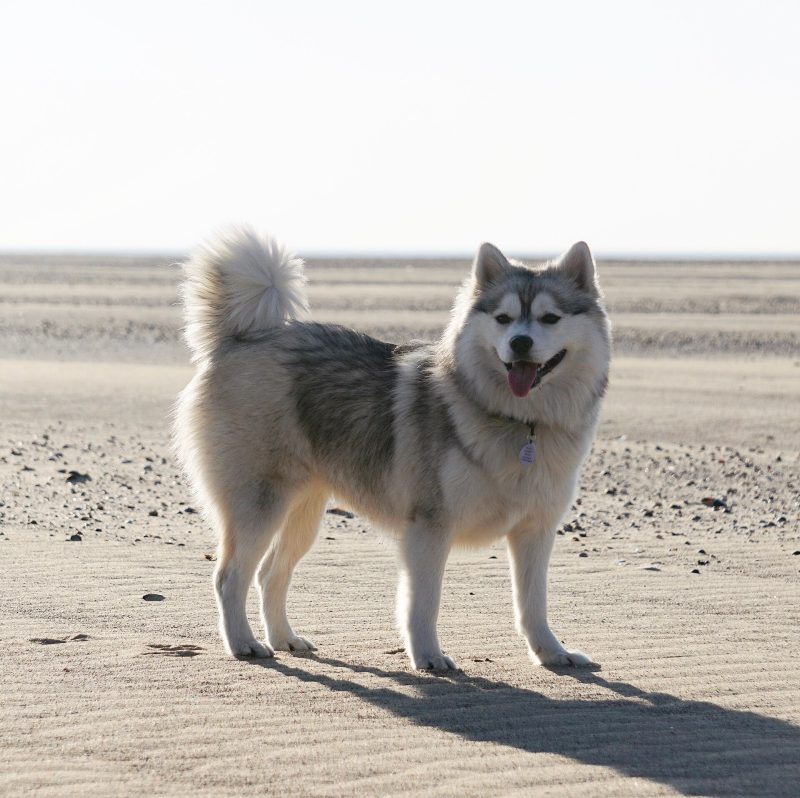
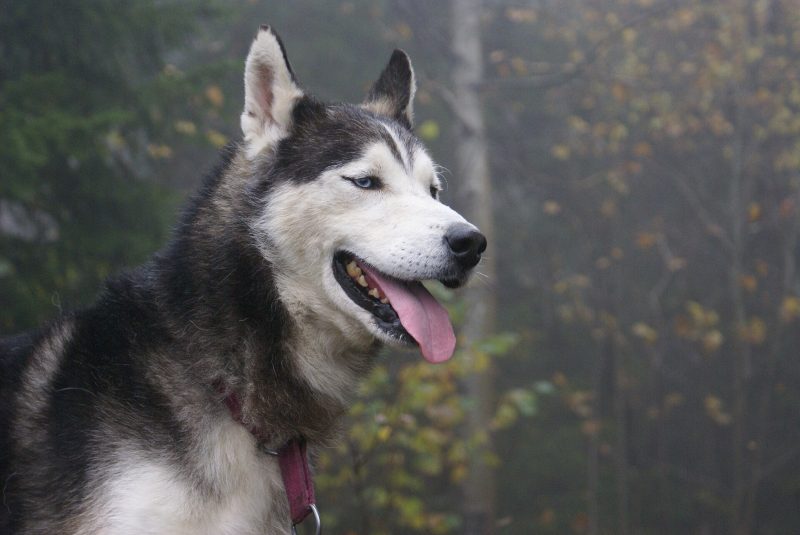
A typical Pomsky looks like a Siberian Husky at half scale: erect ears, a wedge-shaped head, often with a Husky mask and sometimes with blue eyes, and a plumed tail carried over the back. Height is about 10 to 15 inches; males weigh 20 to 30 pounds and females 15 to 25. Because the parents differ so much in size, the range within a litter is wide, and first-generation puppies are harder to predict than those from Pomsky-to-Pomsky pairings.
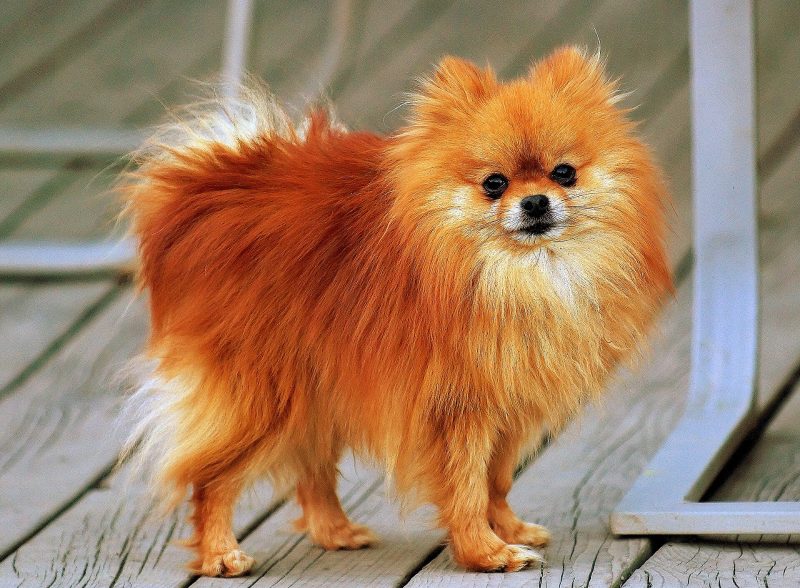
The coat is a thick, fluffy double coat of medium length that sheds heavily. Grey and white is the classic color, followed by black and white, red, brown and merle. Merle is not found in purebred Siberian Huskies, so in a Pomsky it comes from the Pomeranian side, where it is an accepted color. Compared with a Pomeranian, a Pomsky is larger, longer-legged and masked; compared with a Husky it is smaller, fluffier and often rounder in the face. Some Pomskies look more Pomeranian, with a foxy muzzle and a very full ruff.
Temperament & Personality
Pomskies are lively, clever and vocal. The Husky side brings a friendly, playful, independent nature, a love of running and a wide repertoire of howls and talking; the Pomeranian side brings alertness, a big-dog attitude and a tendency to bark at anything that moves. Indoors a well-exercised Pomsky is affectionate and playful; an underexercised one is a whirlwind that chews, digs and sings.
Most are devoted to their family and friendly or at least polite with strangers once introduced. They usually get along with other dogs but have a strong prey drive, so cats and small pets are a poor fit unless raised together and still supervised. With children they do best in homes where the kids are older and calm; a bouncy, mouthy adolescent and a toddler are a bad combination. Temperament varies by generation and even within a litter, so meet the parents and ask the breeder which side a puppy favors.
Exercise & Activity
Plan on at least an hour of activity a day: a brisk walk or jog, off-leash running in a securely fenced area and play that uses the brain. A Pomsky bred from a working sled-dog line has stamina out of proportion to its size and will happily hike for hours. Cold weather is a delight for this double-coated dog; heat is the hazard, so in summer shift exercise to early and late and watch for heavy panting.
Mental work matters as much as mileage. Scent games, puzzle feeders, trick training and canine sports such as agility channel the energy. A bored Pomsky howls, digs under fences, shreds cushions and escapes to run the neighborhood.
Never trust recall off leash in open country; Huskies are famous for running and Pomskies inherit it.
Use a well-fitted harness and double-check gates; many are escape artists.
On short-exercise days, add a food puzzle or training session.
Training
Pomskies are intelligent but independent, and the Husky side in particular sees little point in repeating a cue it already understands. Reward-based training with varied, high-value rewards and short, upbeat sessions works best; repetition bores them and harsh handling makes them stubborn. Start early and keep going, because this is a dog that needs rules and routine to be pleasant to live with.
Typical sticking points are recall, which may never be reliable off leash, leash pulling, barking and howling, and mouthiness in adolescence. Crate training and a settle cue help with the noise. Prey drive needs a solid leave-it and a leash around small animals. Socialize puppies widely between 8 and 16 weeks to people, dogs, handling, grooming tools and car travel; Pomeranian genes can produce a suspicious, yappy adult without it. Many Pomskies excel at agility, trick training, scent work and even weight-free canicross with their owners.
Grooming & Care
The thick double coat sheds all year and blows out heavily twice a year, when loose undercoat comes away in handfuls. Brush two or three times a week with a slicker brush and an undercoat rake, and every day during shedding seasons. Bathe every six to eight weeks or when dirty, and dry the coat thoroughly, because damp undercoat can lead to skin irritation. Do not shave a Pomsky; the double coat insulates against heat as well as cold and often grows back patchy.
Check the ears weekly, trim nails every three to four weeks and brush teeth several times a week, since Pomeranian genes bring crowded teeth and early dental disease.
Ask a professional groomer for a de-shedding treatment during coat blows.
Keep hair between the paw pads trimmed in winter to stop ice balls forming.
Watch for thinning coat or symmetrical hair loss, and mention it to your vet.
Health
Pomskies can inherit conditions from both parents, and the cross is too new and too varied for breed-wide statistics. From the Pomeranian come patellar luxation, which is more common in Pomeranians than in almost any other breed, collapsing trachea, dental disease, alopecia X (a patchy coat loss) and, in tiny puppies, low blood sugar. From the Siberian Husky come hereditary cataracts, juvenile glaucoma, corneal dystrophy, progressive retinal atrophy, hip dysplasia, hypothyroidism, zinc-responsive skin disease and an inherited polyneuropathy.
Ask a breeder for veterinary patellar evaluations and ACVO eye exams on both parents, an OFA hip result on the Husky, a cardiac evaluation, and DNA tests for Husky polyneuropathy and shaking puppy syndrome where available. Merle puppies should come only from one merle parent; merle-to-merle breeding risks deaf and blind puppies, and a BAER hearing test is sensible for any merle. Lifespan is usually 12 to 15 years. See your vet for a skipping hind leg, a honking cough, cloudy eyes, limping or sudden coat loss.
Nutrition
A Pomsky's appetite is more Husky than Pomeranian: northern breeds evolved to work hard on relatively little food, so many Pomskies eat less than their activity suggests and some are picky. Feed a quality puppy food in three meals a day until about six months, then two measured meals a day for life; ask your vet when to switch to adult food, usually around a year. Smaller, Pomeranian-leaning puppies can be prone to low blood sugar if meals are skipped.
Adjust portions to body condition, not to the bag. Under the fluff you should be able to feel ribs easily; a thick coat hides weight gain, so run your hands over the dog monthly. Extra weight stresses the small knees and the windpipe. Because the Husky side can carry a zinc-absorption problem that shows up as crusty skin, mention any skin changes to your vet before trying supplements on your own. Fresh water should always be available, especially after exercise in warm weather.
Living With This Breed
A Pomsky needs an active home, ideally a house with a securely fenced yard and owners who hike, run or train. It can live in an apartment only with a lot of daily exercise and a tolerance for noise; Pomskies howl, talk and bark, and neighbors will hear it. Cold climates are perfect; hot ones require air-conditioning and careful scheduling. Long days alone go badly and often end in a shredded sofa.
Families with older children and other dogs usually suit it well. Cats and small pets are a risk. Fences should be high, dig-proof and gate-latched, because escape is a hobby.
For sitters: walks on leash and harness only, and check every gate before letting the dog out.
Expect vocalizing, especially at departures; a stuffed food toy helps.
Brush daily during a stay in shedding season to keep the coat and the house under control.
Interesting Facts
The Pomsky craze began with a 2011 internet hoax: the viral photos of a tiny Husky-like puppy showed a different breed, yet the demand produced real litters within a year.
Almost every Pomsky comes from a Husky mother and a Pomeranian father, bred by artificial insemination; the reverse pairing would be dangerous for a Pomeranian dam.
Its parents share spitz ancestry: the Pomeranian descends from large German sled-type dogs that were bred down in the 1800s, so the cross reunites distant cousins.
Many Pomskies inherit the Husky habit of talking back in howls and grumbles instead of barking.
Blue eyes, odd eyes and the Husky mask all show up in Pomskies, along with Pomeranian-style ruffs.
There is no fixed size: one litter can hold a 10-pound and a 30-pound sibling.
What Pomsky owners say
Real pets, photos, stories and tips from the SitterNation community — separate from the editorial guide above.
Log in to add your pet, photos, stories and tips.
Meet Pomskys on SitterNation
No Pomskys have joined yet. Owners can show their pet here from the pet's profile.
Pomsky community photos
No Pomskys photos yet — be the first to share one.
Stories from Pomsky owners
No stories yet. What is life with yours really like?
Tips from Pomsky owners
No tips yet. One practical thing that works for you is enough.
Ask Pomsky owners
No questions yet. Ask the people who live with the breed.