Typical tendencies
Energy level
Needs a real outlet most days.
Good with children
Gentle and tolerant around children.
Good with other dogs
Enjoys most canine company.
Trainability
Quick to learn and keen to please.
Shedding
A light scatter, easy to keep up with.
Apartment friendly
Can manage in a flat with plenty of outings.
More traits
Exercise needs
Adaptability
Grooming needs
Drooling
Intelligence
Family friendly
Good with cats
Friendly with strangers
Sociability
Protectiveness
Prey drive
Overview
The Wirehaired Pointing Griffon is a bearded, tousled gundog built to hunt close to a walking hunter in any cover, and at home it is one of the most affectionate and biddable of the sporting breeds. It suits active people who hike, run, hunt or compete in dog sports and who want a dog that is calm indoors once it has worked. Griffs bond closely, dislike being left out, and are gentle with children and friendly with other dogs.
Their coat is low-shedding but not low-maintenance, and their energy is real: an unexercised Griffon is a restless, vocal and inventive one. They are a poor fit for sedentary homes, apartments without serious daily outings, or households with free-roaming small pets. For an outdoorsy family that wants a scruffy, soft-eyed partner who will do anything you suggest, there are few better choices.
History & Origin
The Griffon is the creation of one man. Eduard Karel Korthals, born in Amsterdam in 1851, set out in the 1870s to build the ideal walking hunter's dog: hardy, close-working, able to point and retrieve on land and water in rough terrain. Starting with a rough-coated bitch named Mouche in 1874 and a handful of other griffon-type dogs, he bred and selected ruthlessly, moving his kennel to Germany in 1877 and traveling France and Belgium to promote the breed. Three dogs from his early generations, Moustache I, Lina and Querida, are known as the Korthals Patriarchs and stand behind the modern breed.
An international club was founded in 1888, two years after Korthals published his standard. In the United States, a bitch named Zolette was entered in the AKC studbook in 1887, and the first American club formed in 1916. After decades of obscurity the breed grew steadily from the 1980s, and in 1991 the AKC recognized the American Wirehaired Pointing Griffon Association as the parent club.
Appearance
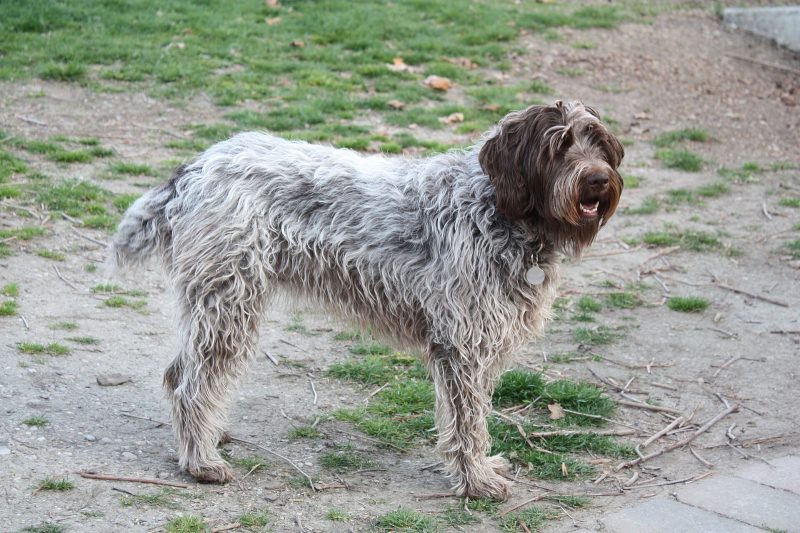
A Griffon is a medium-sized, slightly rectangular gundog, with males 22 to 24 inches and 50 to 70 pounds, and females 20 to 22 inches and 35 to 50 pounds. The outline is athletic rather than heavy, with a level back and a tail usually docked where allowed or carried straight. The head is long and framed by bushy eyebrows, a mustache and a beard that give a wise, slightly comic expression; the eyes are large and yellow to brown, and the ears are medium, flat and set at eye level.
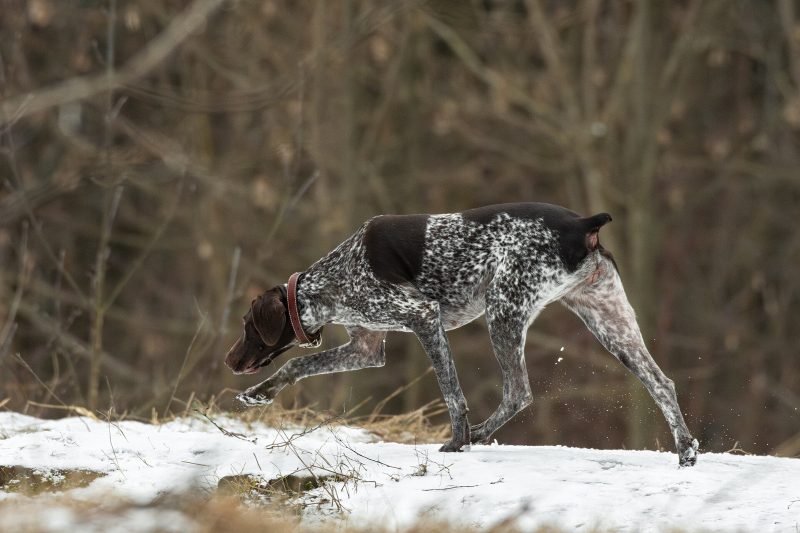
The coat is the signature: a harsh, wiry outer coat about finger length over a dense, water-resistant undercoat, never curly or woolly. The preferred color is steel gray with brown patches, with chestnut brown, brown roan, and white with brown or orange also seen. The German Wirehaired Pointer is similar but larger, sleeker and more often liver and white; the Spinone Italiano is heavier with a longer, softer coat.
Temperament & Personality
Griffons are gentle, devoted and a little goofy. They want to be with their people, prefer to lean against someone on the couch, and can become anxious or noisy if routinely left out of family life. They are outgoing with visitors after a quick check, rarely aggressive, and are reliable with children, though an excited young Griffon can knock a small child over. With other dogs they are friendly and playful, and they generally live well with household cats introduced early, although rabbits, chickens and other small animals trigger the hunting instinct.
Outdoors they are focused and methodical, quartering with their nose down and pointing anything that smells like a bird; indoors, after exercise, they are calm. They are sensitive to tone of voice and want to please, which makes them forgiving to train but easy to hurt with harshness. Expect a dog that watches you constantly and reads your moods.
Exercise & Activity
An adult Griffon needs at least an hour of real exercise a day, and more is better: off-leash running in safe areas, swimming, hiking, jogging alongside a bike once mature, and field work or sports such as hunt tests, agility, dock diving and nose work. A leash walk around the block is a warm-up, not a workout. Because they were bred to stay within gun range, most Griffons check in naturally and have better recall than many sporting breeds, but birds and rabbits will still test it.
Give them scent games, retrieving and problem-solving every day; this breed gets as tired from using its nose as from running. Keep puppy exercise free-form and short until the growth plates close, around 14 to 18 months, and avoid repetitive jumping. The coat handles cold, rain and water well, but they can overheat on hot days, so swim or walk early.
60 to 120 minutes daily, with off-leash running
Scent work, retrieving and training count
Avoid forced running and jumping in puppies
Training
Griffons are among the easiest sporting dogs to train because they care what you think. They learn quickly with food, retrieving games and praise, and they generalize well. The flip side is sensitivity: raised voices, leash corrections and frustration shut them down, so stay calm and set them up to succeed. Housetraining and crate training usually go smoothly.
The common sticking points are adolescent selective hearing when a bird is in the air, jumping up in greeting, and velcro behavior that can turn into separation anxiety if independence is not taught early. Practice short, cheerful absences and reward calm settling. Socialize widely with people, dogs, surfaces and noises; a Griffon that meets the world as a puppy is steady for life. Many owners take advantage of the breed's natural pointing and retrieving with hunt tests or field training, which gives the dog an outlet and the handler a focused partner. Keep sessions varied and stop while the dog still wants more.
Grooming & Care
The Griffon's harsh coat sheds little but needs regular work to stay harsh. Brush thoroughly once or twice a week with a slicker and a metal comb, working through the furnishings on the legs, the beard and the eyebrows where mats and burrs collect. Every few months, strip out the dead outer coat by hand or with a stripping stone to keep the texture wiry and weatherproof; clipping is faster but softens the coat and lets it hold water and dirt. Keep the hair between the paw pads trimmed and tidy the ears and head lightly.
Bathe only when needed, since frequent shampooing strips the protective oils. The beard soaks up water and food and will drip across your floors; a quick towel after drinks helps. Check ears weekly, especially after swimming, and dry them. Trim nails every two to three weeks and brush teeth several times a week.
Brush 1 to 2 times a week; hand-strip 2 to 3 times a year
Dry the ears after swimming
Low shedding, but the beard is messy
Health
Wirehaired Pointing Griffons are a generally healthy breed with a lifespan of 12 to 15 years, and the parent club has avoided the worst of the inherited diseases seen elsewhere. The club's screening program asks breeders to certify hips and elbows for dysplasia, eyes by a veterinary ophthalmologist and thyroid function, and to register results with the OFA. Hip dysplasia is the most common orthopedic concern; elbow dysplasia appears less often. Eye problems include entropion and ectropion, where the eyelid rolls in or out and irritates the eye, as well as occasional cataracts. Hypothyroidism occurs and is easy to test for.
Like other deep-chested breeds, Griffons can suffer gastric dilatation and volvulus, or bloat, which is an emergency. Ear infections are common in dogs that swim, and field dogs pick up cuts, foxtails and ticks. Ask breeders for OFA numbers for both parents, and ask your vet about joint care, tick prevention and weight management as the dog ages.
Nutrition
Feed a Griffon a complete diet for its life stage in two measured meals a day. Puppies should eat a large-breed growth formula with controlled calcium to protect developing joints, three meals a day until about six months and then two. Adult needs vary enormously with work: a hunting dog in season may need half again as much food as the same dog lounging through summer, so adjust portions to body condition rather than feeding a fixed scoop year-round. You should feel ribs easily under the coat and see a waist.
Because bloat is a risk in deep-chested dogs, avoid one large meal, do not exercise hard right before or after eating, and ask your vet whether a preventive gastropexy makes sense at the time of neutering. Working dogs benefit from a higher-fat performance food during hunting season. Keep training treats small, and provide fresh water always, especially after swimming or field work.
Living With This Breed
Griffons are house dogs that want to sleep where you sleep and ride where you ride. They do best in a home with a fenced yard and access to open country or water, and they can manage in an apartment only with a dedicated runner or hunter. They tolerate cold and wet weather cheerfully and heat less well. Left alone all day without exercise they get noisy and destructive, and some develop separation anxiety, so arrange a midday walker if you work long hours. They are good with children and with other dogs, and generally fine with resident cats. Fences need to be secure, but Griffons are not notable escape artists.
A sitter should know the dog's exercise routine, that it may try to bring them a sock or shoe in greeting, how it does when alone, and that the beard needs a towel. Griffons usually thrive in daycare and with active sitters who hike.
House with yard and nearby trails or water is ideal
Not for long solitary days without exercise
Sociable with sitters, other dogs and daycare
Interesting Facts
Eduard Korthals kept detailed breeding records and produced the whole breed from a handful of founders in about 20 years; dogs from his lines are still called Korthals Griffons in Europe.
A Griffon named Zolette appeared in the AKC studbook in 1887, listed as a Russian Setter (Griffon), because no one knew what else to call her.
The beard and eyebrows are not decoration; they protect the face from thorns and briars when the dog pushes through heavy cover.
Fanciers call the Griffon the supreme gundog for its habit of working within shotgun range rather than ranging far ahead.
The first American breed club formed in 1916, and sixteen Griffons were shown at Westminster that year.
Owners often describe the breed's expression as that of a kindly, slightly bewildered professor.
Breeds similar to the Wirehaired Pointing Griffon
What Wirehaired Pointing Griffon owners say
Real pets, photos, stories and tips from the SitterNation community — separate from the editorial guide above.
Log in to add your pet, photos, stories and tips.
Meet Wirehaired Pointing Griffons on SitterNation
No Wirehaired Pointing Griffons have joined yet. Owners can show their pet here from the pet's profile.
Wirehaired Pointing Griffon community photos
No Wirehaired Pointing Griffons photos yet — be the first to share one.
Stories from Wirehaired Pointing Griffon owners
No stories yet. What is life with yours really like?
Tips from Wirehaired Pointing Griffon owners
No tips yet. One practical thing that works for you is enough.
Ask Wirehaired Pointing Griffon owners
No questions yet. Ask the people who live with the breed.