Typical tendencies
Energy level
Always on; boredom turns into mischief.
Good with children
Gentle and tolerant around children.
Good with other pets
Easygoing with most household animals.
Shedding
A light scatter, easy to keep up with.
Vocalization
Speaks up only when something matters.
Sociability
Follows the household from room to room.
More traits
Exercise needs
Adaptability
Grooming needs
Trainability
Intelligence
Family friendly
Friendly with strangers
Apartment friendly
Overview
The Abyssinian is a lean, ticked-coated athlete that looks like a small wild cat and behaves like a perpetual explorer. Males weigh 8 to 12 pounds and females 6 to 8, and the breed lives 12 to 15 years. Abys suit active people who want a cat that participates in everything, climbs to the top of every bookcase and learns tricks for fun. They are a poor match for someone who wants a lap cat that sleeps all day, a home with fragile ornaments, or a household where the cat would be alone and bored for long hours. Grooming is minimal, but entertainment needs are high. Give an Aby tall furniture, puzzle toys, a companion and a daily game, and you get a loyal, intelligent, endlessly curious cat with a coat that glows like a fox's.
History & Origin
The breed's name points to Abyssinia, now Ethiopia, because the first cat of the type exhibited in Britain, a ticked female called Zula, was said to have been brought home by a soldier after the 1868 expedition there. Zula appeared in a book of 1874, and ticked cats were shown at the Crystal Palace in the 1870s. Whether Zula's descendants survive in today's breed is uncertain, and genetic studies now place the ancestry of the ticked coat along the Indian Ocean coast and in Southeast Asia, with the breed itself developed in England from the 1860s onward by crossing imported ticked cats with British tabbies. A written standard existed by 1889. Abyssinians reached the United States in the early 1900s and were among the breeds CFA registered at its founding in 1906, though serious American breeding began in the 1930s. The GCCF recognized the breed in 1929. Both world wars nearly wiped out British stock, and postwar imports from America and Europe rebuilt it. Today the Aby is consistently among the most popular shorthaired breeds.
Appearance
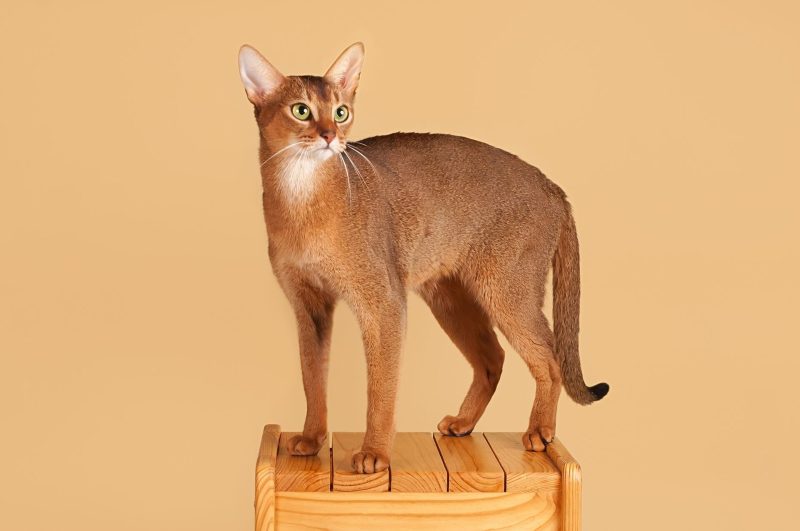
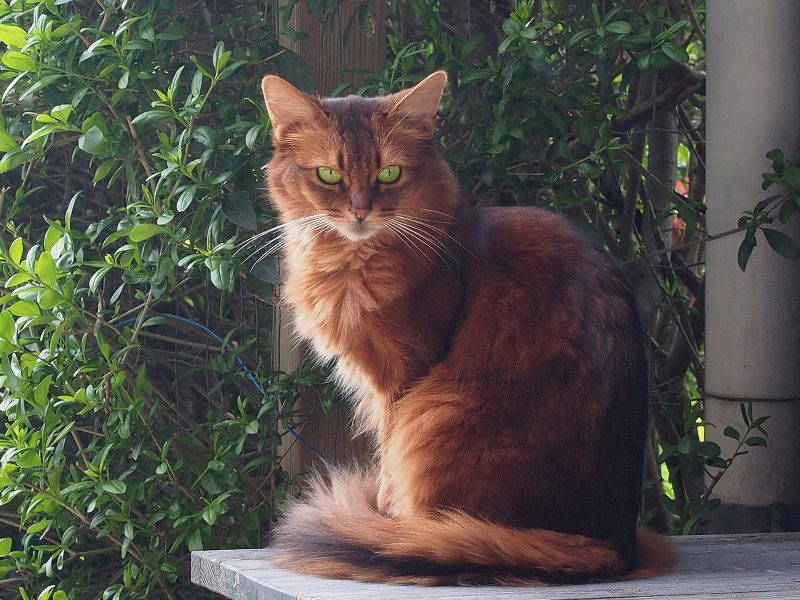
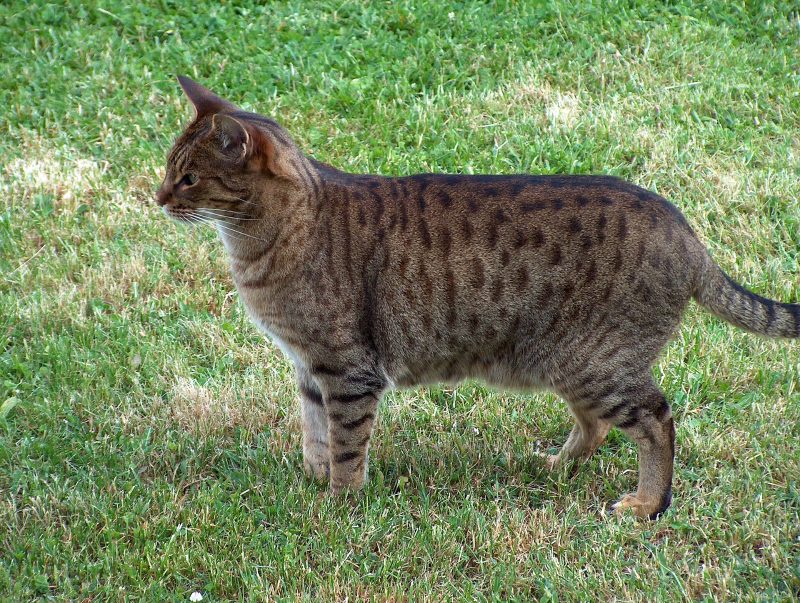
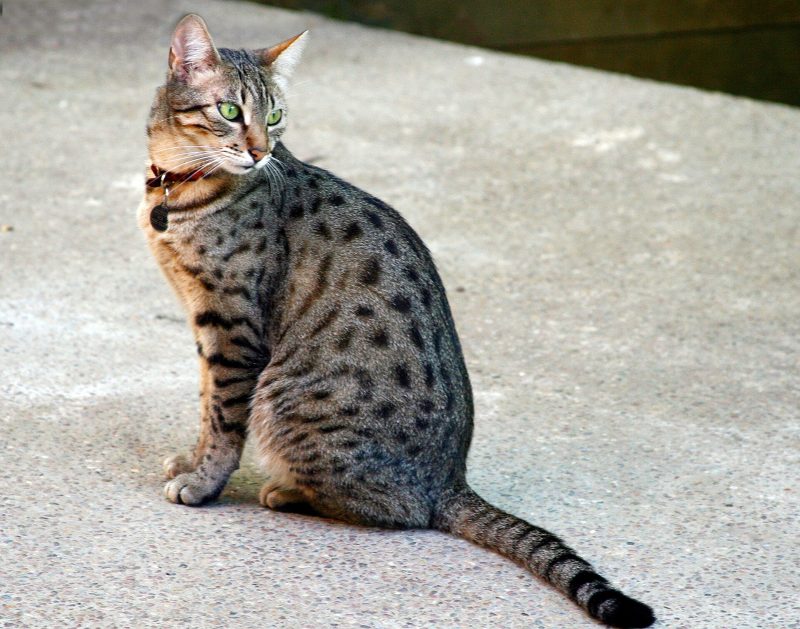
An Abyssinian looks like it is standing on tiptoe, ready to go. The body is medium-sized, lithe and muscular, with long, slim legs, small oval paws and a long tapering tail; it is neither as slender as a Siamese nor as cobby as a British Shorthair. The head is a gently rounded wedge on an arched neck, with large, cupped, alert ears, often tufted, and large almond-shaped eyes in gold or green, outlined in dark pigment as if with eyeliner. The defining feature is the coat: short, fine and close-lying, with each hair banded in four or more alternating light and dark bands, called ticking, so the cat shimmers rather than shows stripes. Ruddy, a warm burnt orange ticked with black, is the original color; red, also called sorrel, is ticked with chocolate brown; blue and fawn are the dilutes, and some registries accept silvers and chocolate. The Somali is a longhaired Abyssinian; the Ocicat is spotted.
Temperament & Personality
Abyssinians are busy, clever and intensely interested in whatever you are doing. A typical Aby sits on top of the door, supervises the kitchen from the refrigerator and follows you to the bathroom to inspect the sink. They are affectionate but not cuddly: a few seconds in a lap, a head-butt, then off to the next project. Most dislike being held and will squirm free. They bond closely with their people and greet visitors with curiosity. With children they are playful, provided the children let them come and go; with dogs they are often fast friends, and with other cats they do well, especially another active breed. The voice is quiet, a soft chirrup. Energy is high indoors and out, and an Aby left without stimulation becomes destructive or anxious. They are watchful in the sense of noticing everything, but not territorial or aggressive.
Exercise & Activity
An Abyssinian needs more exercise than almost any other breed: at least 30 to 45 minutes of active play every day, spread over several sessions, plus an environment that keeps it busy in between. Vertical space is essential; the tallest cat tree you can fit, wall shelves and a clear path along the tops of cupboards will all be used. Wand toys with fast, erratic movement, fetch with small balls, puzzle feeders, treat hunts and motorized toys suit the breed. Many Abys enjoy harness walks and a catio, and some play in water. Rotate toys so nothing goes stale. The short coat gives little protection from cold, so keep outdoor time brief in winter. A bored Aby opens drawers, shreds paper, knocks things off shelves and wakes the house at four in the morning.
Several active play sessions daily, with climbing and fetch
Tall furniture, puzzle feeders and a window view
Rotate toys; novelty matters to this breed
Training
Abys are quick, willing learners that treat training as a game. Clicker training works brilliantly: come, sit, spin, fetch, jumping between stools and ringing a bell are all realistic, and the mental work takes the edge off their energy. Keep sessions short and fast-paced; a bored Aby walks off. Litter training is reliable, but a cat that moves this fast needs boxes on each floor and a daily scoop. Scratching is vigorous and vertical, so provide tall, stable sisal posts and reward their use. Carrier training from kittenhood avoids a fight later: the carrier stays out as a bed with treats inside, and short drives become routine. Harness training usually succeeds because Abys want to go everywhere. The sticking points are counter-surfing and getting into cupboards; childproof latches do more than correction. Socialize kittens broadly; they enjoy it.
Grooming & Care
The Abyssinian's close-lying coat is nearly self-maintaining. A weekly once-over with a rubber curry brush or a fine comb removes loose hair, and a rub with a chamois cloth brings up the shine. Shedding is light and increases modestly in spring and fall. Baths are unnecessary unless the cat gets into something. Check the large ears weekly and clean only when needed. Trim nails every two weeks; this breed climbs and uses its claws. Teeth deserve particular attention, because Abyssinians are prone to gingivitis and periodontal disease; brush several times a week from kittenhood and schedule professional cleanings as your vet advises. Watch the eyes for discharge, and check the skin for over-grooming, which some stressed Abys develop.
Weekly brush and a chamois polish
Nails every two weeks
Teeth brushed several times a week
Health
Abyssinians are generally healthy and live 12 to 15 years, though UK veterinary records from a small sample put median longevity nearer 10 years. Several inherited conditions have DNA tests and breeders should use them. Pyruvate kinase deficiency, a recessive enzyme defect in the PKLR gene, causes intermittent anemia with lethargy, pale gums and occasional crises; a simple test identifies carriers. Progressive retinal atrophy occurs in two forms: an early-onset dominant form that blinds kittens, and the more common late-onset recessive rdAc form caused by a CEP290 mutation, which begins with night blindness at around two years and progresses to total blindness; both are testable. Renal amyloidosis, a build-up of abnormal protein in the kidneys, was once a serious problem in the breed and still appears occasionally, typically as kidney failure in young to middle-aged cats; there is no test, so ask about family history. Gingivitis and periodontal disease are common, and patellar luxation is reported. Ask your vet about pale gums, bumping into furniture at night, increased thirst or bad breath.
Nutrition
Feed a complete and balanced food for the cat's life stage, with kitten food through the first year and adult maintenance thereafter. Abyssinians are lean and active, burn calories readily and rarely become overweight, but that is no reason to free-feed; two or three measured meals a day, or a portion of the ration hidden in puzzle feeders, suits their need to work for food. Have your vet set portions, and adjust so you can feel ribs under a thin covering and see the tucked waist the breed should have. Wet food adds moisture, which supports the kidneys in a breed with a history of amyloidosis. Dental health benefits from tooth brushing more than from any particular food. Cats diagnosed with PK deficiency or kidney disease will need a vet-directed plan. Ask your vet before adding supplements, and tell sitters where the treats are hidden, because the cat already knows.
Living With This Breed
An Abyssinian can live in an apartment if it is furnished for climbing and the owner commits to daily play, but a house with room to run and a catio or secure garden suits it better. It should not roam free; it is fast, fearless and easily lost. The home needs to be Aby-proofed: breakables away, cupboards latched, window screens secure. Children who enjoy interactive play are a good match; dogs and other active cats make excellent companions and ease the loneliness an Aby feels when left alone all day. The thin coat means warm beds in winter.
Sitters: expect a cat on your shoulders and in every bag; schedule real play, not a quick visit
Check windows and doors; this breed bolts through gaps
Note any pale gums or reluctance to play, which are not normal for an Aby
Interesting Facts
The first known Abyssinian, Zula, was pictured in an 1874 book on cats, and the claim that she came from Abyssinia after the 1868 expedition is the only link between the breed and its name.
Genetic studies trace the ticked coat to cats along the Indian Ocean coast and in Southeast Asia, not to Africa.
Abyssinians are sometimes called bunny cats because the ticked coat resembles a wild rabbit's.
Jake, the alien cat in the 1978 Disney film The Cat from Outer Space, was played by a pair of Abyssinians.
The Somali is simply a longhaired Abyssinian, born from recessive genes that surfaced in litters in the 1960s.
Abyssinians are famous for drinking from faucets, playing in water bowls and turning on taps with a paw.
Breeds similar to the Abyssinian
What Abyssinian owners say
Real pets, photos, stories and tips from the SitterNation community — separate from the editorial guide above.
Log in to add your pet, photos, stories and tips.
Meet Abyssinians on SitterNation
No Abyssinians have joined yet. Owners can show their pet here from the pet's profile.
Abyssinian community photos
No Abyssinians photos yet — be the first to share one.
Stories from Abyssinian owners
No stories yet. What is life with yours really like?
Tips from Abyssinian owners
No tips yet. One practical thing that works for you is enough.
Ask Abyssinian owners
No questions yet. Ask the people who live with the breed.