Typical tendencies
Energy level
Always on; boredom turns into mischief.
Good with children
Gentle and tolerant around children.
Good with other pets
Easygoing with most household animals.
Shedding
Noticeable, with heavier seasonal blows.
Vocalization
Speaks up only when something matters.
Sociability
Follows the household from room to room.
More traits
Exercise needs
Adaptability
Grooming needs
Trainability
Intelligence
Family friendly
Friendly with strangers
Apartment friendly
Overview
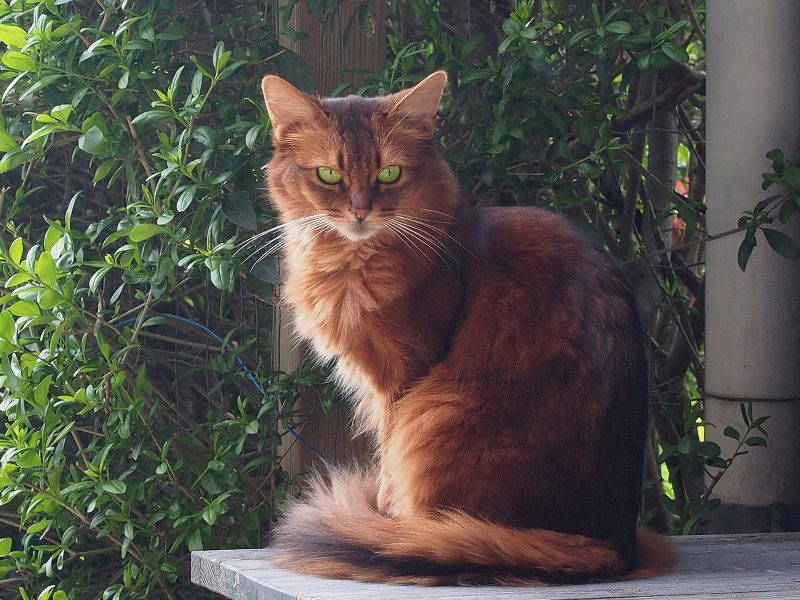
The Somali is an Abyssinian in a fox costume: the same ticked coat, large ears and inquisitive face, with a plumed tail, a full ruff and britches that make it look like a small, elegant wild animal. It suits owners who want an active, clever, deeply involved cat and who are home enough to be part of its day. Somalis open cupboards, learn latches, ride shoulders and supervise every task. They are affectionate without being clingy and are generally good with children and other pets.
Grooming is lighter than the coat suggests, but daily play is not optional. Health screening matters: the breed shares the Abyssinian's inherited anemia and retinal disease, both of which have DNA tests, and a careful breeder will show results. For a lively household that wants a cat with personality and a show-stopping coat, the Somali is a joy; for a quiet home that wants a lap ornament, it is the wrong choice.
History & Origin
The Somali is a longhaired Abyssinian, and its history is the story of a recessive gene that breeders tried for years to ignore. Abyssinians exported from Britain in the 1940s to North America, Australia and New Zealand carried the longhair gene, and the occasional fluffy kitten turned up in litters, usually to be quietly placed as a pet. The first documented longhaired Abyssinian in North America, Raby Chuffa of Selene, arrived in 1953.
In the 1960s Evelyn Mague, an American breeder, decided the longhairs deserved recognition and named them Somali, after the country bordering Abyssinia, today's Ethiopia; the name has no geographical meaning beyond that. Despite resistance from Abyssinian breeders, a breed club formed in the 1970s, CFA began registering the breed in 1976 and granted championship status in 1979, and European recognition followed in 1982. TICA and FIFe recognize it, and in Britain the GCCF registers Somalis separately from Abyssinians.
Appearance
A Somali is medium sized, lithe and muscular, with an arched back and long legs that give it a poised, ready-to-spring look. The head is a gently rounded wedge with large, cupped ears set wide and often tufted, and large almond eyes in gold or green with dark rims that look like eyeliner. The coat is medium long, soft and fine, shorter over the shoulders and longest in the ruff, on the belly, on the britches and on the full brush of a tail.
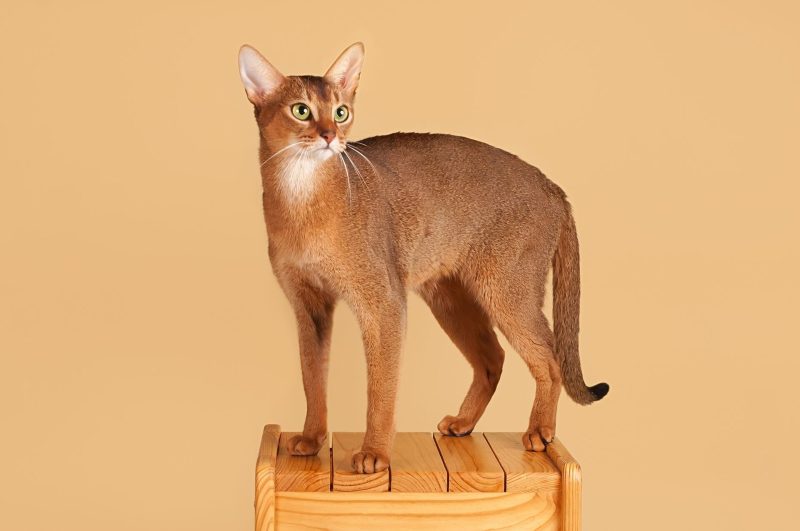
Each hair carries several bands of color, the ticking that gives the breed its shimmering, agouti appearance. Ruddy, a warm reddish-brown ticked with black, is the classic color; sorrel, called cinnamon by some registries, is a lighter copper ticked with chocolate; blue and fawn are the dilute versions. The resemblance to a fox is strong, especially from behind. Beside an Abyssinian it is simply fluffier; beside a Maine Coon it is far smaller and finer.
Temperament & Personality
The Somali is busy. It explores, climbs, opens drawers, fishes toys out of the water bowl and follows its people from room to room, communicating mostly through body language and the occasional chirp. It is affectionate in an active way, rubbing, head-butting and kneading, and many are shoulder riders, but few are lap cats; they prefer to be near you and doing something. Intelligence is high, and so is mischief, especially in the first two years.
Strangers are met with curiosity rather than fear. With children the Somali is a good match for those who like to play; with other cats and dogs it is generally sociable and often happiest with a companion animal to wrestle. It dislikes being alone for long, and a bored, lonely Somali will find its own projects, which may involve your houseplants. Many are fascinated by running water.
Exercise & Activity
This is one of the most active cat breeds, and a Somali that does not get an outlet will make one. Plan on thirty minutes or more of interactive play a day in several sessions: wand toys to leap at, balls to chase down corridors, fetch for the many that learn it, and puzzle feeders and treat balls for brain work. Vertical space is essential, with a tall cat tree, shelves and a window perch, and a cat wheel suits some Somalis. Harness walks and catios are popular, and the breed does well in feline agility.
The semi-long coat is fine and not very insulating, so the Somali seeks warmth and should not be left cold. Heat is tolerated reasonably well.
Boredom shows as cupboard raids, knocked-over objects, chewing and attention-seeking at night
A second active cat is the most effective enrichment
Rotate toys weekly and hide treats around the house
Training
The Somali learns anything that looks like a game. Clicker training with food teaches sit, come, fetch, high five and target-jumping, and it is also the best way to channel the breed's energy into something you approve of. Litter habits are reliable; give one box per cat plus one and scoop daily, and keep the hair around the rear tidy so litter does not cling. Scratching is strong, so provide tall, sturdy posts in several rooms and trim nails every few weeks.
Harness training usually succeeds, especially with kittens, and it opens up safe outdoor time. Carrier training is easy if the carrier lives in the living room and good things happen inside it. The sticking point is boundaries: a Somali will test the counter rule every day, open the cupboard you thought was shut and learn that the fridge opens if the handle is pulled, so childproof latches and consistency beat any correction. Socialize kittens widely; they are naturally confident and stay that way.
Grooming & Care
Despite the fluffy look, the Somali's coat is fine and relatively tangle-resistant, and most cats need a thorough combing once or twice a week with a wide-toothed metal comb followed by a slicker or soft brush. Concentrate on the ruff, armpits, belly, britches and under the tail, where mats start if neglected. Shedding is moderate, heaviest in spring, when the winter ruff thins and daily combing is worthwhile. Baths are rarely necessary, though a greasy coat or a show entry may call for one with a gentle cat shampoo and thorough drying. Many Somalis enjoy grooming once it is routine.
Nails every two to three weeks; this breed climbs hard
Teeth brushed daily if possible, because gum disease is common in the breed
Ears checked weekly for debris, cleaned only if needed
Start combing in kittenhood with short, rewarded sessions
A sanitary trim keeps the rear clean on fluffier cats
Health
The Somali shares the Abyssinian's inherited diseases, and two of them have DNA tests that every responsible breeder uses. Pyruvate kinase deficiency is a recessive red-cell enzyme defect that causes intermittent anemia with lethargy, pale gums and weight loss; one study of Abyssinians and Somalis found about 7 percent affected and 23 percent carriers, so testing both parents matters. Progressive retinal atrophy of the rdAc type, caused by a CEP290 variant, is also recessive; affected cats lose night vision from around one to two years and are usually blind by three to five. A second, early-onset form, Rdy, exists in the Abyssinian family and has its own test.
Renal amyloidosis, a protein deposition disease that causes kidney failure in young adults, occurs in the breed and has no genetic test, so ask breeders about it in their lines. Gum disease is common, and a blood type incompatibility occurs in some lines, which breeders manage. Lifespan is typically 11 to 16 years. Ask your vet about screening for an adopted cat of unknown background.
Nutrition
Feed a complete, balanced diet for life stage: kitten food to about a year, adult food after, and a senior diet later if your vet suggests it. The Somali is lean and burns energy, so it can look underfed to people used to stockier cats; judge by body condition rather than the bowl, with ribs easy to feel and a visible waist. Measured meals two or three times a day, with a puzzle feeder for part of the ration, suit its appetite for activity. Wet food adds water, and a fountain appeals to a breed that loves running water.
The semi-long coat produces some hairballs; regular combing is the first defense, and a hairball-control formula can help if they are frequent. Because gum disease is common in the breed, a dental diet or dental chews may be worth discussing with your vet. A cat with pyruvate kinase deficiency has no special diet but should be kept at a healthy weight. Ask your vet before supplements or home-prepared food.
Living With This Breed
A Somali fits best in a home with room to climb and people who enjoy an interactive cat. It can live in an apartment if vertical space and daily play are provided, but it is not a cat for a small, quiet flat with an owner out twelve hours a day. Indoor living is safest; a catio or harness walks satisfy its curiosity. It copes with a workday alone if it has a companion animal, and two Somalis or a Somali and an Abyssinian are a classic pairing. It is good with children who play rather than grab, and with dogs that will play back.
Climate: seeks warmth; provide beds away from drafts
Noise: low; chirps and trills rather than yowls
Escape habits: fast and curious at doors, and a determined cupboard opener; use childproof latches
For sitters: expect a cat that supervises everything; play with a wand toy daily, keep toilet lids down and cupboards latched, comb if asked, and note any lethargy or pale gums, which need a vet
Interesting Facts
The name Somali was chosen because Somalia borders Ethiopia, once called Abyssinia; the breed has no connection to either country.
Each hair in a Somali's coat carries several bands of color, which is why the cat seems to change shade as it moves.
Nicknamed the fox cat, a Somali from behind, with its bushy tail and bushy britches, is routinely mistaken for a small red fox.
The first documented longhaired Abyssinian in North America, Raby Chuffa of Selene, arrived from Britain in 1953 and appears in many Somali pedigrees.
Somalis are notorious latch openers; owners report cats that open cupboards, drawers and the occasional refrigerator.
Abyssinian breeders resisted the longhair for years, and the Somali only reached CFA championship status in 1979 after a long campaign.
Breeds similar to the Somali
What Somali owners say
Real pets, photos, stories and tips from the SitterNation community — separate from the editorial guide above.
Log in to add your pet, photos, stories and tips.
Meet Somalis on SitterNation
No Somalis have joined yet. Owners can show their pet here from the pet's profile.
Somali community photos
No Somalis photos yet — be the first to share one.
Stories from Somali owners
No stories yet. What is life with yours really like?
Tips from Somali owners
No tips yet. One practical thing that works for you is enough.
Ask Somali owners
No questions yet. Ask the people who live with the breed.