Typical tendencies
Energy level
Ready to go when you are, settles after.
Good with children
A famously patient playmate for kids.
Good with other pets
Easygoing with most household animals.
Shedding
Keep the lint roller within reach.
Vocalization
Speaks up only when something matters.
Sociability
Follows the household from room to room.
More traits
Exercise needs
Adaptability
Grooming needs
Trainability
Intelligence
Family friendly
Friendly with strangers
Apartment friendly
Overview
The Norwegian Forest Cat, or Wegie to its friends, is a big, bushy, weatherproof cat from Scandinavia with a calm, self-possessed temperament and a climber's build. It is affectionate on its own schedule, friendly with children and other pets, quiet, and far less demanding than its size suggests. Males weigh 12 to 16 pounds and females 9 to 12, with full size reached only around four or five years, and most live 12 to 16 years. It suits families, multi-pet households, people who like an independent cat that still wants to be in the room, and anyone with the space for tall cat furniture. It is a poor fit for someone who wants a lap cat on demand, for a hot climate without air conditioning, or for anyone unwilling to comb a long coat through two heavy sheds a year. Given height, a view and steady company, it is an easy and dignified housemate.
History & Origin
Longhaired cats have lived on Norwegian farms for centuries, and the skogkatt, or forest cat, appears in Norse legend as a creature that could climb sheer rock and as the animal that pulled the goddess Freyja's chariot. Their ancestors probably arrived as ships' cats with Viking traders around 1000 AD and may have mixed with longhaired cats brought from the south in later centuries; the harsh climate selected for a dense double coat, big paws and a heavy frame. The breed was first exhibited in Oslo in 1938, when the first Norwegian breed club was founded, but World War II interrupted the effort and interbreeding with shorthaired strays nearly dissolved the type. In the early 1970s a group of fanciers led by Carl-Fredrik Nordane began a rescue program, selecting foundation cats approved by a judging panel, and in 1977 FIFe granted the breed full recognition. The first breeding pair reached the United States in 1979; TICA accepted the breed in 1984 and the Cat Fanciers' Association granted championship status in 1993. It is widely described as Norway's national cat.
Appearance
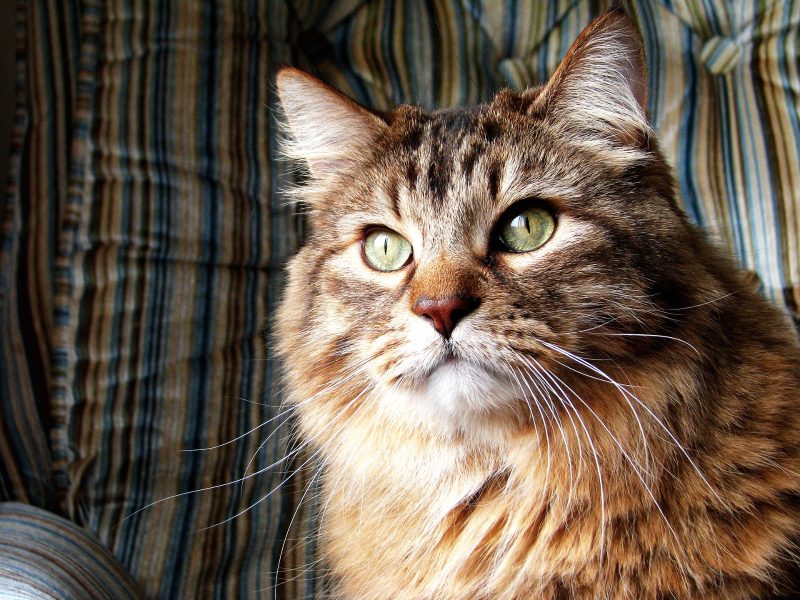
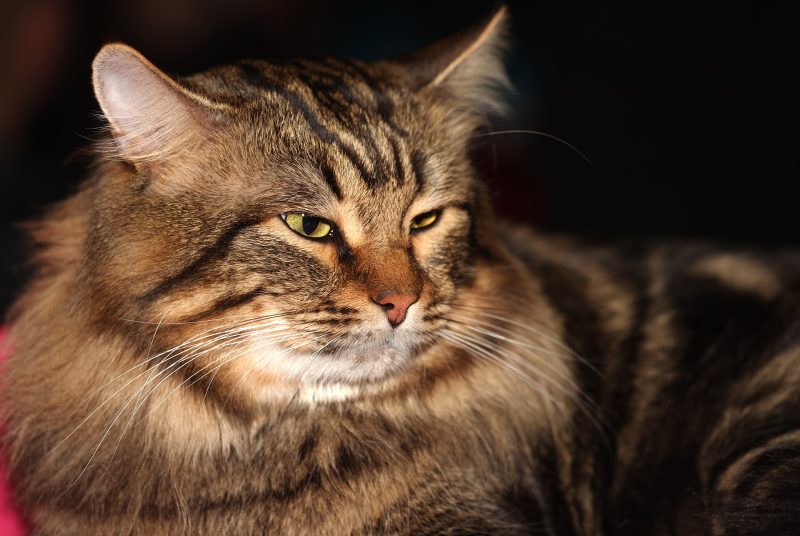
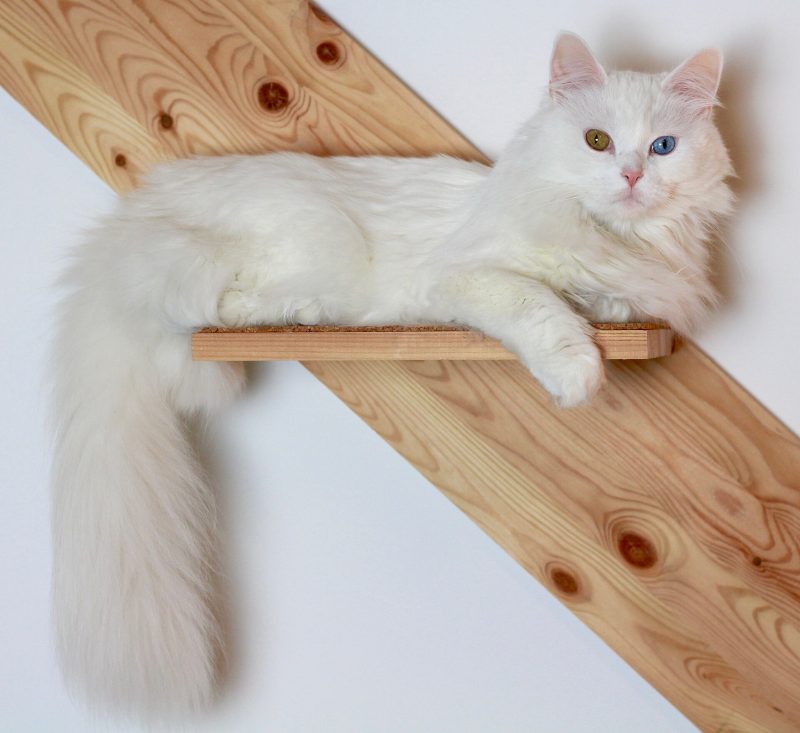
A Norwegian Forest Cat is large, long and powerfully built, with heavy bone, a broad chest, hind legs longer than the front and a long, bushy tail carried high. The head is an equilateral triangle with a straight profile from brow to nose tip, a strong chin and medium to large ears set high, broad at the base, furnished and often tipped with lynx-like tufts. The eyes are large and almond-shaped, set at a slight angle, in green, gold or copper, or blue or odd-eyed in white cats. The coat is the breed's armor: a woolly, insulating undercoat beneath long, glossy, water-resistant guard hairs, with a full ruff, side mutton chops, a short collar and heavy britches on the hind legs. It is thickest in winter and much lighter in summer, when the cat can look like a different animal. All colors and patterns are allowed except pointed, chocolate, lilac, cinnamon and fawn; brown tabby with white is the classic look. Compared with a Maine Coon it is a little smaller, with a triangular head and straight profile rather than a square muzzle; compared with a Siberian it is longer-legged and less rounded.
Temperament & Personality
Wegies are calm, intelligent and quietly social. They like to be in the same room as their people, often on the highest perch in it, and they accept laps and cuddles on their own terms rather than demanding them. They are friendly with visitors after a short assessment and reliably good with children, dogs and other cats, which makes them one of the better large breeds for family life. The voice is soft, with chirps and trills that are easy to live with. Energy comes in bursts: long periods of observation are broken by sudden sprints, climbs and hunting-style play, and the breed keeps a kitten's curiosity for years because it matures so slowly. They are independent enough to cope with a workday alone, but they do notice prolonged absence and can become withdrawn or vocal if routinely neglected. Prey drive is strong, and a Wegie with garden access will hunt.
Exercise & Activity
Plan on 20 to 30 minutes of active play a day, ideally in two sessions, plus serious climbing opportunities. This is a cat built to scale trees, so a floor-to-ceiling cat tree, wall shelves at staggered heights and a sturdy window perch are the core equipment, and the furniture must be heavy enough to take a 15-pound cat landing on it. Hunting-style games with wand toys, fetch with soft balls and puzzle feeders suit its instincts, and a catio or secure enclosure gives it fresh air without the hazards of roaming. Cold is no problem at all; heat is, so provide cool floors, shade and water in summer and consider air conditioning in hot climates. Boredom shows as counter surfing, climbing curtains and night-time sprints.
Two play sessions daily, with climbing built into the game
Tall, stable cat trees and shelves; this cat descends head first
Shade and cool spots in warm weather
Training
Norwegian Forest Cats are thoughtful learners that respond well to patient, reward-based training. Clicker sessions with small treats teach sit, high five, fetch and recall, and most learn to come to a name or sound reliably. Keep sessions short; this breed is not frantic and loses interest in repetition. Litter habits are reliable, but the box must be large and tall enough for a big cat, and a longhaired coat benefits from a sanitary trim. Scratching outlets need to be tall and heavy, since the breed climbs and stretches to full height; a sisal post of at least three feet, anchored or wall-mounted, saves door frames. Carrier training matters for a cat this size, so choose a large carrier and leave it out as a bed. Harness and leash walking suits many Wegies, who are confident outdoors; introduce the harness indoors as a kitten. Socialize kittens widely to visitors, dogs and handling, and handle paws and coat daily so that grooming and nail trims are easy. Kittens are more inclined to explore and attempt escapes than most breeds, so check screens and doors.
Grooming & Care
For a longhaired cat the Wegie is manageable, because the glossy guard hairs resist tangling, but the woolly undercoat still needs help twice a year. Comb with a wide-toothed metal comb once or twice a week most of the year, paying attention to the ruff, armpits, belly and britches, then daily during the spring and fall sheds, when the undercoat comes out in handfuls and hairballs follow if it is not removed. A slicker brush tidies the surface. Baths are rarely needed and are a project, since the water-repellent coat takes a long time to wet and longer to dry. Trim nails every two to three weeks, parting the toe tufts to find them. Check ears weekly and clean only if there is debris, brush teeth several times a week and keep a sanitary trim under the tail.
Comb once or twice a week, daily during spring and fall sheds
Nails every two to three weeks, teeth several times a week
A professional groomer can handle mats and sanitary trims if needed
Health
Norwegian Forest Cats are generally robust, with a typical lifespan of 12 to 16 years, but a few inherited conditions are recognized and most can be screened. Glycogen storage disease type IV, caused by a recessive GBE1 gene rearrangement, prevents normal glucose storage; affected kittens usually die at or soon after birth, and the few that seem normal develop progressive muscle and nerve degeneration by about five months. A DNA test identifies carriers, and breeders should never pair two. Hypertrophic cardiomyopathy, a thickening of the heart muscle, occurs in the breed; there is no Wegie-specific DNA test, so breeding cats are screened by echocardiogram. Hip dysplasia is more common in this heavy breed than in cats generally and shows as reluctance to jump or a stiff gait; some breeders X-ray hips. Pyruvate kinase deficiency and polycystic kidney disease have DNA tests that some breeders also run, and eosinophilic granuloma complex and retinal dysplasia have been reported. Obesity is a risk in a slow-maturing, food-loving cat and worsens joint problems. Ask your vet about heart screening, weight tracking and senior bloodwork from about ten years old.
Nutrition
A Wegie grows for four to five years, so feed a complete, balanced diet labeled for growth or all life stages until your vet agrees it is time for adult food, usually later than for small breeds. Measure meals, two or three a day, and adjust to body condition; the coat hides fat, so feel for ribs and a waist rather than trusting your eyes. Obesity strains hips and heart in a cat this size. Wet food adds water and helps kidney and urinary health, and a fountain encourages drinking. During the spring and fall sheds a hairball-control formula or extra fiber can help, though combing helps more. Puzzle feeders slow a fast eater and give the brain work. Treats should stay under a tenth of daily calories. Sitters should feed the measured amounts the owner leaves and resist the impression that a cat this large must need more.
Living With This Breed
A Norwegian Forest Cat can live in an apartment if it has vertical space, but it is happiest in a house with tall furniture, windows to watch from and ideally a catio or secure garden. It copes with a workday alone and does well with a second cat or a cat-friendly dog. Children who are gentle get a patient, sturdy playmate; the breed is large enough not to be hurt easily and calm enough not to retaliate. It handles cold winters with ease and needs cooling in hot summers. Expect fur on everything during shedding seasons, a cat on top of the refrigerator and occasional attempts to open screens.
Sitters: a friendly cat that may greet you from a high perch; comb it if the owner asks
Check window screens and doors; kittens and young adults explore
Keep the house cool in summer and water bowls full
Interesting Facts
Norse myth says two large forest cats pulled the chariot of the goddess Freyja, and the skogkatt was described as a fairy cat that could climb sheer rock faces.
Unlike most cats, a Wegie can climb down a tree head first, thanks to strong claws and powerful hindquarters.
The breed was nearly lost after World War II and was rebuilt in the 1970s by Norwegian fanciers who selected foundation cats from farms and approved them one by one.
A Norwegian Forest Cat takes four to five years to reach full size, and its winter coat can make it look twice as big as its summer self.
The breed is often called Norway's national cat, and its Norwegian name, Norsk Skogkatt, simply means Norwegian forest cat.
The Wegie's coat is famously water-resistant: its long guard hairs shed rain and snow so well that the cat can sit out in weather that would soak most breeds.
Breeds similar to the Norwegian Forest Cat
What Norwegian Forest Cat owners say
Real pets, photos, stories and tips from the SitterNation community — separate from the editorial guide above.
Log in to add your pet, photos, stories and tips.
Meet Norwegian Forest Cats on SitterNation
No Norwegian Forest Cats have joined yet. Owners can show their pet here from the pet's profile.
Norwegian Forest Cat community photos
No Norwegian Forest Cats photos yet — be the first to share one.
Stories from Norwegian Forest Cat owners
No stories yet. What is life with yours really like?
Tips from Norwegian Forest Cat owners
No tips yet. One practical thing that works for you is enough.
Ask Norwegian Forest Cat owners
No questions yet. Ask the people who live with the breed.