Typical tendencies
Energy level
Always on; boredom turns into mischief.
Good with children
Gentle and tolerant around children.
Good with other pets
Coexists with other pets after a settling-in.
Shedding
A light scatter, easy to keep up with.
Vocalization
Talkative, with opinions on most things.
Sociability
Follows the household from room to room.
More traits
Exercise needs
Adaptability
Grooming needs
Trainability
Intelligence
Family friendly
Friendly with strangers
Apartment friendly
Overview
The Bengal is a domestic cat wearing a leopard's coat, bred from crosses between house cats and the small wild Asian leopard cat and now many generations removed from that ancestor. It is athletic, intensely curious, clever and far more active than the average pet cat. Males weigh 10 to 15 pounds, females 8 to 12, and most live 12 to 16 years. A Bengal suits an experienced, energetic owner who wants a cat to play fetch, walk on a harness, learn tricks and climb to the top of every room, and who can give it an hour or more of engagement a day. It is a poor choice for a quiet household, a small apartment with no vertical space, someone out all day, or anyone who wants a cat that sits still. Before buying, check that your city and state allow Bengals, because a few do not.
History & Origin
Crosses between domestic cats and the Asian leopard cat, Prionailurus bengalensis, a small spotted wild cat of South and East Asia, were recorded as early as 1889, but the breed began in California with Jean Mill, who made a deliberate cross in 1963 and took the project up seriously in the early 1980s. She acquired hybrid females from Dr. Willard Centerwall, a geneticist who had bred leopard cats to domestics while studying feline leukemia resistance, and bred them to domestic toms, including spotted street cats and Egyptian Maus, working toward a cat with wild looks and a domestic temperament. The name comes from the leopard cat's species name. TICA accepted the Bengal as a new breed in 1986 and granted championship status in 1991; the GCCF followed in 1997 and FIFe in 1999. The Cat Fanciers' Association was slower, accepting Bengals for registration in 2016 only when at least five generations removed from the wild cat, with championship status in 2018. By then the Bengal had become one of the most popular pedigreed cats in the world.
Appearance
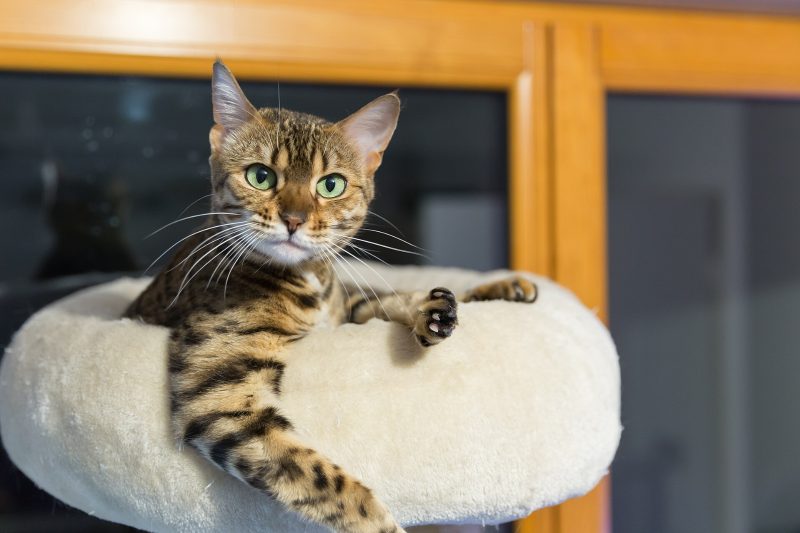
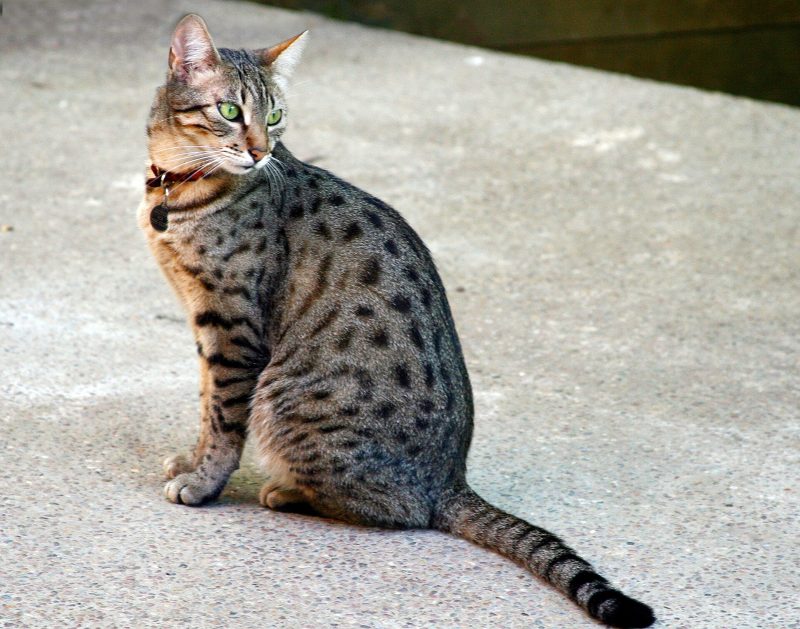
A Bengal is built like a small wild cat: medium to large, long and muscular, with hindquarters slightly higher than the shoulders, a thick low-carried tail and large round paws. The head is a broad modified wedge with small rounded ears, prominent whisker pads, a wide nose and large oval eyes in gold, green or, in snow colors, blue or aqua. The coat is short, dense and unusually soft, lying close like a pelt, and many Bengals carry glitter, a sparkle at the hair tips that catches light. Two patterns exist: spotted, ideally with rosettes that have a darker outline around a lighter center, and marbled, with flowing horizontal swirls. The brown tabby is the classic color, from gold to orange with black or brown markings. Silver, charcoal, blue and the snow colors, seal lynx, mink and sepia, are also recognized, and some registries accept a long-haired version. Generation terms describe ancestry: F1 kittens have a leopard cat parent, F2 a leopard cat grandparent and so on, and cats at least four generations removed with Bengal-to-Bengal breeding are called SBT, the only Bengals most people should own.
Temperament & Personality
Bengals are confident, busy and clever. They are devoted to their people and often follow them around, talk in chirps, trills and yowls, and play fetch like a retriever, but they are not usually lap cats, and many dislike being picked up and held. Energy stays kitten-high into middle age. They are famous for a fascination with water: dripping taps, full sinks and bathtubs are all fair game, and some will join you in the shower. Prey drive is strong, so fish tanks, hamsters and birds need secure housing. Territorial instincts run a little higher than in most breeds, which makes introductions to other cats slower and careful socialization essential; well-raised Bengals live happily with dogs and other cats. With children they do well if the children are old enough to play rather than cuddle. Early-generation cats, F1 to F3, are shyer, more territorial and harder to litter train, and are not pets for ordinary homes.
Exercise & Activity
Budget an hour or more of real activity a day, split into several sessions. A Bengal needs to run, climb, hunt and solve problems, and a bored one will dismantle the house. Wand toys worked like prey, fetch with small balls, laser games that end on a catchable toy and a cat exercise wheel are the staples. Vertical space is non-negotiable: floor-to-ceiling cat trees, wall shelves, a catio or window perches. Water play is enrichment too, so a shallow tub with floating toys or a pet fountain keeps a Bengal entertained. Puzzle feeders, treat hunts and training sessions give the brain a workout. Harness walks and secure outdoor enclosures add safe adventure. Heat and cold tolerance are ordinary for a shorthaired cat. Signs of under-exercise include shredded furniture, yowling at night, emptied cupboards and aggressive play.
Several play sessions daily, totaling an hour or more
Exercise wheel, tall climbing furniture and a catio if possible
Water bowls and tubs are toys, so expect splashing
Training
Bengals learn fast and enjoy it. Clicker training with small meaty treats teaches sit, high five, spin, jump through a hoop, fetch and recall, and it also channels energy that would otherwise go into mischief. Keep sessions short and frequent. Litter habits are reliable in SBT cats given large, clean boxes; cover-shy or territorial cats may prefer uncovered boxes placed apart. Scratching needs serious outlets, because a Bengal scratches hard and high; provide tall sisal posts and horizontal scratchers in several rooms. Harness and leash training is one of the best things you can do for this breed, starting indoors as a kitten and progressing to a quiet garden. Carrier training with the carrier left open and treated keeps vet trips calm. Socialize kittens to visitors, dogs, car rides and handling early and widely. Common sticking points are rough play, waking owners at night and opening doors and drawers, all of which improve with more exercise and clear routines rather than punishment.
Grooming & Care
The pelt-like coat is short and sheds less than most shorthairs, so grooming is light. A weekly brush with a soft bristle or rubber brush removes loose hair and spreads oils, and many Bengals treat it as a game. Baths are unnecessary unless the cat has rolled in something, though plenty of Bengals will walk into the tub voluntarily. Trim nails every two to three weeks; a Bengal's claws are strong and grow fast. Check the ears weekly and clean only if there is visible debris. Brush teeth several times a week and have the mouth checked at every vet visit. Because the breed is active and sometimes rough, check paws and skin for scrapes after play.
Weekly brushing, rare baths
Nails every two to three weeks, ears checked weekly
Glitter and sheen depend partly on diet and health, so a dull coat is worth a vet visit
Health
Bengals are generally healthy but carry a few well-defined inherited conditions. Bengal progressive retinal atrophy, PRA-b, is a recessive degeneration of the retina caused by a KIF3B gene variant; vision loss begins around seven weeks and is severe by about two years. Pyruvate kinase deficiency, a recessive enzyme defect that causes intermittent anemia, is common in the breed. Both have DNA tests; ask to see the parents' results. Hypertrophic cardiomyopathy, a thickening of the heart muscle, is the breed's most serious concern, with a prevalence well above the average in screening studies; no DNA test exists, so breeders have cats scanned by a cardiologist before breeding and every year or two afterward. Other conditions seen include patellar luxation, hip dysplasia, flat-chested kitten syndrome, ulcerative nasal dermatitis, a higher rate of lymphoma and sensitivity to some gastrointestinal upsets. UK veterinary records put median longevity nearer 8 years. Ask your vet about a heart check with a lifetime record, and report lethargy, breathing changes or night blindness promptly.
Nutrition
A Bengal is a lean, muscular athlete and should look like one, with a visible waist and easy-to-feel ribs. Feed a complete, balanced diet suited to life stage; kittens grow fast and need a growth formula until about a year old. Because the breed burns a lot of energy, active adults may need more than the package suggests, while a quieter indoor Bengal can gain weight on free feeding, so measure meals and adjust to body condition. Several small meals a day suit its hunting rhythm, and puzzle feeders or treat-dispensing toys make eating part of exercise. Many Bengals enjoy wet food, which adds water, and a fountain encourages drinking. Despite marketing that leans on the wild ancestry, Bengals do not need raw or exotic diets; if you want to feed raw, ask your vet about safe handling and balance. Some have sensitive digestion, so change foods gradually. Treats are valuable training currency and should stay under a tenth of daily calories.
Living With This Breed
A Bengal thrives in a home with vertical space, active people and a secure way to experience the outdoors, such as a catio or harness walks. It can adapt to an apartment only if it has climbing furniture, an exercise wheel and daily engagement; otherwise it becomes loud and destructive. Long days alone are hard on this breed, and a second active cat or a cat-savvy dog helps. Children who play actively are welcomed; toddlers who grab are not. Small pets and fish must be secured. Keep doors and windows latched, because Bengals open simple handles and will bolt. Check local law first: Hawaii, Connecticut and New York City prohibit Bengals outright, some states regulate early generations with permits, and Seattle and Denver have limits.
Sitters: play hard before feeding, keep water bowls full and expect splashing
Secure cabinets, tanks and screens; this cat climbs and opens things
Know the generation and any permit requirements before you take the job
Interesting Facts
The Bengal is the only domestic breed with rosettes, the two-toned spots that mimic a leopard's coat, and many carry glitter, a sparkle at the hair tips caused by hollow or translucent hair shafts.
Jean Mill, the breed's founder, also helped create the Himalayan in the 1940s before turning to leopard cat hybrids.
Early-generation males, F1 through F3, are usually sterile, so breeders rely on hybrid females bred to domestic or later-generation Bengal males.
Bengals famously love water and have been known to join their owners in the bath or fish toys out of the toilet.
A Bengal named Cato was reportedly sold in 1998 for more than 40,000 dollars, one of the highest prices ever paid for a pet cat.
Australia announced in 2025 that it would end its exemption for fifth-generation Bengals, banning all Bengal imports from March 2026.
Breeds similar to the Bengal
What Bengal owners say
Real pets, photos, stories and tips from the SitterNation community — separate from the editorial guide above.
Log in to add your pet, photos, stories and tips.
Meet Bengals on SitterNation
No Bengals have joined yet. Owners can show their pet here from the pet's profile.
Bengal community photos
No Bengals photos yet — be the first to share one.
Stories from Bengal owners
No stories yet. What is life with yours really like?
Tips from Bengal owners
No tips yet. One practical thing that works for you is enough.
Ask Bengal owners
No questions yet. Ask the people who live with the breed.