Typical tendencies
Energy level
Always on; boredom turns into mischief.
Good with children
Patient with kids when well supervised.
Good with other pets
Coexists with other pets after a settling-in.
Shedding
A light scatter, easy to keep up with.
Vocalization
Talkative, with opinions on most things.
Sociability
Follows the household from room to room.
More traits
Exercise needs
Adaptability
Grooming needs
Trainability
Intelligence
Family friendly
Friendly with strangers
Apartment friendly
Overview
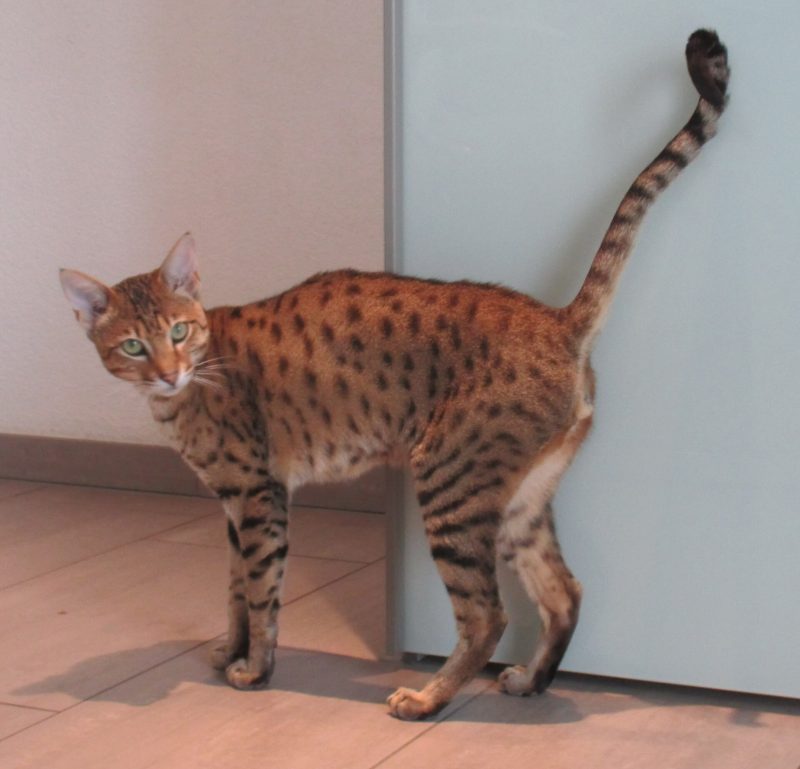
The Savannah is a tall, long-legged, boldly spotted cat descended from a cross between the African serval and the domestic cat. It is the most athletic breed in the encyclopedia, able to leap onto a refrigerator from the floor, open doors and play fetch for an hour, and it bonds to its people with a dog-like intensity. It suits experienced, active owners who can provide a cat-proofed home, a great deal of interactive play, secure outdoor access on a harness or in an enclosure and a tolerance for a cat that is always involved. It is not a good match for a quiet household, for people away all day or for anyone who has not checked the law: several states, cities and countries restrict or ban Savannahs, often by generation. Later generations, labeled F4 and beyond, are closer in size and temperament to an ordinary cat and are what most families should consider. For the right home it is a remarkable, demanding companion.
History & Origin
The first Savannah was born on April 7, 1986, when a female domestic cat owned by Pennsylvania Bengal breeder Judee Frank produced a kitten sired by a male serval belonging to Suzi Wood. The kitten, named Savannah after the serval's habitat, was fertile and in 1989 produced a second-generation litter. Patrick Kelley bought one of her offspring and, convinced the cross could become a breed, recruited Bengal breeder Joyce Sroufe; the two wrote the first breed standard in 1996 and presented it to TICA. After a moratorium on new breeds, TICA accepted the Savannah for registration in 2001, advanced it through its new-breed classes and granted championship status in May 2012, which allowed fourth-generation and later cats to compete. Outcrosses permitted during development included the Egyptian Mau, Ocicat, Oriental Shorthair and domestic shorthair; since championship, only Savannah-to-Savannah breeding is allowed. The Savannah is not recognized by CFA. Generations are labeled by distance from the serval: F1 has a serval parent, F2 a serval grandparent, and so on, and a cat with three generations of Savannah parents behind it is registered as SBT, stud book tradition.
Appearance
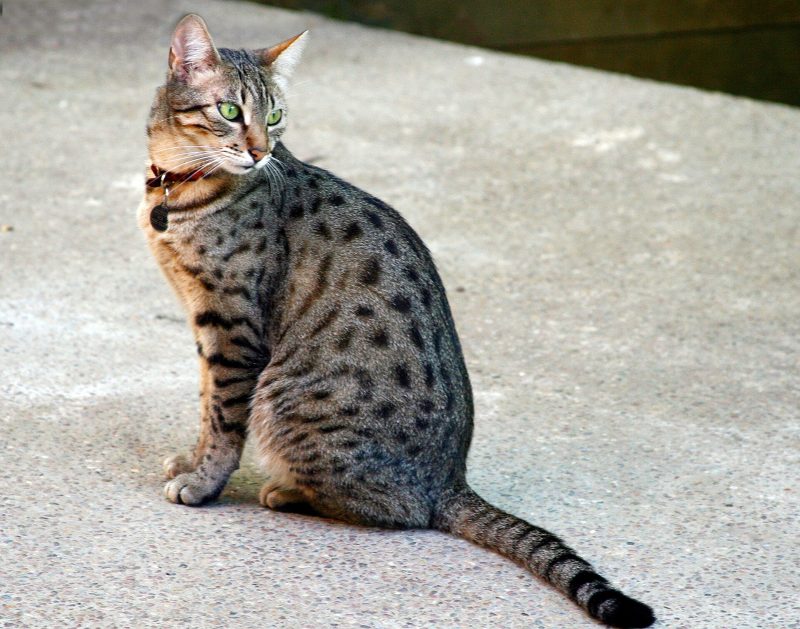
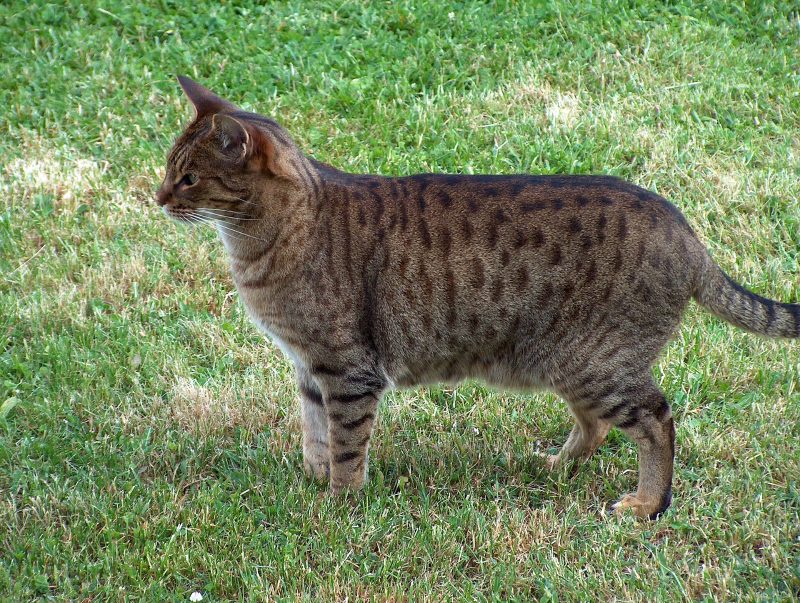
A Savannah looks like a small wild cat because, a few generations back, it was. The body is long, lean and tall, with long legs, a long neck and a medium-length tail that stops well short of the ground; it stands taller than any other domestic breed, and an early-generation male can weigh twenty pounds or more while a later-generation female may be an ordinary nine or ten. The head is a small, tall triangle on a long neck, with large, high-set rounded ears marked with pale ocelli on the back, and hooded, medium-sized eyes with dark tear-stain lines running from the inner corners. The coat is short to medium, dense and slightly coarse, and the pattern is always spotted: bold, solid, dark spots on a warm golden to tawny ground in the brown (black) spotted tabby, or on a silver ground in the silver spotted tabby, plus solid black and black smoke, in which the spots show only in certain light. Early generations are larger and wilder-looking; later generations keep the long legs, ears and spots in a more domestic frame.
Temperament & Personality
Savannahs are confident, curious, loyal and relentless. They attach strongly to their family, follow people from room to room, greet them at the door and often learn to walk on a leash and ride in the car. They are intensely active and intelligent: they open cupboards and doors, turn on taps, play in water and sinks, carry toys around and fetch for as long as a human will throw. Many communicate with chirps, hisses used as greetings and a repertoire that sounds more wild than domestic. Vertical space is used to the fullest; an eight-foot jump from a standing start is routine. Temperament varies by generation and by socialization. Later-generation cats are generally friendly with gentle children and with cat-savvy dogs, and they can live with other cats. Early-generation cats, especially F1 and F2, can be aloof with strangers, territorial and prone to spraying, and the Savannah Cat Association advises against placing them with young children. All Savannahs need company; a bored, lonely Savannah becomes destructive.
Exercise & Activity
Plan on at least an hour of active engagement every day, split into several sessions, and an environment designed for a cat that can jump to the top of a door frame. Wand toys, fetch, a cat wheel, puzzle feeders, water play in a bathtub with a few inches of water and daily harness walks or time in a secure outdoor enclosure are the basics, not extras. Build vertical: floor-to-ceiling cat trees, wall shelves that connect into routes, a tall perch at every window. Rotate toys and hide food so the cat hunts for it. Clicker training is exercise for the brain. Heat is well tolerated by this short-coated breed, but cold is not, and a Savannah should never be loose outdoors; it will climb any fence and travel far.
Signs of too little stimulation: shredded furniture, opened cupboards, emptied shelves, spraying, yowling at night
Secure everything: toilet lids down, taps off, windows screened with pet-grade mesh
Early generations need more of everything, including space
Training
Savannahs are among the most trainable cats and among the most demanding to live with untrained. Clicker training with high-value food rewards teaches sit, come, fetch, jumping onto a target and walking calmly on a harness, and a trained Savannah is a far better roommate. Start harness work indoors in kittenhood; most Savannahs accept the leash readily and come to expect their daily walk. Litter habits are the breed's most common problem, particularly in early generations and intact cats, so provide several large, very clean boxes in quiet places, neuter at the age your vet recommends and address any lapse immediately with a vet check and a management plan. Scratching is powerful; supply tall, heavy sisal posts and expect to replace them. Carrier training is essential for a cat this strong and this often on the road. Socialize kittens widely to people, dogs, noises and handling, and keep socializing through adolescence. Rules must be consistent, since a Savannah will test a door, a cupboard latch or a rule a hundred times. Never use punishment; redirection and reward work.
Grooming & Care
The Savannah coat is short, dense and low-maintenance. A weekly going-over with a rubber curry brush or a grooming mitt removes loose hair and brings up the sheen; shedding is light to moderate with seasonal peaks. Most Savannahs enjoy water and will tolerate or even seek a bath, which is handy after a muddy walk, but baths are rarely needed; use a cat shampoo and dry thoroughly. Check the large ears weekly and wipe the visible part if dirty, keeping them dry after water play. Clip the nails every two to three weeks; the claws are big and the scratching is forceful. Brush the teeth several times a week and keep up with dental checks, since periodontal disease is common. Check the eyes and skin while brushing and watch for over-grooming, which in this breed usually signals boredom or stress rather than skin disease.
Weekly: curry brush, ear check, tooth brushing
Every two to three weeks: nails
After outdoor time: check for ticks and burrs
Health
Savannahs are generally healthy and often live into their late teens. The conditions breeders screen for are those of the outcross breeds. Pyruvate kinase (PK) deficiency, an inherited anemia that causes intermittent weakness, pale gums and jaundice, is on the DNA-test list for the breed. Progressive retinal atrophy of the rdAc type, causing gradual blindness in adulthood, entered through Oriental Shorthair, Egyptian Mau and Bengal ancestry and also has a DNA test. Hypertrophic cardiomyopathy (HCM) is screened by echocardiogram. The Savannah Cat Association recommends all three screens for breeding cats. Early-generation kittens are hard to produce because serval and domestic pregnancies differ in length, and F1 to F3 males are infertile. Claims that Savannahs need special anesthesia or have unusually small livers are not supported by evidence; servals and Savannahs have been safely anesthetized with standard feline protocols, and your vet should treat the cat as a cat. Dental disease and urinary problems are the common day-to-day issues. Ask the breeder for PK, PRA and HCM results on both parents, and ask your vet about a baseline heart scan in early adulthood.
Nutrition
Despite the exotic ancestry, a Savannah needs an ordinary complete, balanced cat diet matched to its life stage, with no evidence that raw or special diets are required; raw feeding carries real risks and is a question for your vet. What is different is the amount: a tall, athletic cat that exercises hard may eat more than a typical house cat, and early-generation cats more still. Feed measured meals two or three times a day, adjust to body condition and keep the cat lean; you should feel ribs easily under a thin layer and see a clear waist. Kittens grow for up to three years and can stay on growth food longer than usual, with portions watched. Wet food supports hydration and the urinary tract, and kibble works in puzzle feeders that make the cat work. Keep treats under ten percent of daily calories, provide fresh water in several places and expect the cat to play in it. Taurine is already in any complete cat food; do not add supplements without veterinary advice.
Living With This Breed
Before anything else, check the law. In the United States most states treat Savannahs as domestic cats, but Georgia, Hawaii, Nebraska and Rhode Island prohibit them; New York allows F5 and later while New York City bans them; several states, including Massachusetts and Vermont, allow only later generations; Texas regulates by county; and cities such as Denver and Seattle have their own bans. Australia has banned imports since 2008 under federal environmental law, New Zealand bars hybrid cats, and the Netherlands and parts of Belgium prohibit early generations. Rules change, so confirm with state and local authorities and your landlord. The home itself should be a house with room to run, a secure enclosure or harness routine, and no fragile ornaments. Children and other pets fit best with F4 and later cats.
Time alone: poor; this breed needs a companion animal and a daily presence, and a sitter must play, not just feed
For sitters: secure every door and window, keep lids and taps closed, expect a cat that climbs onto you, and never let it outside unleashed
Insurance and landlord: ask about breed restrictions
Interesting Facts
The first Savannah, born in 1986, was named for the African grasslands where the serval lives, and her name became the breed's.
An F2 Savannah named Arcturus Aldebaran Powers was verified in 2016 as the tallest domestic cat, at just over nineteen inches at the shoulder, and another Savannah, Fenrir, later took the record.
Servals carry their kittens about seventy-five days and domestic cats about sixty-five, one reason first-generation Savannahs are so hard to breed.
Male Savannahs are usually infertile until the fifth generation from the serval, so early breeding depended entirely on females.
Many Savannahs greet people with a hiss that sounds alarming but is simply the serval's hello, and others chirp like birds.
Australia's 2008 ban on importing Savannahs was later backed by a study estimating that the cats could threaten most of the country's native mammals.
Breeds similar to the Savannah
What Savannah owners say
Real pets, photos, stories and tips from the SitterNation community — separate from the editorial guide above.
Log in to add your pet, photos, stories and tips.
Meet Savannahs on SitterNation
No Savannahs have joined yet. Owners can show their pet here from the pet's profile.
Savannah community photos
No Savannahs photos yet — be the first to share one.
Stories from Savannah owners
No stories yet. What is life with yours really like?
Tips from Savannah owners
No tips yet. One practical thing that works for you is enough.
Ask Savannah owners
No questions yet. Ask the people who live with the breed.