Typical tendencies
Energy level
Calm at home with short bursts of play.
Good with children
A famously patient playmate for kids.
Good with other pets
Friends with everything that lives at home.
Shedding
Noticeable, with heavier seasonal blows.
Vocalization
Speaks up only when something matters.
Sociability
Follows the household from room to room.
More traits
Exercise needs
Adaptability
Grooming needs
Trainability
Intelligence
Family friendly
Friendly with strangers
Apartment friendly
Overview
The Birman is a gentle, silky colorpoint cat with deep blue eyes and a trademark set of pure white gloves on all four paws. It is affectionate without being clingy, playful without being wild and quiet without being aloof, which makes it one of the easiest pedigreed cats to live with. Males weigh 10 to 15 pounds, females 6 to 10, and most live 12 to 16 years, with many going longer. A Birman suits families with children, multi-pet homes, first-time cat owners and anyone who wants a companion that follows them around and helps with whatever they are doing. It is a poor fit for people away from home for long days with no other pet, for anyone who wants a very active or very vocal cat, and for those who will not keep up with weekly combing. Its coat is long but, with no undercoat, far easier than a Persian's.
History & Origin
Legend places the Birman's ancestors in the temples of Burma, where white cats with golden eyes are said to have been transformed by a goddess into blue-eyed, golden-coated guardians with white paws. The documented history begins in France. A pair of pointed, white-gloved cats was shipped from Burma to Nice around 1919; the male died on the way, but the pregnant female survived and founded the breed, which French fanciers named Sacré de Birmanie after the French word for Burma. The Cat Club de France recognized it in 1925. World War II almost erased the breed: by 1945 only one breeding pair, Orloff and Xenia de Kaabaa, remained in Europe, and breeders rebuilt it by crossing to Persians and Siamese and breeding back until pure litters were again being produced in the early 1950s. FIFe recognized the Birman in 1949, Britain's GCCF in 1966 and the Cat Fanciers' Association in 1967, with CFA championship status in 1972; the first Birmans had reached the United States in 1959. Seal point was the original color, blue arrived in 1959 and British breeders later added chocolate, lilac, red, cream, tortie and tabby points.
Appearance
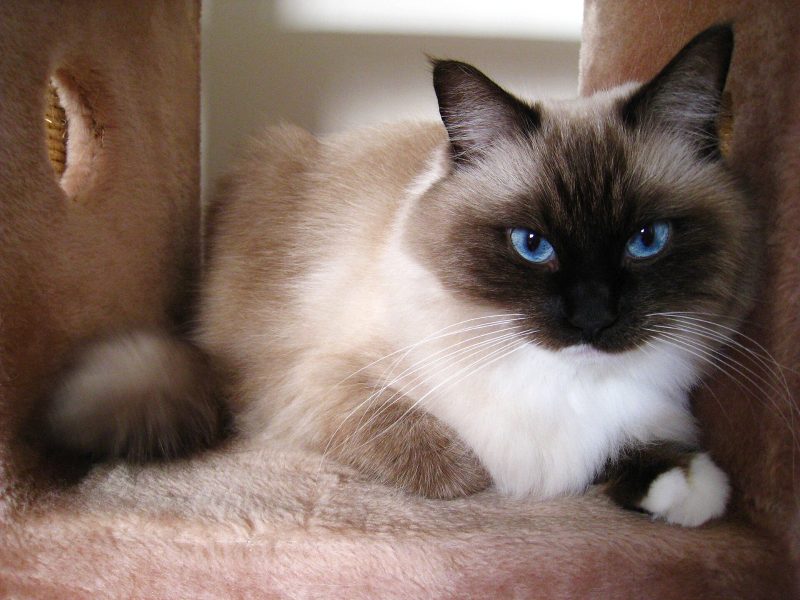
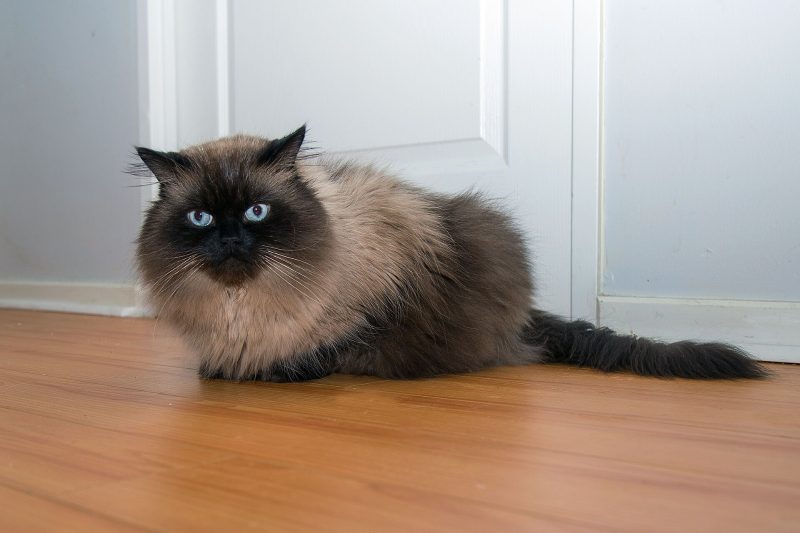
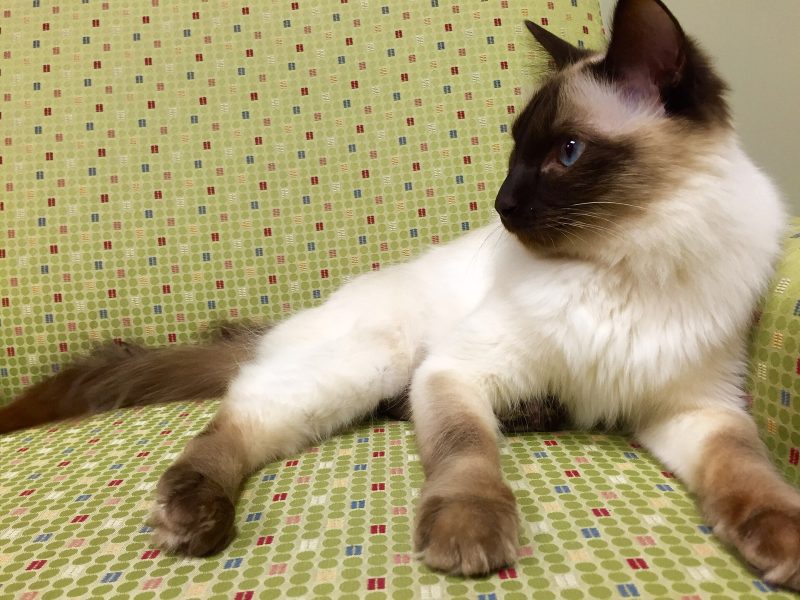
A Birman is a medium to large, long and stocky cat with heavy bone and a solid feel. The head is broad and rounded with full cheeks, a strong chin and a medium-length Roman nose with a slight convex curve, and the ears are medium and set well apart. The eyes are almost round, set wide and always deep blue, the deeper the better. The coat is medium-long to long and silky, with a heavy ruff around the neck, but it has no thick undercoat, so it rarely mats. Color follows the pointed pattern: a pale body with a golden mist over the back, darker mask, ears, legs and tail, in seal, blue, chocolate, lilac, red, cream, tortie and lynx points. What sets the breed apart is the gloves: all four paws are white, ending in an even line across the front paws, and on the back paws the white extends up the hock in points called laces. A Ragdoll is larger and floppier with a different white pattern; a Himalayan has a flat face and a dense undercoat.
Temperament & Personality
Birmans are even-tempered, people-oriented cats that like to be involved. They follow their owners from room to room, sit beside rather than on them, supervise chores and greet guests politely after a brief look. The voice is soft and chirpy and rarely used unless the cat is answered. Play is lively but not frantic, and many Birmans keep a kitten's enthusiasm for toys into their third or fourth year before settling into a calm adulthood. They are patient with children, tolerant of dogs and sociable with other cats, which makes them a good choice for busy family homes. Their devotion has a cost: a Birman left alone all day grows lonely, and breeders often recommend a second cat for working households. They are not great climbers of curtains or counters, preferring moderate heights and a good view. Sensitivity is part of the package; a Birman notices tension and responds to a gentle, consistent routine.
Exercise & Activity
A Birman is moderately active and needs about 20 to 30 minutes of play a day, best given in two sessions. Wand toys, soft balls for fetch, which many Birmans learn eagerly, and puzzle feeders all suit its thoughtful style of play. Cat trees and shelves at moderate height satisfy its liking for a perch, and a window seat with a bird feeder outside counts as entertainment. Rotate toys to keep interest up, and let the cat win by catching the prey at the end of each game. Puzzle feeders, treat hunts and short training sessions provide mental work. The long coat means the breed copes well with cool rooms but should have shade and cool floors in summer. A bored Birman is more likely to follow you around meowing than to wreck furniture.
Two short play sessions daily, with fetch if the cat takes to it
Moderate-height perches and a window view
Food puzzles for the hours you are away
Training
Birmans are responsive, food-motivated and eager to please, which makes them one of the more trainable longhaired breeds. Clicker training teaches sit, high five, fetch and recall, and most learn to come when called within a few sessions. Keep sessions short and gentle; this breed shuts down under harsh handling. Litter habits are reliable, but a longhaired cat needs a large, clean box, and a sanitary trim around the hindquarters prevents soiling. Provide sturdy scratching posts in sisal and cardboard; Birmans scratch moderately and take well to a post placed where they stretch after naps. Carrier training with the carrier left open as a bed keeps vet visits calm. Harness walking suits many Birmans, whose calm nature makes them steady on a leash in a quiet garden. Socialize kittens to grooming early, handling the paws, belly and tail daily so that combing and nail trims are easy for life. Few sticking points exist beyond a tendency to follow you into every room and ask for a cuddle while you work.
Grooming & Care
The silky single coat is forgiving for a longhair, but it still needs regular attention. Comb the whole cat with a wide-toothed metal comb two or three times a week, paying attention to the ruff, armpits, belly and britches, where tangles start, and daily during the spring and fall sheds when loose hair would otherwise become hairballs. A slicker brush finishes the surface. Baths are rarely needed, though an occasional bath with a cat shampoo during heavy shedding helps. Trim nails every two to three weeks, check the ears weekly and wipe eye corners, which can collect dark tear staining on pale faces. Brush teeth several times a week. Keep a sanitary trim under the tail and check the fur between the toes for mats.
Comb two or three times a week, daily in shedding seasons
Nails every two to three weeks, eyes and ears weekly
Professional grooming is optional and helpful for a sanitary trim
Health
Birmans are generally healthy, with a typical lifespan of 12 to 16 years and a UK study putting the average above 14, but the breed's genetic diversity is among the lowest of the pedigreed cats and a few inherited conditions are recognized. Hypertrophic cardiomyopathy, a thickening of the heart muscle, occurs in the breed and has no Birman-specific DNA test, so breeders screen breeding cats by echocardiogram. Polycystic kidney disease, inherited from historical Persian outcrosses, can be excluded with a DNA test. Birman hypotrichosis with thymic aplasia, caused by a recessive FOXN1 variant, produces hairless kittens with no immune thymus that die young; a DNA test identifies carriers so they are never paired. Hemophilia B, an X-linked clotting disorder, has been reported, and vets sometimes check clotting before surgery. The breed is over-represented for chronic kidney disease, urate bladder stones, feline infectious peritonitis and corneal dermoids, and some lines have had cataracts. Birmans also tend to have naturally higher blood creatinine, which a vet should interpret with the breed in mind. Ask your vet about heart screening, kidney monitoring from middle age and an annual exam with weight and dental checks.
Nutrition
A Birman is a solid cat that should still have a waist under all that fur, so measure meals rather than free feeding. Feed a complete, balanced diet suited to life stage, kitten food until about a year, then two or three measured adult meals a day; because the breed matures slowly, ask your vet when to switch. Run your hands along the ribs regularly, since the coat hides weight gain. A hairball-control formula or added fiber can help during shedding seasons, and regular combing helps more. Wet food adds water, which matters for a breed with a tendency to kidney and urinary problems, and a fountain encourages drinking. Wide, shallow bowls suit the full cheeks and whiskers. Puzzle feeders slow fast eaters and add enrichment. Older Birmans benefit from kidney monitoring, and your vet may suggest a senior or renal diet at some point; follow that advice rather than guessing. Treats should stay under a tenth of daily calories.
Living With This Breed
A Birman settles into an apartment or a house with equal ease, as long as it has company. It copes with a normal workday if there is another pet, and it should not be an only animal in a home that is empty most of the time. Children who are gentle will find a patient playmate that does not scratch easily; dogs and other cats are usually accepted after a slow introduction. Noise is low: a soft chirp when it wants something. It is not an escape artist, but it is trusting, so keep it indoors or in a secure enclosure. Expect fur on dark clothing and a cat on the bed.
Sitters: a friendly cat that will come to you; comb it if the owner asks and watch for eye discharge
Keep water fresh and meals measured; weight hides under the coat
Check the hindquarters and paws for mats or litter clumps
Interesting Facts
In the breed legend a temple cat named Sinh gained his blue eyes and golden coat at the moment his priest died, keeping only his paws white where they touched the holy man.
French and many other breeders name every kitten born in a given year with the same first letter, so a Birman's name often reveals its age.
Karl Lagerfeld's Birman, Choupette, became a fashion celebrity with her own staff, book deals and reported inheritance.
By the end of World War II only one breeding pair of Birmans, Orloff and Xenia de Kaabaa, survived in Europe, and every modern Birman descends from the rebuilding that followed.
Birman kittens are born pure white and take up to two years to develop their full points and golden mist.
The white laces that run up the back of the hind legs are unique to the breed and must reach at least part way to the hock to be correct.
Breeds similar to the Birman
What Birman owners say
Real pets, photos, stories and tips from the SitterNation community — separate from the editorial guide above.
Log in to add your pet, photos, stories and tips.
Meet Birmans on SitterNation
No Birmans have joined yet. Owners can show their pet here from the pet's profile.
Birman community photos
No Birmans photos yet — be the first to share one.
Stories from Birman owners
No stories yet. What is life with yours really like?
Tips from Birman owners
No tips yet. One practical thing that works for you is enough.
Ask Birman owners
No questions yet. Ask the people who live with the breed.