Typical tendencies
Energy level
Happiest dozing; a stroll is an event.
Good with children
Patient with kids when well supervised.
Good with other pets
Easygoing with most household animals.
Shedding
Keep the lint roller within reach.
Vocalization
Speaks up only when something matters.
Sociability
Likes being in the room with people.
More traits
Exercise needs
Adaptability
Grooming needs
Trainability
Intelligence
Family friendly
Friendly with strangers
Apartment friendly
Overview
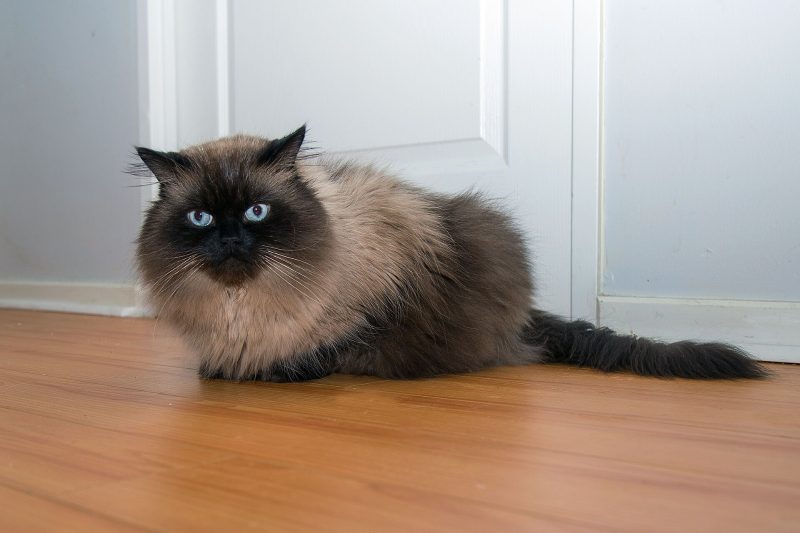
The Himalayan is a Persian wearing a Siamese costume: the same round, heavy-boned body, flat sweet face and floor-length coat, with the color concentrated on the ears, face, legs and tail and vivid blue eyes to match. It suits people who want a calm, gentle, decorative companion that prefers a lap to a cat tree and is content in a quiet apartment. Himmies are affectionate without being demanding, soft-voiced and tolerant of handling, which makes them good with considerate older children and with placid dogs. The price is grooming: a long, cottony coat that mats within days if it is not combed, eyes that need daily wiping and a face that needs keeping clean. There is also a health price attached to the flat face. If you can commit ten minutes a day to the comb and accept a cat that watches the world rather than racing through it, the Himalayan is one of the most rewarding breeds to share a home with.
History & Origin
The idea of putting Siamese points on a Persian goes back to the 1920s and 1930s. At Harvard, Virginia Cobb and geneticist Clyde Keeler crossed the two breeds to study how the pointed pattern was inherited and published their results in 1936; one of their cats, Newton's Debutante, is often called the first Himalayan. In Britain, Brian Sterling-Webb spent about a decade on a similar project, and the GCCF recognized his cats as the Colourpoint Longhair in 1955. In the United States, Marguerita Goforth and other breeders worked through the 1950s, and CFA recognized the Himalayan as a breed in its own right in December 1957. Over the following decades breeders bred back to Persians until the cats were Persians in all but color, and in 1984 CFA folded the Himalayan into the Persian breed as a color division, where it remains. TICA registers the Himalayan as its own breed within a Persian breed group that shares one standard with the Persian and the Exotic Shorthair, and some registries, including ACFA, list it as fully separate. The name refers to the Himalayan rabbit, which carries the same pointed pattern.
Appearance
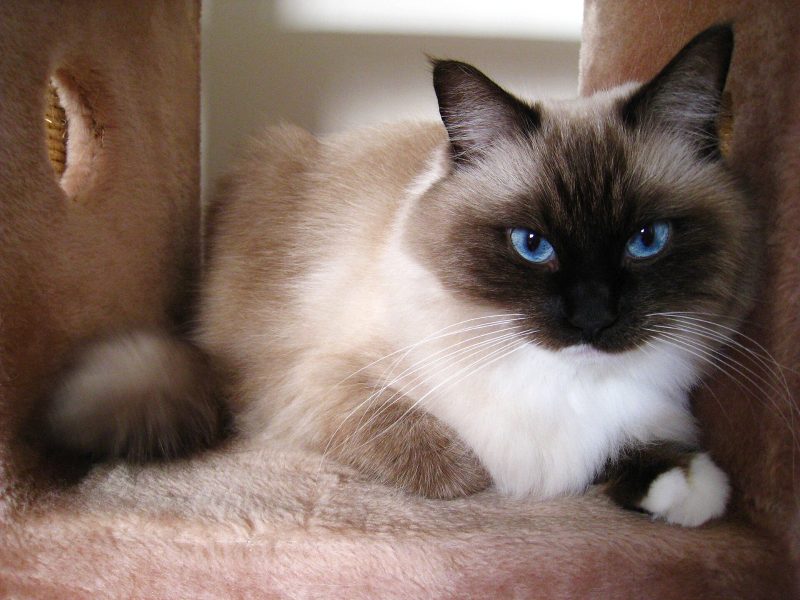
A Himalayan is a Persian in type: a cobby, low-slung body on short, thick legs, a broad chest, a short tail and a big round head with full cheeks, small rounded ears set low and wide, and large round eyes in a clear, deep blue. The nose is short and, in show-type cats, set almost between the eyes to give the flat face, while traditional or doll-faced cats keep a longer nose and a more open expression. The coat is long and thick all over, with a full ruff around the neck, long fringes on the ears and toes and a plumed tail. The pointed pattern is the point of the breed: a pale cream or ivory body with darker color on the mask, ears, legs and tail. Points come in seal, blue, chocolate, lilac, red (often called flame), cream and tortoiseshell versions of several of those, plus lynx points that add tabby stripes to the mask and legs. Kittens are born nearly white and the points develop over weeks; the body color darkens with age. Compared with a Birman, the Himalayan is heavier, rounder and flatter-faced, with no white gloves.
Temperament & Personality
Himalayans are quiet, sweet-natured and placid. They enjoy attention and will settle on a lap or beside you on the sofa for as long as you stay, but they rarely demand it and are content to watch from a cushion when you are busy. Energy is low; bursts of play with a feather or a crumpled ball are short and often comical, and most of the day is spent lounging in a favorite spot. They are devoted to their own people and somewhat reserved with strangers, retreating under a bed when the house is loud and emerging once things settle. With children they do best when handling is gentle and quiet; a Himmy picked up roughly will go limp and then avoid the child. With calm dogs and other cats they are usually fine, and they seldom start trouble. The voice is soft and seldom used. Routine suits them; they like meals, grooming and bedtime at the same times each day, and they accept daily combing more willingly if it has been part of life since kittenhood.
Exercise & Activity
A Himalayan will not exercise itself, so you have to make play happen. Aim for two short sessions a day of five to ten minutes with a wand toy dragged slowly along the floor, a toy mouse tossed a few feet or a laser dot followed by a real toy to catch. Keep it low to the ground; this is not a climber, and a cat tree with wide, low platforms suits it better than a tall one. Puzzle feeders and lick mats add mental work and slow down eating. Watch breathing: a flat-faced cat tires quickly, and open-mouth breathing means stop at once and let it rest. Heat is dangerous, so play in a cool room and never in a warm car or a sunny conservatory. Gentle daily play matters more for this breed than for most because weight gain is easy and arthritis is hard to spot under the fur.
Boredom shows as overeating, over-grooming and sleeping more than usual
A window perch with a bird feeder outside counts as enrichment
Training
The Himalayan is not an eager student, but it is a willing one if lessons are short, quiet and rewarded with food or gentle praise. Clicker training can teach sit, come and entering the carrier; keep sessions to a minute or two and stop before the cat loses interest. The most important training is tolerance of grooming: from the first week, pair a few strokes of the comb with treats, handle the paws, belly, armpits and tail daily and wipe the eyes, so that these become routine rather than battles. Litter habits are reliable if the box is large, low-sided, uncovered and scooped daily; a sanitary trim keeps litter from clinging to the britches, and some Himmies refuse a dirty box. Scratching is mild and satisfied by a sturdy sisal post and a flat scratcher. Carrier training is worth the effort because vet visits are frequent with this breed. Harness walking is possible in a cool garden but not a priority. Socialize kittens gently to visitors and noise so the breed's natural reserve does not become timidity.
Grooming & Care
Grooming is a daily commitment for life. Comb the whole coat every day with a wide-toothed metal comb down to the skin, then follow with a finer comb, paying particular attention to the ruff, behind the ears, the armpits, the belly, the britches and under the tail, where mats form overnight. Tease small tangles apart with your fingers; never cut a mat with scissors, since the skin pulls into it. A bath every two to four weeks with a cat shampoo, after a complete combing, keeps the coat from becoming greasy and separates the hairs; dry thoroughly with towels and a low, cool dryer if the cat tolerates it. Wipe the eyes daily with a soft damp cloth to prevent tear staining and skin infection in the folds. Clean ears monthly, clip nails every two to three weeks and brush the teeth as often as possible, since the short jaw crowds them. A professional groomer every six to eight weeks, or a lion clip, is a reasonable option for a cat that will not tolerate daily combing.
Shedding is heavy and year-round, peaking in spring
Hairballs: daily combing is the best prevention
Health
The Himalayan carries the Persian's health list. Polycystic kidney disease (PKD) was once present in a large share of Persian-type cats; it is caused by a dominant mutation in the PKD1 gene, and a DNA test lets breeders exclude affected cats, so insist on test results for both parents. The flat face brings brachycephalic airway problems: narrowed nostrils, noisy breathing, heat intolerance and poor exercise tolerance, which in some cats is severe enough to need surgery. The same face causes tear overflow and staining, eye ulcers and corneal sequestrum, entropion and crowded, misaligned teeth. An early-onset form of progressive retinal atrophy (PRA-pd, gene AIPL1) blinds affected kittens in their first months and is recessive; a DNA test exists. Hypertrophic cardiomyopathy occurs and is screened by echocardiogram. Persians and Himalayans are also more prone to ringworm, to a greasy facial skin condition seen only in these breeds, and to hairballs. Lifespan is typically twelve to fifteen years. See a vet promptly for open-mouth breathing, squinting, drinking more than usual or weight loss, and ask about a kidney ultrasound and dental check at the annual exam.
Nutrition
Feed a complete, balanced diet matched to the cat's life stage. The Himalayan's low activity level and heavy bone make weight gain easy and hard to see under the coat, so measure meals, feed two or three small portions a day rather than free-feeding and weigh the cat monthly. Kibble shape matters more than usual: the short, broad jaw cannot pick up tiny round pieces easily, and some manufacturers make larger or specially shaped kibble for flat-faced cats; a wide, shallow dish also helps, and it keeps the ruff out of the food. Wet food adds water, which supports the kidneys, an important point in a breed with PKD in its history, and offering water in a fountain encourages drinking. A hairball-control formula or added fiber can help a cat that brings up hair despite daily combing; ask your vet before switching. Keep treats under ten percent of daily calories, avoid supplements unless your vet recommends one and clean the chin and ruff after meals to prevent staining and skin irritation.
Living With This Breed
A Himalayan is an ideal apartment cat: quiet, sedentary, indoor by nature and uninterested in escaping. The home should be cool, since heat and a flat face are a bad combination; air conditioning in summer is not a luxury for this breed. Hard floors and washable furnishings make the shedding easier to live with. It does well with adults, seniors and gentle older children, and with calm dogs and cats; a boisterous puppy or a rough toddler will drive it into hiding. Keep it indoors; the coat collects everything and the cat has little street sense.
Time alone: tolerates a workday well; for trips, a daily sitter visit must include combing, eye wiping and a check for mats
For sitters: comb gently every day, wipe the eyes, keep the house cool, watch for noisy or open-mouth breathing and note food and water intake
Travel: carrier with a cool pack in summer; this is not a cat for long car journeys in heat
Grooming costs are part of the budget
Interesting Facts
The breed is named for the Himalayan rabbit, which carries the same pointed pattern, not for the mountains.
The Harvard genetics experiments of the 1930s that produced the first Himalayans were published in the Journal of Heredity in 1936.
The pointed pattern is temperature-sensitive: the pigment develops only on the cooler parts of the body, which is why kittens are born nearly white and a shaved patch may grow back darker.
Mr. Jinx, the toilet-using cat in the film Meet the Parents, was played by Himalayans.
Himalayans have blue eyes because the same gene that restricts color to the points also limits pigment in the iris.
CFA counts the Himalayan as a Persian color division, so a seal point Himalayan and a solid black Persian can be littermates.
Breeds similar to the Himalayan
What Himalayan owners say
Real pets, photos, stories and tips from the SitterNation community — separate from the editorial guide above.
Log in to add your pet, photos, stories and tips.
Meet Himalayans on SitterNation
No Himalayans have joined yet. Owners can show their pet here from the pet's profile.
Himalayan community photos
No Himalayans photos yet — be the first to share one.
Stories from Himalayan owners
No stories yet. What is life with yours really like?
Tips from Himalayan owners
No tips yet. One practical thing that works for you is enough.
Ask Himalayan owners
No questions yet. Ask the people who live with the breed.