Typical tendencies
Energy level
Always on; boredom turns into mischief.
Good with children
A famously patient playmate for kids.
Good with other pets
Friends with everything that lives at home.
Shedding
Barely a hair on the sofa.
Vocalization
A comment now and then.
Sociability
Hates being left out of anything.
More traits
Exercise needs
Adaptability
Grooming needs
Trainability
Intelligence
Family friendly
Friendly with strangers
Apartment friendly
Overview
The Cornish Rex is a small, greyhound-built cat wrapped in a coat of tight, velvety waves and powered by an engine that never seems to idle. It suits people who want an acrobat and a lap-warmer in one body: it races, leaps to the top of the refrigerator and plays fetch, then climbs under a sweater or onto the nearest warm person to recover. The breed is affectionate to the point of clinginess, good with children, dogs and other cats, and happy in an apartment as long as there is something to climb. Grooming is minimal, shedding is light and the coat is pleasant to touch, though it is no cure for allergies. You'll need a warm house, a sense of humor about counters and cupboards and the patience to involve the cat in whatever you are doing. For a quiet, independent cat that sleeps all day, choose something else.
History & Origin
In 1950 a cream-colored male kitten with a curly coat appeared in a litter of ordinary barn cats on a farm in Cornwall, England. His owner, Nina Ennismore, had bred rabbits and recognized a rex coat when she saw one; she named the kitten Kallibunker and, on a geneticist's advice, bred him back to his mother. The cross produced more curly kittens and showed the trait was recessive. Outcrosses to Siamese, Burmese, British Shorthairs and household cats kept the tiny gene pool viable and gave the breed its slender frame. A pair reached a California breeder in 1956, and American Shorthairs, Siamese and Havana Browns were used in the United States. CFA accepted the breed for registration in 1962 and for championship in 1964; the GCCF, TICA and FIFe also recognize it. In 2013 researchers identified the mutation: a small deletion in the LPAR6 gene, which governs hair-shaft structure. The Devon Rex, discovered nine years after Kallibunker, carries a different mutation in a different gene, which is why the two breeds never produced curly kittens together.
Appearance
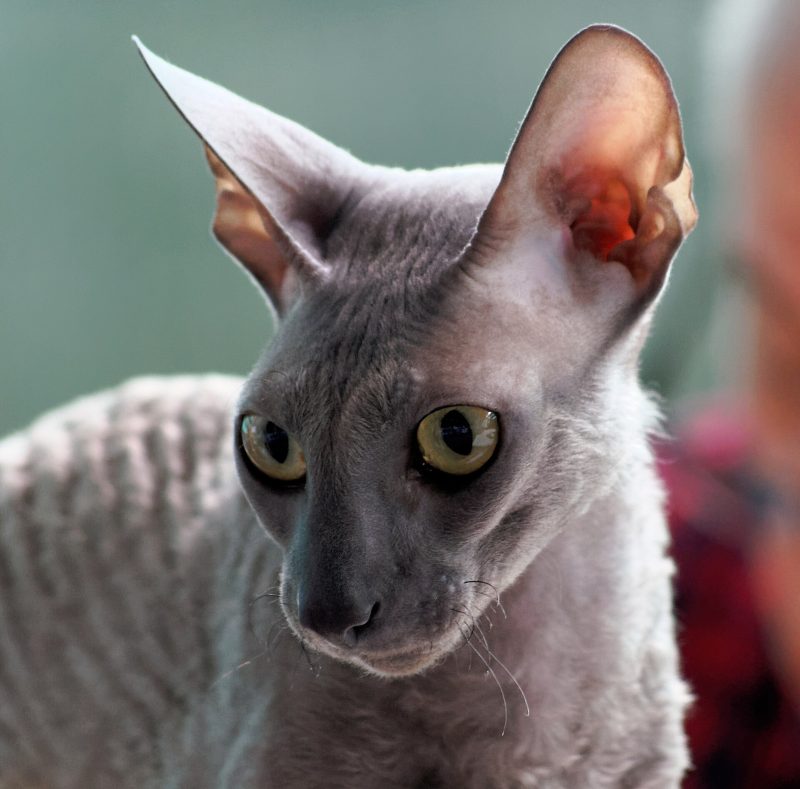
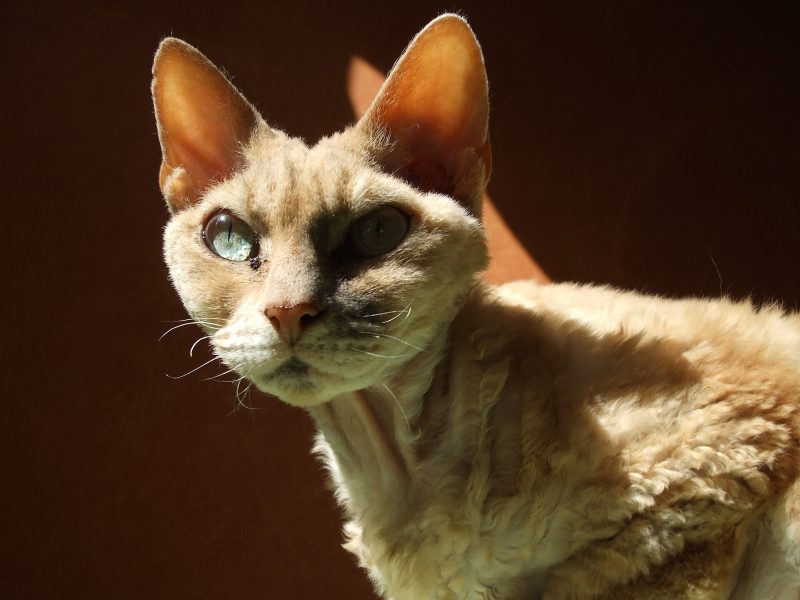
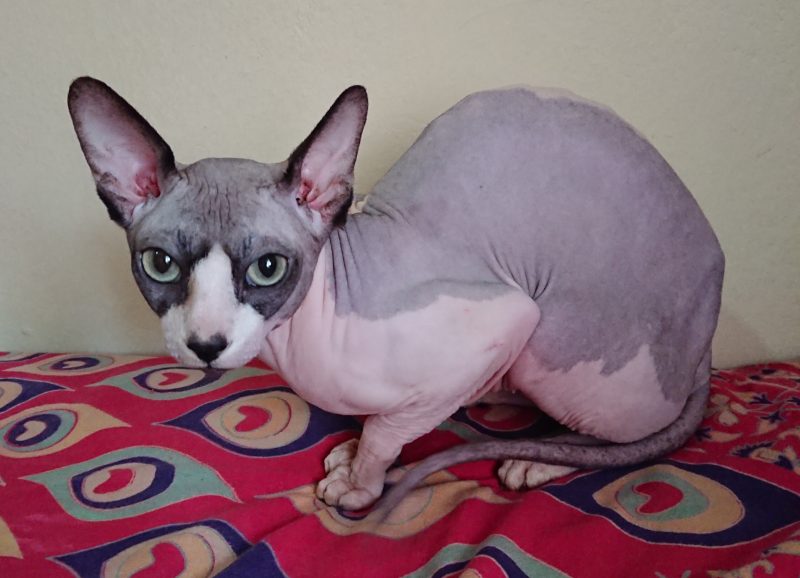
A Cornish Rex looks like a cat drawn with a fine pen. The body is small to medium, long and lean, with a naturally arched back, a tucked-up waist and very long, slim legs that make it stand tall; the tail is long and tapering. The head is a narrow egg with high cheekbones, a Roman nose, large oval eyes and enormous ears set high and alert. The coat is the point: there are no guard hairs at all, only a short, dense undercoat that falls in tight, even waves like a 1920s marcelled hairstyle, with crimped whiskers and eyebrows to match. It feels like warm velvet or crushed silk. Every color and pattern is accepted, including pointed and bicolor. The Devon Rex has a looser, more rumpled coat and a wide, pixie face with low-set ears; the Selkirk Rex is a heavy-boned cat with loose curls; the Sphynx is the hairless cousin. Rex kittens are sometimes nearly bald for a few weeks before the wave comes in, and the coat can thin in patches on some adults.
Temperament & Personality
Cornish Rexes are extroverts. They greet strangers at the door, climb into visitors' laps and are often the first cat to investigate a new dog. They are intensely people-oriented and earn the nickname Velcro cat by following their person everywhere, riding on shoulders and burrowing under blankets at night for warmth. The energy level is remarkable and does not fade with age; a ten-year-old Rex still does laps around the living room and leaps onto the tops of doors. They are clever and mischievous, opening cupboards, stealing food from plates and inventing games with whatever they find. Most are good with gentle children and enjoy other cats and dogs, and they are rarely aggressive. Vocally they are moderate, with a soft voice used freely. Because of the thin coat they seek heat compulsively, and a Rex curled against a radiator or inside a sunny windowsill is a common sight. Emotionally they are sensitive and dislike being left alone for long days.
Exercise & Activity
A Cornish Rex needs active play every day, in two or more sessions of fifteen minutes, plus an environment it can climb and explore. Wand toys with feathers or strings satisfy the chase instinct, and many Rexes fetch for as long as you will throw. Vertical space is essential: a tall cat tree, shelves, a window perch and permission to use the top of the wardrobe. Puzzle feeders and foraging toys keep the quick mind busy, and clicker tricks double as exercise. Watch the thermometer: the coat gives little insulation, so play in a warm room in winter and provide heated beds, and in summer keep the cat out of direct sun, where the thin coat lets the skin burn. A harness and a sunny, sheltered garden on a mild day is a treat.
Boredom looks like counter-surfing, cupboard raids, shredded tissues and night-time racing
A cat wheel suits this breed better than most
Training
Cornish Rexes are quick, food-driven learners, which makes clicker training easy and fun: sit, high five, jump through a hoop and come when called are all within reach of a few short sessions. Litter habits are reliable with a clean, roomy box; because the breed is small, a lower-sided box suits kittens and seniors. Scratching is normal and needs a sisal post and a cardboard scratcher, placed near favorite sleeping spots; nails need trimming every couple of weeks. Carrier training is worth doing early, since this cat will go to the vet for sunburn, ear cleaning and dental work over its life; make the carrier a cozy, heated bed. The breed takes to harness walking readily, and a jacket or sweater in cold weather is not an affectation. The main sticking points are theft and heights: train an incompatible behavior, such as sitting on a mat during meals, rather than trying to punish a cat that can leap onto any surface in the house. Socialize kittens to handling, bathing and ear cleaning so grooming stays easy.
Grooming & Care
The coat needs almost no brushing; in fact, a brush can damage the delicate waves. Stroke the cat with a soft grooming mitt or your hand to lift loose hairs, and that is usually enough. What does need attention is the skin. With no guard hairs to carry oil away, sebum builds up in the fur, especially on the back, between the toes and in the ears, and some cats develop a greasy feel or dark staining. A bath every few weeks with a mild cat shampoo, followed by a thorough towel dry in a warm room, keeps the skin clean; never use a blow dryer, which flattens the waves and frightens the cat. Ears produce wax faster than in most breeds and need a weekly wipe with a damp cotton pad. Clip nails every two to three weeks and brush teeth regularly. Check the skin for red patches or thinning fur and ask your vet if you see either.
Shedding is very light; the coat sheds mostly during baths
Sun protection: keep the cat out of midday sun; ask your vet before using any sunscreen
Health
Cornish Rexes are generally hardy and often live into their mid-teens. The heart condition hypertrophic cardiomyopathy (HCM) occurs in the breed; there is no Rex-specific DNA test, so breeders screen breeding cats by echocardiogram, and a murmur or rapid breathing at rest should be investigated. Patellar luxation, a kneecap that slips out of its groove, is reported occasionally and shows up as skipping on a hind leg. A DNA test for the rdAc form of progressive retinal atrophy, inherited from Siamese ancestors in several breeds, is available and some breeders use it. The coat creates practical issues rather than diseases: sunburn on ears and nose in strong sun, chilling in cold rooms, greasy skin and sometimes patches of thin or absent hair. Ear infections follow wax build-up if the ears are not cleaned. Dental disease is common, as in most small cats. Despite the reputation, the breed is not hypoallergenic; it produces the same Fel d 1 protein as other cats. Ask your vet about a baseline heart check and about any supplement before giving it.
Nutrition
A Cornish Rex is a small cat with a large appetite and a fast metabolism, and it will eat things most cats ignore, from olives to bread. Feed a complete, balanced diet for the life stage and divide it into three or four small meals a day, which suits a cat that burns energy constantly and keeps it from stealing. Measure portions; the lean frame shows weight gain quickly as a pot belly, and an overweight Rex loses its athletic edge and risks diabetes. A mix of wet and dry food supports hydration, and puzzle feeders slow a greedy eater. Because the breed loses heat through its thin coat, it may genuinely need a little more food in a cool house in winter; adjust with your vet rather than guessing. Keep human food out of reach, since onions, grapes, chocolate and cooked bones are dangerous and a Rex will help itself. Treats under ten percent of daily calories, fresh water in several places, and no supplements without a vet's say-so.
Living With This Breed
A Cornish Rex is an excellent apartment cat: small, clean, light-shedding and content indoors as long as it has company and things to climb. The house must be warm; a Rex in a drafty room is unhappy and may get sick. It is good with children who are gentle, with dogs that play nicely and with other cats, and it generally prefers to have another pet than to be alone. Indoor life is strongly recommended because of sunburn, cold and the breed's trusting nature with strangers.
Time alone: a workday is fine with a companion and puzzle toys; longer absences need a sitter who will play and provide warmth
For sitters: expect a cat on your shoulder; secure food, close cupboards, check the heating and keep it out of strong sun
Baths and ear cleaning are routine; a sitter on a long stay may need to continue them
Keep windows screened; this cat jumps higher than you expect
Interesting Facts
The first Cornish Rex, Kallibunker, was born in 1950 to an ordinary tortoiseshell-and-white barn cat; his owner knew the word rex from curly-coated rabbits.
The Cornish Rex and the Devon Rex, discovered in neighboring counties nine years apart, carry mutations in different genes, which breeders learned the hard way when crossing them produced only straight-coated kittens.
With no guard hairs, the coat is the shortest and finest of any furred breed, and even the whiskers curl.
The breed is sometimes called the greyhound of cats for its tucked waist, arched back and galloping run.
A Rex often feels warmer to the touch than other cats; its body temperature is normal, but there is less fur between your hand and the skin.
Cornish Rexes have a reputation for eating unusual foods, and owners trade stories of cats stealing olives, pasta and corn on the cob.
Breeds similar to the Cornish Rex
What Cornish Rex owners say
Real pets, photos, stories and tips from the SitterNation community — separate from the editorial guide above.
Log in to add your pet, photos, stories and tips.
Meet Cornish Rexs on SitterNation
No Cornish Rexs have joined yet. Owners can show their pet here from the pet's profile.
Cornish Rex community photos
No Cornish Rexs photos yet — be the first to share one.
Stories from Cornish Rex owners
No stories yet. What is life with yours really like?
Tips from Cornish Rex owners
No tips yet. One practical thing that works for you is enough.
Ask Cornish Rex owners
No questions yet. Ask the people who live with the breed.