Typical tendencies
Energy level
Needs a real outlet most days.
Good with children
A famously patient playmate for kids.
Good with other pets
Friends with everything that lives at home.
Shedding
Barely a hair on the sofa.
Vocalization
A comment now and then.
Sociability
Hates being left out of anything.
More traits
Exercise needs
Adaptability
Grooming needs
Trainability
Intelligence
Family friendly
Friendly with strangers
Apartment friendly
Overview
The Sphynx is the cat for people who want a companion that never leaves their side. Nearly hairless, warm to the touch and wrinkled like a peach that has been sat on, it is also one of the most outgoing breeds in the cat fancy, greeting visitors at the door and climbing into the nearest lap or hoodie. Males weigh 8 to 12 pounds, females 6 to 9, and registries give a lifespan of 10 to 15 years, though veterinary data suggest many die younger. A Sphynx suits a household that is home a lot, enjoys an interactive, slightly clownish pet and does not mind weekly baths and a little extra heating. It is a poor fit for anyone who wants an independent cat, keeps the house cold, lets cats roam outdoors or hopes that no fur means no allergies. The breed is not hypoallergenic, and it needs more hands-on care than most shorthairs, not less.
History & Origin
Hairless kittens have turned up in litters of ordinary cats for at least a century, but the modern Sphynx traces to Toronto, where in 1966 a black-and-white house cat named Elizabeth produced a hairless male kitten called Prune. Early attempts to breed from him ran into fertility problems and the Cat Fanciers' Association withdrew its early provisional status in 1971. The breed was rescued by a second wave of natural mutations: hairless barn kittens found in Minnesota in 1975 and 1976, among them Epidermis and Dermis, and three more found in Toronto in 1978, two of which went to the Netherlands and were bred to a Devon Rex. Breeders learned the trait was recessive and spent decades outcrossing to Devon Rex, American Shorthairs and domestic cats to widen the gene pool, which is why the breed is healthier than its tiny beginnings suggest. The CFA accepted the Sphynx for registration in 1998 and granted championship status in 2002; TICA had recognized it earlier. The unrelated Russian hairless breeds, the Don Sphynx and Peterbald, carry a different gene.
Appearance
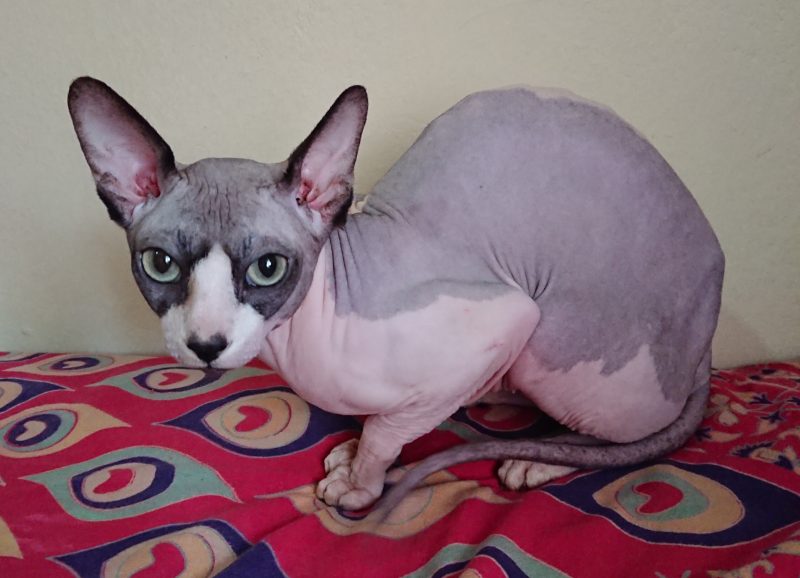
A Sphynx is medium-sized and surprisingly heavy for its look, with a broad chest, a rounded belly that the standard actually calls for, and hind legs slightly longer than the front. The head is a modified wedge with prominent cheekbones, a strong whisker break and enormous bat-like ears. The eyes are large and lemon-shaped, set wide apart, in any color. The tail is long, slender and whip-like, and the toes are long and knuckled, which gives the paws a hand-like dexterity. The skin feels like warm suede or a peach, with a fine down that is easier to feel than see, and a few short hairs usually remain on the nose, ears, toes and tail. Wrinkles are prized, especially around the muzzle, between the ears and across the shoulders. Because the pigment sits in the skin, a Sphynx can be any color or pattern: solid, tortie, tabby, pointed or bicolor. The Donskoy and Peterbald look similar but have narrower heads and a dominant, separate gene; the Bambino is a dwarf cross.
Temperament & Personality
Sphynx cats are extroverts. They want to be where you are, on you if possible, and will supervise cooking, typing and bathing with equal interest. They greet strangers rather than hiding, get along with dogs and other cats, and tolerate handling well, which makes them one of the better pedigreed cats for households with respectful children. Their energy is high and their sense of humor is obvious: a Sphynx will perform for an audience, knock things off shelves to get a reaction and invent games. They are vocal in a conversational way, usually asking for food, warmth or attention, but not shrill. The downside of all this devotion is that they do badly when left alone for long stretches and can become anxious or destructive. Many breeders recommend a pair, or at least another social pet. They are intelligent and quick to learn routines, including which drawer the treats live in.
Exercise & Activity
A Sphynx burns energy fast and needs 20 to 30 minutes of active play spread across the day, plus places to climb. Wand toys, fetch with crumpled paper or soft balls and food puzzles are the favorites. Tall cat trees, shelves and a heated window perch keep a Sphynx busy and warm at the same time. Because its long toes can open cabinets and drawers, cat-proofing is part of enrichment: give it a drawer of its own to raid. Temperature limits matter more than for any other breed. A Sphynx chills quickly in a cool house and will seek radiators, laptops and your bed; a sweater helps in winter. It also sunburns, so block direct sun through windows and never leave it outside unsupervised.
Two or three short, vigorous play sessions a day
Heated bed or fleece-lined hideaway for naps
Boredom shows as counter surfing, yowling and opening cupboards
Training
Few cats are easier to train than a Sphynx, because it is food-motivated, people-focused and already watching everything you do. Clicker training works well for sit, high five, spin and coming when called, and short sessions before meals get the best results. Litter habits are normally reliable; keep the box clean and away from drafts, since a cold cat may hold on or go elsewhere. Scratching posts are essential and should be tall and sturdy, because this breed scratches with enthusiasm; put one near where the cat sleeps. Carrier training pays off, as a Sphynx visits the vet and the bathtub more than most cats, so leave the carrier out with a warm blanket inside. Harness walks are possible in mild weather but need a sweater underneath in cooler months and sunscreen-free shade in summer. Socialize kittens to baths, ear cleaning and nail trims early so that weekly grooming becomes routine rather than a battle.
Grooming & Care
No fur does not mean no grooming. A Sphynx's skin produces the same oils a coated cat would spread into its fur, so without regular washing it turns greasy, leaves brown marks on bedding and can develop clogged pores or acne, especially on the chin and tail. Most owners bathe weekly to every other week with a mild cat shampoo and rinse thoroughly, drying the cat quickly so it does not chill. Between baths a damp cloth wipes the body and the skin folds. The ears produce a lot of dark wax and need cleaning weekly; the toes and nail beds collect grime and should be wiped too. Nails are trimmed every couple of weeks. Brush teeth several times a week, because periodontal disease is common in the breed. Watch for dry or flaky skin from over-bathing and for red bumps that may need a vet's opinion.
Bath every one to two weeks, ears and nails weekly
Wipe skin folds and chin between baths
Keep out of direct sun and cold drafts
Health
The Sphynx is a generally robust breed, but it carries one serious inherited concern: hypertrophic cardiomyopathy, a thickening of the heart muscle that can appear in young adults and in one study affected about a third of cats screened. There is no DNA test for the Sphynx form, so responsible breeders have breeding cats scanned by a veterinary cardiologist every year or two and share the results. A second condition, congenital myasthenic syndrome, formerly called hereditary myopathy, causes muscle weakness in kittens and is linked to a recessive COLQ gene variant shared with the Devon Rex; a DNA test identifies carriers so they are never bred together. Other issues seen in the breed include urticaria pigmentosa and other skin eruptions, periodontal disease, sensitive digestion, urate bladder stones, sunburn and skin cancer with sun exposure, and respiratory infections in young kittens, which is why breeders keep kittens until about 14 weeks. Ask your vet about an echocardiogram schedule and see them promptly for breathing changes, weakness or skin lesions. Registry figures put lifespan at 10 to 15 years, but UK veterinary records put average life expectancy for the breed nearer 7 years, the shortest of any breed studied.
Nutrition
A Sphynx runs warm and burns calories keeping itself that way, so it eats more per pound than most cats and tends to have a visible round belly even at a healthy weight. Feed a complete, balanced diet labeled for the cat's life stage, with kittens on a growth formula until about a year old. Several small meals a day suit the breed's high metabolism better than one large one, and food puzzles slow a fast eater while giving its brain something to do. Free feeding often leads to obesity in adults, so measure portions and adjust them to activity and body condition; ask your vet what weight to aim for. Some Sphynx have sensitive stomachs and do better on a consistent diet with changes made gradually. Skin health depends partly on diet, so ask your vet whether a food with added omega fatty acids is worth trying. Fresh water should always be available, ideally away from the food bowl.
Living With This Breed
A Sphynx is an indoor cat, full stop. Its skin cannot handle sun, cold or scrapes, and its friendliness makes it easy to steal. It adapts well to an apartment because its needs are company and warmth rather than space. Keep the home at a comfortable temperature, provide heated beds or fleece caves, and expect the cat to sleep under your covers. Long days alone are the breed's weak point; a second Sphynx, a cat-friendly dog or a sitter who visits twice a day is better than solitude. Children who handle gently are welcomed, and most Sphynx enjoy other pets. Visitors should know the cat will climb on them and may leave a faint oily mark on light clothing.
Sitters: keep doors and windows closed, the house warm and baths on schedule
Expect a cat that wants to be held and will follow you to the bathroom
Watch for shivering, sunbathing by windows and sudden breathing changes
Interesting Facts
The breed is named for the Great Sphinx of Giza, although the first Canadian breeders briefly called their cats Canadian Hairless and the name Sphynx was spelled with a y to make it distinctive.
Two Sphynx played Mr. Bigglesworth, Dr. Evil's cat in the Austin Powers films, which did more for the breed's fame than any cat show.
A Sphynx's skin shows every color and pattern a coated cat could have, including tabby stripes and Siamese-style points, printed directly on the skin.
The breed's hairlessness comes from a mutation in the same KRT71 keratin gene that gives the Devon Rex its curls.
Because it loses heat fast, a Sphynx feels noticeably warmer than a furred cat, and it is often described as a living hot-water bottle.
The Sphynx is often described as Canada's first native cat breed.
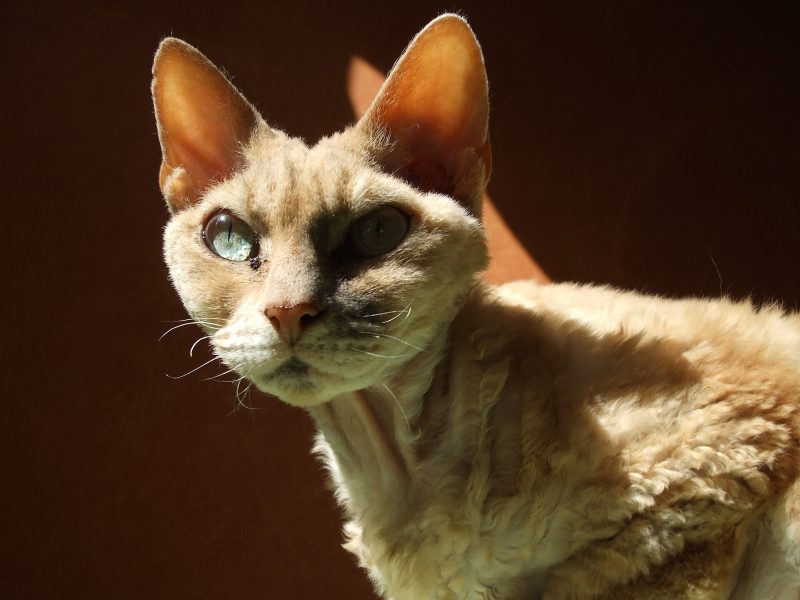
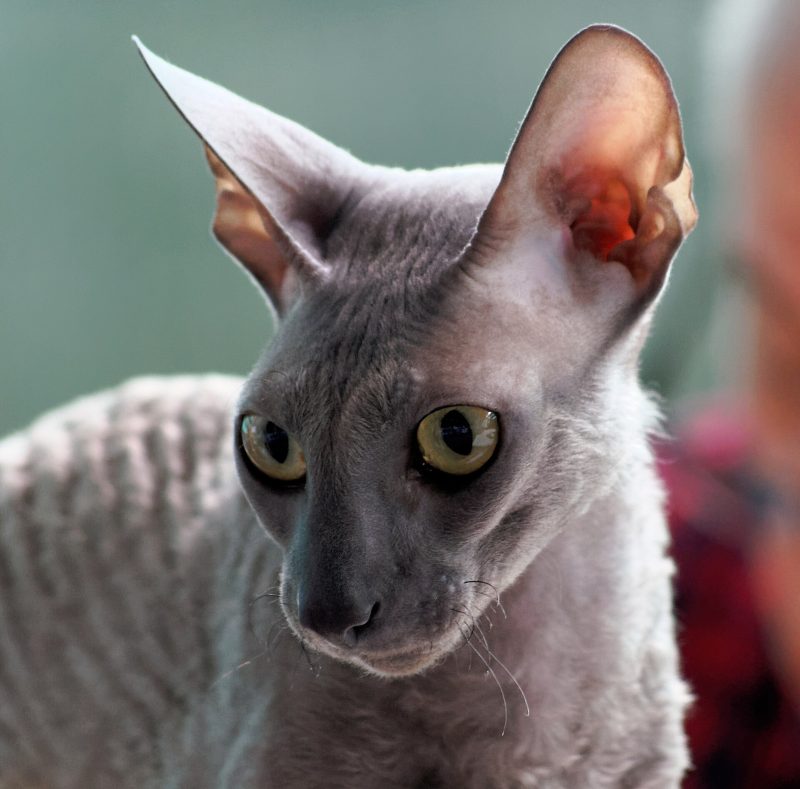
Breeds similar to the Sphynx
What Sphynx owners say
Real pets, photos, stories and tips from the SitterNation community — separate from the editorial guide above.
Log in to add your pet, photos, stories and tips.
Meet Sphynxs on SitterNation
No Sphynxs have joined yet. Owners can show their pet here from the pet's profile.
Sphynx community photos
No Sphynxs photos yet — be the first to share one.
Stories from Sphynx owners
No stories yet. What is life with yours really like?
Tips from Sphynx owners
No tips yet. One practical thing that works for you is enough.
Ask Sphynx owners
No questions yet. Ask the people who live with the breed.