Typical tendencies
Energy level
Always on; boredom turns into mischief.
Good with children
A famously patient playmate for kids.
Good with other pets
Friends with everything that lives at home.
Shedding
Barely a hair on the sofa.
Vocalization
A comment now and then.
Sociability
Hates being left out of anything.
More traits
Exercise needs
Adaptability
Grooming needs
Trainability
Intelligence
Family friendly
Friendly with strangers
Apartment friendly
Overview
The Devon Rex is a small, elfin cat with a pixie face, enormous low-set ears and a soft, rippled coat that feels like warm suede. Males weigh 8 to 10 pounds and females 6 to 8, and the breed lives 12 to 15 years. Devons suit people who are home a lot and want a cat that behaves like a mischievous toddler crossed with a lap dog: they ride shoulders, steal food, learn tricks and sleep under the covers. They are a poor fit for anyone who wants a dignified, independent cat or who is away for long days. Grooming is minimal, but the thin coat means they feel the cold and need warm beds and sunny spots. Families with children and dogs tend to love them. Expect to be followed everywhere, including into the shower.
History & Origin
In 1959 a curly-coated kitten was born to a stray tortoiseshell near a disused tin mine at Buckfastleigh in Devon, England. Beryl Cox, who had been feeding the mother, kept the kitten and named him Kirlee. A curly-coated breed, the Cornish Rex, had been discovered in the neighboring county ten years earlier, and Kirlee was offered to the Cornish breeding program. When Kirlee was mated to Cornish Rex queens, every kitten had straight hair, proving that his curl came from a different, recessive gene. Breeders then built a separate breed around him through the 1960s, outcrossing to British Shorthairs and other cats to widen the gene pool and then breeding back for the coat. The GCCF recognized the Devon Rex in 1967. The first Devons reached North America in 1968; ACFA accepted them in 1972 and TICA in 1979. CFA registered the breed separately from the Cornish in 1979 and granted championship status in 1983. Every Devon Rex alive descends from Kirlee.
Appearance
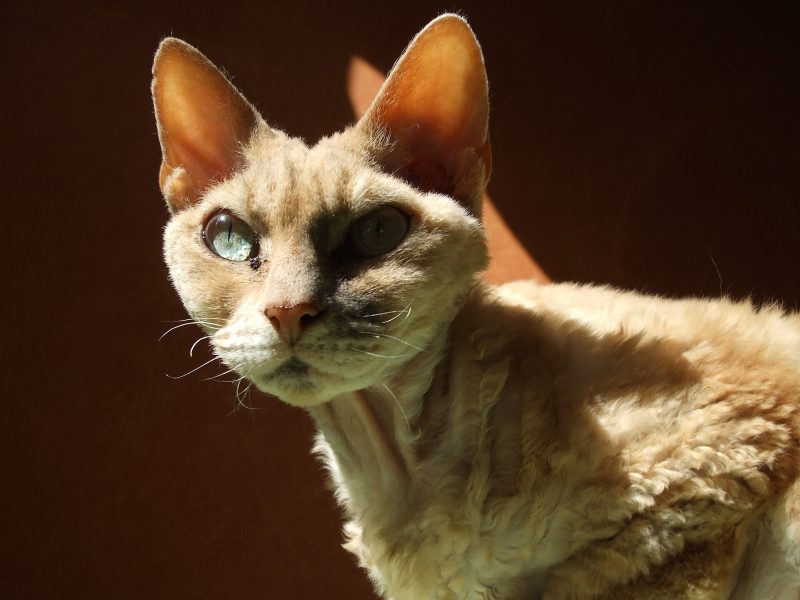
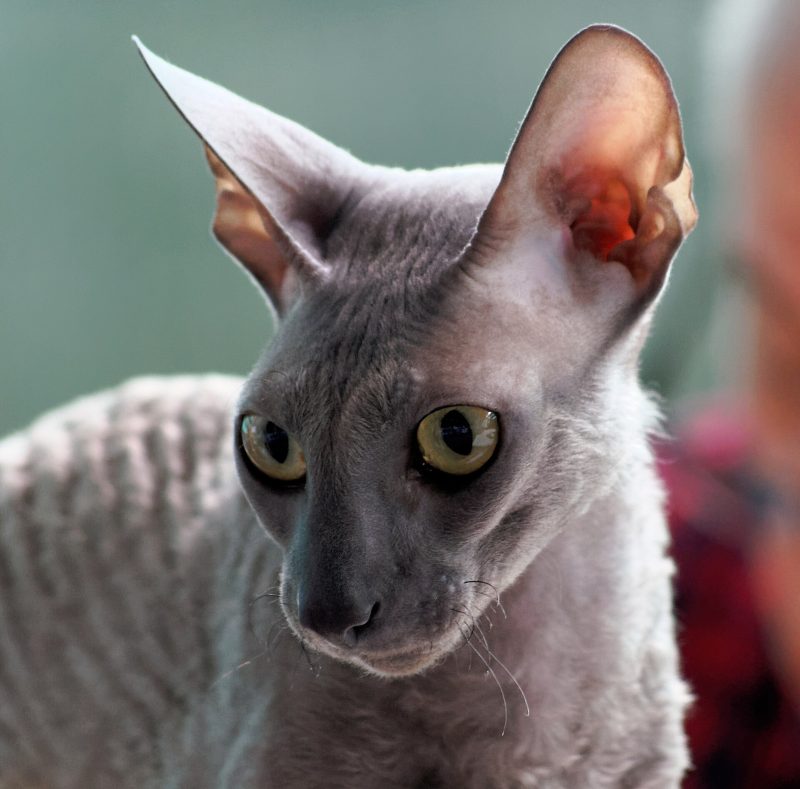
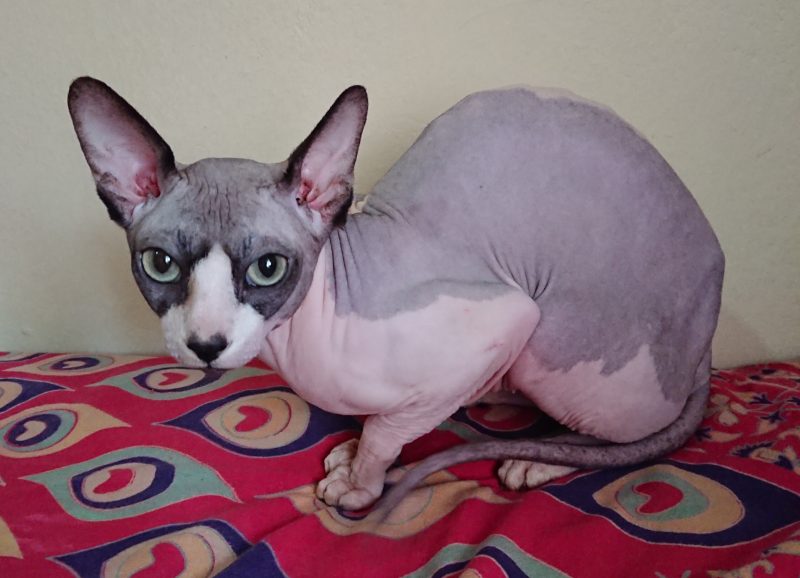
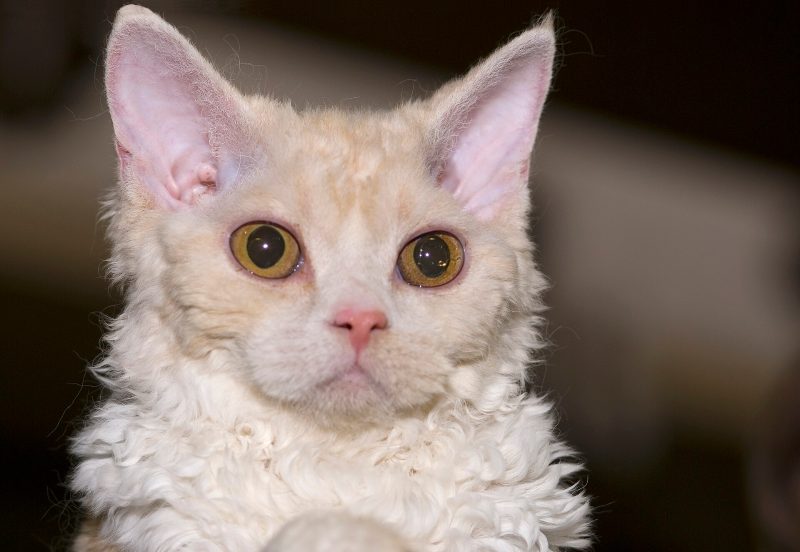
Nothing else looks quite like a Devon. The head is a short, broad wedge with prominent cheekbones, a short muzzle, a firm chin and a distinct stop at the bridge of the nose. The ears are huge, set very low and wide, and rounded at the tips, giving the famous pixie or bat-like expression; the eyes are large, oval and widely spaced, in any color. The body is small to medium but surprisingly muscular, with a broad chest, slender neck, long legs and a long, fine tail. The coat is short, soft and loosely waved, with sparse guard hairs that are themselves curled, so the texture is more rippled than frizzy; whiskers and eyebrows are crinkled and often break short. The coat varies with season and age, and some cats have thinner patches on the chest and belly. Every color and pattern is accepted. A Cornish Rex has a longer, narrower head, higher ears and a tighter washboard wave with no guard hair; a Sphynx is hairless.
Temperament & Personality
Devons are people cats to an extreme degree. A typical Devon rides on a shoulder, wedges itself between you and the laptop, inspects every visitor and sleeps pressed against its person under the duvet. They are playful into old age, inventive about mischief, and quick to learn where food is kept; many steal from plates and open cupboards. The voice is quiet, with chirps and trills more than meows. Strangers are greeted, not avoided, and children, dogs and other cats are generally welcomed as playmates. Energy is high but comes in bursts, with a Devon racing up a cat tree and then collapsing in the warmest spot in the house. They are loyal and can become anxious or destructive when left alone for long periods, so this breed does best with a companion animal or a household with someone usually home. Watchfulness is nil; a Devon assumes everyone is a friend.
Exercise & Activity
A Devon Rex needs real daily play: 30 minutes or more split into several sessions, more for a young cat. They are exceptional jumpers and climbers, so a tall cat tree, wall shelves and the tops of cupboards will all be used. Wand toys, thrown toys for fetch, feather teasers and laser dots that end on a real toy all suit the breed, and puzzle feeders and treat hunts occupy a clever mind. Many Devons walk on a harness and love a secure garden or catio. The thin coat offers little insulation, so keep play indoors in cold weather and provide heated beds; Devons also sunburn, so limit direct summer sun on light-colored cats. A bored Devon shreds paper, raids counters and swings from curtains.
Several play sessions daily, with climbing and fetch
Tall cat tree, shelves and puzzle feeders
Warm beds in winter, shade in summer
Training
Devons are among the most trainable cats, motivated by food, play and attention in roughly equal measure. Clicker training produces sit, come, spin, fetch and jump-through-a-hoop in short order; keep sessions to a few minutes and end on success. Litter training is easy, but place boxes where a cat in a hurry can reach them and scoop daily. Scratching is enthusiastic, so offer tall sisal posts and cardboard pads and reward their use. Carrier training should start in kittenhood: the carrier lives in the living room as a bed, treats appear inside, and short drives become normal. Harness training usually succeeds because Devons want to be wherever you are, including outdoors. The sticking points are counter-surfing and food theft; manage the environment, since no amount of training beats a Devon's appetite. Socialize kittens widely; they take to it eagerly.
Grooming & Care
The Devon is close to wash-and-wear, but its skin needs attention precisely because the coat is thin. Avoid brushes, which break the fragile hairs; instead smooth the coat with your hand or a soft chamois once a week to spread natural oils and remove loose hair. Oil can build up on the skin, especially in the ears, on the paws and in the skin folds, so wipe these weekly with a soft damp cloth and clean the large ears gently as needed; many Devons need a gentle bath every few weeks to control greasiness, with thorough drying afterward because they chill quickly. Trim nails every two weeks, since Devons climb. Brush teeth several times a week. Shedding is light but not absent, and the breed is not hypoallergenic.
Weekly wipe-down rather than brushing
Ears and skin folds checked weekly, bath as needed
Keep the cat warm after bathing
Health
Devon Rex are generally healthy and live 12 to 15 years, but a few inherited conditions are known. Congenital myasthenic syndrome, long called Devon Rex myopathy or spasticity, is a muscle weakness caused by a recessive mutation in the COLQ gene; affected kittens show weakness of the head and neck from a few weeks of age and a characteristic chin-on-chest posture. A DNA test identifies carriers, and breeders should use it. Hypertrophic cardiomyopathy occurs in the breed, and breeding cats should have regular echocardiograms. Patellar luxation and hip dysplasia are reported more often than in most cats. Hereditary hypotrichosis, a near-hairless coat, can appear in some lines. Blood type B is common, which matters for transfusions and for breeding, where a type-A kitten nursing from a type-B mother can die. Thin skin can bring greasy dermatitis and yeast overgrowth. Ask your vet about weakness, exercise intolerance, limping or skin odor.
Nutrition
Feed a complete and balanced food for the cat's life stage, with kitten food for the first year and adult maintenance thereafter. Devons burn energy quickly and feel the cold, so they often eat more per pound than placid breeds, but their appetite outruns their needs and they will beg, steal and gain weight. Measured meals two or three times a day, with treats counted in, keep them trim; a small cat shows weight gain fast, so check body condition monthly. Puzzle feeders and slow bowls suit a cat that bolts food. Wet food adds moisture and supports urinary health. Secure the trash, keep plates out of reach and warn guests, since this breed samples anything, including foods that are toxic to cats. Cats with the muscle disorder may need special feeding positions and textures, which your vet will advise. Ask your vet before supplements.
Living With This Breed
A Devon Rex thrives anywhere its people are, from a studio apartment to a farmhouse, as long as there is vertical space and company. It is an indoor cat: the thin coat gives little protection from cold or sun, and its trust in everyone makes it an easy target. Heated beds, blankets and sunny windows keep it comfortable, and air conditioning should not blow directly on its sleeping spots. Children, dogs and other cats are usually welcomed, and a second pet eases the loneliness this breed feels when alone. Secure food and small objects; Devons chew and steal.
Sitters: expect a cat on your shoulder and in your bag
Keep it warm; a shivering Devon needs a blanket, not more play
Lock away food, medicines and string
Interesting Facts
The founding cat, Kirlee, was born in 1959 near an old tin mine in Buckfastleigh and was first mistaken for a Cornish Rex until test matings proved otherwise.
Nicknames include pixie cat, alien cat and poodle cat, all earned by the big ears and rippled coat.
Devons are not hypoallergenic; they shed less, but they still produce the Fel d 1 protein that triggers allergies.
Their whiskers are curly and brittle, so many Devons seem to have no whiskers at all.
A Devon Rex feels warmer to the touch than other cats because the thin coat lets body heat through, although its actual temperature is normal.
Many Devons eat fruit and vegetables, and owners report cats that beg for melon, olives and corn on the cob.
Breeds similar to the Devon Rex

What Devon Rex owners say
Real pets, photos, stories and tips from the SitterNation community — separate from the editorial guide above.
Log in to add your pet, photos, stories and tips.
Meet Devon Rexs on SitterNation
No Devon Rexs have joined yet. Owners can show their pet here from the pet's profile.
Devon Rex community photos
No Devon Rexs photos yet — be the first to share one.
Stories from Devon Rex owners
No stories yet. What is life with yours really like?
Tips from Devon Rex owners
No tips yet. One practical thing that works for you is enough.
Ask Devon Rex owners
No questions yet. Ask the people who live with the breed.