Typical tendencies
Energy level
Ready to go when you are, settles after.
Good with children
A famously patient playmate for kids.
Good with other pets
Friends with everything that lives at home.
Shedding
Noticeable, with heavier seasonal blows.
Vocalization
Speaks up only when something matters.
Sociability
Follows the household from room to room.
More traits
Exercise needs
Adaptability
Grooming needs
Trainability
Intelligence
Family friendly
Friendly with strangers
Apartment friendly
Overview
The Selkirk Rex is the cat in sheep's clothing: a round-faced, heavy-boned cat built like a British Shorthair and covered in loose, plush curls that come in both short and long coats. It suits people who want a mellow, cuddly, tolerant companion that enjoys being handled and makes a sturdy playmate for children, a calm friend for dogs and an easy roommate for other cats. Selkirks are affectionate without being needy, playful in a relaxed way and quiet. The curly coat is softer than it looks and sheds moderately; it needs combing but not the daily labor of a Persian. You'll need to accept a cat that matures slowly, enjoys its food and would rather occupy your lap than your bookshelf, and a breeder who tests for the kidney and heart conditions inherited from the breeds used to build it. For a laid-back cat with an unforgettable look, the Selkirk is the one.
History & Origin
The breed began with a single curly kitten born in 1987 in a litter of ordinary shelter cats in Montana. The kitten, with her wavy coat and curled whiskers, was placed with Persian breeder Jeri Newman, who named her Miss DePesto and, when she was old enough, bred her to a black Persian. Three of the six kittens were curly, which showed that the gene was dominant, unlike the recessive Cornish and Devon Rex genes. Newman named the breed after her stepfather, making it the only cat breed named after a person. Persians, British Shorthairs, Exotic Shorthairs and American Shorthairs were used as outcrosses to build a substantial, round-headed cat around the coat. TICA accepted the breed in the early 1990s and CFA accepted it for registration in 1992 and for championship in 2000; FIFe recognized it in 2015 and the GCCF also registers it. Researchers later traced the curl to a splice variant in the KRT71 gene, the same gene involved in the Devon Rex and Sphynx coats. CFA closed Persian outcrosses in 2020 and now requires both parents to be Selkirk Rex for kittens born from 2025.
Appearance
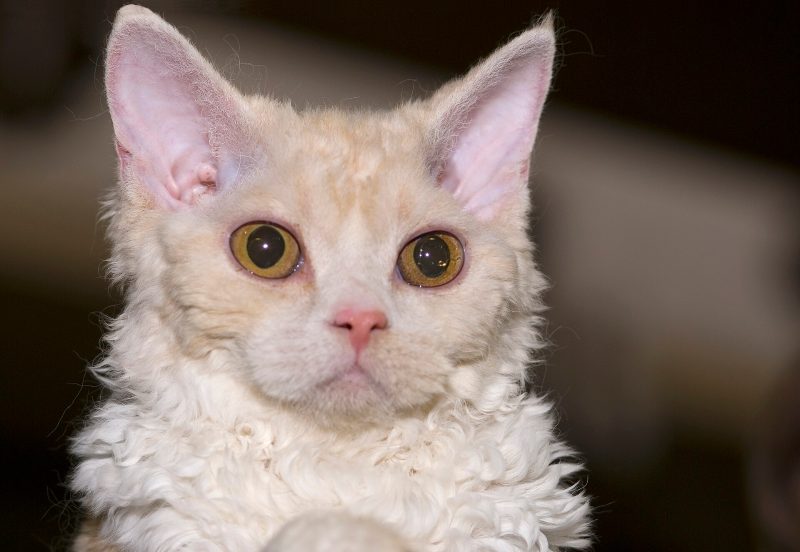
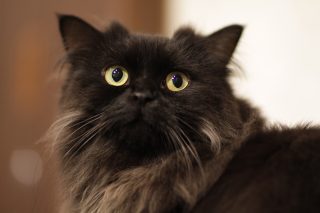
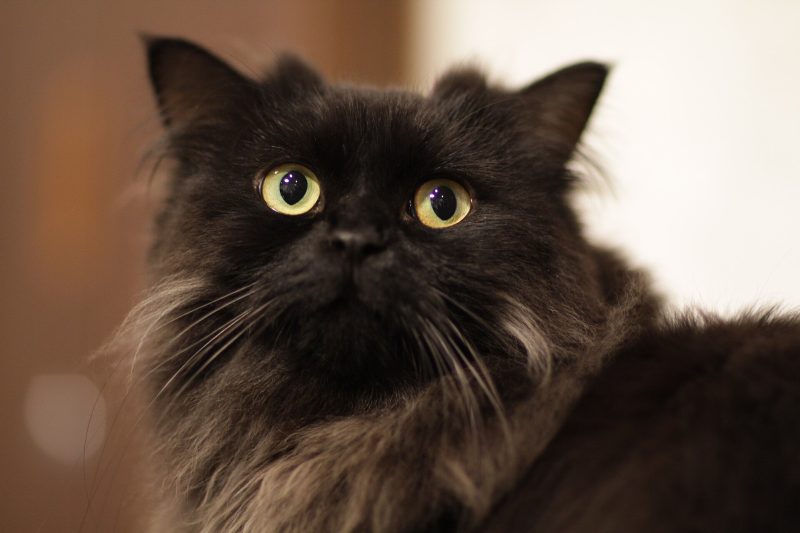
The Selkirk Rex is a medium to large cat with heavy bone, a muscular, rectangular body and a round head with full cheeks, a short muzzle, prominent whisker pads and large round eyes that give it a sweet, slightly surprised expression. The ears are medium and set well apart. The coat is the signature: loose, random curls arranged in soft clumps rather than tight waves, most pronounced around the neck, on the belly and on the tail, with curly whiskers that are brittle and often break. Shorthaired Selkirks have a dense, plush coat with curls like a lamb's; longhaired Selkirks have a ruff that frames the face, curly britches and a plumed tail of loose ringlets. Every color and pattern is accepted, including pointed, and all eye colors occur. Cats with one copy of the curl gene have the full, loose coat the standard asks for; cats with two copies have a tighter, sparser curl. Straight-coated kittens, called Selkirk Straights, appear in litters and look like British Shorthairs. Curl develops over time, often looking straighter in adolescence and fullest at around two years.
Temperament & Personality
Selkirks are easygoing, patient and affectionate. They enjoy being picked up, carried and cuddled far more than most cats, which makes them good with children who are taught to be gentle, and they are known for persistent, good-natured attention-seeking: a paw on your arm, a head under your hand, a quiet presence on the keyboard. They are playful without being manic, happy to chase a toy for a few minutes and then retire to a lap or a warm spot. Energy is moderate and settles with age. They are confident with strangers, usually greeting visitors rather than hiding, and they get along well with dogs and other cats. The voice is soft and rarely used, though many will chirp back when spoken to. The breed inherited a measure of the British Shorthair's reserve and the Persian's calm, blended with a sense of humor of its own. A Selkirk does not demand constant stimulation, but it does want company and will mope if left alone too much.
Exercise & Activity
A Selkirk needs moderate daily play to stay fit: two sessions of ten to fifteen minutes with a wand toy, a thrown mouse or a rolling treat ball, pitched at a cat that enjoys a chase but does not need to run marathons. A cat tree with broad, stable platforms suits this heavy cat better than narrow perches, and a window seat with a view keeps it entertained. Puzzle feeders and foraging games give the mind something to do and slow down a breed that likes its food. Clicker tricks count as exercise too. The thick coat makes heat uncomfortable, so play in a cool room in summer and provide a tile floor or cooling mat; winter is no problem. Because weight gain is the breed's main fitness risk, keep play a daily habit even when the cat seems content to nap.
Boredom looks like over-eating, over-sleeping and the occasional midnight gallop
Heavier cats need gentle, low-impact games to protect hips and joints
Training
Selkirks are calm, food-motivated and tolerant, which makes them pleasant to train even if they are not the fastest learners. Clicker sessions of a few minutes teach sit, touch, come and entering the carrier, and the breed's willingness to be handled makes vet visits and grooming easier than in most cats. Litter habits are reliable with a large, clean box and a litter the cat likes; longhaired Selkirks may need a sanitary trim so that litter does not cling. Scratching is ordinary and satisfied by a tall sisal post and a horizontal scratcher; trim nails every two to three weeks. Make the carrier a bed from the start, since this is a heavy cat to wrestle into one. Harness training is possible for a cat that is relaxed and curious, and a stroll in a quiet garden is an enjoyable outing. Begin grooming tolerance in kittenhood: brief combing sessions, handling the ears and paws and the occasional bath, all paired with treats. Socialize kittens to children, visitors and dogs; the breed's natural confidence makes this easy.
Grooming & Care
The Selkirk coat looks high-maintenance but is moderate in practice, and the main rule is not to overdo it. Comb once or twice a week with a wide-toothed comb to remove dead hair and prevent clumps, then fluff the curls with your fingers; brushing too often or too hard pulls the curl out and leaves the coat frizzy. Longhaired Selkirks need combing two or three times a week, with attention to the ruff, armpits, belly and britches, and a hair pick helps separate large clumps. Shedding is moderate and heavier in spring and fall. The skin can become oily, especially around the ears and on the back, so a bath every few weeks with a mild cat shampoo helps; towel dry and let the curls spring back on their own rather than using a dryer. Ears may collect wax and need a wipe when dirty. Clip nails every two to three weeks and brush teeth regularly.
Do not brush daily; comb lightly and finger-fluff
Curly whiskers break easily; this is normal
Health
The Selkirk Rex has no diseases unique to it, but it inherited risks from the breeds used to build it, and good breeders screen for all of them. From the Persian and British Shorthair side comes polycystic kidney disease (PKD), a dominant disorder in which cysts gradually destroy the kidneys; a DNA test for the PKD1 mutation identifies affected cats, and an ultrasound can confirm. Hypertrophic cardiomyopathy (HCM), the thickening of the heart muscle common in British Shorthairs, is screened by echocardiogram, since no Selkirk-specific DNA test exists. Hip dysplasia occurs in heavy-boned cats and may show as reluctance to jump; some breeders have hips X-rayed. The early-onset Persian form of progressive retinal atrophy (AIPL1) has a DNA test. British Shorthair ancestry also brings blood type B, so breeders type their cats to avoid newborn kittens being harmed by incompatible milk. Day to day, watch for obesity, ear wax build-up and skin oiliness. Lifespan is typically twelve to fifteen years. Ask the breeder for PKD and PRA DNA results and an HCM scan on the parents, and ask your vet about a baseline heart check.
Nutrition
Feed a complete, balanced diet for the life stage. Selkirks mature slowly and can stay on growth food for the first year, but they also love to eat and carry weight easily under that forgiving coat, so measured meals two or three times a day are better than free feeding. Weigh the cat monthly and feel for ribs; a round Selkirk is not necessarily a fat one, but a missing waist is a warning. Wet food adds water, which matters for a breed with PKD in its ancestry, and a fountain encourages drinking. Puzzle feeders slow a greedy eater and add activity. During the spring and fall sheds, a hairball-control formula or added fiber may help the longhaired variety; ask your vet. Keep treats under ten percent of daily calories and skip supplements unless your vet recommends one. Older, heavier cats may benefit from a joint-support diet, again on veterinary advice.
Living With This Breed
The Selkirk Rex is an adaptable house cat that suits apartments and family homes alike. It is quiet, not an escape artist and happy indoors, with a catio or harness walks as a bonus. It prefers a cool home; thick curls and a heat wave make for a miserable cat. Children who handle it gently will find a tolerant, cuddly friend, and dogs and other cats are usually accepted after a calm introduction. Shedding is moderate, so expect some curly hair on dark furniture.
Time alone: a workday is fine, especially with a companion; for trips a daily sitter visit with play and a quick comb is enough
For sitters: it will likely come to you for a cuddle; comb lightly if asked, never brush hard, keep the house cool and note appetite
Weight: measure food exactly; this cat is persuasive
Allergies: the curly coat does not make it hypoallergenic
Interesting Facts
The founding cat, Miss DePesto, was named after a character in the 1980s TV series Moonlighting and came from a Montana shelter litter in 1987.
The Selkirk is the only cat breed named after a person, breeder Jeri Newman's stepfather.
Its curl gene is dominant, so one curly parent can produce curly kittens, unlike the Cornish and Devon Rex.
Straight-coated kittens from Selkirk litters, called Selkirk Straights, are registered and used in breeding but cannot be shown.
Breeders call it the cat in sheep's clothing and the sheep cat for its lamb-like coat.
Newborn Selkirks have curly whiskers and a curly coat, but the curl often straightens for months before returning fully at around two years.
Breeds similar to the Selkirk Rex
What Selkirk Rex owners say
Real pets, photos, stories and tips from the SitterNation community — separate from the editorial guide above.
Log in to add your pet, photos, stories and tips.
Meet Selkirk Rexs on SitterNation
No Selkirk Rexs have joined yet. Owners can show their pet here from the pet's profile.
Selkirk Rex community photos
No Selkirk Rexs photos yet — be the first to share one.
Stories from Selkirk Rex owners
No stories yet. What is life with yours really like?
Tips from Selkirk Rex owners
No tips yet. One practical thing that works for you is enough.
Ask Selkirk Rex owners
No questions yet. Ask the people who live with the breed.