Typical tendencies
Energy level
Ready to go when you are, settles after.
Good with children
Gentle and tolerant around children.
Good with other pets
Friends with everything that lives at home.
Shedding
A light scatter, easy to keep up with.
Vocalization
A comment now and then.
Sociability
Hates being left out of anything.
More traits
Exercise needs
Adaptability
Grooming needs
Trainability
Intelligence
Family friendly
Friendly with strangers
Apartment friendly
Overview
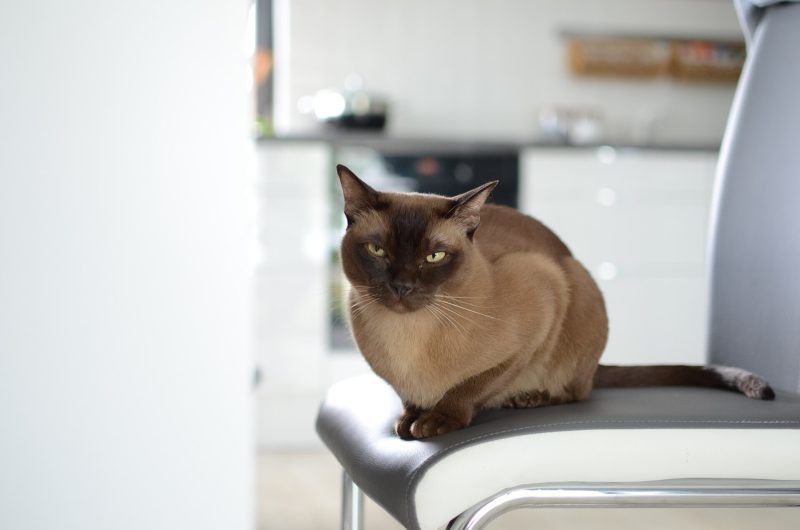
The Havana Brown is a rare, glossy, chocolate-colored cat with vivid green eyes and a habit of reaching out to touch whatever interests it, people included. It is medium-sized and moderate in every way: males weigh 8 to 10 pounds, females 6 to 8, and the breed lives 12 to 15 years or longer. Temperament is affectionate, inquisitive and quietly devoted, with a soft voice and a strong need for company. It suits apartments and houses alike, singles and families with considerate children, and homes with other pets, since Havanas prefer not to be alone. It is a poor fit for anyone who wants an independent cat or who is away for long days. Grooming is minimal. Finding one is the hard part; only a small number of breeders exist, mostly in North America. Sitters can expect a cat that watches, then investigates, then settles in a lap.
History & Origin
Solid brown cats of Siamese type were shown in Europe in the 1890s, sometimes called Swiss Mountain Cats, but a 1920s ruling by the Siamese Cat Club of Britain against brown cats without blue eyes pushed them out of the fancy. After the Second World War a small group of English breeders set out to recreate a self-brown cat by crossing seal-point and chocolate-point Siamese with black domestic shorthairs, with a little Russian Blue in some lines. A chocolate male named Elmtower Bronze Idol, born in 1952, was the first registered. The GCCF recognized the breed in 1958 as the Chestnut Brown Foreign, later renamed Havana, and in Britain it developed into today's Oriental type. Cats exported to the United States in the mid-1950s, notably Roofspringer Mahogany Quinn, founded a separate line that kept the original moderate head. CFA registered the breed in 1959 and granted championship status in 1964. Outcrossing closed in 1974, and the resulting bottleneck led to supervised outcross programs beginning in the late 1990s and formalized again in 2019.
Appearance
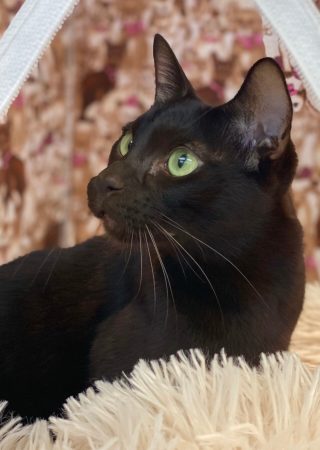
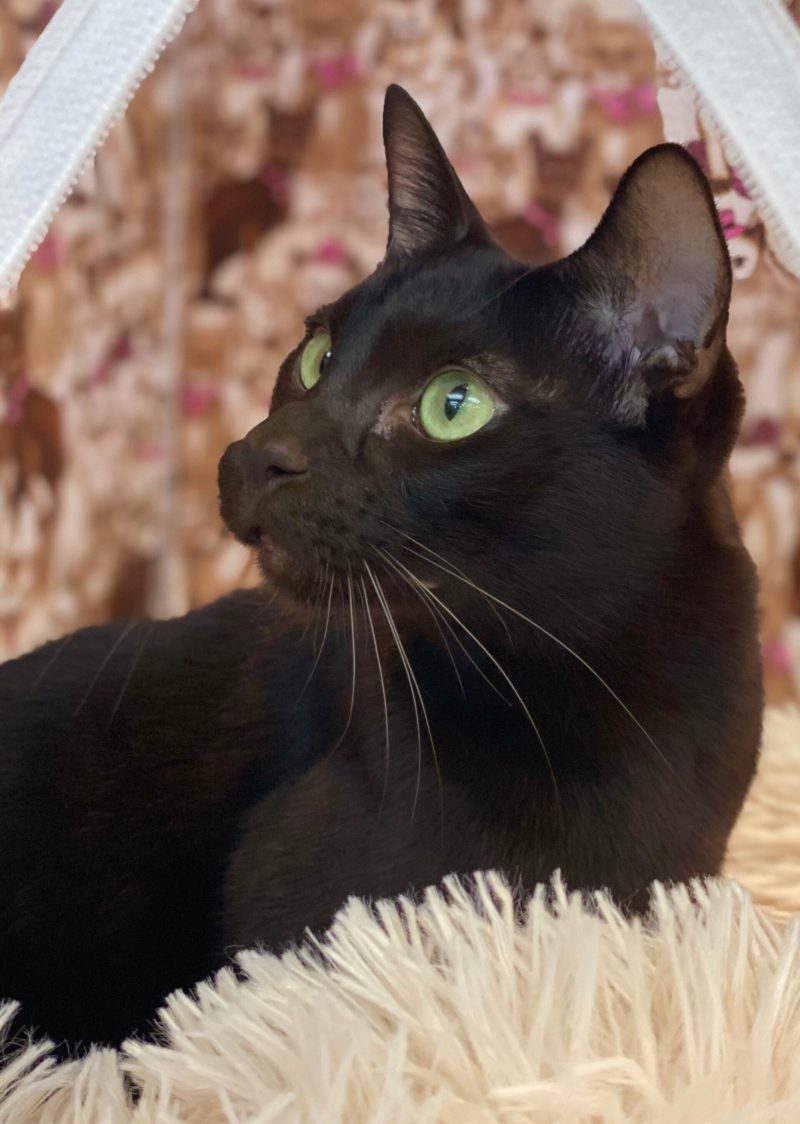
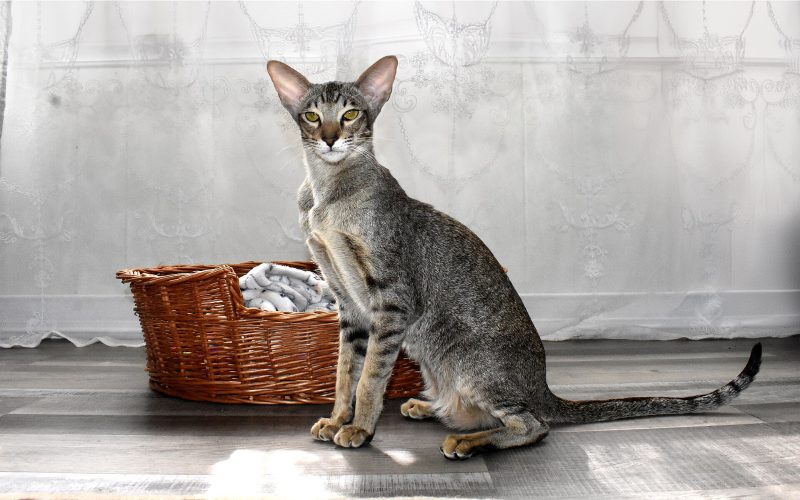
The Havana Brown is a medium cat of medium build, muscular and surprisingly solid, with males noticeably larger than females. What sets it apart is the head: longer than it is wide, with a distinct stop at the eyes and a rounded muzzle that juts forward beyond prominent whisker pads, a shape breeders compare to a corncob or a light bulb. The ears are large, round-tipped, wide-set and tilted forward, giving an alert look, and the oval eyes are a clear, even green, the deeper the better. The coat is short to medium, smooth and glossy, in a rich, warm chocolate to mahogany brown that is even from root to tip, with brown whiskers, a rosy-brown nose and paw pads to match. Some registries also accept a lilac dilute. Compared with a chocolate Oriental Shorthair the Havana is sturdier, with a shorter head and a very different muzzle; next to a Burmese it is longer-bodied and never sable.
Temperament & Personality
A Havana Brown is curious without being pushy. Its signature move is to extend a paw and touch: a new object, a sleeping dog, your cheek when it wants attention. It is affectionate and people-oriented, follows its owner from room to room and likes to be in the same chair, but it tends to watch and wait rather than demand. Individuals vary; some are shy and bond to one person, others are outgoing with everyone, so meeting the kitten's parents is useful. The voice is soft, more trill than meow, and the breed is moderately active: playful in bursts, then content to rest. Havanas usually get on well with other cats and gentle dogs and often prefer having an animal companion. They are patient with children who are calm. Left alone for long stretches they become withdrawn or anxious, which is why breeders often recommend a pair.
Exercise & Activity
Two play sessions of 10 to 15 minutes a day suit most Havana Browns, with wand toys, soft balls to carry around and games that reward the breed's tactile curiosity, such as toys hidden under a towel or inside a puzzle box. Many fetch. Provide a cat tree and a window perch, because this is a cat that likes to observe, and a rotating selection of small toys to be batted and carried. Puzzle feeders give the clever mind a job when you are out. Harness walks in a quiet area are enjoyed by many once trained. The short coat offers modest insulation, so a warm bed or a sunny spot matters in winter. Boredom shows as pawing at you for attention, carrying objects around the house and rearranging small items on shelves.
Two short daily play sessions with carry-and-fetch toys
Window perch and climbing tree for observation
Puzzle feeders and hidden treats for solo time
Training
Havanas learn quickly when training is gentle and rewarding. Clicker work for come, sit, high five and targeting suits the breed's paw-oriented nature; target training in particular comes naturally to a cat that already touches things. Keep sessions short and end on success. Litter habits are reliable; one box per cat plus one, scooped daily, and any change in habits is a reason to see the vet. Give a tall sisal post and a horizontal scratcher, placed where the cat already stretches, and reward their use. Leave the carrier out as a bed and feed treats inside so vet trips are easy; the breed is known for traveling well. Harness training usually succeeds with a slow indoor start. Socialize kittens to visitors, handling and other animals early, since shyness runs in some lines. The breed is not stubborn; its main sticking point is sensitivity, so avoid harsh corrections.
Grooming & Care
The glossy coat needs little work. A weekly session with a soft bristle or rubber brush removes loose hair, followed by a wipe with a chamois or a damp cloth to polish the shine. Shedding is light and the coat does not mat. Baths are rarely needed. Trim nails every two to three weeks, check the large ears monthly for wax and clean only the visible surface with a vet-approved product. Dental care matters: Havanas and related Siamese-type breeds are prone to gum disease, so brush several times a week with cat toothpaste and ask your vet about professional cleanings. Check the eyes for discharge and wipe gently. An oily or dull coat on a cat that has stopped grooming itself is worth a vet visit.
Weekly soft brush and chamois polish
Nails every two to three weeks, ears monthly
Dental care several times a week; gum disease is the main risk
Health
The Havana Brown is generally healthy and long-lived, often reaching 15 years and beyond, and no disorder unique to the breed has been documented. The concern is genetic: with fewer than a thousand cats alive at the turn of the century, the gene pool is very small, which is why the breed's outcross program now requires DNA screening of breeding cats and why buyers should ask breeders what testing they do. Conditions to be aware of are those of Siamese-type cats generally: dental and gum disease, which appears early in some lines, and the universal feline risks of hypertrophic cardiomyopathy, obesity and kidney disease in later life. There is no breed-specific DNA test, so responsible breeders rely on the general feline genetic panels, cardiac ultrasound where indicated and careful pedigree management. Ask your vet about an annual exam with a dental assessment, weight tracking and senior bloodwork from about ten years old.
Nutrition
Feed a complete and balanced food with a nutritional adequacy statement for the cat's life stage: kitten formula to about twelve months, adult thereafter, with a senior review from ten. Havanas are moderately active and can gain weight if free-fed, so measure two or three meals a day rather than leaving a bowl out. Puzzle feeders suit the breed's paw-and-poke style and slow down eating. Wet food adds water, which supports the kidneys and urinary tract; a fountain encourages drinking. Treats count toward the daily total and should stay under a tenth of calories. Check body condition monthly by feeling for ribs under a thin layer of flesh and looking for a waist from above. Sitters should feed exactly the amount the owner measures out and report any appetite change; a Havana that stops eating is telling you something, and your vet should hear about it quickly.
Living With This Breed
A Havana Brown fits an apartment or a house, a single owner or a family, provided someone is around for a good part of the day or there is another pet. It is quiet, clean and not destructive, and neighbors will not hear it. Children who are calm get a gentle, playful friend; rough handling makes this sensitive breed hide. Other cats and cat-friendly dogs are generally welcomed. Keep it indoors, since it is trusting and not street-smart, and warm, since the coat is thin.
Sitters: expect a paw on your arm when it wants something
Give a warm bed and a window perch
Travels and boards better than most if introduced early
Watch for hiding or appetite loss, which signal stress
Interesting Facts
The breed's name is usually traced to the color of a Havana cigar, though some say it was borrowed from the Havana rabbit of the same shade.
Elmtower Bronze Idol, born in England in 1952, was the first Havana Brown ever registered.
Breeders nicknamed the cats Brownies, after the helpful household spirits of Scottish folklore.
The Havana Brown is one of the few breeds whose standard requires brown whiskers.
In the late 1990s fewer than a thousand Havanas existed worldwide, and only 36 were registered with CFA in 1997.
In Britain the same early cats evolved into the chocolate Oriental, so a UK Havana and a North American Havana Brown now look quite different.
Breeds similar to the Havana Brown
What Havana Brown owners say
Real pets, photos, stories and tips from the SitterNation community — separate from the editorial guide above.
Log in to add your pet, photos, stories and tips.
Meet Havana Browns on SitterNation
No Havana Browns have joined yet. Owners can show their pet here from the pet's profile.
Havana Brown community photos
No Havana Browns photos yet — be the first to share one.
Stories from Havana Brown owners
No stories yet. What is life with yours really like?
Tips from Havana Brown owners
No tips yet. One practical thing that works for you is enough.
Ask Havana Brown owners
No questions yet. Ask the people who live with the breed.