Typical tendencies
Energy level
Needs a real outlet most days.
Good with children
A famously patient playmate for kids.
Good with other pets
Friends with everything that lives at home.
Shedding
A light scatter, easy to keep up with.
Vocalization
Talkative, with opinions on most things.
Sociability
Hates being left out of anything.
More traits
Exercise needs
Adaptability
Grooming needs
Trainability
Intelligence
Family friendly
Friendly with strangers
Apartment friendly
Overview
The Japanese Bobtail is the cat of the beckoning-cat figurine: a slim, long-legged cat with a pom-pom tail, a triangular face and a confident, chatty personality. It suits active households that want a cat involved in everything, including the children's games, the dog's walks and the contents of your handbag. Bobtails fetch, carry toys about, talk in a soft, musical voice and adapt to new people and places with ease, which makes them excellent family cats and good travelers.
They are intelligent and easy to train, and the short tail comes from a gene that does not affect the spine, so the breed is sturdy and healthy. Grooming is minimal for the shorthair and light for the longhair. The breed is rare outside Japan, so expect a wait for a kitten. For a quiet home that wants a decorative, independent cat, it is the wrong choice; a Bobtail wants company and conversation.
History & Origin
Short-tailed cats reached Japan from the Asian mainland more than a thousand years ago, probably aboard ships carrying goods and Buddhist scriptures. They appear in paintings, woodblock prints and carvings from medieval Japan, and for a time they were kept largely by the court and the nobility. In 1602 an edict ordered cats released to protect the silk industry from rodents, and the bobtailed cats spread through farms, streets and temples, where they became the ordinary cat of Japan. The maneki-neko, the beckoning cat with a raised paw that sits in shop windows worldwide, is modeled on a tricolor Bobtail.
The breed came to the West when Elizabeth Freret imported the first cats to the United States in 1968, and a small group of breeders built the gene pool from further imports. CFA granted championship to the shorthair in 1976 and to the longhair in 1993; TICA recognizes both. American breeders have since imported Japanese street cats to keep the breed diverse.
Appearance
The Japanese Bobtail is a medium-sized, slender cat with long, clean lines and the look of a cat on tiptoe, because the hind legs are longer than the front. The head is an equilateral triangle with high cheekbones, a long nose, large upright ears set wide apart and large oval eyes slanted at a pronounced angle, in any color including blue and odd-eyed. The tail is the signature: a short, kinked or curved bundle of vertebrae, usually two to three inches long, carried like a pom-pom or a rabbit's scut and unique to each cat, like a fingerprint. It may be rigid or flexible and is always sensitive.
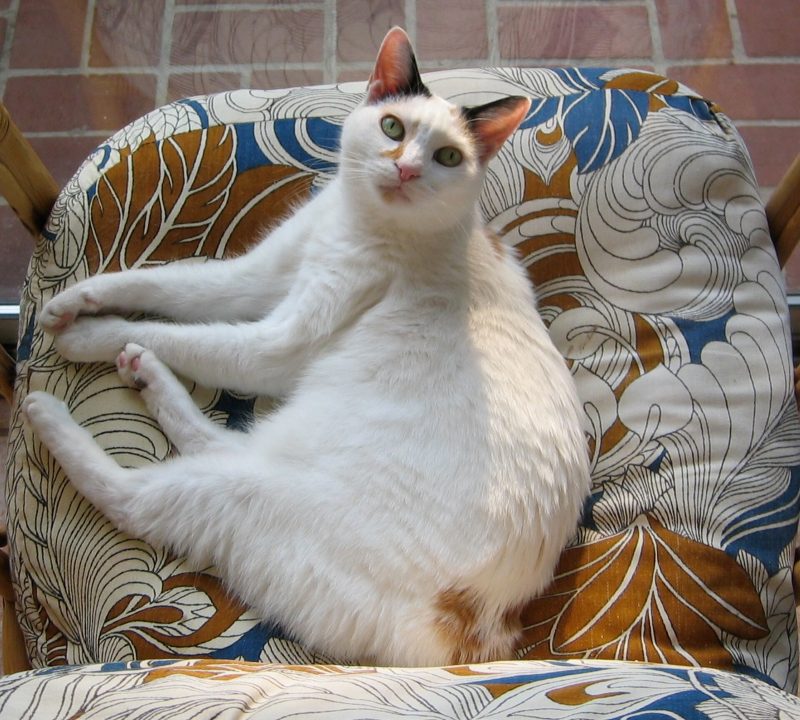
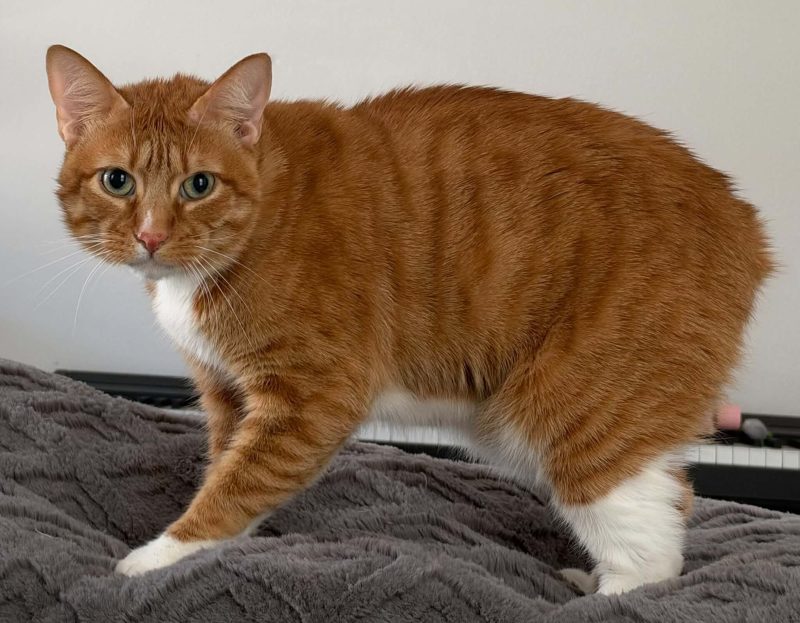
The coat is soft and silky with little undercoat, short in one variety and medium long with a ruff and plumed tail in the other. Any color and pattern is accepted, but the classic is mi-ke, a bold calico of white with patches of black and red; bicolors and vans are also prized. It is lighter and more refined than a Manx and, unlike the Manx, always has a visible tail.
Temperament & Personality
The Bobtail is outgoing, talkative and busy. It greets visitors, follows its people from room to room and comments in a soft, chirping voice with a wide range of notes; owners say it sings. It is intelligent and inventive, learning to open doors, play fetch and carry favorite toys around the house, and it has a strong hunting instinct that shows in pouncing games. It is affectionate and often rides shoulders or sleeps on the bed, but it is not clingy and is confident enough to entertain itself.
The breed is exceptionally good with children who want to play, gets on well with dogs and is tolerant of other cats, though it likes to be the one in charge. It adapts quickly to new homes, travel and routines, which makes it a good cat for families that move. Some Bobtails like water and will splash in a bowl or follow you to the bath.
Exercise & Activity
A Bobtail is a natural athlete that jumps high and lands precisely. Plan on twenty to thirty minutes of active play daily across several sessions: wand toys to leap for, balls and soft toys to fetch, which many do tirelessly, and puzzle feeders and treat balls for problem-solving. The breed shines in feline agility, and a home course of tunnels, hoops and jumps is a cheap way to burn energy. Climbing furniture, shelves and a window perch satisfy its need for height. Harness walks and catios suit it well.
The coat has little undercoat, so the Bobtail seeks warm spots in winter but copes well with heat.
Boredom shows as door-opening, toy-stealing and vocal demands for attention
Rotate toys and hide them around the house for the cat to find and carry back
A second playful cat or a dog is excellent enrichment
Training
The Japanese Bobtail is one of the most trainable cats, quick to learn and eager to work for food or praise. Clicker training teaches sit, come, fetch, spin and agility obstacles in short order, and trick training is the best outlet for its energy and intelligence. Litter habits are reliable; provide one box per cat plus one and scoop daily. Scratching goes to a sturdy post placed where the cat likes to stretch; trim nails every few weeks.
Harness and leash training is unusually successful, especially started in kittenhood, and the breed's adaptability makes carrier training simple: feed in the carrier, take short pleasant trips, and the vet run becomes routine. Handle the tail gently from the start; it is sensitive and should never be pulled, and kittens taught that tail-touching predicts a treat accept the vet's examination calmly. Socialization is easy, but keep exposing kittens to new people, dogs and sounds; the breed stays bold if given the chance.
Grooming & Care
Grooming is light. The shorthair needs a weekly pass with a fine comb or a rubber brush to lift loose hair and keep the silky coat bright; shedding is low because there is almost no undercoat. The longhair needs a fine, long-toothed comb once or twice a week, concentrating on the ruff, britches and tail plume, and a little more during the spring shed; the coat rarely mats. Baths are seldom needed, but the breed tolerates them, and a longhair should be dried thoroughly. Handle the tail with care when grooming, combing gently around rather than through the kinked bones.
Nails every two to three weeks
Teeth brushed daily if possible
Ears checked weekly; the large ears collect dust
Eyes wiped if any crust forms
Keep sessions short and rewarded so grooming stays a pleasure for this sociable cat
Health
The Japanese Bobtail is a healthy, sturdy natural breed with no known breed-specific diseases, and a typical lifespan of 13 to 16 years. The short tail is the result of a dominant mutation in the HES7 gene, identified in 2016, which affects how the tail vertebrae form; unlike the Manx gene it does not shorten the spine or damage the nerves to the hind legs, bladder or bowel, so there is no Bobtail equivalent of Manx syndrome, and breeding two Bobtails together is routine. The tail itself is sensitive, and trauma to it is painful, so it should never be pulled.
Litters tend to be small and kittens are born relatively large and mature quickly. Because the breed is rare, breeders use genetic testing and imports from Japan to keep the gene pool diverse and avoid the problems of inbreeding. Ordinary feline risks apply: dental disease, obesity, kidney disease in old age and hypertrophic cardiomyopathy, which your vet may screen for if a murmur is heard. Ask the breeder what testing they do, and your vet about routine screening.
Nutrition
Feed a complete, balanced diet for life stage: kitten food until about a year, adult food after, and a senior diet later if your vet recommends one. The Bobtail is lean, leggy and active, and its weight should stay in the modest range typical of the breed; the standard favors a slender cat, and extra weight is easy to see on it. Measured meals two or three times a day, with part of the ration in a puzzle feeder, suit its appetite for games. Keep treats under a tenth of daily calories, especially when training, and count training treats as part of the day's food.
Wet food adds water for kidney and urinary health, and a fountain appeals to the many Bobtails that like water. The longhair benefits from regular combing more than from hairball formulas, though one can help in spring. Mother cats and kittens, which grow fast, need kitten food through weaning. Ask your vet before supplements or home-prepared diets.
Living With This Breed
The Japanese Bobtail is a flexible cat. It lives happily in an apartment with climbing space, in a family house with children and dogs, or on the road with people who travel, and it adapts to change faster than most breeds. Indoor life is recommended; a catio or harness walks give it the outdoors safely. It copes with a workday alone if it has toys and a companion animal, but it is a social cat that will greet you at the door and tell you about its day, and a long, quiet absence every day is not what it wants.
Climate: comfortable in most homes; seeks warmth in winter
Noise: moderate; a musical chirp rather than a loud meow, used often
Escape habits: curious at doors and good at opening them; use latches
For sitters: expect a greeter that wants to play fetch; carry a wand toy and a soft ball, keep the routine, mind the tail when lifting, and check that opened cupboards and bags have not been raided. A chatty cat going quiet is worth a call
Interesting Facts
The maneki-neko, the beckoning cat seen in shops and restaurants worldwide, is modeled on a tricolor Japanese Bobtail, and a mi-ke Bobtail is still considered lucky in Japan.
Every Bobtail's tail is unique, with its own combination of curves and kinks, and the standard asks only that it look like a pom-pom and sit close to the body.
In 2016 researchers traced the breed's short tail to a variant in the HES7 gene, shared with short-tailed street cats across East Asia and entirely different from the Manx gene.
An imperial edict in 1602 released Japan's cats to fight rodents in the silk industry, which is how the Bobtail became the country's common street cat.
Mochi, the family cat in Disney's Big Hero 6, is a Japanese Bobtail.
The breed is famous for carrying toys about, and show judges often find their feather teaser stolen by a Bobtail on the table.
Breeds similar to the Japanese Bobtail
What Japanese Bobtail owners say
Real pets, photos, stories and tips from the SitterNation community — separate from the editorial guide above.
Log in to add your pet, photos, stories and tips.
Meet Japanese Bobtails on SitterNation
No Japanese Bobtails have joined yet. Owners can show their pet here from the pet's profile.
Japanese Bobtail community photos
No Japanese Bobtails photos yet — be the first to share one.
Stories from Japanese Bobtail owners
No stories yet. What is life with yours really like?
Tips from Japanese Bobtail owners
No tips yet. One practical thing that works for you is enough.
Ask Japanese Bobtail owners
No questions yet. Ask the people who live with the breed.