Typical tendencies
Energy level
Needs a real outlet most days.
Good with children
Patient with kids when well supervised.
Good with other pets
Coexists with other pets after a settling-in.
Shedding
Barely a hair on the sofa.
Vocalization
A comment now and then.
Sociability
Follows the household from room to room.
More traits
Exercise needs
Adaptability
Grooming needs
Trainability
Intelligence
Family friendly
Friendly with strangers
Apartment friendly
Overview
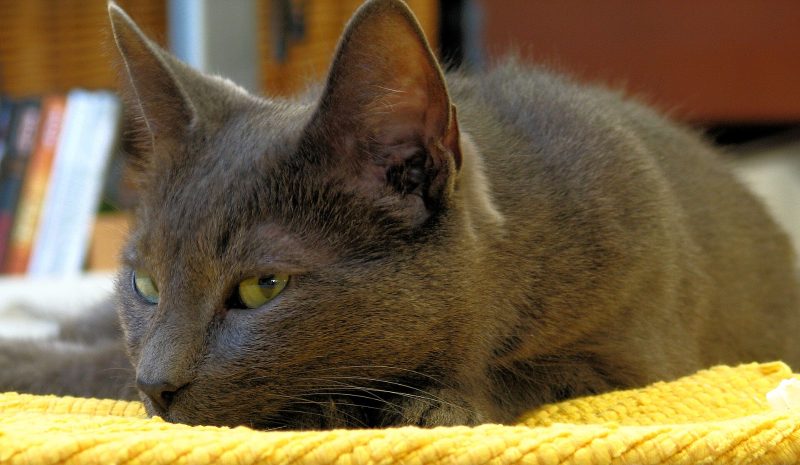
The Korat is Thailand's silver-blue good-luck cat, a compact, heart-faced breed with luminous green eyes and a personality that is intense, observant and devoted. It is affectionate with its own people, cautious with strangers and inclined to run the household, including any other pets. Males weigh 8 to 10 pounds, females 6 to 8, and the breed lives 12 to 15 years, often longer. It suits quiet to moderately busy homes, apartments, and owners who want a close, interactive bond and are home a good deal. It is less suited to a revolving door of visitors, very young children or a home where it would be one pet among many with little attention. Grooming is minimal; the coat is single and sheds little. Sitters should expect a cat that assesses them first and warms up on its own schedule.
History & Origin
The Korat is among the oldest documented cat breeds. It appears in the Tamra Maew, the Thai Cat-Book Poems, a manuscript tradition dating from the Ayutthaya period between 1350 and 1767, which lists it among the cats that bring good fortune. In Thailand it is called Si-Sawat, a word that describes its silvery-blue color, and pairs were traditionally given to brides as a wish for prosperity. The name Korat comes from the northeastern province of Nakhon Ratchasima, where the cats were found. The first Korats in the West, a pair named Nara and Darra, were imported to the United States in 1959 by Jean Johnson, and CFA granted championship status in 1966. Further Thai imports in 1969 broadened the lines. Korats reached Britain in 1972 and gained GCCF championship status in 1984; TICA and FIFe recognize the breed, and Thai cats are still imported to maintain its character. Unlike many breeds, the Korat has never been outcrossed to other breeds.
Appearance
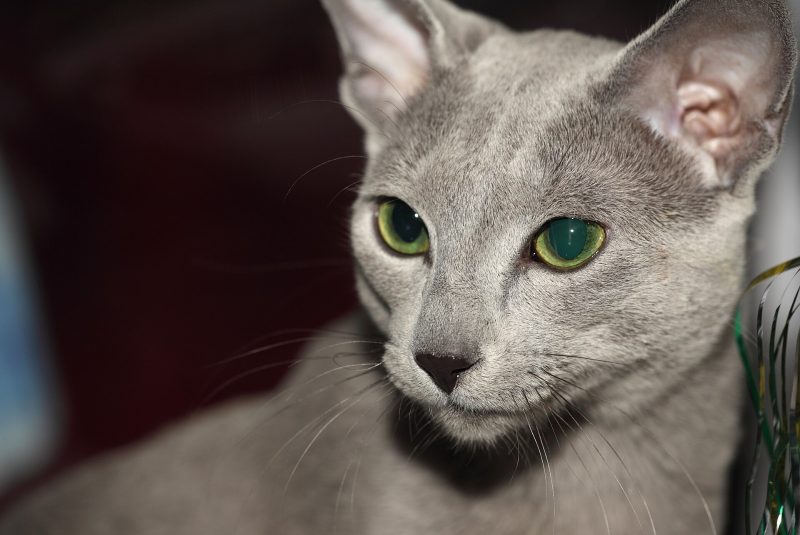
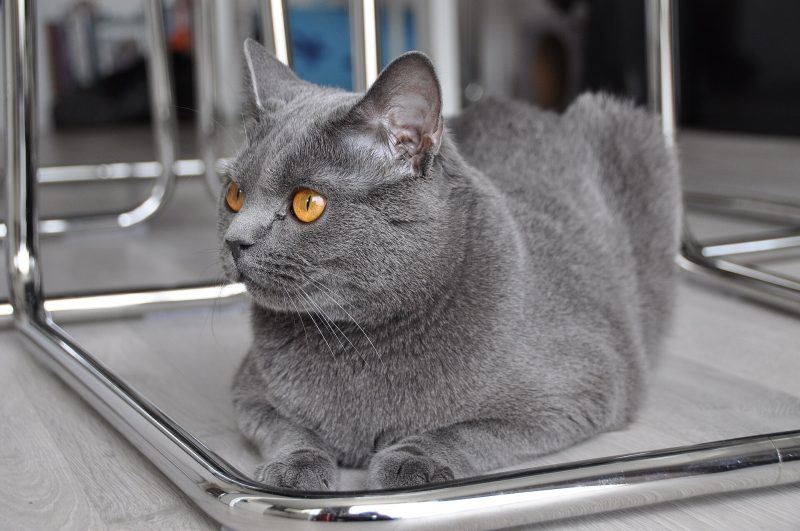
The Korat is a medium, semi-cobby cat that feels much heavier than it looks, with a muscular, rounded body and a back that curves gently. The head is the breed's hallmark: viewed from the front, the brow ridges, cheekbones and tapering muzzle form a heart shape, set with large, round-tipped ears that flare at the base. The eyes are oversized and round when open, with a slight slant when half-closed, and they ripen slowly from kitten amber to the mature peridot green that may take two to four years to arrive. The coat is single, short, fine and glossy, lying close to the body, in one color only: blue, with each hair tipped in silver so the cat seems to shimmer, strongest on the muzzle, feet and toes. Kittens may show faint ghost tabby markings that fade. A Russian Blue is longer and finer with a wedge head and a plush double coat; a Chartreux is larger and woollier.
Temperament & Personality
Korats bond fiercely. A Korat picks its people, follows them, sits on them and watches their faces with unusual attention, and it expects that devotion to be returned. It is intelligent and quick to learn routines, playful well into old age, and more active than its sturdy build suggests, though not frantic. Many are talkative, with a range of sounds from soft murmurs to insistent demands. With strangers the breed is reserved; it may retreat and observe before deciding a visitor is acceptable. With other cats and dogs it usually gets along but wants to be first in the pecking order, and a new pet brought home can trigger jealousy unless the Korat gets extra attention. It is sensitive to loud noise and chaos and prefers a calm household with older, respectful children. Left alone for long periods it can become anxious and may call for company.
Exercise & Activity
Two or three play sessions of 10 to 15 minutes a day suit a Korat, with wand toys, fetch with a small ball or toy and chase games across the floor. The breed likes height and will claim the top of a cat tree or a bookcase as its lookout, so provide safe climbing routes and a window perch. Puzzle feeders, treat hunts and training sessions matter as much as physical play, because an under-stimulated Korat turns its intelligence to mischief. Toys that involve you are preferred over toys left on the floor. Keep the cat indoors or in a secure enclosure; it is territorial and may challenge neighborhood cats. The single coat gives little insulation, so a warm bed in cool rooms is appreciated.
Short daily play sessions that include the owner
Vertical space and a lookout perch
Mental work through puzzles and training to prevent boredom
Training
Korats are among the more trainable cats, provided the trainer is someone they trust. Clicker training with small treats teaches recall, sit, high five and simple tricks quickly, and the breed enjoys the one-on-one time as much as the reward. Keep sessions short and consistent. Litter habits are reliable; one box per cat plus one, scooped daily, in quiet spots, since a Korat dislikes being startled mid-task. Provide a sturdy sisal post and a horizontal scratcher near its resting places and reward their use. Carrier training is worth effort because the breed is wary of change: leave the carrier open with a bed inside and feed treats there. Many Korats accept a harness after a slow indoor introduction. Socialize kittens broadly to visitors, handling and other animals; a Korat that meets little variety early can become a cat that hides from everyone but its owner.
Grooming & Care
The Korat's single coat is close to maintenance-free. It sheds lightly, does not mat and responds to a weekly going-over with a soft rubber brush or simply firm stroking with damp hands to lift loose hair, followed by a polish with a chamois or silk cloth to bring out the silver sheen. Baths are rarely needed. Shedding increases slightly in spring. Trim nails every two to three weeks, check the large ears monthly for wax and clean only the visible part with a vet-approved product. Brush the teeth several times a week with cat toothpaste and ask your vet about professional cleanings, since dental disease is common in all cats. Eyes rarely need attention beyond a gentle wipe. A dull coat on a Korat that usually gleams is a reason for a check-up.
Weekly rubber brush or damp-hand groom, chamois polish
Nails every two to three weeks, ears monthly
Dental care several times a week
Health
The Korat is a hardy natural breed, often living into its late teens, but it carries two serious recessive disorders that every buyer should ask about. GM1 and GM2 gangliosidosis are inherited storage diseases in which a missing enzyme lets fatty material build up in the nervous system; affected kittens appear normal at birth, develop tremors, incoordination and weakness at a few weeks to a few months of age, and die before their first birthday. DNA tests identify normal, carrier and affected cats, and the Korat was the first breed to be screened this way, so responsible breeders test every breeding cat and avoid carrier-to-carrier matings. Korats may carry a recessive LDLR gene variant that causes atherosclerosis, a buildup of cholesterol in the artery walls that leads to heart failure; a DNA test became available in 2025, and carriers are healthy. Korats carry little body fat, which vets should consider when planning anesthesia. Otherwise the usual feline risks apply: dental disease, obesity and age-related kidney problems. Ask your vet about annual exams and senior bloodwork from about ten years old.
Nutrition
Feed a complete and balanced food with a nutritional adequacy statement for the cat's life stage: kitten formula to about twelve months, adult thereafter, with a senior review from ten. The Korat is solid and muscular, which makes early weight gain easy to miss, so measure two or three meals a day and avoid free feeding. Puzzle feeders slow a fast eater and give the intelligent mind a task. Wet food supplies water that supports the kidneys and urinary tract, and a fountain encourages drinking. Treats stay under a tenth of daily calories. Judge condition by feel: ribs easy to find under a thin layer of flesh, a waist visible from above. Because the breed naturally carries little body fat, sudden weight loss shows quickly and should prompt a vet call. Sitters should feed exactly the measured amount and note any refusal to eat, which in a Korat often signals stress.
Living With This Breed
A Korat is an apartment-friendly cat in size and noise, but it needs company and consistency more than space. It does best with one or two devoted people who are home much of the day, in a calm home without constant visitors. It tolerates a workday alone better with a companion cat it has known from kittenhood, and it prefers older children who respect its boundaries. Other pets are accepted on its terms. The voice is moderate and expressive. Keep it indoors; it is territorial and would roam.
Sitters: let it approach you first, and keep routines exactly as the owner set them
Expect watchfulness, then a cat that follows you everywhere
Provide a warm bed; the single coat is thin
Loud noise and chaos stress this breed
Interesting Facts
The Korat appears in the Tamra Maew, Thai cat manuscripts whose tradition dates back as far as the fourteenth century, as one of the cats that bring good luck.
In Thailand pairs of Si-Sawat cats were traditionally given to brides, and the cats took part in rain-making ceremonies in some regions.
The silver tipping on each blue hair gives the coat a sheen that Thai poetry compared to the silver edge of a rain cloud.
A Korat's eyes can take up to four years to turn from kitten amber to adult peridot green.
The first Korats in the West, Nara and Darra, arrived in the United States from Bangkok in 1959.
The Korat was the first cat breed screened by DNA test for GM1 and GM2 gangliosidosis, and UK lines were declared clear in 1998.
Breeds similar to the Korat

What Korat owners say
Real pets, photos, stories and tips from the SitterNation community — separate from the editorial guide above.
Log in to add your pet, photos, stories and tips.
Meet Korats on SitterNation
No Korats have joined yet. Owners can show their pet here from the pet's profile.
Korat community photos
No Korats photos yet — be the first to share one.
Stories from Korat owners
No stories yet. What is life with yours really like?
Tips from Korat owners
No tips yet. One practical thing that works for you is enough.
Ask Korat owners
No questions yet. Ask the people who live with the breed.