Typical tendencies
Energy level
Ready to go when you are, settles after.
Good with children
Patient with kids when well supervised.
Good with other pets
Easygoing with most household animals.
Shedding
A light scatter, easy to keep up with.
Vocalization
Speaks up only when something matters.
Sociability
Likes being in the room with people.
More traits
Exercise needs
Adaptability
Grooming needs
Trainability
Intelligence
Family friendly
Friendly with strangers
Apartment friendly
Overview
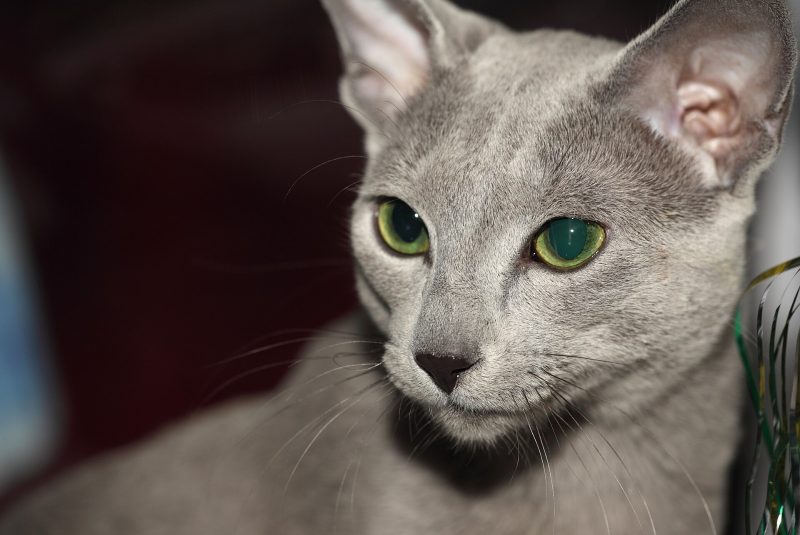
The Russian Blue is a quiet, elegant cat with a plush silver-blue coat, vivid green eyes and a gentle, slightly reserved temperament. It bonds closely with its own people, plays with real enthusiasm when the mood takes it, and prefers to watch strangers from a safe distance before deciding about them. Males weigh 10 to 12 pounds and females 7 to 10, and the breed is long-lived, often reaching 15 to 20 years. It suits calm households, single people and couples, older children and anyone who works a normal day, since a Russian Blue copes well with time alone and keeps itself tidy. It is a poor match for a loud, chaotic home, for frequent houseguests who expect a greeter, or for someone who wants a cat that loves everybody on sight. Give it routine and respect and it gives back a devoted, low-maintenance companion.
History & Origin
The breed's name points to the northern Russian port of Arkhangelsk, from which sailors are believed to have carried thick-coated blue cats to Britain and Scandinavia in the 1860s. The first printed British mention of an Archangel Cat dates to 1862, and blue cats under that name were exhibited at the Crystal Palace in London in the 1870s, competing against British Blues in a shared class for all blue cats until 1912, when the Russian type was given its own. Between the wars the breed was known in Britain as the Foreign Blue, while Scandinavian breeders worked their own lines. World War II nearly ended it in Europe; to rebuild numbers British breeders crossed to blue point Siamese and Scandinavian breeders to a blue Finnish cat, and later breeders spent decades removing the Siamese look. American fanciers imported cats from both lines after the war and blended them into the modern Russian Blue, which the Cat Fanciers' Association registered in 1949. Solid white and black Russians were developed in Britain and Australia from the 1960s but are not recognized by the CFA.
Appearance
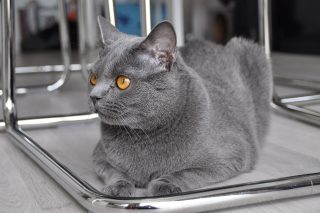
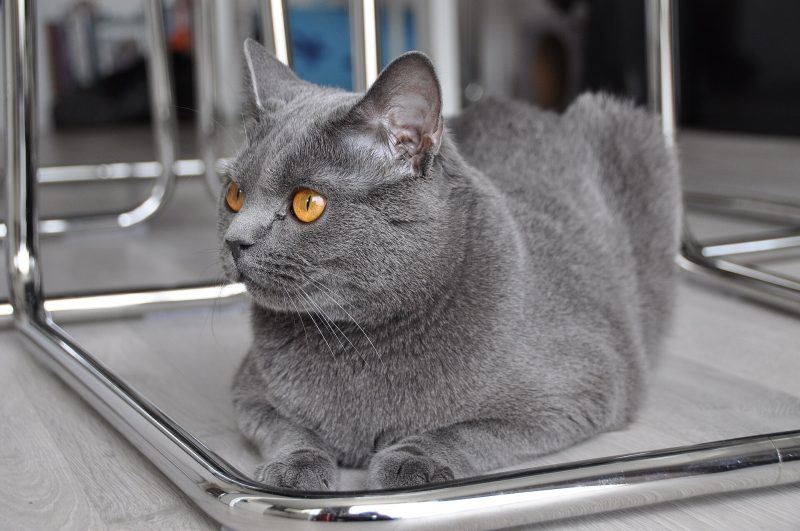
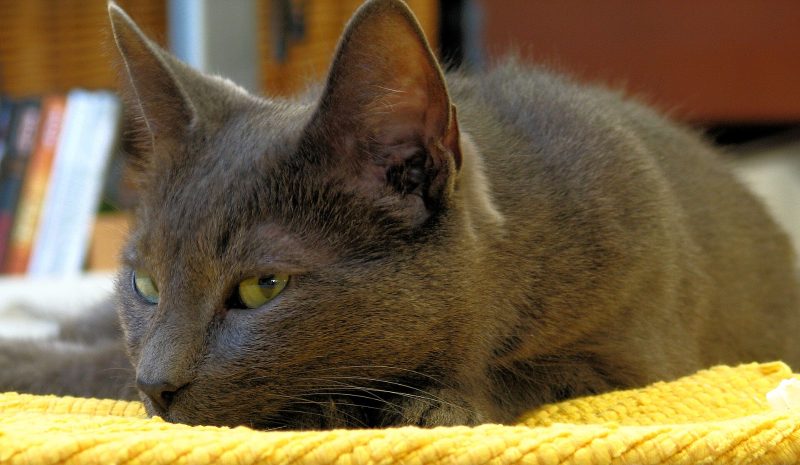
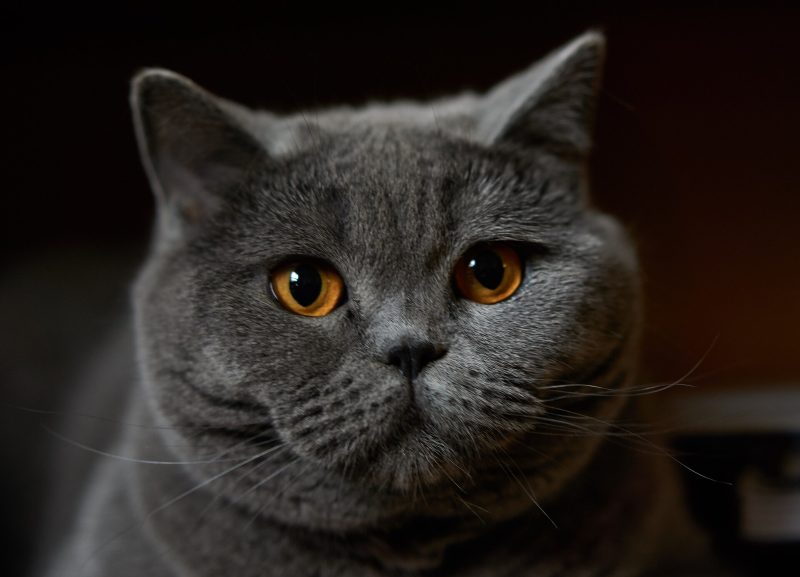
A Russian Blue is a medium-sized cat on fine bones, long and graceful without looking fragile. The head is a smooth modified wedge with a flat top, a straight nose, a two-plane profile and large ears set wide and high, broad at the base and thin enough to be almost translucent. Prominent whisker pads give the mouth an upturned line that fanciers call the Russian smile. The eyes are rounded and vivid green in adults; kittens have yellow eyes with a green ring that spreads outward during the first year or two. The coat is the breed's signature: short, dense and double, standing out from the body so that you can draw a pattern in it with a finger, in a single even bright blue with silver tipping on the guard hairs that gives the cat a shimmering, frosted look. Paw pads are lavender-pink to mauve and the nose leather slate gray. It is easily confused with the Chartreux, a heavier cat with gold eyes, the Korat, with a heart-shaped face and a single, close-lying coat, and the British Shorthair, which is round and cobby.
Temperament & Personality
Russian Blues are gentle, observant cats that love deeply but selectively. With their own family they are affectionate and playful, following a favorite person from room to room, settling in laps, riding on shoulders and greeting them at the door. With strangers they are shy, usually vanishing when the doorbell rings and reappearing only when the visitor has proved harmless. They are intelligent and mechanically minded, known for opening drawers, cabinets and doors, and they remember people and routines for years. They dislike change, prefer meals and play at the same times every day and may sulk if the schedule slips. The voice is soft and used sparingly. They are good with respectful older children and with calm dogs and cats, and they are sensitive to moods, often turning up to comfort a sad owner. Energy is moderate: bursts of fast play alternate with long, dignified rests on the highest available perch.
Exercise & Activity
A Russian Blue needs two short play sessions a day, around 10 to 15 minutes each, and will happily take more. Fetch is a breed specialty: many will retrieve a crumpled ball or a toy mouse for as long as you keep throwing. Wand toys with feathers, springs to bat across hard floors and puzzle feeders all suit its hunting style and its taste for problem solving. High places matter, so give it a tall cat tree or a cleared bookshelf and a window perch for watching birds. Because the breed enjoys solitary play, leave out a few toys that move or crinkle for the hours you are away, and rotate them weekly. The dense coat handles cold well; in hot weather provide shade and cool floors. Boredom shows mostly as overeating and opened cupboards rather than destruction.
Two 10 to 15 minute sessions daily, with fetch if the cat enjoys it
Puzzle feeders and solo toys for the workday
Tall perches and a window for surveillance
Training
Russian Blues are clever and willing but independent, so training works best as a game the cat chooses to play. Clicker training with small treats teaches recall, sit, high five and fetch quickly, and most will come to a specific sound or word reliably. Keep sessions short and never force handling. Litter habits are exceptionally fastidious; this breed may refuse a dirty box, so scoop daily and keep one box per cat plus one. Scratching posts in sisal and cardboard, placed near sleeping and entry spots, protect furniture. Carrier training matters because a shy cat is easily stressed by vet trips; leave the carrier out as a bed and reward entering it. Harness walking is possible with a patient introduction, though many Russian Blues prefer a window to a walk. Socialization is the key task: expose kittens gently to many people, sounds and handling so that adult reserve stays polite rather than fearful. Counter surfing and cabinet raiding are the usual sticking points.
Grooming & Care
The double coat is nearly maintenance-free and should not be over-brushed, since heavy grooming can flatten the plush texture that defines the breed. A once- or twice-weekly pass with a soft brush, grooming mitt or comb, or simply firm stroking with slightly damp hands, removes loose hair. Shedding is light, with a modest increase in spring and fall when a damp cloth wiped over the coat helps. Baths are rarely needed. Trim nails every two to three weeks, check ears for debris and clean only if needed, and get to know the cat's normal eye appearance so you spot changes early. Brush teeth several times a week and have them checked at each vet visit, as dental disease is common in all cats.
Light brushing once or twice a week, never aggressive
Nails every two to three weeks, teeth several times a week
No professional grooming needed
Health
The Russian Blue is one of the healthiest pedigreed cats, with no condition unique to the breed and a typical lifespan of 15 to 20 years. The main risks are lifestyle ones. The breed has a hearty appetite and a quiet temperament, so obesity is the most common problem seen by vets, bringing diabetes, arthritis and urinary disease with it. Bladder stones and lower urinary tract disease are reported in the breed, and dental disease is common as in all cats. Because the gene pool is relatively small, some breeders screen for progressive retinal atrophy and polycystic kidney disease, both of which have DNA tests, and for hypertrophic cardiomyopathy by echocardiogram; ask a breeder what they test and why. Reserved cats can hide illness well, so weight and appetite should be tracked at home. Ask your vet about an annual exam with weight and dental checks, senior bloodwork from about ten years old, and see them promptly if the cat strains in the litter box, drinks more than usual or becomes withdrawn.
Nutrition
Portion control is the whole story for this breed. Russian Blues love food, ask for it persuasively and will eat whatever is offered, so a free-fed cat is usually an overweight cat within a year or two. Feed a complete, balanced diet suited to life stage, kitten food until about a year, then measured adult meals twice a day, adjusted to keep a visible waist and easily felt ribs. Ask your vet for a target weight. Puzzle feeders slow eating and make the cat work for calories, and a mix of wet and dry food adds water that supports urinary health. Treats count toward the daily total and should be small. Because this breed dislikes change, switch foods gradually and keep mealtimes consistent; a late dinner will be reported. Sitters should feed exactly what the owner leaves and ignore the silent, expectant stare that follows.
Living With This Breed
A Russian Blue is an ideal apartment cat: quiet, clean, undemanding of space and comfortable alone during a workday as long as the routine holds. It wants a calm home, a predictable schedule and a few high perches. It will share with another gentle cat or a quiet dog and often prefers being the only pet. Older children who respect its space make good companions; toddlers and rowdy households tend to send it under the bed. Expect it to hide from visitors and to reappear on its own terms. Keep it indoors, as its shyness makes it vulnerable outside.
Sitters: move slowly, keep feeding and play times exactly as written, do not chase it out of hiding
Measure meals; this cat will convince you it is starving
Check that cabinets and doors it can open hold nothing dangerous
Interesting Facts
The breed has been called the Archangel Cat, the Foreign Blue and the Maltese Cat at different times; the name Russian Blue was settled in Britain in the 1940s.
Legend says Russian Blues were favored by the tsars and kept as good-luck charms, and a blue cat was supposedly given to Queen Victoria.
The silver tipping on each guard hair gives the coat its shimmer and sets the breed apart from other blue cats.
Kittens are born with yellow eyes that turn vivid green during the first year or two.
The Nyan Cat meme was inspired by its creator's Russian Blue, Marty, and the breed also appears as Felicity in Felidae and Arlene in the Garfield film.
Because they produce somewhat less of the Fel d 1 allergen than many cats, Russian Blues are often suggested to allergy sufferers, though no cat is truly hypoallergenic.
Breeds similar to the Russian Blue
What Russian Blue owners say
Real pets, photos, stories and tips from the SitterNation community — separate from the editorial guide above.
Log in to add your pet, photos, stories and tips.
Meet Russian Blues on SitterNation
No Russian Blues have joined yet. Owners can show their pet here from the pet's profile.
Russian Blue community photos
No Russian Blues photos yet — be the first to share one.
Stories from Russian Blue owners
No stories yet. What is life with yours really like?
Tips from Russian Blue owners
No tips yet. One practical thing that works for you is enough.
Ask Russian Blue owners
No questions yet. Ask the people who live with the breed.