Typical tendencies
Energy level
Always on; boredom turns into mischief.
Good with children
Gentle and tolerant around children.
Good with other pets
Easygoing with most household animals.
Shedding
A light scatter, easy to keep up with.
Vocalization
Narrates the whole day out loud.
Sociability
Hates being left out of anything.
More traits
Exercise needs
Adaptability
Grooming needs
Trainability
Intelligence
Family friendly
Friendly with strangers
Apartment friendly
Overview
The Siamese is the cat that talks back. Slender, elegant and blue-eyed, with dark points on a pale body, it is also one of the most intelligent, social and vocal breeds there is, forming intense bonds with its people and commenting loudly on everything they do. Males weigh 8 to 12 pounds, females 5 to 8, and many live well past 15, with 12 to 20 years a reasonable expectation. A Siamese suits someone who is home a lot, wants a cat that behaves like a shadow and a conversation partner, and enjoys play and training. It is a poor fit for a quiet household that wants a decorative cat, for people out all day with no second pet, or for anyone who finds a persistent, raspy voice irritating. Choose between the modern show type and the rounder traditional or Thai type by looks; the personality is much the same.
History & Origin
Pointed cats appear in the Tamra Maew, a collection of Thai cat poems written during the Ayutthaya period between the 14th and 18th centuries, where they are called wichienmaat, or moon diamond. They lived in temples and royal households and were given as gifts to visiting diplomats in the 19th century. The first documented Siamese in the United States was Siam, sent to President Rutherford B. Hayes and his wife Lucy in 1878 by the American consul in Bangkok. In Britain, Siamese were shown at the Crystal Palace in the 1870s and a breed club formed in 1901. The Cat Fanciers' Association recognized the breed at its founding in 1906. Seal point was the original color; the CFA accepted blue in 1934, chocolate in 1952 and lilac in 1955. From the 1950s show breeders selected for an increasingly long, fine, wedge-headed cat, and by the 1980s the older rounder style had been pushed out of the ring. Breeders who kept the moderate type founded the Thai breed, recognized by the World Cat Federation in 1990 and by TICA for championship in 2010.
Appearance
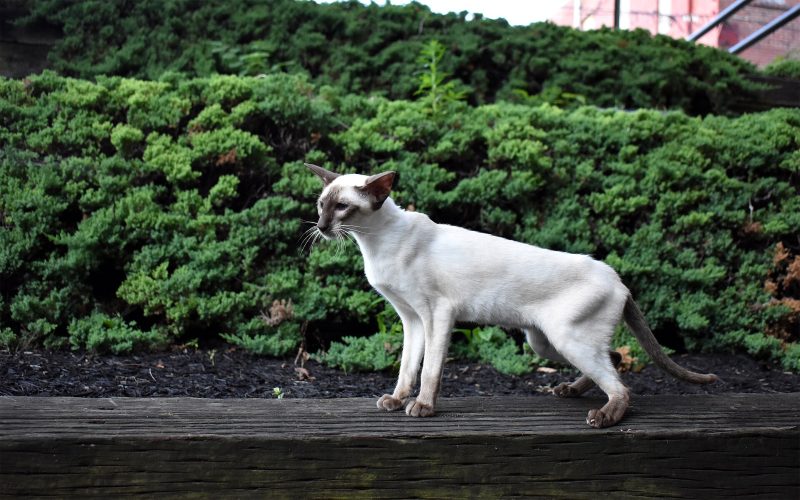
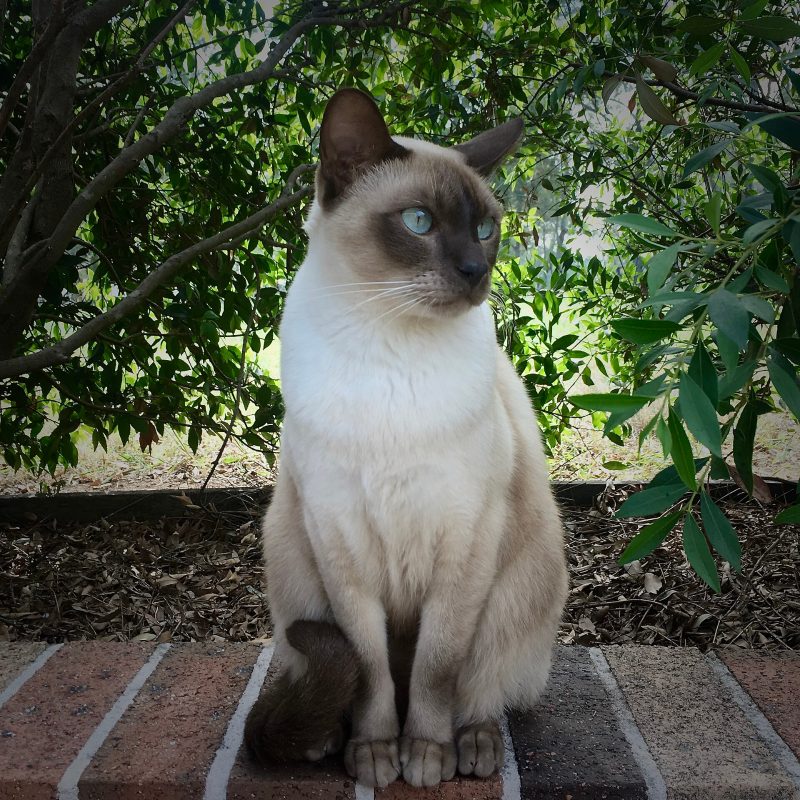
The modern show Siamese is a long, tubular cat on fine bones, with a long neck, slim legs, dainty oval feet and a whip-thin tail. The head is a long tapering wedge that starts at the nose and flares in straight lines to the tips of the large ears, with a flat skull, a straight profile and almond-shaped eyes slanted toward the nose. The coat is short, fine and glossy. Color is restricted to the points, meaning the mask, ears, legs and tail, over a pale body that darkens with age and in cool climates. The CFA accepts four colors: seal, chocolate, blue and lilac point. TICA and other registries also accept red, cream, tortie and lynx (tabby) points, which the CFA shows as the Colorpoint Shorthair. The traditional or Thai type has the same coat and vivid blue eyes but a rounder apple-shaped head, a sturdier body and medium ears. Both must have blue eyes; crossed eyes and kinked tails were once common and are now faults.
Temperament & Personality
A Siamese does not share your home so much as run it with you. It follows its person from room to room, rides on shoulders, sleeps under the covers and holds up its end of the conversation in a loud, raspy voice that ranges from chirps to something like a crying baby. It is among the most intelligent of cats, quick to learn routines and tricks and equally quick to find trouble when bored. Energy is high at all ages, and the breed climbs, leaps and investigates everything. Siamese are affectionate with the whole family and usually warm to visitors after a short inspection. They are good with children who play actively and with cat-friendly dogs; another Siamese or Oriental is the best companion of all. The breed's weak spot is solitude: left alone too long it can become anxious, overgroom or chew fabric. Attachment is intense, and a Siamese will tell you plainly when it feels ignored.
Exercise & Activity
Plan on at least 30 minutes of active play a day in two or three sessions, more for young cats. Siamese love fetch, wand toys, laser pointers finished with a catchable toy and any game that involves running and leaping. Vertical space matters as much as floor space: tall, sturdy cat trees, shelves and a window perch satisfy the breed's urge to climb and survey. Mental work is essential. Puzzle feeders, treat hunts, training sessions and rotating toys all help, and a second cat provides play that no human can match. The short coat offers little protection, so provide warm beds in winter; Siamese seek heat and will choose a lap or a radiator. Boredom shows as yowling, opening cupboards, shredding paper and chewing wool or plastic.
30 or more minutes of interactive play daily, split into sessions
Tall climbing furniture and a view of outdoors
Food puzzles and training instead of free feeding
Training
Siamese are among the easiest cats to train and among the hardest to out-think. Clicker training with small, soft treats teaches sit, high five, fetch, spin and recall quickly, and the cat will enjoy the attention as much as the reward. Keep sessions short and end on success. Litter habits are usually reliable, but a stressed Siamese may protest changes by missing the box, so keep boxes clean, consistent and away from noisy appliances. Scratching posts need to be tall and stable to suit a cat that stretches full length; place one by the favorite sleeping spot. Carrier training is worth doing early, since this breed objects loudly to confinement it has not chosen. Harness walking suits many Siamese, who enjoy new sights, and leash training from kittenhood is straightforward. Socialize kittens widely to people, sounds and handling. The common sticking point is pica, especially wool sucking in young cats; keep knitwear, hair ties and string out of reach and give the cat legal things to chew and carry.
Grooming & Care
The short, close-lying coat is nearly self-maintaining. A weekly pass with a rubber brush, grooming mitt or even damp hands lifts loose hair and leaves a glossy finish; shedding is light but steady. Bathing is unnecessary except before a show. Check the ears weekly, since the large ears collect dust, and wipe gently if needed. Trim nails every two to three weeks. Dental care deserves attention because Siamese and their relatives are prone to gingivitis and periodontal disease; brush several times a week and have the teeth checked at every vet visit. Watch for thinning patches on the belly or inner legs, which can mean overgrooming from stress rather than a skin problem.
Weekly brushing, no baths
Ears checked weekly, nails every two to three weeks
Teeth brushed several times a week
Health
Siamese are long-lived, often reaching 15 to 20 years, but a few inherited conditions run in the breed. UK veterinary records put average life expectancy at birth nearer 12 years. Progressive retinal atrophy, a recessive degeneration of the retina that begins with night blindness around one to two years and ends in total blindness, is caused by a known CEP290 gene variant; a DNA test identifies carriers, and responsible breeders test both parents. Familial amyloidosis, in which abnormal protein deposits damage the liver, has no DNA test, so ask breeders about it in their lines. Siamese are over-represented for feline asthma, for mediastinal lymphoma in young cats, for certain gastrointestinal cancers and for dental disease. Strabismus and nystagmus, the crossed eyes and eye flicker tied to the pointed gene, were once common and are now mostly bred out but still appear. Behavioral medicine matters too: pica and wool sucking can cause intestinal blockages, and anxiety can lead to overgrooming. Hypertrophic cardiomyopathy occurs at the background rate for cats. Ask your vet about a yearly exam with dental assessment, prompt investigation of coughing or wheezing, and senior bloodwork from about ten.
Nutrition
A Siamese is lean by design and should stay that way: the ribs should be easy to feel and the body long and tubular, not pear-shaped. Feed a complete, balanced diet suited to life stage, kitten food until about a year, and measure portions because many Siamese will overeat if a bowl is always full. Two or more small meals a day fit the breed's active, hunting-style rhythm, and puzzle feeders or lick mats turn meals into enrichment. Wet food adds water, which helps urinary health, and some owners offer a mix of wet and dry. Treats are useful training currency but should stay under a tenth of daily calories. Siamese with a history of wool sucking or pica sometimes do better with more fiber and more frequent meals; ask your vet before changing the diet. Older cats may need a senior formula and regular weight checks, since unexplained weight loss in a thin breed is easy to miss.
Living With This Breed
A Siamese can live happily in an apartment as long as the people in it are present and engaged and the neighbors can tolerate some noise. Vertical space, a window and a companion animal matter more than square footage. This breed should not be left alone for long workdays without another pet; the result is a stressed, loud, destructive cat. It is good with active children, usually fine with cat-friendly dogs and best of all with another Siamese. Keep it indoors or in a secure enclosure, because its curiosity and confidence make it a likely escapee and its coat offers little protection from cold. Expect a cat on every lap, in every box and behind every closed door.
Sitters: visit twice daily at minimum, play before feeding and talk back
Keep wool, string and hair ties out of reach
Double-check doors; this cat will try to come along
Interesting Facts
The first Siamese in America, named Siam, was a gift to President Rutherford B. Hayes and First Lady Lucy Hayes from the American consul in Bangkok in 1878.
The pointed pattern is temperature-sensitive: pigment forms only on the cooler parts of the body, which is why kittens are born nearly white and cats darken in winter and with age.
Siamese are ancestors of a whole family of breeds, including the Balinese, Oriental, Himalayan, Tonkinese, Burmese, Ocicat and Snowshoe.
Early Siamese were nicknamed Royal Cats of Siam because they were believed to live only with royalty and temple priests.
The breed starred as Si and Am in Disney's Lady and the Tramp and as Tao, one of the three heroes of Disney's The Incredible Journey.
Traditional-type breeders were once mocked with the name applehead; today the Thai breed uses the shape proudly.
Breeds similar to the Siamese
What Siamese owners say
Real pets, photos, stories and tips from the SitterNation community — separate from the editorial guide above.
Log in to add your pet, photos, stories and tips.
Meet Siameses on SitterNation
No Siameses have joined yet. Owners can show their pet here from the pet's profile.
Siamese community photos
No Siameses photos yet — be the first to share one.
Stories from Siamese owners
No stories yet. What is life with yours really like?
Tips from Siamese owners
No tips yet. One practical thing that works for you is enough.
Ask Siamese owners
No questions yet. Ask the people who live with the breed.