
Typical tendencies
Energy level
Ready to go when you are, settles after.
Good with children
A famously patient playmate for kids.
Good with other dogs
Loves every dog at the park.
Trainability
Quick to learn and keen to please.
Shedding
A light scatter, easy to keep up with.
Apartment friendly
Can manage in a flat with plenty of outings.
More traits
Exercise needs
Adaptability
Grooming needs
Drooling
Intelligence
Family friendly
Good with cats
Friendly with strangers
Sociability
Protectiveness
Prey drive
Overview
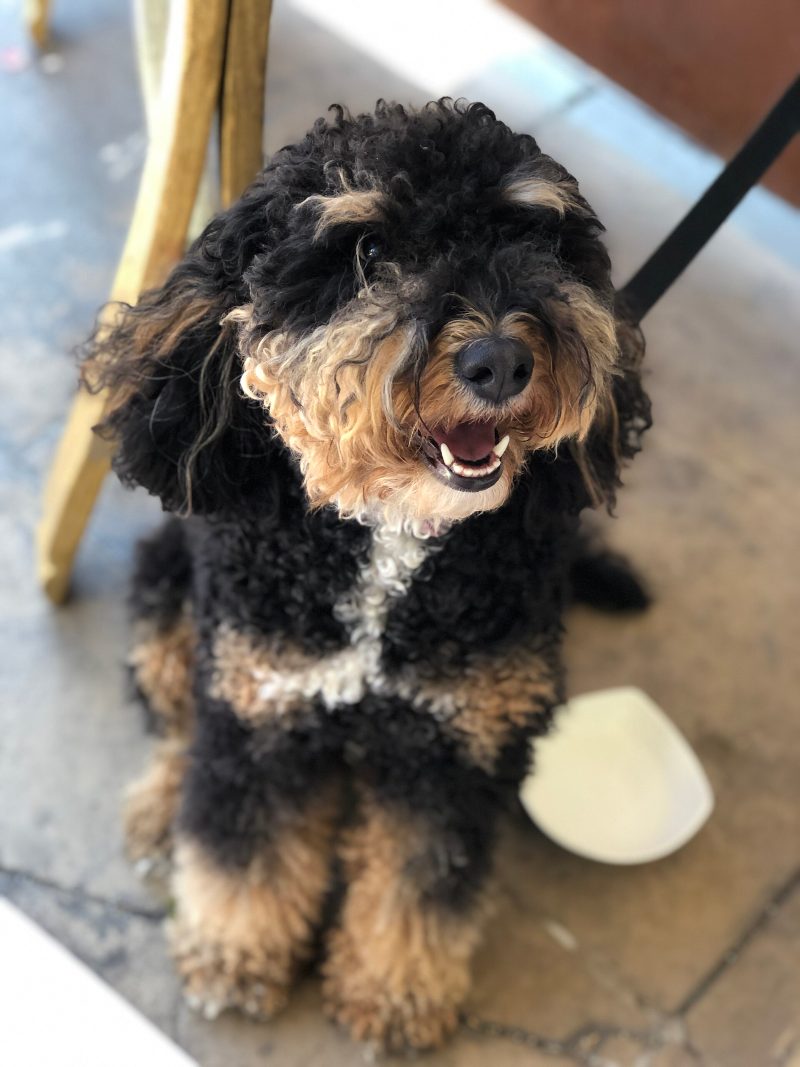
A Bernedoodle is what you get when a Bernese Mountain Dog is crossed with a Poodle: a big, affectionate, often tricolored dog with a wavy or curly coat that sheds less than a Bernese. It suits active families who want a gentle companion for walks and backyard play, who have room for a large dog and who can commit to serious grooming. Most Bernedoodles are patient with children, easy with other dogs and happy to greet visitors.
Remember that this is a cross, not a breed. Two puppies from the same litter can differ in size, coat and temperament, and no kennel club recognizes the Bernedoodle or publishes a standard for it. The dog in front of you may lean toward the steady, slightly stubborn Bernese or the quick, busy Poodle. If you want predictability, a purebred is the safer choice; if you can enjoy a little variability and do your homework on the breeder, a Bernedoodle can be a wonderful family dog.
History & Origin
Bernese Mountain Dogs and Poodles have surely met by accident before, but the deliberate cross is recent. The first intentionally bred litters are generally credited to a breeder in Ontario, Canada, around 2003, and the idea spread through the United States during the 2000s as part of the wider doodle movement that began with the Labradoodle in the late 1980s. The motivation was simple: keep the Bernese Mountain Dog's affectionate, tricolored charm while adding the Poodle's lower-shedding coat and, breeders hoped, a longer life than the Bernese's typical seven to ten years.
No kennel club recognizes the Bernedoodle and there is no written standard. The American Kennel Club, The Kennel Club and the FCI register only the two parent breeds. A few designer-dog registries will record crossbred litters for a fee, but that is paperwork rather than recognition. Breeders now sell standard, mini and tiny versions, plus F1, F1b and multigenerational lines, each with a different balance of parent traits.
Appearance
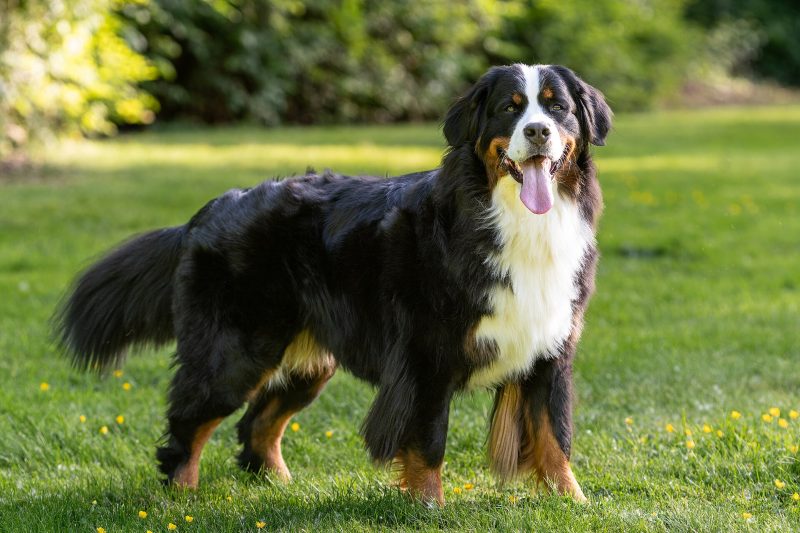
Picture a Bernese Mountain Dog seen through a soft-focus lens. A standard Bernedoodle, bred from a Standard Poodle, stands about 23 to 29 inches for males and 22 to 27 inches for females, weighing roughly 70 to 90 and 50 to 80 pounds. Minis from a Miniature Poodle and tinies from a Toy Poodle are much smaller, and size within a single litter varies more than it would in a purebred.
The body is sturdy but a little leggier than a Bernese, with a broad head, floppy ears and dark, expressive eyes. The coat is usually wavy to curly and medium length; a few puppies get a straighter, more Bernese-like coat that sheds more. Tricolor (black, white and rust) is the signature look, but black, black and white, sable and merle all occur. Merle is not found in either parent breed, so a merle Bernedoodle tells you another breed was introduced somewhere in the line. Beside a Goldendoodle it is bulkier and darker; beside a Bernese it is curlier and lighter-shedding.
Temperament & Personality
Most Bernedoodles are affectionate, goofy and people-focused. The Bernese side brings a calm, loyal temperament and a wish to be wherever the family is; the Poodle side adds alertness, playfulness and a sharper mind. Indoors a well-exercised adult is a sofa companion that follows you from room to room. Outdoors the same dog is up for a hike, a swim or a long game of fetch, then content to nap.
They are usually gentle with children, friendly with other dogs and tolerant of cats, with a low prey drive. Strangers get a bark and then a wagging welcome; this is a watchful dog rather than a guard dog. Because they bond so closely, many dislike being left alone for long and can become anxious or destructive. Some inherit a Bernese stubborn streak, others a Poodle sensitivity that wilts under harsh handling. Puppy temperaments vary even within one litter, so meet the parents.
Exercise & Activity
Plan on 45 to 60 minutes of activity a day for a standard Bernedoodle, split into a couple of walks plus play, with more for a Poodle-leaning adolescent. Minis need a little less distance but just as much engagement. Swimming, hiking and fetch suit the cross well; sustained running on hard ground should wait until the growth plates close, usually around 18 months in a large dog, to protect developing joints.
Bernese heritage means heat tolerance is poor, so in summer walk early and late and offer shade and water. Cold is rarely a problem. A Bernedoodle's brain needs work too: training games, scent work and food puzzles prevent the boredom that shows up as chewing, counter-surfing, digging and barking at the window.
Pace exercise for puppies: short, frequent sessions rather than long hikes.
Watch for heavy panting and lagging in warm weather; stop and cool down.
Mix physical outings with mental tasks for a settled dog indoors.
Training
Bernedoodles are usually quick learners that want to please, which makes basic manners straightforward with positive, reward-based methods. Food and praise both work; tug and fetch are good rewards for the more Poodle-like dogs. Keep sessions short and upbeat, because the sensitive ones shut down under shouting and the stubborn ones simply dig in.
Common sticking points are mouthing and jumping, which matter more in a dog that will weigh 80 pounds, and a tendency to pull on leash. Teach a solid sit for greetings early. Recall can fade when a scent or a playmate appears, so practice it with high-value rewards in safe, enclosed areas first. Socialize puppies widely to people, dogs, sounds and surfaces between about 8 and 16 weeks; a well-socialized Bernedoodle grows into a confident, easygoing adult, while an undersocialized one may become shy or barky. Many enjoy rally, agility, scent work and therapy-dog visits as adults.
Grooming & Care
The coat is the main job. A wavy or curly Bernedoodle needs brushing to the skin three or four times a week, daily in heavy coats, to prevent the mats that form behind the ears, under the collar, in the armpits and on the legs. Use a slicker brush followed by a metal comb; if the comb snags, the mat is still there. Most owners book a professional groom every six to ten weeks for a trim, bath and tidy-up.
Shedding is low to moderate, not zero, and straighter-coated puppies shed noticeably. Floppy ears trap moisture, so check and clean them every week or two and dry them after swimming. Trim nails every three to four weeks and brush teeth several times a week.
Introduce brushing, dryers and clippers gently in puppyhood.
Ask the groomer for a shorter cut in summer and a longer one in winter.
Check between the toes for burrs and matted hair after walks.
Health
Crossing two breeds does not cancel their problems; a Bernedoodle can inherit conditions from either side. A 2024 Royal Veterinary College study of three popular Poodle crosses found their overall health broadly matched their parent breeds, so judge a Bernedoodle by its parents' screening rather than by the hybrid label.
From the Bernese come high cancer rates, especially histiocytic sarcoma, along with hip and elbow dysplasia, degenerative myelopathy and bloat. From the Poodle come progressive retinal atrophy, sebaceous adenitis, Addison's disease, von Willebrand disease, hip dysplasia and, in the smaller sizes, patellar luxation. Ask the breeder for OFA or PennHIP hip results, OFA elbow and cardiac evaluations and a recent ACVO eye exam on both parents, plus DNA tests for degenerative myelopathy, prcd-PRA and von Willebrand disease. Good breeders show certificates, not promises. With sound parents, 12 to 15 years is a reasonable expectation, longer than a typical Bernese. See your vet promptly for lameness, lumps, a swollen or hard belly, or sudden weakness.
Nutrition
Feed a Bernedoodle according to its expected adult size. A standard puppy that will top 70 pounds should eat a large-breed puppy food, which limits calcium and energy so the skeleton grows at a steady pace; too-rapid growth raises the risk of joint problems. Mini and tiny puppies can eat a regular or small-breed puppy formula. Ask your vet when to switch to adult food, usually between 12 and 18 months for the larger dogs.
Adults do well on two measured meals a day. Bernese genes make weight gain easy, and extra pounds load hips and elbows that may already be imperfect, so weigh the dog monthly and adjust portions to its body condition rather than the chart on the bag. Because the Bernese is a deep-chested breed prone to bloat, avoid one big daily meal, slow down fast eaters with a puzzle bowl and skip hard exercise right after eating. Seniors benefit from a diet suited to a slower metabolism and aging joints; your vet can advise.
Living With This Breed
A standard Bernedoodle is a house dog with a yard, or at least an owner who walks a lot. Minis adapt better to apartments if they get out daily. The cross wants company; a home where someone is around most of the day, or where daycare and sitters fill the gaps, suits it far better than eight-hour absences. Separation anxiety is one of the most common problems sitters report.
Children and other pets usually get along well with a Bernedoodle, though a bouncy adolescent can flatten a toddler by accident. Cool climates are ideal; in hot regions plan on air-conditioning and early walks. Most are moderate barkers and not escape artists, but a bored one will dig.
For sitters: brush daily during a stay, dry ears after swims and keep walks short in heat.
Note which parent the dog resembles; a Poodle-leaning dog needs more mental work.
Keep feeding times and bloat precautions on the care sheet.
Interesting Facts
The Bernedoodle is one of the youngest doodles; the first planned litters date only to the early 2000s, well over a decade after the Labradoodle.
It comes in three sizes depending on the Poodle used: tiny, mini and standard, with standards weighing up to 90 pounds.
Nicknames include Bernepoo and Bernese Mountain Poo; breeders also use the labels F1, F1b and multigen to describe generations.
A merle Bernedoodle cannot come from purebred parents alone, because neither the Bernese nor the Poodle carries the merle gene.
Many Bernedoodles inherit the Bernese habit of leaning their full weight against a favorite person.
Because Poodles were bred as water retrievers, a surprising number of Bernedoodles love swimming despite their mountain-dog looks.
What Bernedoodle owners say
Real pets, photos, stories and tips from the SitterNation community — separate from the editorial guide above.
Log in to add your pet, photos, stories and tips.
Meet Bernedoodles on SitterNation
No Bernedoodles have joined yet. Owners can show their pet here from the pet's profile.
Bernedoodle community photos
No Bernedoodles photos yet — be the first to share one.
Stories from Bernedoodle owners
No stories yet. What is life with yours really like?
Tips from Bernedoodle owners
No tips yet. One practical thing that works for you is enough.
Ask Bernedoodle owners
No questions yet. Ask the people who live with the breed.