Typical tendencies
Energy level
Ready to go when you are, settles after.
Good with children
Gentle and tolerant around children.
Good with other dogs
Gets along with known, polite dogs.
Trainability
Quick to learn and keen to please.
Shedding
A light scatter, easy to keep up with.
Apartment friendly
Can manage in a flat with plenty of outings.
More traits
Exercise needs
Adaptability
Grooming needs
Drooling
Intelligence
Family friendly
Good with cats
Friendly with strangers
Sociability
Protectiveness
Prey drive
Overview
The Bouvier des Flandres is a big, bearded, tousled farm dog from the Flemish lowlands that drove cattle, pulled milk carts and guarded the yard, and still carries itself like a dog with a job. It is calm, steady and deeply loyal, affectionate with its family and watchful with everyone else. Under the rough coat is a powerful, agile athlete with a working brain that needs something to do.
The Bouvier suits experienced owners with a house, a fenced yard and time for daily exercise, training and grooming. It is excellent with children it has grown up with and protective of them, usually fine with other dogs when socialized, but can be intense toward cats and small animals it does not know. It is not a dog for apartments, first-time owners or anyone who wants a stranger-friendly greeter. For a committed family it is one of the most devoted and dependable large breeds there is.
History & Origin
The Bouvier took shape in the farm country of Flanders, the region that straddles modern Belgium and northern France, where farmers wanted one rugged dog that could drive cattle to market, haul carts, guard the homestead and even turn the butter churn. Its ancestors likely included local herding dogs, large cart-pulling mastiff types and rough-coated dogs kept by monks at the Ter Duinen abbey. Regional types developed with different names, and the dog's own nicknames, "vuilbaard" (dirty beard) and "koehond" (cow dog), describe it well.
The first standards appeared in 1912 and 1913 but still allowed wide variation. The First World War, fought across the breed's home ground, nearly destroyed it; Bouviers served as messenger and ambulance dogs, and only a handful of breeders remained. A wartime survivor named Nic became the foundation sire of the modern breed, a Belgian club adopted a standard in 1922 and a unified Franco-Belgian standard followed in 1936. The first Bouviers were registered with the AKC in the early 1930s, the Second World War again cut numbers in Europe, and dogs smuggled to the United States helped the breed recover.
Appearance
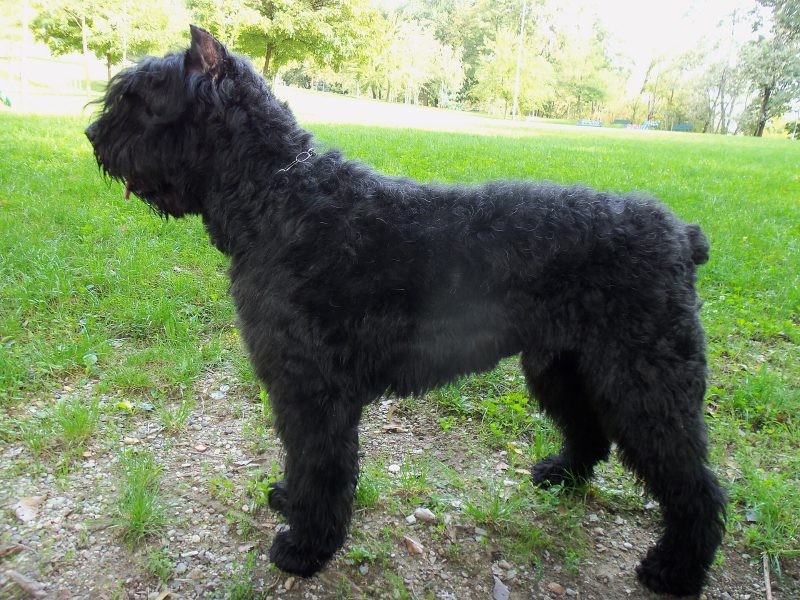
The Bouvier is a large, compact, powerfully built dog, square in outline, standing 24.5 to 27.5 inches for males and 23.5 to 26.5 inches for females and weighing roughly 70 to 110 pounds. It is heavy-boned and muscular without being clumsy, with a broad chest, a short, strong back and a free, ground-covering trot. The head is big and flat-skulled, finished with a heavy beard and mustache and bushy eyebrows that shade dark oval eyes and give the breed its serious, thoughtful look. Ears are natural or cropped; tails are traditionally docked where that is still permitted.
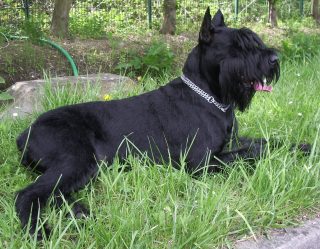
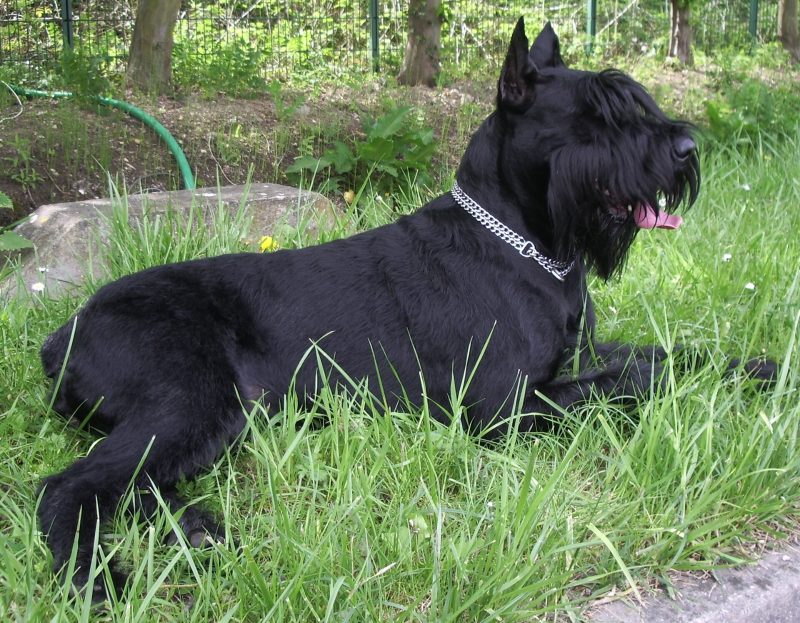
The coat is the breed's weather gear: a dense, fine undercoat beneath a harsh, tousled outer coat about two and a half inches long, rough to the touch and never silky or woolly. Colors run from fawn through gray, salt and pepper and brindle to black, often with a small white star on the chest. The Giant Schnauzer is the obvious look-alike, but it is leaner, with a longer head and a wiry rather than tousled coat; the Black Russian Terrier is larger with a longer, softer coat.
Temperament & Personality
A good Bouvier is even-tempered, confident and quietly affectionate, a dog that would rather lean against your leg than bounce around the room. It is calm indoors once mature, slow to startle and remarkably patient with its own family's children, whom it tends to shepherd. Its loyalty comes paired with a strong protective instinct: Bouviers are reserved with strangers, size people up before accepting them and will place themselves between their family and anything they consider a threat. They are not barkers by habit, but they are serious when they do speak.
With other dogs they are usually fine if socialized, though some males are assertive with other males. Their herding and guarding background gives many a strong prey drive toward cats, rabbits and small dogs they were not raised with. They are late to mature, often puppyish until two or three, and they are thinkers; a Bouvier will assess a situation before acting, which makes it a steady companion but also one that needs an owner it respects.
Exercise & Activity
This is a working breed that needs real exercise: plan on at least 60 to 90 minutes a day, ideally more, combining long walks, free running in a secure area and some kind of task. Bouviers excel at herding trials, carting, tracking, obedience, agility and protection sports, and even a backyard version of carting or fetch gives them the sense of purpose they crave. A bored Bouvier becomes destructive, restless and, in the worst cases, self-appointed security for the neighborhood.
Puppies should not be run hard, jogged on pavement or allowed to jump from heights before their joints finish growing at around 18 months; free play on grass and short walks are enough. The thick coat laughs at cold, wind and rain, but hot, humid weather is hard on a big, dark, double-coated dog, so shift activity to cooler hours in summer and watch for heavy panting.
60 to 90 minutes or more daily, including a job or sport
Protect growing joints; no forced running before 18 months
Cold-hardy; take care in heat
Training
Bouviers are intelligent and capable, and they learn fast, but they learn like working dogs rather than lap dogs: they want a reason and a leader they trust. Training must start in puppyhood and stay consistent through a long adolescence, because a 90-pound dog with a mind of its own and no manners is a problem. Use clear rules, calm firmness and rewards; they respond poorly to harshness and quickly tune out nagging or endless repetition. Short, purposeful sessions suit them better than drills.
Socialization is the non-negotiable. Expose puppies to many people, places, sounds and dogs so that their natural reserve stays polite and their protectiveness is channeled rather than reflexive. Teach loose-leash walking early while the dog is still liftable, and work on reliable recall and a solid "leave it" to manage prey drive. Many Bouviers thrive in herding, obedience, rally, tracking and Schutzhund-style sports and have long records as police, military, guide and search dogs.
Grooming & Care
The Bouvier's rough coat does not shed much, but it holds dirt, debris and food, so it needs real work. Brush and comb thoroughly once or twice a week, going to the skin with a slicker and a steel comb, with special attention to the beard, behind the ears, under the legs and the trousers. Without that, the undercoat felts into mats. Every six to eight weeks the coat benefits from a tidy by a groomer or a handy owner: trimming around the feet, ears and hygiene areas and shaping the body so the dog keeps its square outline. Show dogs are hand-stripped; pet coats are usually clipped.
The beard is the daily chore. It soaks up water, soup and drool and should be wiped after meals and drinks to prevent odor and staining. Bathe only when dirty, every couple of months. Check ears weekly, clean them after swimming, trim nails every three to four weeks and brush teeth regularly.
Thorough brush and comb 1 to 2 times a week
Tidy or clip every 6 to 8 weeks
Wipe the beard daily
Health
Bouviers typically live 10 to 12 years. As a large, deep-chested breed they are at real risk of gastric dilatation-volvulus, or bloat, in which the stomach fills with gas and twists; it is a life-threatening emergency, and many owners discuss a preventive gastropexy with their vet at the time of spaying or neutering. Hip and elbow dysplasia occur in the breed, as does an inherited cardiac condition, subaortic stenosis, which is often first detected as a heart murmur in a puppy. Eyes can be affected by glaucoma, which can appear young, and by cataracts and entropion. The breed also has its own inherited muscle disorder, Bouvier myopathy, which causes swallowing difficulty, and sees laryngeal paralysis, hypothyroidism and epilepsy at above-average rates.
The American Bouvier des Flandres Club recommends OFA or PennHIP hip evaluation, OFA elbow evaluation, a cardiac exam and an ophthalmologist eye exam for breeding stock, with eyes rechecked every couple of years. Ask any breeder for these. For your own dog, keep it lean, know the signs of bloat, and ask your vet about any murmur, limping, noisy breathing or regurgitation.
Nutrition
Feed a large-breed puppy formula from weaning until about 12 to 18 months; these diets control calcium and calories so that joints grow at a steady pace, which matters in a breed prone to hip and elbow dysplasia. Switch to a large-breed adult food afterward and keep the dog lean through its life; a Bouvier under its coat can gain weight unnoticed, so feel for ribs regularly. Adults do best on two measured meals a day rather than one large one.
Bloat prevention shapes feeding habits in this breed. Split the daily ration into two or three meals, use a slow-feeder bowl for fast eaters, avoid vigorous exercise for an hour before and after meals and skip raised bowls, which have not been shown to help. Keep treats to about a tenth of calories. Many owners ask their vet about joint supplements as the dog ages; that conversation is worth having, but it is a decision for your vet, not the pet-store aisle. Fresh water should always be available, and the beard will need a wipe afterward.
Living With This Breed
The Bouvier is a house-and-yard dog. It is too large and too active for most apartments, needs secure fencing, and is happiest where it has space, a daily job and its family within sight. It is quiet indoors, sheds little and tolerates cold superbly; heat and humidity need managing. Expect a wet beard on your lap, debris carried in on the coat and a dog that positions itself where it can watch the door.
It is a devoted family dog that is gentle and protective with its own children, though its size and herding instinct mean supervising play with toddlers. It can live with cats and other dogs when raised with them. Strangers, including delivery drivers and new sitters, should be properly introduced. For a pet sitter or daycare, the essentials are: meet the dog with the owner present first, keep it leashed and away from small animals outdoors, provide a real walk rather than a potty break, know the signs of bloat, and wipe that beard.
House with a fenced yard; not an apartment dog
Introduce new people properly; protective by nature
Cold-hardy, heat-sensitive; needs daily exercise and a job
Interesting Facts
"Bouvier" is French for cowherd, and the breed's Flemish nicknames translate as "dirty beard" and "cow dog."
Bouviers carried messages and hauled ambulance carts in the First World War, and the breed survived mainly through one dog, a trench veteran named Nic.
Ronald and Nancy Reagan were given a Bouvier puppy, Lucky, at the White House in 1984; she grew large enough to tow the President across the lawn and was retired to the Reagan ranch.
Patrasche, the cart dog in the novel A Dog of Flanders, is usually drawn as a Bouvier.
In the Second World War Bouviers again served as couriers, this time for resistance movements in occupied countries, and the breed had to be rebuilt afterward.
Modern Bouviers work as police, military, search-and-rescue and guide dogs, and the breed competes in herding, carting, tracking and protection sports.
Breeds similar to the Bouvier des Flandres
What Bouvier des Flandres owners say
Real pets, photos, stories and tips from the SitterNation community — separate from the editorial guide above.
Log in to add your pet, photos, stories and tips.
Meet Bouvier des Flandres on SitterNation
No Bouvier des Flandres have joined yet. Owners can show their pet here from the pet's profile.
Bouvier des Flandres community photos
No Bouvier des Flandres photos yet — be the first to share one.
Stories from Bouvier des Flandres owners
No stories yet. What is life with yours really like?
Tips from Bouvier des Flandres owners
No tips yet. One practical thing that works for you is enough.
Ask Bouvier des Flandres owners
No questions yet. Ask the people who live with the breed.