Typical tendencies
Energy level
Needs a real outlet most days.
Good with children
Patient with kids when well supervised.
Good with other dogs
Selective; careful introductions needed.
Trainability
Quick to learn and keen to please.
Shedding
Barely a hair on the sofa.
Apartment friendly
Needs space and a garden to be happy.
More traits
Exercise needs
Adaptability
Grooming needs
Drooling
Intelligence
Family friendly
Good with cats
Friendly with strangers
Sociability
Protectiveness
Prey drive
Overview
The Giant Schnauzer is the largest of the three Schnauzer breeds: a bold, bearded working dog bred to drive cattle, guard property and later serve police forces in Germany. Giants are smart, intensely loyal and happiest with a job, which makes them superb partners for active, experienced owners who enjoy training and want a dog that takes its guardian role seriously.
They are not a casual choice. A Giant needs an hour or more of real exercise every day, consistent leadership, early and ongoing socialization and a coat that has to be brushed and either stripped or clipped. Left unemployed, a 75-pound dog with this much drive and suspicion of strangers becomes a handful. Give one structure, work and company, though, and you get a devoted, playful and remarkably attentive companion that would rather be with you than anywhere else.
History & Origin
The Giant Schnauzer took shape in the 1800s in the farming country of Bavaria and Wurttemberg in southern Germany, where cattlemen wanted a bigger, tougher version of the Standard Schnauzer to drive stock to market and guard the farmyard. Rough-coated drover dogs, the Standard Schnauzer and larger breeds such as the Great Dane and local smooth-coated cattle dogs are usually credited as ingredients, though no breeding records survive. For many years the dog was known as the Munchener after Munich, where it guarded breweries, butcher shops, stockyards and beer wagons once railroads made long droves obsolete.
In the years before the First World War, German police schools began training Giants, and police and military work became the breed's main occupation across Europe. The first Giants reached the United States in the 1920s and the AKC recognized the breed in 1930, but it stayed rare until the 1960s, when show winners and obedience competitors raised its profile. The Giant Schnauzer Club of America was founded in 1962.
Appearance
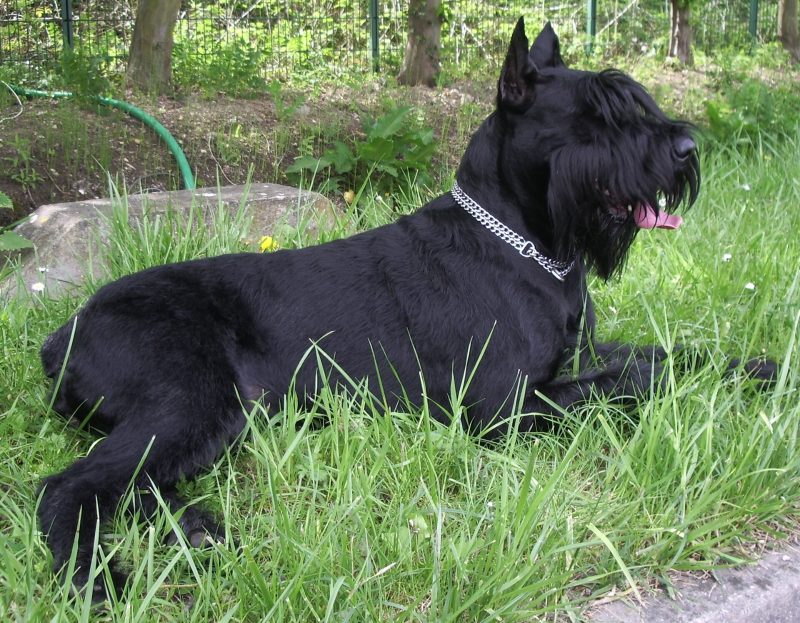
A Giant Schnauzer looks like a Standard Schnauzer enlarged into a powerful, square working dog. Males stand 25.5 to 27.5 inches at the shoulder and weigh 60 to 85 pounds; females run 23.5 to 25.5 inches and 55 to 75 pounds. The body is as long as it is tall, the chest deep, the back strong and short, and the whole outline suggests strength with agility rather than bulk. The long, rectangular head carries the breed's signature arched eyebrows and dense beard, which frame dark, oval eyes with a keen expression. Ears are set high and fold forward naturally; cropping and tail docking are still seen in the United States but are banned in much of Europe.
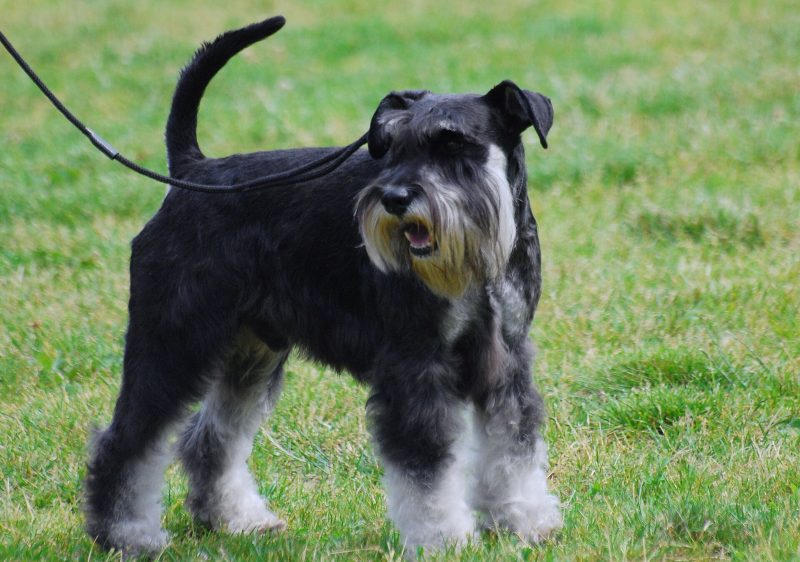
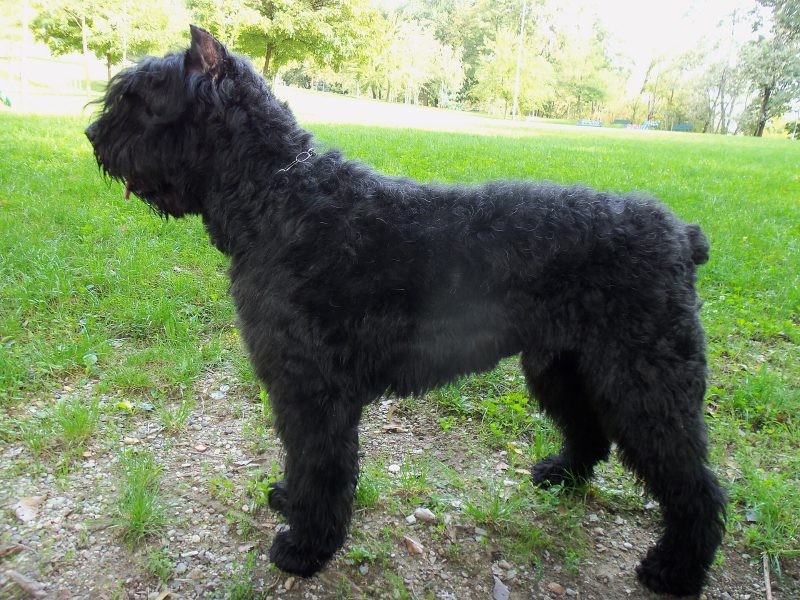
The coat is harsh, wiry and dense over a soft undercoat, and comes in solid black or pepper and salt, a banded gray mix. Look-alikes include the Bouvier des Flandres, which is heavier and shaggier, and the Black Russian Terrier, a larger, longer-coated breed that counts the Giant among its ancestors.
Temperament & Personality
Giants are serious, intelligent dogs with a strong sense of territory and family. Indoors with their people they can be playful, affectionate and even clownish, leaning against a leg or shoving a head under your hand; outdoors they are alert, driven and watchful. They form deep bonds and like to keep an eye on the household, following you from room to room. Strangers are met with reserve until the dog decides they belong, and a Giant will bark at anything it finds suspicious. That guardian instinct is the point of the breed, but it needs early socialization and steady guidance so wariness does not tip into overreaction.
They generally do well with older, respectful children, though their size and boisterous play make them a poor fit for toddlers. Same-sex dog aggression is common, and cats and small pets may trigger chasing. Giants push soft owners around and settle down under firm, fair, consistent handling.
Exercise & Activity
Plan on at least 60 to 90 minutes of purposeful exercise every day, and more for a young adult. A stroll around the block will not do; Giants were built to work from dawn to dusk and they need to run, hike, swim or train. Long brisk walks, jogging or biking with a conditioned adult, retrieving games and serious training sessions are all good. The breed excels at obedience, agility, tracking, herding trials and protection sports, and many are happiest with some form of structured work. Mental exercise matters as much as miles: scent games, puzzle feeders and new skills take the edge off. Black coats absorb heat, so shift hard exercise to cooler hours in summer; cold weather suits them fine.
An hour or more of real activity daily, plus training
Secure fencing; a bored Giant will patrol and may roam
Boredom shows as barking, digging, destructive chewing and pushy behavior
Training
Giants learn fast and remember everything, which is a gift in the right hands and a problem in the wrong ones. They respond best to clear rules, upbeat rewards and short, varied sessions; endless drilling bores them and harsh corrections make them shut down or push back. Start socialization the week the puppy comes home and keep it going through adolescence, with many calm exposures to new people, dogs, places and surfaces, because a suspicious adult Giant is hard to live with. Teach loose-leash walking early, before the dog weighs 80 pounds, along with a reliable recall and a settle on a mat. Common sticking points are puppy mouthing, jumping and a tendency to test every household member for weak spots. Adolescence from around 8 to 24 months brings a second wave of pushiness, and many owners find a good training club keeps them on track. Giants thrive on advanced work and most are capable of titles in obedience, rally, tracking and protection sports.
Grooming & Care
The wiry coat sheds little, but it needs regular, hands-on care. Brush and comb thoroughly once or twice a week, paying extra attention to the beard, leg furnishings and armpits, where mats form. Every six to eight weeks the body coat should be hand-stripped to keep its hard texture, or clipped if you do not show; clipping softens the coat and may lighten pepper and salt color, which most pet owners accept. The beard collects food and water and benefits from a wipe after meals. Bathe as needed, roughly monthly, with a dog shampoo. Check and clean the ears weekly, especially in dogs that swim, trim nails every few weeks and brush teeth several times a week. Hair between the pads should be trimmed to prevent slipping and debris. Many owners book a professional groomer for the full strip or clip and handle brushing at home.
Health
Giant Schnauzers are generally robust and typically live 12 to 15 years, but a few inherited problems deserve attention. Hip and elbow dysplasia occur in the breed, and osteochondritis dissecans can cause lameness in fast-growing puppies. Autoimmune thyroiditis leading to hypothyroidism is well documented, as are eye problems including cataracts, progressive retinal atrophy and glaucoma. Black Giants have an unusually high rate of squamous cell carcinoma of the toe, a cancer that often starts as a swollen, bleeding nail bed; any persistent toe lesion should be seen by a vet promptly. Other reported conditions include seasonal flank alopecia, epilepsy, narcolepsy and, as in any deep-chested large breed, bloat.
The Giant Schnauzer Club of America recommends that breeding stock have an OFA or PennHIP hip evaluation, an OFA elbow evaluation, an eye exam by a veterinary ophthalmologist and thyroid screening through an approved laboratory. Ask your vet about regular thyroid checks as your dog ages.
Nutrition
Feed a complete, balanced diet formulated for large breeds, and choose a large-breed puppy formula for the first 12 to 18 months so growth stays steady rather than rapid, which helps protect developing joints. Puppies do well on three meals a day; adults generally eat two. Measure portions and adjust to the dog's workload, because a Giant in serious training needs considerably more than a couch companion, and overweight Giants put extra strain on hips and elbows. You should be able to feel ribs under the coat without pressing hard. Because the breed is large and deep-chested, take sensible bloat precautions: split the daily ration into two or more meals, avoid hard exercise for an hour either side of eating and consider a slow feeder for gulpers. Ask your vet before adding supplements, and discuss diet choices if your dog has thyroid disease or recurrent skin problems.
Living With This Breed
A house with a securely fenced yard suits the Giant best; apartments are a stretch unless you are committed to several hours outside every day. They cope with cold easily and need shade and water in heat. Giants want to be with their people and do poorly left alone for long workdays, which can produce barking, destruction and territorial behavior. They are protective of home and car, so visitors should be introduced properly, and a sitter or daycare must be comfortable handling a strong, watchful dog. Teens and older children who respect dogs make good companions; toddlers are easily bowled over. Other dogs of the same sex and small pets need careful management.
Tell a sitter about guarding, same-sex dog issues and the dog's warning cues
A tired, trained Giant is a quiet housemate; an idle one is not
Two-dog households usually work best with opposite-sex pairs
Interesting Facts
Schnauzer comes from the German word for snout, a nod to the breed's bushy muzzle.
For decades the breed was called the Munchener after Munich, where Giants guarded brewery wagons and butcher shops.
German police schools were training Giant Schnauzers before the First World War, and the breed still works in law enforcement today.
A Giant Schnauzer named Monty won Best in Show at Westminster in 2025, the breed's first win at America's most famous dog show.
Pepper and salt is not gray: each hair is banded light and dark, which is why clipped coats look paler than stripped ones.
Many Giants are leaners that press their weight against their owners' legs, a habit fanciers consider a breed signature.
Breeds similar to the Giant Schnauzer
What Giant Schnauzer owners say
Real pets, photos, stories and tips from the SitterNation community — separate from the editorial guide above.
Log in to add your pet, photos, stories and tips.
Meet Giant Schnauzers on SitterNation
No Giant Schnauzers have joined yet. Owners can show their pet here from the pet's profile.
Giant Schnauzer community photos
No Giant Schnauzers photos yet — be the first to share one.
Stories from Giant Schnauzer owners
No stories yet. What is life with yours really like?
Tips from Giant Schnauzer owners
No tips yet. One practical thing that works for you is enough.
Ask Giant Schnauzer owners
No questions yet. Ask the people who live with the breed.