Typical tendencies
Energy level
Ready to go when you are, settles after.
Good with children
Gentle and tolerant around children.
Good with other dogs
Gets along with known, polite dogs.
Trainability
Quick to learn and keen to please.
Shedding
Keep the lint roller within reach.
Apartment friendly
Fine in a flat if exercise is kept up.
More traits
Exercise needs
Adaptability
Grooming needs
Drooling
Intelligence
Family friendly
Good with cats
Friendly with strangers
Sociability
Protectiveness
Prey drive
Overview
The Cardigan Welsh Corgi is the older, longer-tailed and slightly more serious of the two Welsh corgis: a low-slung herding dog with heavy bone, round ears and a thoughtful nature. It suits people who want a clever, trainable dog of manageable size that enjoys walks, games and dog sports but can also settle for an evening. Cardigans are devoted to their family, reserved rather than gushing with strangers, and vocal about anything out of place. They do well with respectful children and generally with other pets, adapt to apartments if walked, and are easier to groom than their coat suggests.
The challenges are shedding, barking, a tendency to put on weight, and a long back that needs protecting. Someone looking for a fetch-obsessed sprinter or a silent dog should look elsewhere; someone who wants a sturdy, sensible companion with a big personality will be well served.
History & Origin
The Cardigan is thought to be the older of the two corgi breeds, descended from dogs brought to Wales by Celtic migrants perhaps three thousand years ago and related to the teckel family that also produced the Dachshund. In the hills of Cardiganshire in mid-Wales these dogs drove cattle to market, nipping heels and dropping flat under the kicks, and doubled as farm guardians and vermin catchers. The Pembroke Welsh Corgi developed separately in the southwest with later spitz influence, but for years the two were shown and bred together.
The Kennel Club recognized Welsh Corgis in 1925 and, after a decade of friction between breeders, separated Cardigan and Pembroke in 1934. The first Cardigans reached the United States in the early 1930s, the AKC recognized the breed in 1935, and the Cardigan Welsh Corgi Club of America formed the same year. A red and white bitch named Megan became the first American champion. The Cardigan has never matched the Pembroke's popularity, which its admirers consider a feature.
Appearance
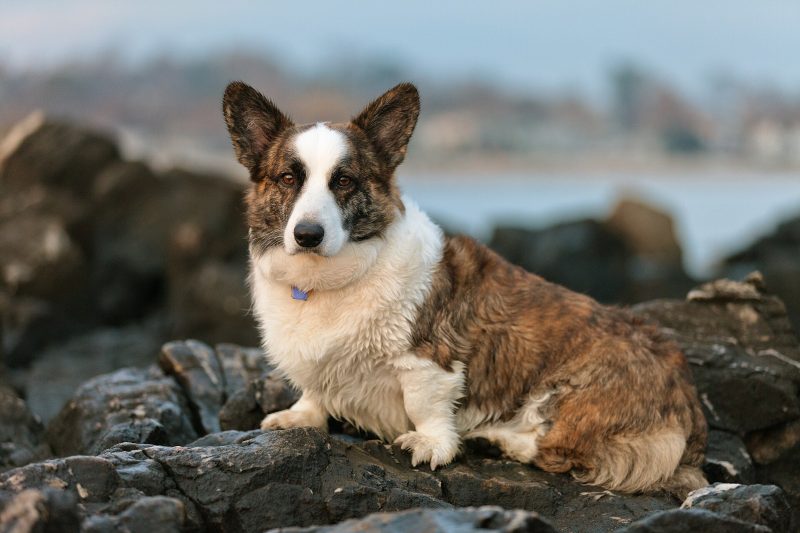
A Cardigan stands 10.5 to 12.5 inches at the shoulder and weighs 30 to 38 pounds for males and 25 to 34 for females, a surprisingly heavy, long and low dog with a deep chest and slightly bowed front legs. The head is fox-like with a flat skull and a moderately pointed muzzle, the eyes are medium and dark except in merles, which may have blue eyes, and the ears are large, upright and rounded at the tips. The long, bushy tail is set low and carried like a fox's brush.
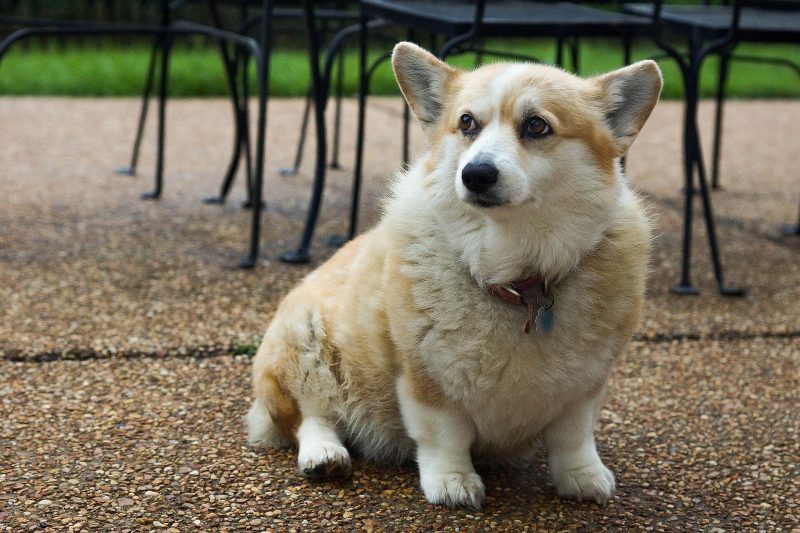
The coat is a medium-length double coat with a dense undercoat and a slightly harsh outer coat. Colors include red, sable, brindle, black with or without tan or brindle points, and blue merle, usually with white on the neck, chest, legs, muzzle and tail tip. The Pembroke is the look-alike: it is lighter in bone, has pointed ears and a docked or naturally short tail, and does not come in brindle or merle.
Temperament & Personality
Cardigans are affectionate, even-tempered and a little reserved. They form close bonds with their family and like to be in the room, but they are less insistent than many herding dogs and will often observe from a comfortable spot. With strangers they are polite and watchful, warming up once they decide a person is acceptable, and they announce arrivals with a bark that sounds like it belongs to a much bigger dog. They are good with children who treat them kindly, though the herding instinct can surface as heel nipping when kids run and shriek.
Most Cardigans get along with other dogs and with cats, especially those they grew up with, and they tend to be bossy rather than aggressive. Indoors they are calm once exercised; outdoors they are quick, agile and fond of chasing anything that moves. They think before acting and can be stubborn when they see no point, but they are rarely nervous or sharp.
Exercise & Activity
Cardigans need about 45 to 60 minutes of activity a day. A couple of good walks, a game of fetch or tug, and some training or a puzzle toy will satisfy most adults, while younger dogs appreciate the chance to run off leash in a fenced area. They are talented at herding, agility, rally, obedience, scent work and tricks, all of which give the clever brain a job.
Protect the back: discourage jumping off furniture and out of cars, use ramps where you can, and keep stairs to a minimum for puppies. Cardigans can swim but their shape makes them poor swimmers, so supervise around water. The double coat copes well with cold and poorly with heat, so plan summer exercise for cooler hours. A bored Cardigan barks, herds the household and gains weight, so consistency matters more than intensity.
45 to 60 minutes a day of walks, play and training
Ramps and no high jumps to protect the spine
Dog sports suit the herding brain
Training
Cardigans are quick learners who enjoy working with their person, and they are motivated by food, play and a sense of being useful. Keep sessions short and varied; the breed bores easily and will offer creative alternatives if asked to repeat too often. They respond well to positive methods and poorly to heavy-handed ones. Teach a quiet cue early, because barking at every sound is the most common complaint, and reward calm behavior near doors and windows.
Redirect heel nipping onto toys and teach children not to run from the dog. Recall is usually reasonable since Cardigans like to stay near their people, but practice around distractions. Socialize puppies broadly with people, dogs and environments to keep the natural reserve from becoming suspicion. Cardigans excel in obedience, rally, agility and herding trials and often enjoy tricks. They have opinions, and training works best when they believe the idea was partly theirs.
Grooming & Care
The Cardigan's double coat sheds year-round and heavily twice a year when the undercoat lets go. Brush once or twice a week with a slicker brush and an undercoat rake, going daily during the spring and fall coat blow, when a bath followed by a thorough blow-dry removes an astonishing amount of hair. Never shave the coat; it protects against cold and sun and may grow back patchy. Bathe every month or two or when dirty.
The upright ears stay relatively clean but should be checked weekly. Trim nails every two to three weeks, as long nails change the gait and stress the long back. Brush teeth several times a week. Check the feathering on the back legs and the bushy tail for burrs and mats, and keep the hair between the pads trimmed for traction on hard floors. Professional grooming is optional; a good vacuum is not.
Brush 1 to 2 times a week, daily in shedding season
No shaving
Keep nails short for the sake of the back
Health
Cardigans usually live 12 to 15 years and are a fairly healthy breed, but a few inherited problems deserve attention. The parent club asks breeders to screen hips for dysplasia and to run two DNA tests: one for the rcd3 form of progressive retinal atrophy, an early-onset blindness specific to Cardigans, and one for degenerative myelopathy, a slowly progressive spinal disease of older dogs in which a sizable share of the breed carry the risk gene. An eye exam by a veterinary ophthalmologist is also recommended.
As a chondrodysplastic breed with a long back, Cardigans are prone to intervertebral disc disease; sudden back pain, reluctance to jump or hind-end weakness needs a prompt vet visit. Obesity is the most common and most preventable problem and worsens the spine, joints and lifespan. Lymphoma and other cancers, patent ductus arteriosus, lens luxation and hypothyroidism are reported. Ask breeders for OFA and DNA results for both parents, and ask your vet about weight at every visit.
Nutrition
Cardigans are efficient eaters with a strong interest in food, so portion control is the main nutritional task. Feed two measured meals a day of a complete diet appropriate to life stage, weighing the food rather than scooping, and subtract training treats from the daily total; small pieces of carrot or green bean make good low-calorie rewards. Puppies do well on a quality growth food, three meals a day until about six months, with no extra calcium.
Adults often need less than the bag suggests, and neutered dogs and seniors need less still. You should feel ribs under a light fat cover and see a waist from above, which takes hands rather than eyes under the thick coat. Dogs with a history of back trouble benefit especially from staying lean; ask your vet about a joint-support or lower-calorie food if weight creeps up. Keep fresh water available and avoid free feeding.
Living With This Breed
Cardigans adapt to apartments, suburban homes and farms as long as they get daily exercise and someone manages the barking, which can be a problem with close neighbors. They are indoor family dogs who want to be part of things, cope with a normal workday alone if exercised first, and settle well in the evening. They tolerate cold happily and heat poorly. They are good with considerate children and most other pets, and they make alert watchdogs without being aggressive. Protect the back at home with ramps to the sofa and bed and by discouraging leaps.
A sitter should know the dog's exact portion sizes, the no-jumping rules, that the dog may try to herd children or other dogs, and that a sudden reluctance to move or climb stairs is a reason to call the vet. Daycare suits sociable Cardigans; others prefer a walker and a quiet house.
Apartment-capable with daily walks and bark management
Ramps, strict portions, no leaps off furniture
Sitters: watch for back pain, expect hair and commentary
Interesting Facts
The Welsh name Ci Sawdl means heel dog, a reference to the way Cardigans nip at cattle's heels.
Cardigans are believed to have been in Wales for about three thousand years, long before the Pembroke emerged.
Unlike the Pembroke, the Cardigan comes in blue merle and brindle and always has a long, fox-like tail.
The first American champion, Ch. Megan, gives her name to the parent club's annual champions-only competition.
Cardigans have slightly bowed front legs and a deep chest, an old adaptation for ducking under kicks while driving cattle.
Breed fans like to say that the Cardigan is the corgi for people who have done their research.
Breeds similar to the Cardigan Welsh Corgi
What Cardigan Welsh Corgi owners say
Real pets, photos, stories and tips from the SitterNation community — separate from the editorial guide above.
Log in to add your pet, photos, stories and tips.
Meet Cardigan Welsh Corgis on SitterNation
No Cardigan Welsh Corgis have joined yet. Owners can show their pet here from the pet's profile.
Cardigan Welsh Corgi community photos
No Cardigan Welsh Corgis photos yet — be the first to share one.
Stories from Cardigan Welsh Corgi owners
No stories yet. What is life with yours really like?
Tips from Cardigan Welsh Corgi owners
No tips yet. One practical thing that works for you is enough.
Ask Cardigan Welsh Corgi owners
No questions yet. Ask the people who live with the breed.