Typical tendencies
Energy level
Calm at home with short bursts of play.
Good with children
A famously patient playmate for kids.
Good with other dogs
Gets along with known, polite dogs.
Trainability
Learns, but on its own schedule.
Shedding
Fur on everything, all year round.
Apartment friendly
Needs space and a garden to be happy.
More traits
Exercise needs
Adaptability
Grooming needs
Drooling
Intelligence
Family friendly
Good with cats
Friendly with strangers
Sociability
Protectiveness
Prey drive
Overview
The Great Pyrenees is a giant white livestock guardian bred to live with sheep in the mountains and make its own decisions about wolves. At home that history produces a calm, patient, affectionate dog that is wonderful with children, gentle with other animals, deeply protective of its territory, and inclined to bark at night and to ignore recall. It suits people with a house and a secure fence, a tolerance for hair and drool, and a temperament that does not need instant obedience.
Pyrs are quiet indoors, slow-moving in warm weather, and happy to spend hours watching the yard. They are a poor fit for apartments, hot climates without air conditioning, off-leash lifestyles, or owners who want a dog that lives to please. For a family that wants a serene, loyal guardian and understands that the dog is working even when it appears to be napping, there is nothing quite like one.
History & Origin
The Great Pyrenees descends from ancient livestock guardian dogs that spread west with shepherds from Asia Minor and settled in the Pyrenees mountains between France and Spain thousands of years ago. For centuries these dogs lived with the flocks, moving between winter valleys and summer pastures and working alone at night against wolves and bears; their white coats let them blend with the sheep. French nobles adopted them as estate guardians in the 1600s, and a dog brought home by Louis XIV's young son in 1675 helped make them fashionable; the breed was later styled the Royal Dog of France.
The Marquis de Lafayette sent two to America in 1824. The modern breed was shaped by the French standard of 1927 and by American imports in the early 1930s, led by Mary and Francis Crane's Basquaerie kennel. The AKC recognized the breed in 1933. After wolves returned to the French Pyrenees in the 1990s, working Patous were put back on the mountains, and ranchers across North America now rely on them.
Appearance
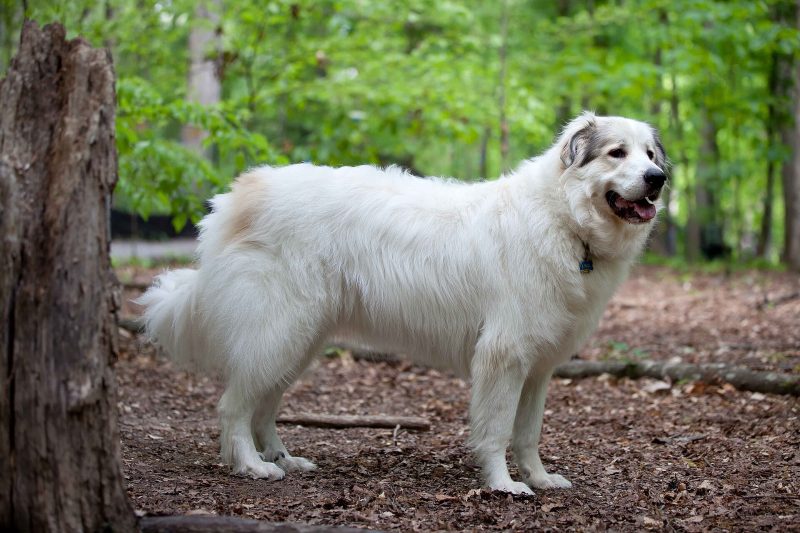
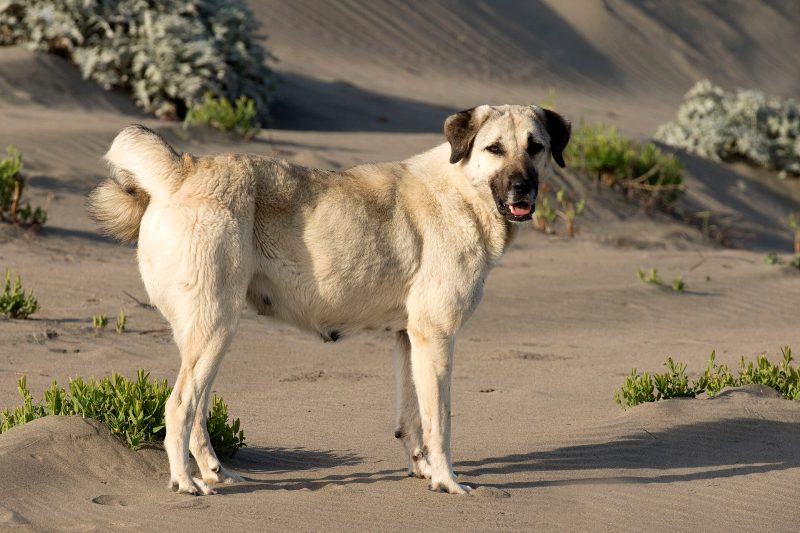
The Great Pyrenees is a giant, with males 27 to 32 inches at the shoulder and 100 to 125 pounds, and females 25 to 29 inches and 85 to 105 pounds. Despite the size it should look elegant rather than ponderous, with a level back, a deep chest and a plumed tail that hangs low with a hooked tip, the so-called shepherd's crook, and curls over the back when the dog is alert. The head is wedge-shaped with a gentle slope rather than a pronounced stop, dark almond eyes with a soft, intelligent expression, and small V-shaped ears that hang flat. A distinctive feature is the double dewclaws on each hind leg, which are left on.
The coat is a thick, weather-resistant double coat, long and flat or slightly wavy on top over a dense woolly undercoat, with a mane on the neck and feathering on the legs and tail. Color is white or white with patches of gray, badger, tan or reddish brown, mostly on the head and tail. The Kuvasz and Maremma are similar white guardians but smaller and without the markings.
Temperament & Personality
Pyrs are calm, confident and affectionate with their family and strikingly patient with children, whom they tend to regard as part of the flock. They are gentle with other animals, from cats and chickens to goats, and generally good with other dogs, though they may be assertive with strange dogs that approach their property. With strangers they are reserved and watchful; they accept people the family accepts and keep a polite distance from everyone else. They are protective by nature rather than by training, and they bark to warn off anything they consider a threat, which includes most of the night.
They are independent thinkers bred to work without instruction, so they weigh requests rather than obeying them. Indoors they are quiet and sedate, often asleep across a doorway. They are not playful in a retriever way and do not need constant interaction. Well-bred Pyrs are steady and tolerant, never nervous or quick to bite.
Exercise & Activity
A Great Pyrenees needs moderate exercise, about 30 to 60 minutes a day of walking, some free time patrolling a fenced yard and a little mental work. They are not runners or fetch dogs, and they conserve energy as a working trait, so do not expect enthusiasm for repetition. A long leash walk, a hike at a steady pace in cool weather or a session of carting or backpacking suits them. Off-leash exercise outside a fence is not realistic; Pyrs roam, follow their own agenda and have little recall.
Heat is a serious limit: exercise early or late in summer, offer shade and water and watch for heavy panting. Puppies grow fast and should have short, gentle play on soft ground, with no forced walks or stairs until the joints mature at 18 to 24 months. A bored Pyr barks more, digs and tests fences; a Pyr with a yard to oversee is usually content.
30 to 60 minutes of walking daily, cool hours in summer
Fenced patrol time counts as work
No off-leash freedom outside a fence
Training
Training a Pyrenees means negotiating with a dog that was bred to decide for itself. They are intelligent and learn quickly, but they see little reason to repeat things and will simply walk away from drilling. Use food, calm praise and short sessions, and reward the behavior you want in daily life rather than expecting formal obedience. Early, gentle socialization is essential so that the natural wariness toward strangers stays polite; introduce visitors, children, other animals and handling in the first months.
Teach loose-leash walking before the dog weighs more than you, and teach a reliable settle and a wait at doors, because a Pyr that decides to go through a gate will go through it. Barking cannot be trained away entirely, but a quiet cue and bringing the dog indoors at night reduce it. Harsh methods damage trust and achieve nothing. Pyrs can do rally, obedience and therapy work with patient handlers who accept a thoughtful pace.
Grooming & Care
The Pyrenees coat is self-cleaning to a surprising degree, shedding dirt once dry, but it is also enormous and sheds year-round with a heavy undercoat drop in spring. Brush thoroughly once or twice a week with a pin brush, slicker and undercoat rake, concentrating on the mane, behind the ears, the pants and the tail where mats form; daily brushing during shedding season saves your house. Never shave a Pyr, since the coat insulates against heat as well as cold and protects the skin from sun.
Bathe every couple of months or when needed, and plan for a long drying time or a high-velocity dryer. Check and clean the hanging ears weekly, trim nails every two to three weeks including the double dewclaws, which do not wear down, and brush teeth regularly. Expect some drool, particularly after drinking. Many owners use a professional groomer for the seasonal blowout.
Brush 1 to 2 times a week, daily when blowing coat
Trim the double dewclaws; they catch on things
Never shave
Health
Great Pyrenees typically live 10 to 12 years, a respectable span for a giant breed, but a few problems deserve attention. The parent club's screening program asks breeders to certify hips for hip dysplasia and knees for patellar luxation, which is unusually common in this breed, with elbows, eyes, heart and thyroid as additional recommended checks. Gastric dilatation and volvulus, or bloat, is a life-threatening emergency in deep-chested giants; learn the signs of restlessness, a swollen belly and unproductive retching. Osteosarcoma and other cancers are leading causes of death in large breeds like this one.
DNA tests exist for neuronal degeneration, a progressive disease of young puppies, for a form of dwarfism and for Glanzmann thrombasthenia, a bleeding disorder. Eye conditions such as cataracts, entropion and canine multifocal retinopathy are reported, as are hypothyroidism and skin problems under the heavy coat. Pyrs may be sensitive to anesthesia because of their low metabolism, so remind your vet of the breed before any procedure.
Nutrition
Pyrenees eat less than their size suggests; a slow metabolism built for long mountain summers means many adults need no more than a dog half their weight. Feed a complete diet for giant breeds in two measured meals a day, never one, and adjust to body condition: you should feel ribs under the coat and see a waist from above. Puppies must grow slowly on a large- or giant-breed growth food with controlled calcium and phosphorus, fed three times a day until about six months; rapid growth and extra calcium raise the risk of joint disease.
To reduce bloat risk, avoid vigorous exercise for an hour either side of meals, discourage gulping with a slow feeder, and ask your vet whether a preventive gastropexy makes sense at the time of neutering. Treats add up fast on a dog that moves little, so keep them small. Fresh water should always be available, especially in warm weather when a Pyr drinks a great deal.
Living With This Breed
A Great Pyrenees needs a house with a secure fence at least five feet high and preferably no close neighbors who object to barking. They are not apartment dogs, and they struggle in hot, humid climates without air conditioning and shade. They cope well with being alone during a workday, provided they have a yard to patrol, and they are generally quiet indoors. They are superb with children and with other household animals, and they often adopt livestock, cats and smaller dogs as charges. Night barking is the most common reason Pyrs end up in rescue, so plan to bring the dog inside at night or accept the sound.
A sitter should know the gate and fence routine, that the dog will not come when called outdoors, that strangers should be introduced by a family member, and that heat and bloat are the emergencies to watch for. Boarding and daycare are stressful for many Pyrs; a home sitter is kinder.
House, secure fence, cool climate
Expect barking, hair and drool
Sitters: leash always, introduce visitors, watch the heat
Interesting Facts
In France the breed is called the Patou, and working dogs still guard flocks on summer pastures where hikers are warned not to approach the sheep.
The Great Pyrenees has double dewclaws on each hind leg, a breed hallmark that is never removed.
The Marquis de Lafayette brought two Pyrenees to America in 1824, more than a century before the breed was established here.
In the 1930s Mary and Francis Crane's Basquaerie kennel in Massachusetts imported many of Europe's best Pyrs, helping the breed survive the war years.
Pyrs tend to be most watchful and vocal after dark, when predators once hunted the flocks.
The breed's calm temperament makes it a popular therapy dog despite its size; some weigh more than the patients they visit.
Breeds similar to the Great Pyrenees
What Great Pyrenees owners say
Real pets, photos, stories and tips from the SitterNation community — separate from the editorial guide above.
Log in to add your pet, photos, stories and tips.
Meet Great Pyrenees on SitterNation
No Great Pyrenees have joined yet. Owners can show their pet here from the pet's profile.
Great Pyrenees community photos
No Great Pyrenees photos yet — be the first to share one.
Stories from Great Pyrenees owners
No stories yet. What is life with yours really like?
Tips from Great Pyrenees owners
No tips yet. One practical thing that works for you is enough.
Ask Great Pyrenees owners
No questions yet. Ask the people who live with the breed.