Typical tendencies
Energy level
Calm at home with short bursts of play.
Good with children
A famously patient playmate for kids.
Good with other dogs
Enjoys most canine company.
Trainability
Quick to learn and keen to please.
Shedding
Fur on everything, all year round.
Apartment friendly
Needs space and a garden to be happy.
More traits
Exercise needs
Adaptability
Grooming needs
Drooling
Intelligence
Family friendly
Good with cats
Friendly with strangers
Sociability
Protectiveness
Prey drive
Overview
The Newfoundland is a giant working dog with a reputation for sweetness that is entirely earned. Bred on the cold coast of Canada to haul nets and pull drowning sailors from the sea, the modern Newf keeps the strength, the webbed feet and the heavy coat, and adds a patient, gentle nature that has made it a classic family dog. It is calm indoors, slow to anger and famously tolerant of children.
The trade-offs are physical. A male weighs 130 to 150 pounds, sheds in sheets, drools after every drink and needs a house with room to turn around. Lifespan is short, typically 9 to 10 years, and giant-breed vet bills, food and boarding add up. The breed suits people who want a devoted, unhurried companion, can keep up with the grooming and have a cool place for the dog to lie down in summer. If you can live with hair on everything and a wet chin on your knee, there are few kinder dogs.
History & Origin
Big, water-loving dogs were working the fishing settlements of Newfoundland by the early 1700s, and the name was in print by 1766. Their ancestry is argued over: dogs left by European fishing fleets, possibly mastiff or Pyrenean types from early colonists, and local working stock all seem to have contributed. Two sizes developed on the island. The larger became the Newfoundland; the smaller St. John's water dog went on to found the retriever breeds. The dogs hauled nets, towed lines between boats, pulled carts of fish and firewood, and earned a reputation for swimming out to shipwrecks.
Visiting sailors carried them to Britain, where the painter Sir Edwin Landseer made the black-and-white variety famous enough that it still carries his name. The American Kennel Club recognized the breed in 1886, and the Newfoundland Club of America was founded in 1930. Two world wars cut numbers badly in Britain, and North American stock helped rebuild the breed afterward. Newfoundlands still train for water rescue in Europe and North America today.
Appearance
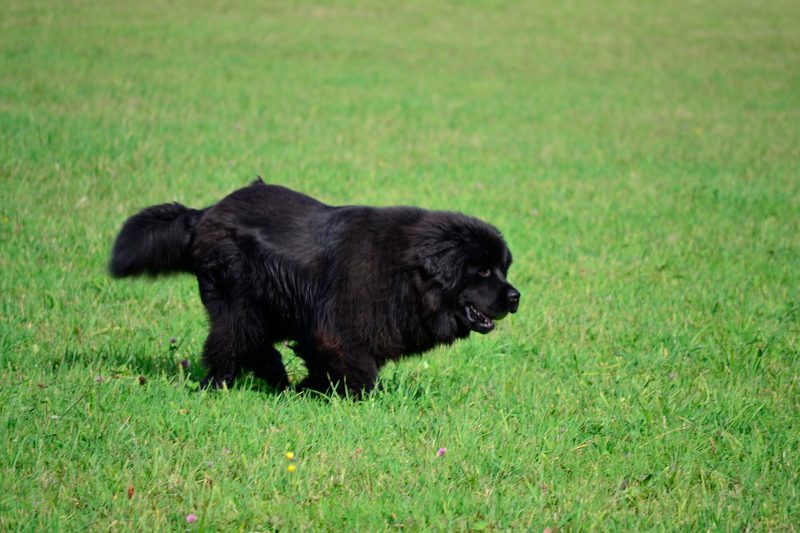
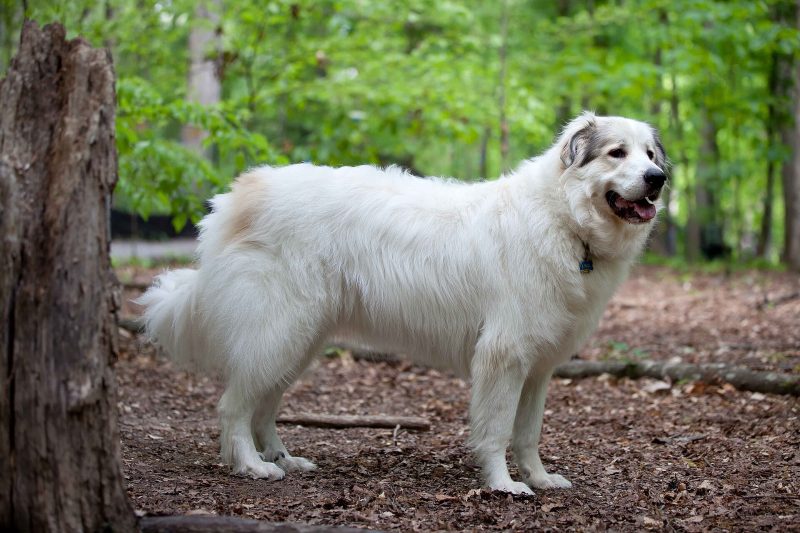
A Newfoundland is built like a working tugboat: broad, deep and heavily boned, with a level back and a thick tail carried low. Males stand 27 to 29 inches at the shoulder and weigh 130 to 150 pounds; females run 25 to 27 inches and 100 to 120 pounds. The head is massive and broad with a short, square muzzle, small triangular ears lying flat and dark, deep-set eyes that give the famously soft expression. Lips are loose, which is where the drool comes from.
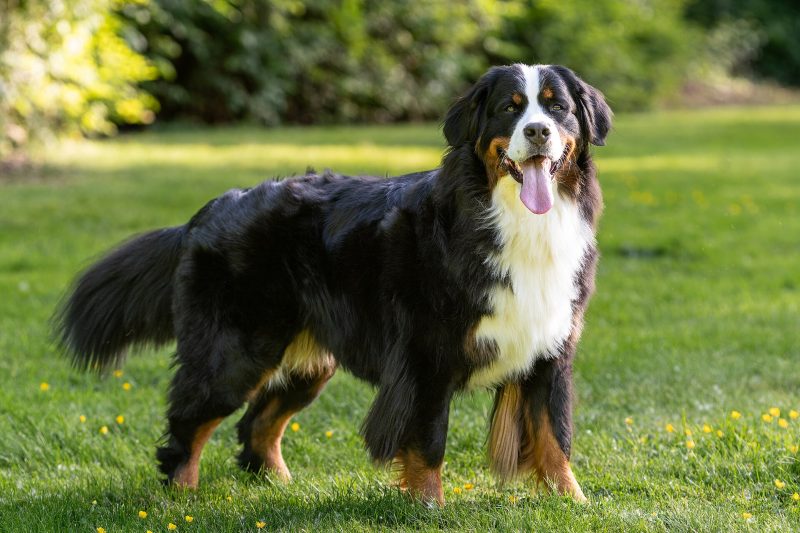
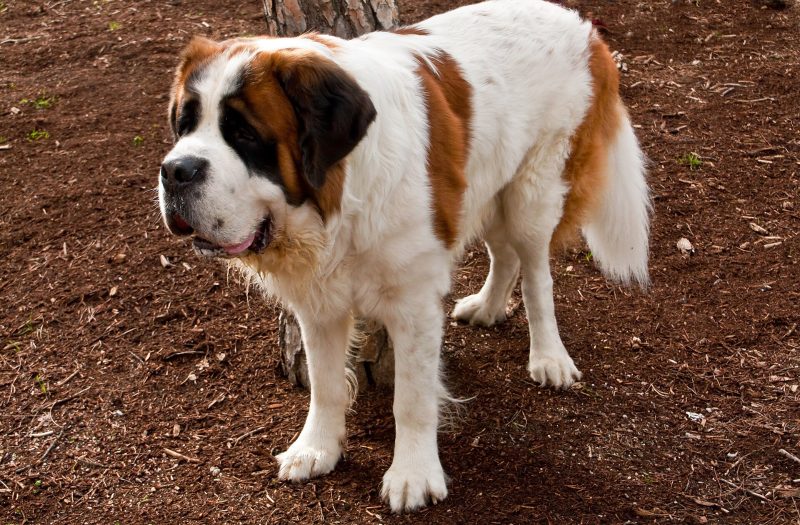
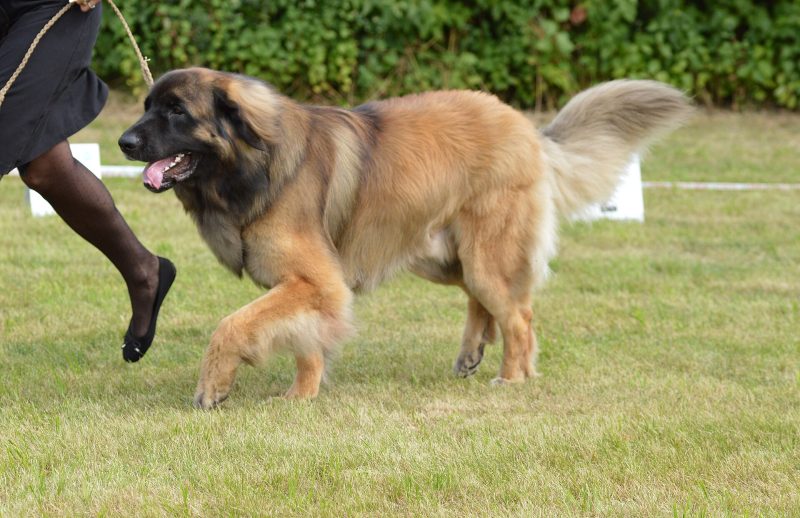
The double coat is long, flat and oily enough to shed water, over a dense, soft undercoat. Black is the most common color, followed by brown and gray; the Landseer pattern is white with black markings. The feet are large and webbed between the toes. A Bernese Mountain Dog has a tricolor coat and a finer head; a Saint Bernard has a more wrinkled face and is usually red and white; a Leonberger is lion-colored with a black mask.
Temperament & Personality
Sweetness of temperament is written into the breed standard, and most Newfoundlands live up to it. They are deeply attached to their families, quietly watchful rather than demonstrative, and happiest lying somewhere they can see everyone. Indoors they are low-key and rarely bark; outdoors they come alive around water. Many will try to tow swimmers to shore whether or not the swimmer wants rescuing.
With children the breed is patient to a fault, though a dog this size can knock a small child over with a wag, so supervision matters. Newfoundlands are generally easygoing with other dogs and cats and polite to strangers, offering a sniff and a lean rather than suspicion. They do have a protective streak and will put themselves between their people and anything that worries them, but aggression is uncharacteristic. They are sensitive dogs that take harsh words to heart and do best in a calm household.
Exercise & Activity
Newfoundlands need moderate daily exercise, roughly 30 to 60 minutes, and most of it should be low impact. A couple of steady walks, a chance to sniff and, above all, swimming suit them perfectly. Swimming is the breed's ideal workout because it builds muscle without loading the joints, and most Newfs take to water the first time they meet it. In cooler weather they enjoy longer hikes at a walking pace and love pulling a cart or sled once trained to it.
Heat is the limiting factor. The heavy coat means a Newfoundland overheats quickly, so summer exercise belongs in the early morning or evening, with shade and water available. Puppies should not be jogged, taken on stairs repeatedly or walked to exhaustion before their growth plates close at around 18 months to two years.
A bored Newf chews, digs and may lie down and refuse to move.
Skip hard exercise for an hour either side of meals to lower bloat risk.
Training
Newfoundlands are willing, thoughtful learners, and training matters more than with most breeds simply because an untrained adult is too big to manage physically. Start young with loose-leash walking, a reliable recall, sit, down and a solid "wait" at doors, before the puppy outweighs you. Reward-based methods work well; the breed is sensitive and shuts down under rough handling, and a Newf that has decided not to move is not going anywhere.
Socialize steadily so the adult's natural calm extends to visitors, delivery people and other dogs. Mouthing and leaning are common puppy habits that need redirecting early. Keep sessions short, because the breed tires of repetition and responds better to variety and praise. Many Newfoundlands excel at water rescue, drafting and obedience work, and the breed club offers titles in all of them. A dog that has a job, even a simple one like carrying a pack on walks, is noticeably more settled at home.
Grooming & Care
The coat is the main chore. Brush thoroughly two or three times a week with a slicker brush and a long-toothed comb, working down to the skin on the feathering behind the legs, under the ears and around the neck where mats form. During the spring and fall sheds, daily brushing keeps the undercoat from felting and the house from disappearing under black hair. An undercoat rake earns its keep. Bathe only every couple of months; too much washing strips the oils that keep the coat water-resistant.
Trim the hair between the pads and around the feet so it does not collect mud and ice. Check and clean the ears weekly, since the flat ear and love of swimming invite infection. Keep a towel by the door for drool and wet beards. Nails need trimming every few weeks, and teeth benefit from regular brushing.
Many owners book a professional groomer for a tidy-up every eight to twelve weeks.
Never shave a Newfoundland; the coat insulates against heat as well as cold.
Health
Newfoundlands are generally hardy but carry a handful of inherited problems worth knowing about. Subaortic stenosis, a narrowing below the aortic valve, is more common in this breed than in almost any other; mild cases cause no trouble, severe cases shorten life, and responsible breeders have hearts checked by a veterinary cardiologist before breeding. Cystinuria is a recessive kidney disorder that leads to urinary stones and can block the urethra in males; a DNA test identifies carriers. Hip and elbow dysplasia and cruciate ligament tears are frequent in a dog this heavy, and dilated cardiomyopathy, hypothyroidism and bloat also appear in the breed.
The Newfoundland Club of America asks breeders for hip and elbow evaluations, a cardiologist exam and a cystinuria DNA test as the minimum clearances. Ask to see them. Typical lifespan is 9 to 10 years. Talk to your vet about a sudden swollen belly, unproductive retching, straining to urinate, lameness or exercise intolerance, all of which need prompt attention in this breed.
Nutrition
Feed a Newfoundland puppy a large- or giant-breed growth formula rather than a standard puppy food. These diets moderate calories and calcium so the dog grows at a steady pace, which lowers the risk of joint problems without changing the final adult size. Keep puppies lean; you should be able to feel the ribs under the coat easily. Most Newfs are not greedy, but they are inactive enough that weight creeps up in adulthood, and the thick coat hides it, so judge condition by hand rather than by eye.
Adults do well on two measured meals a day. Because the breed is deep-chested, take the usual bloat precautions: no single huge meal, no vigorous exercise right after eating, and ask your vet whether a slow-feed bowl or a preventive gastropexy makes sense for your dog. Dogs diagnosed with cystinuria may need a specific diet to manage urine chemistry, which your vet will set up. Fresh water should always be available, ideally in a bowl the dog cannot tip while it drools into it.
Living With This Breed
A Newfoundland needs space more than acreage. A house with a yard is ideal, but the dog itself is calm enough for a roomy ground-floor apartment if it gets its walks and does not have to climb stairs daily. What it cannot live without is cool air; air conditioning or a cold tile floor in summer is a welfare issue, not a luxury. Expect hair on every surface, drool on walls and a water bowl that becomes a small pond.
The breed is wonderful with children and generally relaxed with other pets. Newfs tolerate being alone for a workday if exercised first, but they are people-oriented and do better with company. They are not escape artists and are quiet neighbors.
Sitters should know how to manage heat, keep towels handy and never push the dog on a hot walk.
Daycare settings need space and a calm group; a Newf lying down is immovable.
Keep the dog on a leash near open water unless you want an impromptu rescue.
Interesting Facts
Seaman, a Newfoundland, traveled the entire Lewis and Clark expedition from 1804 to 1806 and once chased a buffalo out of the camp.
Lord Byron's dog Boatswain is buried at Newstead Abbey under a monument larger than the poet's own, inscribed with Byron's "Epitaph to a Dog".
Nana, the canine nursemaid in Peter Pan, was modeled on J. M. Barrie's own Newfoundland, Luath.
In 1828 a Newfoundland named Hairyman helped Ann Harvey's family rescue more than 160 people from a wrecked ship off the Newfoundland coast.
Gander, mascot of the Royal Rifles of Canada, was posthumously awarded the Dickin Medal in 2000 for carrying a grenade away from wounded soldiers in Hong Kong in 1941.
The breed's webbed feet and a swimming stroke that is more breaststroke than paddle let it move heavy loads through cold water.
Breeds similar to the Newfoundland
What Newfoundland owners say
Real pets, photos, stories and tips from the SitterNation community — separate from the editorial guide above.
Log in to add your pet, photos, stories and tips.
Meet Newfoundlands on SitterNation
No Newfoundlands have joined yet. Owners can show their pet here from the pet's profile.
Newfoundland community photos
No Newfoundlands photos yet — be the first to share one.
Stories from Newfoundland owners
No stories yet. What is life with yours really like?
Tips from Newfoundland owners
No tips yet. One practical thing that works for you is enough.
Ask Newfoundland owners
No questions yet. Ask the people who live with the breed.