Typical tendencies
Energy level
Ready to go when you are, settles after.
Good with children
Gentle and tolerant around children.
Good with other dogs
Enjoys most canine company.
Trainability
Picks up cues with steady, short sessions.
Shedding
A light scatter, easy to keep up with.
Apartment friendly
Settles well into smaller homes.
More traits
Exercise needs
Adaptability
Grooming needs
Drooling
Intelligence
Family friendly
Good with cats
Friendly with strangers
Sociability
Protectiveness
Prey drive
Overview
The Greyhound is the fastest dog on earth and, around the house, one of the laziest: a tall, narrow sighthound that sprints for thirty seconds and then sleeps for eighteen hours. Males stand 27 to 30 inches and weigh 65 to 70 pounds, females 27 to 28 inches and 60 to 65 pounds, and most live 10 to 13 years. Greyhounds are gentle, quiet, sensitive and surprisingly good apartment dogs, and the thousands of retired racers rehomed every year make them one of the most accessible purebreds to adopt. They suit calm households, first-time owners who will respect the leash rule, and people who want an affectionate dog that asks for a soft bed, a daily walk and a chance to run now and then. They are a poor fit for homes with cats or small pets unless the individual dog has been tested, for off-leash hiking and for anyone who wants a watchdog.
History & Origin
Sighthounds of Greyhound type are among the oldest dogs in art, appearing on Egyptian tombs from the Middle Kingdom more than 4,000 years ago, and similar remains of the same age have been found in Syria. The Roman writer Arrian described a Celtic coursing hound, the vertragus, and the type was established in Britain by Saxon times. Forest Laws traditionally dated to 1014 restricted ownership near royal forests to the nobility, and for centuries Greyhounds belonged to kings and lords. Organized hare coursing began with the Swaffham club in 1776, the Waterloo Cup was first run in 1836 and the Greyhound Stud Book, started in 1882, has been closed ever since. Greyhounds came to America with early settlers and coursed jackrabbits on the plains; the AKC recognized the breed in 1885, among its earliest. Owen Patrick Smith's mechanical lure and his track at Emeryville, California, in 1919 created modern track racing, which spread to Britain in 1926 and has since declined, sending thousands of retired racers into adoption programs.
Appearance
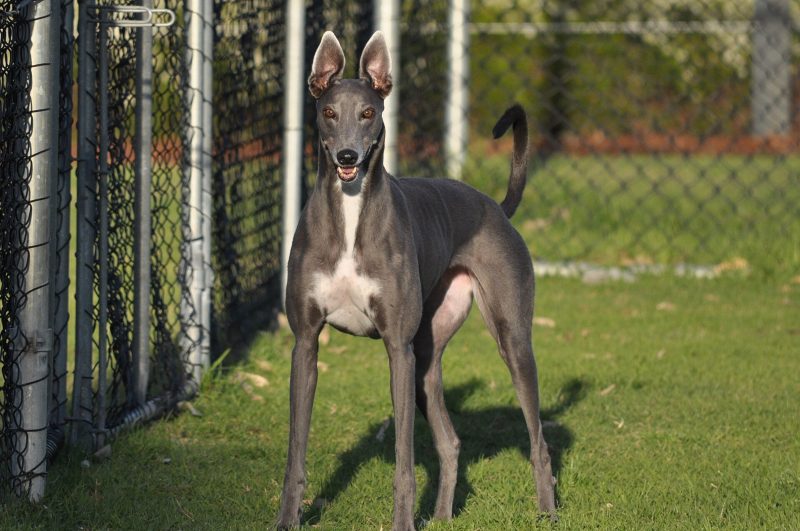
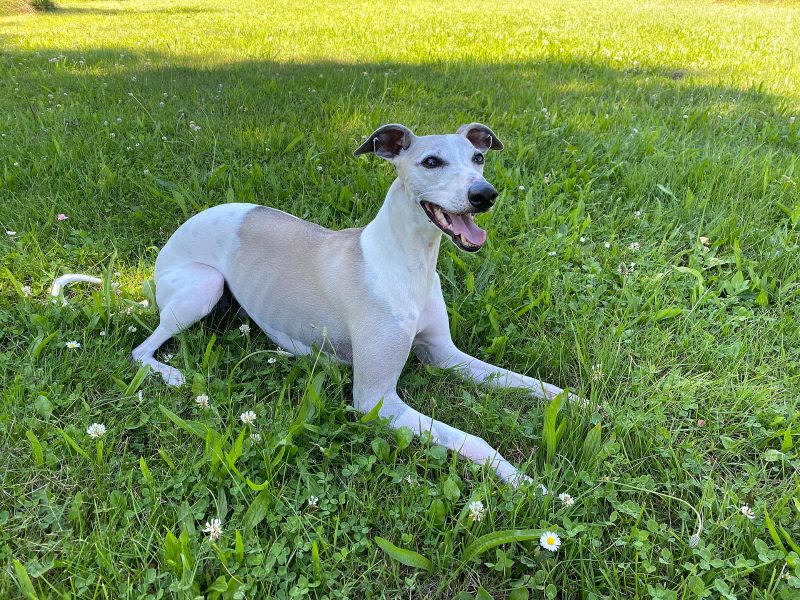
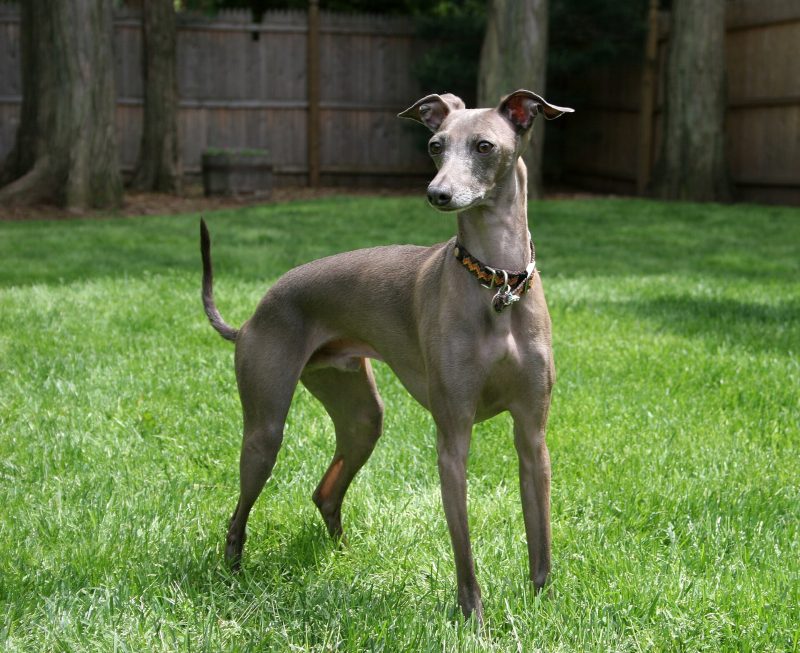
A Greyhound is built entirely for speed: long legs, a deep chest that houses an oversized heart and lungs, a tucked-up waist, a flexible arched back and a long, low-carried tail that acts as a rudder. The head is long and narrow with a barely visible stop, small folded rose ears and dark, far-seeing eyes. The neck is long and arched, the shoulders well laid back and the hindquarters powerfully muscled. The coat is short, smooth and firm, with about thirty recognized colors and patterns, including black, white, fawn, red, blue, brindle and any of these with white. Racing-bred Greyhounds tend to be a little shorter, heavier-boned and more varied in type than show-bred dogs, and many carry scars or bald patches on the thighs from kennel life. Next to a Whippet, a Greyhound is much larger, and next to a Saluki it is smoother-coated with a plainer, rose-eared head.
Temperament & Personality
Greyhounds are famously gentle, quiet and even-tempered, and surveys rank them among the least aggressive breeds toward people and other dogs. They are affectionate with their family without being clingy, polite but often reserved with strangers and almost useless as guard dogs. Indoors they are calm to the point of comedy, sprawled upside down on the sofa, and they rarely bark. Outdoors the hunter wakes up: anything small and fast triggers a chase that no recall will interrupt, and while some Greyhounds live happily with cats, each dog must be tested individually. They are sensitive to harsh voices and rough handling, and because they have little fat or coat to cushion them, they dislike being grabbed or landed on, so toddlers need supervision. Many sleep with their eyes partly open and can startle when woken, a trait adopters call sleep startle. Retired racers may need time to learn stairs, glass doors and household noises.
Exercise & Activity
Despite their speed, Greyhounds need only moderate exercise: a brisk walk or two totaling 30 to 60 minutes a day, plus a chance to sprint in a securely fenced area a few times a week. They are sprinters, not endurance athletes, and are poor jogging partners for long distances until gradually conditioned. Lure coursing, straight racing and fast coursing ability tests are the breed's natural sports, and some enjoy agility or scent work. Their thin coat and lack of body fat make them intolerant of cold and of lying on hard surfaces, so provide a coat in winter and a thick bed indoors, and avoid hard running in heat.
Always on leash outside a fence; a Greyhound can be a quarter mile away in seconds
A fenced yard must be at least five feet high with no gaps
Boredom shows as pacing and whining; most Greyhounds simply sleep
Training
Greyhounds are intelligent but independent, bred to make their own decisions at 40 miles per hour, and they respond to patient, reward-based training with food and praise rather than to pressure. Keep sessions short and gentle; a raised voice can undo a week of progress with this sensitive breed. Sitting is awkward for their build, and many learn down or stand first. Recall should be trained thoroughly and then never trusted around prey or roads. Retired racers arrive knowing how to walk nicely on a leash but may never have seen stairs, mirrors, windows or a tiled floor, so introduce the house slowly and use a crate as a familiar den. Teach children to let a sleeping Greyhound wake on its own. Socialize with calm dogs of other breeds, as racers may have met only Greyhounds. A martingale collar prevents the narrow head from slipping free.
Grooming & Care
The Greyhound's short, thin coat needs very little: a weekly rub with a rubber mitt or hound glove removes loose hair and distributes skin oils, and baths are needed only when the dog is dirty. Shedding is light. The thin skin tears easily, so check for nicks and scrapes after runs. Nails should be trimmed every two to three weeks, as long nails change the way the foot lands. Dental care is the big job, since Greyhounds, especially retired racers, are prone to heavy tartar and gum disease; brush daily if you can and plan on professional cleanings. Check the paw pads for corns, hard painful lumps that are common in the breed, and clean the ears every couple of weeks.
Weekly brushing, occasional bath, light shedding
Daily tooth brushing and regular dental cleanings
Soft bedding prevents pressure sores on the elbows and hips
Health
Greyhounds generally live 10 to 13 years and are free of many common breed problems, but they have quirks every vet should know. The parent club recommends a cardiac exam, an eye examination by a veterinary ophthalmologist and a DNA test for Greyhound polyneuropathy, a recessive nerve disease that appears in puppies as weakness and a hopping gait. Bloat with stomach torsion is an emergency risk in this deep-chested breed. Osteosarcoma, an aggressive bone cancer usually in a leg, is markedly more common in Greyhounds than in most breeds, so persistent lameness or a limb swelling should be checked promptly. The breed metabolizes some anesthetics slowly, bleeds more than expected after surgery because its clots break down early, and has naturally higher red cell counts, lower platelet counts and lower thyroid hormone levels than other dogs, which can be misread as disease. Dental disease, corns on the pads, skin tears and sensitivity to some flea products are also typical. Ask your vet to use breed-specific reference ranges and ask about bleeding precautions before any surgery.
Nutrition
Feed a complete and balanced diet for a large, athletic breed, in two or three measured meals a day for adults and three or four for puppies. Splitting meals, using a slow-feeder bowl and avoiding exercise for an hour either side of eating reduce the risk of bloat, and some owners discuss a preventive gastropexy with their vet. Greyhounds should look lean: the last two or three ribs and the hip bones are normally visible, and a well-meaning owner who feeds a retired racer to a rounder shape is doing it no favors. Treats should stay within a tenth of daily calories. Racers often arrive on a raw or high-protein kennel diet and benefit from a gradual switch over a week or two. Dental chews can help the breed's teeth but are no substitute for brushing. Sitters should feed exactly what the owner provides, keep counters clear because a Greyhound can reach them easily, and know the signs of bloat.
Living With This Breed
A Greyhound is one of the best large dogs for an apartment: quiet, clean, low-shedding and content to sleep most of the day, as long as it gets its walks. It must live indoors, needs soft bedding and a coat in winter and does best with company, though many cope well alone for a workday once settled, especially with another Greyhound. The breed is gentle with respectful children and usually easy with other dogs; cats and small pets are a case-by-case question. Every outing is on leash, and yards need tall, solid fences. Retired racers typically arrive house-trained to a kennel schedule and adapt quickly.
Sitters: martingale collar and leash at all times; never let a Greyhound off in an open space
Let a sleeping Greyhound wake up on its own before touching it
Daycare suits many Greyhounds in calm groups; avoid rough play with much smaller dogs
Interesting Facts
Greyhounds hit speeds of around 43 to 45 miles per hour using a double-suspension gallop in which all four feet leave the ground twice per stride.
The breed is the only dog mentioned by name in the King James Bible, in the Book of Proverbs.
Forest Laws traditionally dated to 1014 made it illegal for commoners to own a Greyhound near a royal forest, and the breed remained a mark of nobility for centuries.
Santa's Little Helper, the Simpson family dog, is a retired racing Greyhound adopted after losing a race.
Greyhounds have more red blood cells and fewer platelets than other dogs, and vets use special reference ranges for their bloodwork.
Primley Sceptre won Best in Show at Crufts in 1928, the first of three Greyhound wins there.
Breeds similar to the Greyhound
What Greyhound owners say
Real pets, photos, stories and tips from the SitterNation community — separate from the editorial guide above.
Log in to add your pet, photos, stories and tips.
Meet Greyhounds on SitterNation
No Greyhounds have joined yet. Owners can show their pet here from the pet's profile.
Greyhound community photos
No Greyhounds photos yet — be the first to share one.
Stories from Greyhound owners
No stories yet. What is life with yours really like?
Tips from Greyhound owners
No tips yet. One practical thing that works for you is enough.
Ask Greyhound owners
No questions yet. Ask the people who live with the breed.