Typical tendencies
Energy level
Ready to go when you are, settles after.
Good with children
Gentle and tolerant around children.
Good with other dogs
Enjoys most canine company.
Trainability
Picks up cues with steady, short sessions.
Shedding
A light scatter, easy to keep up with.
Apartment friendly
Settles well into smaller homes.
More traits
Exercise needs
Adaptability
Grooming needs
Drooling
Intelligence
Family friendly
Good with cats
Friendly with strangers
Sociability
Protectiveness
Prey drive
Overview
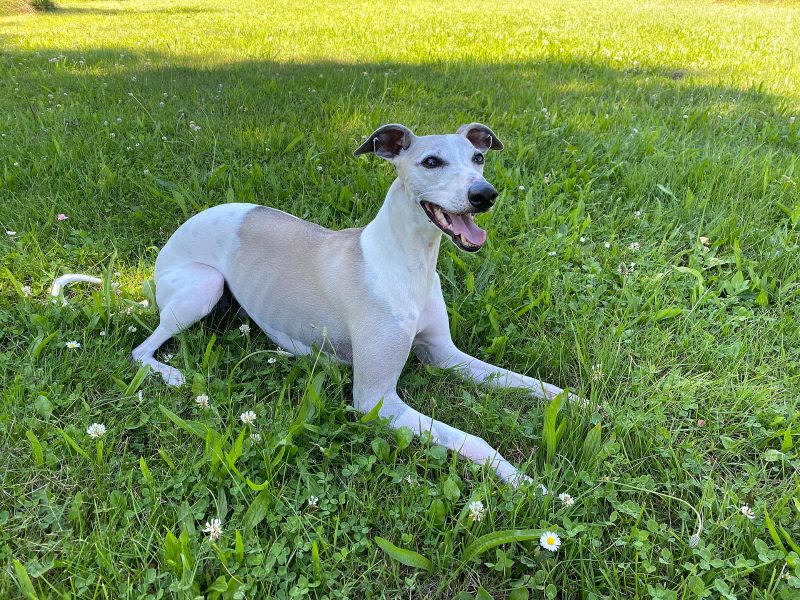
The Whippet is the fastest dog of its size and one of the laziest in the house, and both halves of that sentence are true. Outdoors it explodes into 35-mile-an-hour sprints after a ball, a lure or an unlucky rabbit; indoors it curls up under a blanket and sleeps for hours. Quiet, clean, gentle and almost odorless, it is a medium-sized sighthound that fits surprisingly well into apartment life.
Whippets suit owners who can offer a safely fenced place to run several times a week, who like a dog that is affectionate but not demanding, and who can accept a strong chase instinct that makes off-leash walks in open country a bad idea. They are good with children and other dogs and often fine with cats raised alongside them. They are not guard dogs, they hate the cold, and they feel every hard surface, so expect to share your sofa and your bed.
History & Origin
Small greyhound-type dogs for coursing rabbits existed in England for centuries, and the word whippet was applied to a dog as early as 1610, but the modern breed took shape in the industrial north of England in the 1800s. Coal miners and mill workers in Lancashire, Yorkshire and the northeast wanted a sprinter they could afford to feed and keep in a small home. They crossed small Greyhounds with terriers and perhaps Italian Greyhounds to produce a dog that could catch rabbits in an enclosure, a sport that earned the nickname "snap dog", and race over a straight course toward an owner waving a rag. That rag racing made the Whippet the "poor man's racehorse" and an early form of today's lure coursing.
The AKC registered the breed in 1888 and The Kennel Club in England followed in 1891. Lancashire textile workers emigrating to New England brought their dogs with them, and Whippet racing caught on in Massachusetts. The breed has since won Best in Show at Westminster in 1964 and at Crufts three times, in 1992, 2004 and 2018.
Appearance
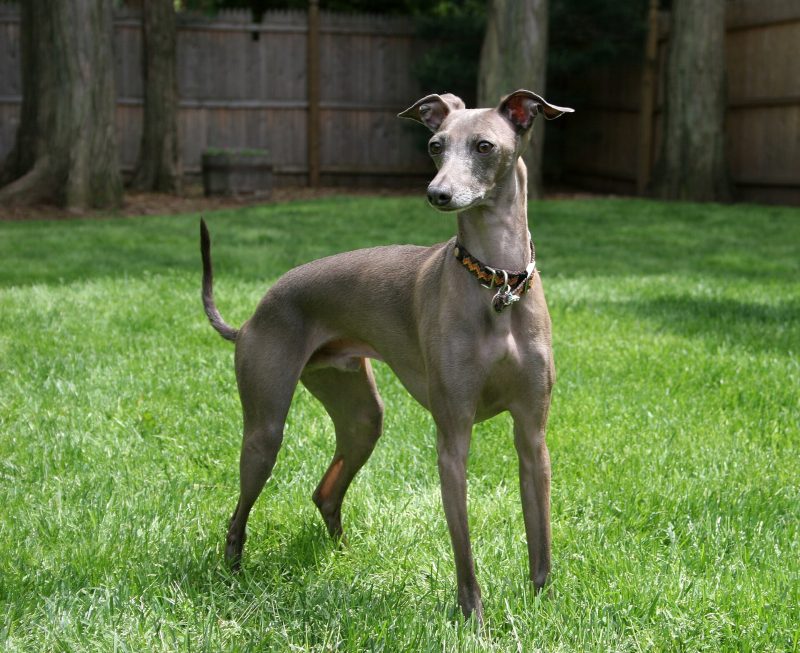
A Whippet looks like a Greyhound scaled down to a medium dog. Males stand 19 to 22 inches at the shoulder and weigh 28 to 40 pounds; females are 18 to 21 inches and 25 to 35 pounds. The outline is the sighthound's inverted S: a long, arched neck flowing into a deep chest, a tucked-up waist, a gently arched loin and powerful, muscular thighs. The head is long and lean with a slight stop, dark oval eyes and small rose ears that fold back and lift only when the dog is alert. The tail is long and carried low with a slight upward curve, never over the back.
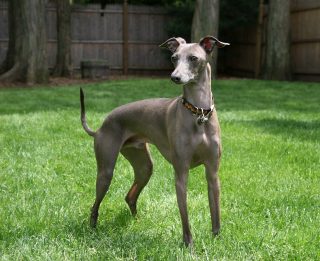
The coat is short, smooth and fine with no undercoat, and any color or pattern is acceptable: fawn, brindle, blue, black, red, white, cream and every combination with white. The skin is thin and the muscles show. Compared with a Greyhound the Whippet is far smaller and lighter; compared with an Italian Greyhound it is taller, heavier and more muscular, with a rose ear rather than a fully folded one.
Temperament & Personality
Whippets are gentle, affectionate and quiet. Indoors they are calm to the point of inertia, happiest pressed against a person on the sofa or burrowed under a blanket, and they rarely bark. They bond closely to their family and are sensitive to tone of voice and household tension; raised voices send them to another room. With strangers they are polite and a little reserved rather than suspicious, and they make poor watchdogs and hopeless guard dogs.
They are typically excellent with children who are kind to them and very good with other dogs, especially other sighthounds who understand the game of sudden sprints. Prey drive is the trait to respect: cats, rabbits, squirrels and small fluffy dogs in motion can trigger a chase that no amount of training will reliably stop. Many Whippets live peacefully with cats they were raised with, but the instinct never fully disappears outdoors. Some are shy or anxious without good early socialization, and most dislike being left alone for long.
Exercise & Activity
A Whippet needs a few short, intense bursts of running rather than long slogs. The ideal week includes several sessions of flat-out sprinting in a securely fenced field or yard, twenty to thirty minutes of walking on most days, and games of fetch or a flirt pole for the days in between. Lure coursing, straight racing and agility are made for the breed and give the chase instinct a safe outlet. After a good run most Whippets are content to sleep for the rest of the day.
Never let a Whippet off leash near roads or open country; a bolting rabbit will outrank your recall every time. The thin coat and low body fat mean they chill fast, so a fitted coat is standard equipment below about 45 degrees Fahrenheit, and they should not be left outdoors in winter. In summer they cope well but need shade after sprinting.
A bored Whippet chews, steals soft items and may develop separation anxiety.
Young dogs can climb and jump fences; six feet is a sensible minimum.
Training
Whippets are intelligent and willing but soft, and they learn best with food rewards, gentle handling and short, upbeat sessions. They are sensitive enough that a sharp correction can set training back for days, and they simply do not respond to force. Many are mildly stubborn about anything that seems pointless, and most would rather lie down than repeat an exercise ten times, so keep things varied. Counter-surfing and bed-stealing are the breed's signature misdemeanors.
Recall is the sticking point. Train it thoroughly with high-value rewards and a long line, and still assume it will fail against a running animal; management, not obedience, keeps a sighthound safe. House training is usually easy, though Whippets hate going out in rain and cold and may need an umbrella escort. Socialize puppies widely to prevent shyness. Crate training helps, since most Whippets love a den, and the breed excels in rally, agility, coursing and even therapy work.
Grooming & Care
Whippet grooming takes minutes a week. A weekly rub with a hound glove or soft rubber brush removes the little hair they shed and keeps the coat glossy. Baths are rarely needed because the breed has almost no doggy odor; wipe muddy legs with a damp cloth and bathe only every few months. The thin skin tears easily on brambles and fences, so check the dog over after runs and keep a vet's number handy for cuts that need stitching.
Nails are important for a running dog: trim them every two to three weeks so they do not touch the ground, because long nails change the gait and can split. Teeth deserve regular brushing, as sighthounds tend to build tartar and lose teeth early. Check the rose ears weekly.
Shedding is light but year-round; white dogs show it more on dark furniture.
Pressure sores on elbows and hips mean the dog needs softer bedding.
Health
Whippets are a healthy breed with a typical lifespan of 12 to 15 years and very low rates of hip dysplasia. The conditions breeders watch most closely are cardiac, ocular and hearing related. Mitral valve disease and other heart problems are a leading cause of death in older Whippets, and the parent club's health foundation asks breeders to have breeding dogs examined by a veterinary cardiologist with an echocardiogram every two years. Congenital deafness occurs in a small number of dogs, so a one-time BAER hearing test is recommended, along with an annual eye exam by a veterinary ophthalmologist. Thyroid testing and a DNA test for the myostatin variant, which produces the heavily muscled "bully" Whippet when inherited from both parents, are also suggested.
Two things every vet should know: Whippets have little body fat and can be sensitive to some anesthetic drugs, and their thin skin tears easily. Ask your vet about anesthesia protocols before any procedure, and have any heart murmur, coughing or exercise intolerance checked promptly.
Nutrition
The hardest part of feeding a Whippet is resisting the urge to fatten it up. A healthy adult shows the outline of the last two or three ribs and the hip bones, which looks thin to people used to heavier breeds; a Whippet that looks "normal" is usually overweight. Feed a complete diet in two measured meals a day and adjust portions to activity, with more for a coursing dog in season and less for a couch companion in winter. Most do not need a special formula, though some have sensitive digestion and do better on a consistent food.
Puppies grow fast and can look gangly; keep them lean rather than chubby to protect their joints. Treats should be small and counted. Whippets are notorious food thieves, so secure counters and bins. Ask your vet to help you judge body condition, because the right weight for this breed surprises many first-time owners.
Living With This Breed
A Whippet is an easy housemate: quiet, clean, nearly odorless and happy to sleep most of the day. Apartments work well as long as the dog gets real runs a few times a week. They want to be near their people, ideally touching them, and they do not like to be left alone for a full workday or to sleep outside. Cold climates require coats and heated indoor beds; warm ones suit them.
They are gentle with children and good with other dogs. Cats and small pets need careful management, and a Whippet that was fine with the house cat may still chase the neighbor's. Furniture will be claimed; most owners give up and buy more blankets.
For sitters and daycare staff:
Never off leash outside a secure fence, whatever the owner says the recall is like.
Separate from small dogs and cats during fast play.
Provide soft bedding and a coat in cold weather.
Check for skin tears after group play or runs.
Interesting Facts
Whippets reach around 35 miles per hour using a double-suspension gallop in which all four feet leave the ground twice per stride.
Victorian miners called them snap dogs and poor man's racehorses, and raced them toward a handler waving a rag.
A single gene variant in myostatin makes some Whippets faster when inherited from one parent and gives them a bodybuilder's physique when inherited from both.
The breed won Best in Show at Westminster in 1964 with Courtenay Fleetfoot of Pennyworth and at Crufts in 1992, 2004 and 2018.
The name may come from an old word meaning to move briskly, or from whappet, a small yapping dog, which is ironic for one of the quietest breeds.
Whippets have been in America since the late 1800s, brought by Lancashire mill workers who settled in New England.
Breeds similar to the Whippet
What Whippet owners say
Real pets, photos, stories and tips from the SitterNation community — separate from the editorial guide above.
Log in to add your pet, photos, stories and tips.
Meet Whippets on SitterNation
No Whippets have joined yet. Owners can show their pet here from the pet's profile.
Whippet community photos
No Whippets photos yet — be the first to share one.
Stories from Whippet owners
No stories yet. What is life with yours really like?
Tips from Whippet owners
No tips yet. One practical thing that works for you is enough.
Ask Whippet owners
No questions yet. Ask the people who live with the breed.