Typical tendencies
Energy level
Calm at home with short bursts of play.
Good with children
Gentle and tolerant around children.
Good with other dogs
Enjoys most canine company.
Trainability
Picks up cues with steady, short sessions.
Shedding
Noticeable, with heavier seasonal blows.
Apartment friendly
Needs space and a garden to be happy.
More traits
Exercise needs
Adaptability
Grooming needs
Drooling
Intelligence
Family friendly
Good with cats
Friendly with strangers
Sociability
Protectiveness
Prey drive
Overview
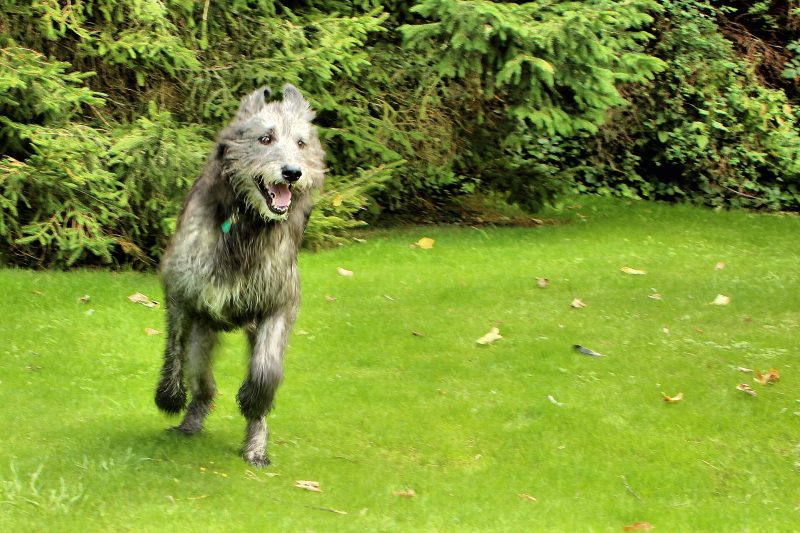
The Irish Wolfhound is the tallest of all dog breeds, a rough-coated sighthound that once ran down wolves and now spends most of its day sprawled across the living room floor. Males stand at least 32 inches and weigh 120 pounds or more, yet the breed is gentle, quiet and remarkably easy to live with for its size: calm indoors, friendly with strangers, patient with children and usually sociable with other dogs. The price of that size is a short life of 6 to 8 years, serious heart and bone health concerns, and the practical costs of feeding, transporting and housing a dog that can rest its chin on the kitchen counter. It suits calm households with a big car, a fenced yard and room on the couch, and it does not suit apartments, tight budgets or anyone who wants a guard dog or a long-lived companion.
History & Origin
Great hounds from Ireland were known to the Romans: in 391 AD the statesman Symmachus wrote to thank his brother for seven Irish dogs that astonished the crowds at the games. For centuries the cu faoil hunted wolves and giant elk for Irish chieftains and were given as diplomatic gifts to foreign courts, so freely that Cromwell banned their export in 1652. When the last Irish wolf was killed in 1786 the hounds lost their purpose, and by the 1840s famine years the breed was nearly gone. From the 1860s a Scottish officer, Captain George Augustus Graham, gathered the few surviving dogs and rebuilt the breed with Scottish Deerhound, Great Dane, Borzoi and other crosses. He and his supporters founded the Irish Wolfhound Club in 1885 and published a standard in 1886. The AKC recognized the breed in 1897, and today a Wolfhound serves as the regimental mascot of the Irish Guards.
Appearance
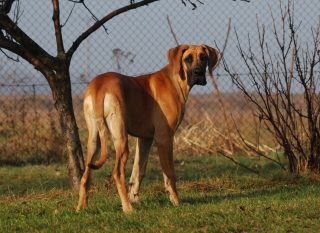
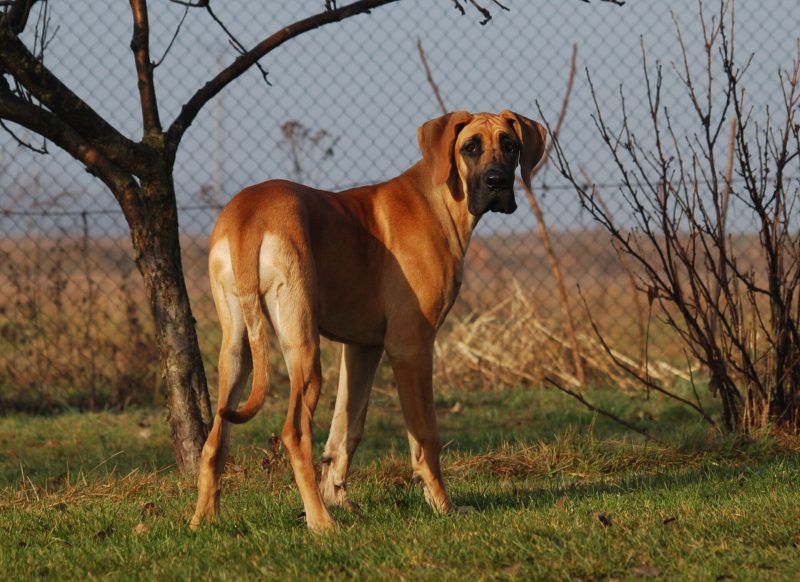
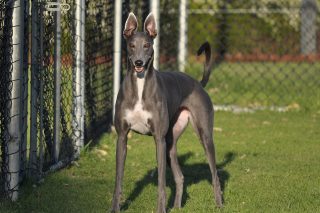
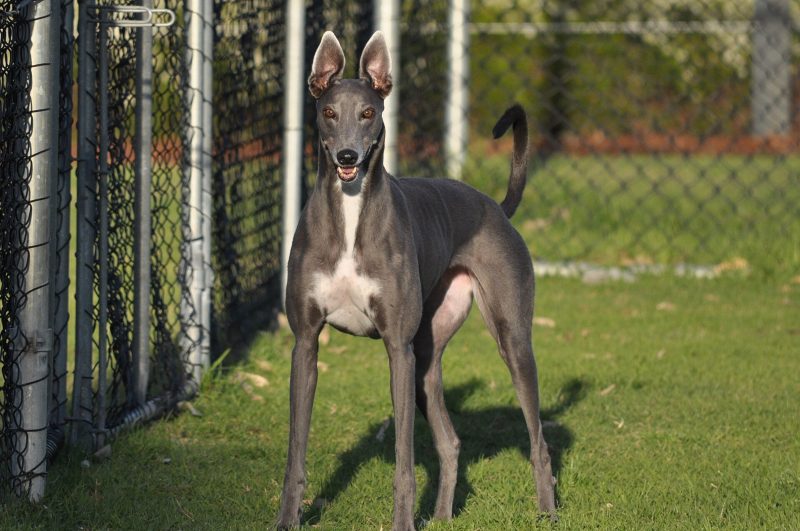
A Wolfhound combines great size with the outline of a Greyhound: a long, arched loin, deep chest, long neck and long legs built for galloping, with an easy, ground-covering stride. The head is long and fairly narrow with a slight rise over the eyes, small rose ears carried back and a wiry beard and brows that give a thoughtful, slightly shaggy expression. The tail is long and slightly curved. The coat is rough, harsh and wiry over the body and especially wiry over the eyes and under the jaw, with a softer undercoat. Colors include gray, brindle, red, black, pure white, fawn and wheaten, with gray the most common. It is taller and more heavily built than its close relative the Scottish Deerhound, and its rough coat and gentler outline separate it at a glance from the smooth, square-headed Great Dane.
Temperament & Personality
Wolfhounds are gentle giants in the truest sense. The breed is calm, affectionate and unhurried at home, happy to drape itself over the family and doze for hours. It is friendly with strangers and children, patient with handling and generally sociable with other dogs, though a bouncing puppy the size of a Labrador needs supervision with small kids. Despite their size they are poor guard dogs; they rarely bark and their instinct is to greet rather than challenge. The hound side shows outdoors. Wolfhounds are sighthounds with a strong urge to chase anything that runs, and cats, deer and the neighbor's small dog can trigger it. They are sensitive and bond closely, and many do not cope well with long hours alone. Adolescence is long, and a two-year-old can still be clumsy and silly.
Exercise & Activity
An adult Wolfhound needs a couple of good walks a day totaling 40 to 60 minutes plus the chance to stretch out and gallop in a safely fenced area a few times a week. The breed is a sprinter, not a marathoner, and it is happiest with a run followed by a long nap. Puppies need the opposite of a workout: short, free play on soft ground and no forced exercise, stairs or jogging until the growth plates close at around 18 months, because their bones are growing fast and are easily damaged. Avoid running before or after meals to reduce the risk of bloat. The rough coat handles cold weather well but the breed overheats in summer, so keep hot-day activity gentle.
Off-leash only behind a tall, secure fence; recall fails when something runs
Lure coursing and tracking suit the breed
Soft bedding and no slippery floors protect joints and elbows
Training
Wolfhounds are intelligent, willing and sensitive, and they respond best to calm, reward-based training started early, because a dog that will weigh 150 pounds must learn manners as a puppy. Priorities are loose-leash walking, a down-stay, polite greetings that keep paws on the floor and a reliable leave-it. Recall should be taught and practiced but never relied on around wildlife. The breed is not a drilled obedience dog; it learns quickly, bores easily and can be stubborn about repeating something it already knows, so keep sessions short and varied. Socialize puppies widely with people, dogs and surfaces, and teach them to be comfortable with handling, nail trims and vet exams while they are still small enough to lift. Sitters should be shown how the dog loads into a car and how it behaves around small animals.
Grooming & Care
The rough coat is low-maintenance but not no-maintenance. Brush or comb thoroughly once a week to remove dead hair and prevent tangles in the beard, behind the ears and in the feathering, and hand-strip or have a groomer strip the coat once or twice a year to tidy it and remove the dead outer layer. Shedding is moderate. Bathe every one to three months or when the beard gets smelly; the beard collects water and food and benefits from a wipe after meals. Check elbows and hocks for calluses and pressure sores, which develop on hard floors. Clean ears every couple of weeks, trim nails regularly since a heavy dog with long nails is miserable, and brush teeth several times a week.
Weekly brushing, stripping once or twice a year
Wipe the beard after meals
Soft bedding to prevent elbow calluses
Health
The Wolfhound's lifespan of 6 to 8 years reflects a short list of serious conditions. Heart disease, particularly dilated cardiomyopathy and atrial fibrillation, is the leading concern; the parent club recommends an echocardiogram and EKG by a cardiologist from age two and annual rescreening. Osteosarcoma, bone cancer that usually appears as sudden lameness, is common in the breed. Gastric dilatation-volvulus, or bloat, is a life-threatening emergency, and many owners opt for a preventive gastropexy. Portosystemic liver shunt affects a few percent of puppies, so breeders should test every pup with a post-meal bile acid blood test after nine weeks. The club's CHIC program asks for heart, eye, hip and elbow screening, and the AKC list adds serum bile acids. Pneumonia, including a hereditary ciliary form, and progressive retinal atrophy also occur. Ask your vet about screening schedules and see them at once for retching, a swollen belly or a new limp.
Nutrition
Feeding a Wolfhound is about steady growth and bloat prevention. Puppies should eat a giant-breed growth formula with controlled calcium and calories so they grow slowly; a lean, slightly leggy puppy is the goal, and extra weight or supplements during growth can damage developing joints. Adults need a complete large-breed diet split into two or three meals a day rather than one large meal, served in a bowl on the floor rather than raised, with no vigorous exercise for an hour before and after eating. A slow-feeder bowl helps gulpers. Keep adults lean, with ribs easy to feel, because excess weight shortens an already short life. Fresh water should always be available. Sitters should follow the owner's feeding and rest routine exactly and know the signs of bloat: restlessness, drooling, unproductive retching and a tight belly.
Living With This Breed
A Wolfhound needs space more than acreage: room to turn around, a sofa it is allowed on, a vehicle it fits in and a yard with a tall, secure fence. Apartments and upper-floor walk-ups do not work. It lives indoors as a family member and tolerates a normal workday alone once mature, but it is not a dog to leave for long stretches. It is wonderful with children and usually with other dogs, risky with cats unless raised with them, and useless as a guard. Everything costs more: food, medication, crates, beds and boarding. Expect a wagging tail at coffee-table height and a head that reaches the counter.
Sitters: walk on a sturdy harness or martingale, never let go of the leash near wildlife
Feed small meals, enforce rest around meals, know the bloat signs
Most Wolfhounds do better with in-home care than with kennel boarding
Interesting Facts
An Irish Wolfhound has been the regimental mascot of the Irish Guards since 1902; the current dogs parade at Trooping the Colour and the changing of the guard.
Oliver Cromwell banned the export of the hounds from Ireland in 1652 because so many were being given away to foreign nobles.
The breed was nearly extinct after the last Irish wolf was killed in 1786, and Captain George Graham spent more than twenty years from the 1860s rebuilding it.
Males must be at least 32 inches tall by the standard, and many stand taller than 35 inches at the shoulder, making this the tallest breed.
The Irish name cu faoil means wolf hound, and cu alone was a term of praise for a brave warrior.
Despite their size, Wolfhounds are famously quiet and rank near the bottom of breeds for barking.
Breeds similar to the Irish Wolfhound
What Irish Wolfhound owners say
Real pets, photos, stories and tips from the SitterNation community — separate from the editorial guide above.
Log in to add your pet, photos, stories and tips.
Meet Irish Wolfhounds on SitterNation
No Irish Wolfhounds have joined yet. Owners can show their pet here from the pet's profile.
Irish Wolfhound community photos
No Irish Wolfhounds photos yet — be the first to share one.
Stories from Irish Wolfhound owners
No stories yet. What is life with yours really like?
Tips from Irish Wolfhound owners
No tips yet. One practical thing that works for you is enough.
Ask Irish Wolfhound owners
No questions yet. Ask the people who live with the breed.