Typical tendencies
Energy level
Ready to go when you are, settles after.
Good with children
Patient with kids when well supervised.
Good with other dogs
Enjoys most canine company.
Trainability
Quick to learn and keen to please.
Shedding
Barely a hair on the sofa.
Apartment friendly
A natural fit for city living.
More traits
Exercise needs
Adaptability
Grooming needs
Drooling
Intelligence
Family friendly
Good with cats
Friendly with strangers
Sociability
Protectiveness
Prey drive
Overview
The Maltipoo crosses a Maltese with a Toy or Miniature Poodle to make a small, fluffy, people-loving companion that weighs 5 to 15 pounds and asks for little more than a lap, a short walk and your attention. It suits apartment dwellers, first-time owners, retirees and anyone who wants a dog that travels well and adapts to a quiet routine. Most are affectionate, bright and eager to please, with a low-shedding coat that many allergy-prone households find easier to live with, though no dog is truly hypoallergenic.
It is a cross, not a breed, so there is no standard and no kennel-club recognition, and littermates can vary in size, coat and personality. The coat needs real grooming, tiny puppies are fragile, and a Maltipoo left alone all day can become a yappy, anxious one. Rough toddlers and this little dog are a poor match.
History & Origin
Small white lap dogs have been crossed with Poodles for a long time, but the Maltipoo as a named mix belongs to the United States designer-dog wave of the 1990s. Breeders wanted to combine the Maltese's sweet, companionable nature and small size with the Poodle's intelligence and tightly curled, low-shedding coat, and to offer a fluffy puppy that would appeal to people with mild dog allergies. There is no founding breeder on record and no first litter anyone can point to; the name itself still appears as Maltipoo, Maltepoo, Malt-A-Poo and, in Australia, Moodle.
No kennel club recognizes the Maltipoo. The American Kennel Club registers the Maltese and the Poodle separately, and the cross cannot compete in conformation. Some designer-dog registries will record a litter for a fee, which proves nothing about quality. Most Maltipoos sold today are F1 crosses or F1b dogs bred back to a Poodle.
Appearance
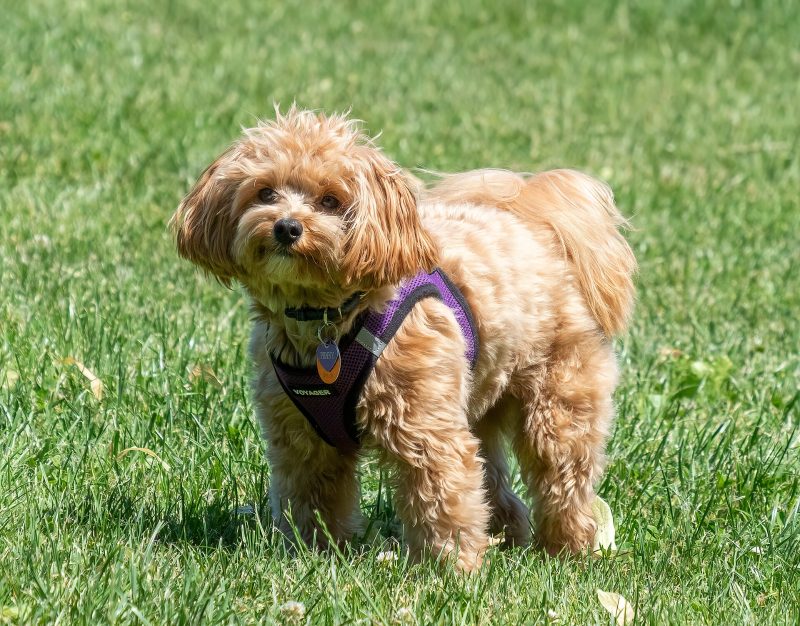
A Maltipoo looks like a teddy bear that has learned to walk. Height runs 8 to 14 inches and weight 5 to 15 pounds, with Toy Poodle crosses at the small end and Miniature Poodle crosses at the large end; because the Poodle parent comes in two sizes, adult size is less predictable than in a purebred. The build is compact and slightly longer than tall, with a rounded skull, a short muzzle, dark round eyes and drop ears covered in long hair.
The coat is soft and fluffy, anywhere from gently wavy to tightly curled, and medium length unless clipped. White and cream are the classic colors, inherited from the Maltese, but apricot, silver, black and parti patterns also occur. Beside a purebred Maltese, a Maltipoo is curlier and often not pure white; beside a Toy Poodle it is softer-coated and rounder in the face. Some adults lighten or silver with age.
Temperament & Personality
Maltipoos are affectionate, cheerful and devoted to their people. Both parents were bred purely for companionship, so most of these dogs want to be on a lap or at least in the same room, and they greet family members like long-lost friends. Indoors they are playful in short bursts and otherwise calm; outdoors they are curious and sociable but not athletic. Strangers usually get a few barks and then a friendly inspection.
They get along with other dogs and most cats, and prey drive is low. With children they do best in homes where kids are old enough to handle a small dog gently; a dropped or squeezed Maltipoo can be hurt or frightened into snapping. Watchfulness varies: Poodle-leaning dogs are quick to alert bark, Maltese-leaning dogs more laid back. Their biggest weakness is attachment itself; left alone for long hours, many become anxious and vocal.
Exercise & Activity
A Maltipoo needs about 30 minutes of activity a day, which can be two short walks plus a few minutes of fetch down a hallway. Indoor play counts, and in bad weather a game of hide-and-seek or a food puzzle can replace the walk. Sturdier Miniature Poodle crosses enjoy longer outings and can keep up on a leisurely hike, but this is not a running partner.
Heat is the main limit; a small dog with a thick coat overheats quickly, so walk early or late in summer and keep the coat trimmed. Cold is tolerable in a sweater for short trips. Boredom shows up as barking, shredding tissues and following you around whining.
Use a harness, not a collar, to protect the small windpipe.
Keep sessions short for puppies; growing joints do not need stairs or jumping off furniture.
Add a few minutes of trick training daily to tire the mind.
Training
Maltipoos are bright, food-motivated and eager to please, so they pick up sits, downs and tricks quickly with reward-based training. Keep sessions short and playful; harsh corrections make these sensitive dogs shut down or hide. Most are happy to work for tiny treats, praise and a game.
The classic sticking point is house-training. Small bladders, dislike of rain and owners who let accidents slide all stretch the process, so set a strict schedule, use a crate or pen and reward every success outside. Barking is the other one; teach a quiet cue early and avoid rewarding alert barking with attention. Build independence by practicing short, calm absences from the first week so the dog learns that being alone is safe. Socialize puppies to new people, larger dogs, grooming tools and car rides between 8 and 16 weeks. Many Maltipoos go on to enjoy rally, trick titles and therapy-dog work.
Grooming & Care
A fluffy coat with little shedding means the loose hair stays put and mats, so brushing is a daily or every-other-day job, especially behind the ears, under the legs and around the collar. Work through with a slicker brush and finish with a metal comb to the skin. Most owners keep the body in a short puppy clip and visit a professional groomer every four to eight weeks.
White and light coats show tear stains; wipe the area under the eyes daily and keep the hair there trimmed. Bathe every three to four weeks with a mild dog shampoo. Small mouths with crowded teeth are prone to tartar, so brush the teeth daily if you can, and ask your vet about dental cleanings.
Check drop ears weekly and keep hair in the canal trimmed if your groomer advises it.
Trim nails every three to four weeks; indoor dogs rarely wear them down.
Start grooming routines in puppyhood so the dryer and clippers are no big deal.
Health
A Maltipoo can inherit problems from either parent, and crossing does not erase them. The Maltese side brings a high rate of luxating patellas, congenital portosystemic liver shunts, dental disease, tremor syndrome (white shaker disease) and heart valve disease in later life. The Toy and Miniature Poodle side adds progressive retinal atrophy (prcd-PRA), patellar luxation, Legg-Calve-Perthes disease of the hip, epilepsy and collapsing trachea. Very small puppies of either lineage can suffer low blood sugar if they miss meals.
Ask a breeder for veterinary patellar evaluations and recent ACVO eye exams on both parents, a prcd-PRA DNA result for the Poodle, a cardiac evaluation and, ideally, a bile-acid test or clear history for liver shunts. Reputable breeders show certificates rather than assurances. A lifespan of 12 to 15 years is typical, and good dental care adds quality to those years. See your vet promptly for a skipping hind leg, a honking cough, stunted growth or odd behavior after meals.
Nutrition
Maltipoos eat little, so quality matters more than quantity. Feed a small-breed puppy food in three or four small meals a day until about six months, because tiny puppies store little energy and can become hypoglycemic between meals; two meals a day suit most adults. Ask your vet when to move to adult food, usually around 9 to 12 months.
Measure every portion. A dog that should weigh 8 pounds cannot afford treats worth a quarter of its daily calories, and extra weight strains small knees and the windpipe. Kibble sized for small mouths helps with crowded teeth, and crunchy food or dental chews support the mouth between cleanings. Table scraps teach begging and can upset small stomachs. Because the Maltese parent is prone to liver shunts, let your vet know about any stunted growth or unusual sleepiness after eating; a diet change may be part of management. Fresh water should always be available, especially for dogs that eat dry food.
Living With This Breed
A Maltipoo is an ideal apartment dog as long as barking is managed and the dog gets a daily walk. It adapts to houses, condos and travel equally well, and tolerates most climates if protected from heat and dressed for deep cold. What it does not tolerate well is solitude; this is a dog for people who are home a lot or who use daycare, sitters and dog-friendly workplaces.
Families with gentle, school-age children and small dogs or cats are a good fit. Supervise play with large dogs, because a 7-pound dog is easily injured. Most Maltipoos are not escape artists but will slip through a gap in a fence or door.
For sitters: stick to the feeding schedule, brush daily and use the harness on walks.
Note which cues the family uses for quiet and for toileting.
Keep it off high furniture and away from the pool unsupervised.
Interesting Facts
The name is spelled Maltipoo, Maltepoo and Malt-A-Poo in the United States; in Australia the same cross is often called a Moodle.
Its parents are two of the oldest companion types in the world: the Maltese appears in Greek and Roman writing, and the Poodle in sixteenth-century European art.
Maltipoos are a favorite of celebrities and apartment dwellers, which helped make them one of the most searched-for small crosses of the 2010s.
The coat can be wavy, curly or almost straight, and littermates often have different textures.
Many Maltipoos lighten with age, so an apricot puppy may become a cream adult.
Because both parents were bred for the lap, a Maltipoo's favorite exercise is often simply following you from room to room.


What Maltipoo owners say
Real pets, photos, stories and tips from the SitterNation community — separate from the editorial guide above.
Log in to add your pet, photos, stories and tips.
Meet Maltipoos on SitterNation
No Maltipoos have joined yet. Owners can show their pet here from the pet's profile.
Maltipoo community photos
No Maltipoos photos yet — be the first to share one.
Stories from Maltipoo owners
No stories yet. What is life with yours really like?
Tips from Maltipoo owners
No tips yet. One practical thing that works for you is enough.
Ask Maltipoo owners
No questions yet. Ask the people who live with the breed.