Typical tendencies
Energy level
Ready to go when you are, settles after.
Good with children
A famously patient playmate for kids.
Good with other dogs
Loves every dog at the park.
Trainability
Learns, but on its own schedule.
Shedding
Keep the lint roller within reach.
Apartment friendly
Settles well into smaller homes.
More traits
Exercise needs
Adaptability
Grooming needs
Drooling
Intelligence
Family friendly
Good with cats
Friendly with strangers
Sociability
Protectiveness
Prey drive
Overview
A Puggle is a Pug crossed with a Beagle: a sturdy, wrinkle-faced little dog with a hound's nose, a curled tail and a cheerful, sociable nature. It suits families, first-time owners and apartment dwellers who want a small dog with more stamina than a Pug and less wanderlust than a Beagle, and who enjoy a comedian in the house. Most Puggles adore children, get along with other dogs and treat strangers as friends they have not met yet.
This is a cross rather than a breed, with no standard and no kennel-club recognition, and littermates can differ noticeably in muzzle length, size and temperament. Expect heavy shedding, a stubborn streak at training time, a nose that overrules the ears and an appetite that makes obesity the most common health problem. A Puggle with a short muzzle also inherits some of the Pug's heat and breathing limits.
History & Origin
The Puggle is usually traced to Wisconsin in the 1980s, where commercial breeder Wallace Havens crossed Pugs with Beagles and marketed the puppies as compact, apartment-friendly companions. He registered the first litters with the American Canine Hybrid Club, a designer-dog registry, and the name stuck. The intent was to pair the Pug's affectionate clowning with the Beagle's longer muzzle and hardier build, softening the Pug's breathing problems while keeping its charm.
The cross stayed a regional curiosity until the mid-2000s, when designer dogs became fashionable. In 2005 news outlets called the Puggle the hottest dog in America, celebrity owners were photographed with theirs, and prices climbed past those of many purebreds. Demand drew in puppy mills as well as careful breeders. No kennel club recognizes the Puggle, there is no breed standard, and it cannot compete in AKC conformation; the parent breeds remain separate registered breeds.
Appearance
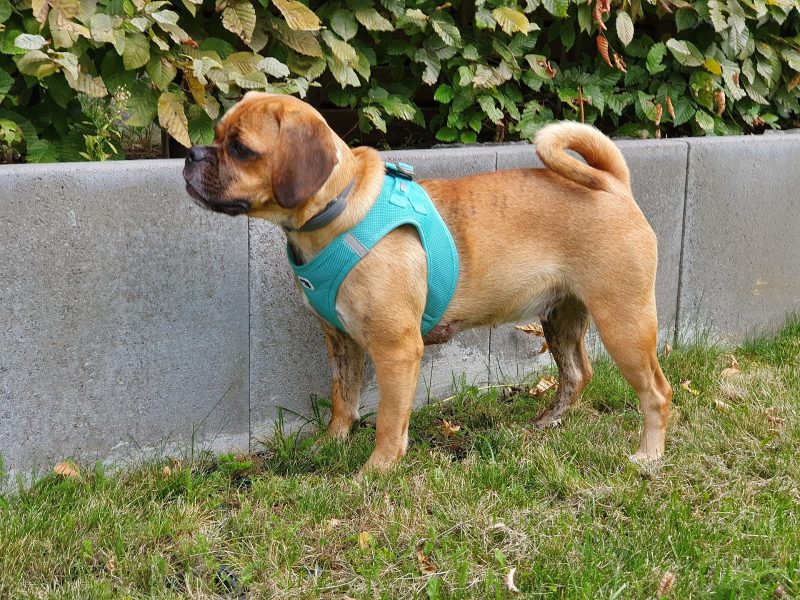
A Puggle looks like a Beagle that borrowed a Pug's face. Adults stand 10 to 15 inches at the shoulder; males weigh 18 to 30 pounds and females 15 to 25, so this is a solid small dog rather than a toy. The body is compact and a little long, the legs short and strong, the chest deep. The head carries a wrinkled forehead, soft drop ears and a muzzle that is shorter than a Beagle's but longer than a Pug's; exactly how long varies from puppy to puppy, and that difference matters for breathing. The tail usually curls over the back.
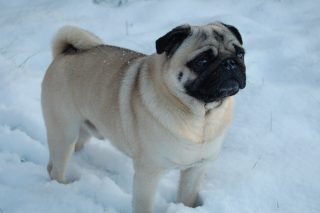
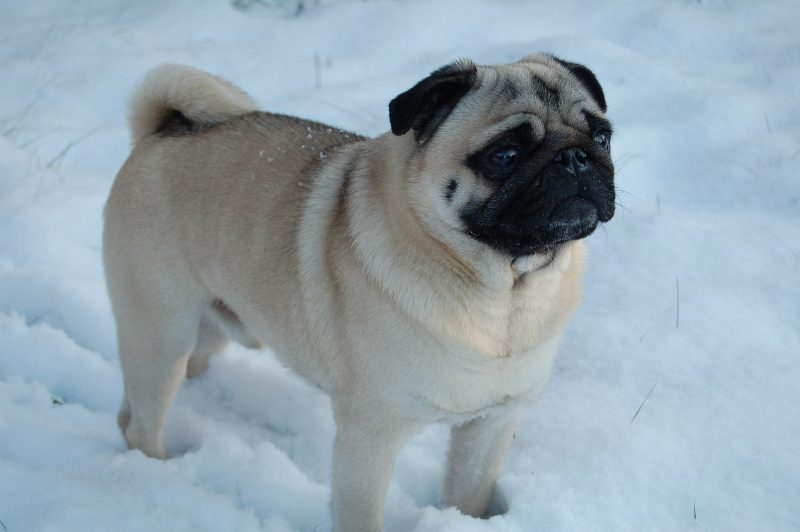
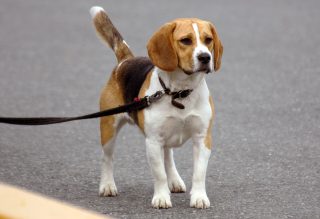
The coat is short, smooth and dense with a double layer, so it sheds year-round. Fawn with a black mask is the signature look; tan, red and black also occur, sometimes with white on the chest and feet. Beside a Pug, a Puggle is leggier with a real nose; beside a Beagle it is smaller, rounder-headed and masked.
Temperament & Personality
Puggles are friendly, playful and endlessly sociable. The Pug side contributes a love of laps and a comic streak; the Beagle side contributes curiosity, energy and a nose that must investigate everything. Indoors most are affectionate couch companions that follow the family around; outdoors they turn into busy explorers who track scents along the fence line.
They are typically excellent with children, tolerant of other dogs and fine with cats they grow up with, though small pets such as rabbits may trigger the Beagle's prey drive. Strangers are greeted as friends, so do not count on a Puggle as a guard dog, although many will announce a visitor with a Beagle-style bay. Independence can tip into stubbornness, and a bored Puggle left alone will howl, dig or chew. Temperament varies within litters, so meet the parents and ask the breeder about the puppy's personality.
Exercise & Activity
A Puggle needs about 30 to 45 minutes of exercise a day, ideally a couple of walks plus play in a fenced area. Beagle stamina means many enjoy longer walks and gentle hikes, but the Pug heritage sets limits: a dog with a shorter muzzle pants poorly, so avoid exertion in heat and humidity, walk early and late in summer and stop at the first sign of loud breathing.
The nose is the key to a happy Puggle. Scent games, snuffle mats and letting the dog sniff on walks tire it more than distance does. Keep it on leash outside a fence; a Puggle on a scent trail is deaf to recall. Boredom shows up as howling, digging and raiding the trash.
Use a harness rather than a neck collar to spare the airway.
Never leave a Puggle in a parked car or near a pool unsupervised; most swim poorly.
Add a sniff walk or food puzzle on days when exercise is cut short.
Training
Puggles are smart but easily distracted, and both parent breeds are known for doing things their own way. Food is the great motivator; use small, tasty treats, keep sessions short and end on a win. Harsh methods backfire on the Pug's sensitivity and the Beagle's independence alike.
House-training can take patience, especially in wet weather when a Puggle would rather not go out. A strict schedule, a crate and rewards for every success outdoors shorten the process. Recall is the hardest skill, because a scent will always compete with you; practice it on a long line and accept that off-leash freedom in open country may never be safe. Teach a quiet cue early to manage baying, and a leave-it cue to protect the dog from eating things it finds. Socialize puppies widely to people, dogs and environments between 8 and 16 weeks; well-raised Puggles are famously easygoing. Many enjoy scent work, rally and trick training as adults.
Grooming & Care
The short coat is low-maintenance but not low-shedding; Puggles drop hair all year with heavier bursts in spring and fall. A weekly session with a rubber curry brush or grooming mitt, more often during coat drops, keeps most of it off the furniture. Bathe every month or two with a mild dog shampoo.
The face needs attention. If your Puggle has facial folds, wipe them every day or two with a damp cloth and dry them well, because trapped moisture leads to itchy, smelly skin-fold dermatitis. The drop ears inherited from the Beagle trap moisture too, so check and clean them weekly and watch for head shaking or odor. Prominent eyes can scratch easily; look for squinting or discharge.
Trim nails every three to four weeks.
Brush teeth several times a week; small mouths crowd teeth.
Check skin folds and ears after swimming or rainy walks.
Health
A Puggle can inherit conditions from both parents, and a crossbreed is not automatically healthier; a 2024 Royal Veterinary College study of other popular Poodle crosses found their health broadly matched that of their parent breeds. From the Pug come brachycephalic airway problems, eye injuries and ulcers, skin-fold dermatitis, hemivertebrae of the spine, patellar luxation, hip dysplasia and necrotizing meningoencephalitis, sometimes called Pug dog encephalitis. From the Beagle come epilepsy, hypothyroidism, intervertebral disc disease, cherry eye, ear infections and the inherited conditions Musladin-Lueke syndrome and factor VII deficiency. Both parents gain weight easily.
Ask a breeder for OFA hip and patellar evaluations and an ACVO eye exam on both parents, a DNA risk-marker test for necrotizing meningoencephalitis on the Pug, and DNA results for Musladin-Lueke syndrome and factor VII on the Beagle. A longer muzzle is no guarantee against breathing trouble, so ask your vet to assess the airway. Lifespan is typically 10 to 15 years. See your vet for noisy breathing, collapse in heat, seizures, a painful back or sudden lethargy.
Nutrition
Puggles are gluttons by inheritance, and obesity is the health problem you can most easily prevent. Feed measured meals twice a day, weigh the dog monthly and adjust portions to its body condition; you should feel the ribs under a thin layer of fat. Treats, including training rewards, should stay within about a tenth of daily calories, and a leave-it cue protects the dog from scavenged food on walks.
Puppies can eat a standard or small-breed puppy food in three meals a day until about six months; ask your vet when to switch to adult food, usually around a year. Adults do well on a maintenance diet suited to a moderately active small dog, and seniors or neutered dogs often need fewer calories than the bag suggests. Extra weight makes breathing harder for a short-muzzled dog and loads the spine of a long-backed one, so keeping a Puggle lean matters more than for many breeds. Fresh water should always be available, particularly in warm weather.
Living With This Breed
Puggles adapt well to apartments and houses alike, provided they get daily walks and are not left to howl. They are sociable dogs that want to be part of the family and can be noisy when bored or alone, which neighbors notice. Temperate climates suit them; in hot regions plan on air-conditioning and shaded, early walks, and in cold weather a short-coated dog appreciates a coat.
Children, other dogs and most cats are fine company. The yard must be securely fenced, because a Beagle nose will follow a scent under or through any gap, and a Puggle in the street has no road sense.
For sitters: keep walks on leash, use the harness and avoid midday heat.
Follow the portion plan exactly; this dog will convince you it is starving.
Note whether the dog needs facial folds wiped and ears checked during the stay.
Interesting Facts
The Puggle was named the hottest dog of 2005 in American press coverage, and by 2006 it reportedly made up more than half of all crossbreed sales in the United States.
Celebrity owners in the mid-2000s included actors Jake Gyllenhaal and James Gandolfini, which fueled the fad.
The Puggle's Beagle half has one of the best noses in the dog world; Beagles work at airports sniffing out banned produce.
The curled tail and black mask come from the Pug, the baying voice from the Beagle; many owners say their Puggle snorts and howls.
Puggle is also the word for a baby echidna or platypus in Australia.
Early Puggle breeders chose Beagle mothers and Pug fathers so the dam would have an easier delivery.
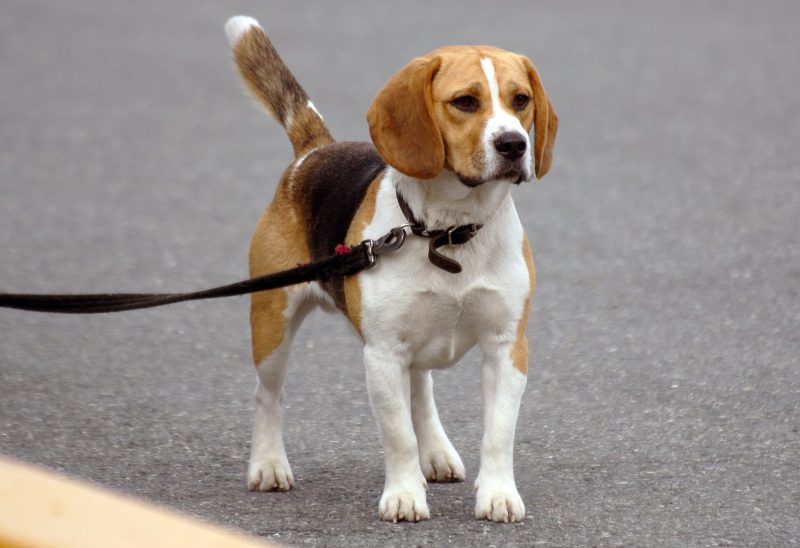
Parent breeds
What Puggle owners say
Real pets, photos, stories and tips from the SitterNation community — separate from the editorial guide above.
Log in to add your pet, photos, stories and tips.
Meet Puggles on SitterNation
No Puggles have joined yet. Owners can show their pet here from the pet's profile.
Puggle community photos
No Puggles photos yet — be the first to share one.
Stories from Puggle owners
No stories yet. What is life with yours really like?
Tips from Puggle owners
No tips yet. One practical thing that works for you is enough.
Ask Puggle owners
No questions yet. Ask the people who live with the breed.