Typical tendencies
Energy level
Ready to go when you are, settles after.
Good with children
Fine with calm, respectful older kids.
Good with other dogs
Gets along with known, polite dogs.
Trainability
Picks up cues with steady, short sessions.
Shedding
Barely a hair on the sofa.
Apartment friendly
A natural fit for city living.
More traits
Exercise needs
Adaptability
Grooming needs
Drooling
Intelligence
Family friendly
Good with cats
Friendly with strangers
Sociability
Protectiveness
Prey drive
Overview
The Brussels Griffon is a tiny Belgian dog with an oddly human face, a big opinion of itself and an enormous need to be near its person. Standing 7 to 10 inches and weighing 8 to 10 pounds, it comes in a rough, wiry coat with a beard or a smooth, glossy one, and typically lives 12 to 15 years. Griffs are sensitive, clever and funny, happiest on a lap or at your heels, and they do well in apartments and quiet households. They suit adults, retirees and families with gentle older children who are home a lot and enjoy a dog that participates in everything. They are a poor fit for busy homes with toddlers, for people out all day, or for anyone who wants an easy, independent pet. Expect some stubbornness over housetraining, a sharp watchdog bark at the door and a shadow that follows you into the bathroom.
History & Origin
In the early 1800s, coachmen in Brussels kept small, rough-coated stable dogs to clear rats from their coach houses. These scruffy griffons d'ecurie were gradually crossed with other small breeds; the Pug is the best documented contributor, with a first recorded cross in 1882, and the English Toy Spaniel added the round head and large eyes. In the 1870s Queen Marie Henriette of Belgium took up the breed, and it became fashionable at court and in wealthy kennels, which refined the expressive face. Belgium recognized the breed in 1880. Griffons appeared in the AKC stud book in 1899 and were formally recognized in 1910. Both world wars devastated the breed in Europe, and British and American fanciers kept it going. In Europe the FCI still treats it as three breeds, the rough red Griffon Bruxellois, the rough black or black-and-tan Griffon Belge and the smooth Petit Brabancon, while the AKC registers all of them as one breed with two coat varieties. The 1997 film As Good As It Gets gave the breed a popularity boost.
Appearance
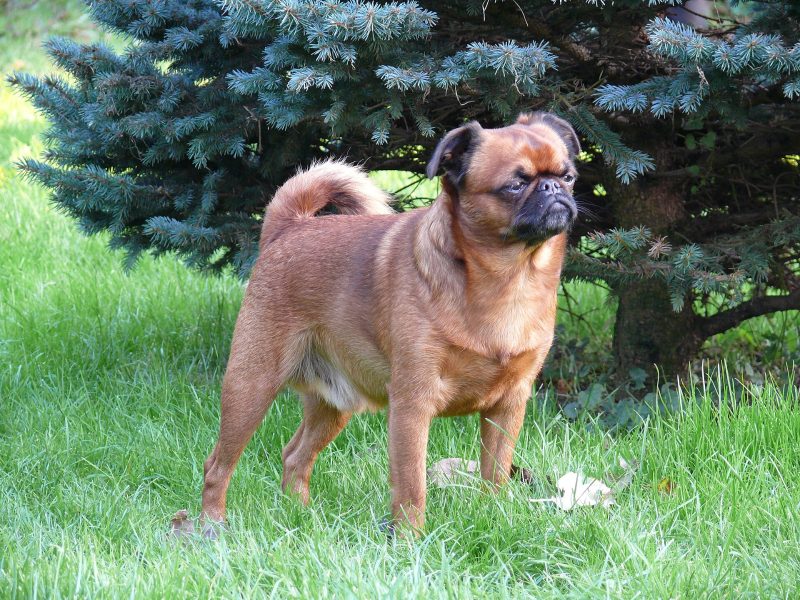
A Brussels Griffon is a sturdy, square little dog, thickset rather than fragile, with a large domed head and a face that people inevitably compare to a small person or an Ewok. The muzzle is very short and turned up, the chin prominent, and the large dark eyes are set wide and look straight at you. Ears are small and either fold forward or are cropped where that is still legal; the tail is carried high. The rough variety has a dense, wiry coat with a pronounced beard, mustache and eyebrows, and it is hand-stripped to keep its texture. The smooth variety, called the Petit Brabancon, has a short, straight, shiny coat and shows the face even more clearly. Colors are red, belge (a mix of black and reddish brown), black and tan, and solid black. Next to an Affenpinscher, a Griff has a rounder head, a shorter muzzle and a more upturned face.
Temperament & Personality
Griffs are often described as full of self-importance, and they do carry themselves like small people who expect to be included. They are affectionate, sensitive and intensely attached, commonly picking one favorite person and following that person everywhere. Many do poorly when left alone and can develop separation anxiety or nuisance barking. With strangers they are watchful and often reserved at first, warming up once they decide a visitor is acceptable. They are alert watchdogs and will announce the mail carrier. Griffs generally get on well with cats and with other dogs, especially when raised together, though they may try to boss much bigger dogs. They are not ideal with toddlers: their eyes are vulnerable, their bodies are small and they dislike rough handling, so homes with older, gentle children work best. Indoors they are moderately active, happy to play and then settle in a lap.
Exercise & Activity
A Brussels Griffon needs about 30 minutes of activity a day, split into a couple of walks around the neighborhood plus indoor play. They enjoy chasing toys, learning tricks and short agility or rally sessions, and many love scent games that use that big nose. Because the muzzle is short, they overheat easily; walk in the cool parts of a summer day, carry water, and never leave a Griff in a hot car or a sunny yard. They also chill quickly in winter and appreciate a sweater. Mental exercise matters: a bored Griff barks, chews and gets into mischief.
Two short walks and a play session most days are plenty
No strenuous exercise in heat or humidity; watch for heavy panting or noisy breathing
Use a harness rather than a collar to protect the throat and eyes
Training
Griffs are smart and read their people closely, which makes them quick learners with gentle, reward-based methods and quick to shut down under harsh treatment. Keep sessions short, playful and full of small treats and praise. Housetraining is the classic sticking point; the breed is small, stubborn about going out in bad weather and easy to overlook, so use a strict schedule, a crate or pen, and plenty of reward for outdoor success. Socialize puppies early and widely with calm people, dogs and sounds, because the breed's sensitivity can tip into shyness or snappiness if it meets the world too late. Teach a quiet cue before door barking becomes a habit, and build up time alone in small steps. Griffs enjoy trick training, rally and even agility, and a job keeps that busy mind out of trouble. Sitters should keep routines consistent and avoid picking the dog up without warning.
Grooming & Care
Grooming depends on the coat. The rough Griff has a wiry coat that barely sheds but needs brushing two or three times a week and hand-stripping or a trim every two to three months; clipping is acceptable for pets but softens the texture and lightens the color. The beard collects food and water, so wipe and comb it daily. The smooth Petit Brabancon sheds lightly year-round and needs only a weekly brush with a rubber mitt. Both varieties need the facial folds and the area under the eyes cleaned and dried regularly, since moisture there invites irritation. Check the large eyes daily for scratches or discharge. Brush the crowded teeth daily if you can, trim nails every two to three weeks and clean ears every couple of weeks.
Rough coat: brush twice weekly, professional stripping or trim every 8 to 12 weeks
Smooth coat: weekly brushing, occasional bath
Daily beard wipe, eye check and tooth brushing
Health
Brussels Griffons generally live 12 to 15 years, and the parent club recommends that breeding dogs have a patella evaluation, a hip evaluation and an eye examination by a veterinary ophthalmologist. The condition most discussed in the breed is Chiari-like malformation with syringomyelia, in which the skull is too small for the back of the brain and fluid pockets form in the spinal cord; one study of American Griffs found the malformation in about two-thirds of dogs scanned, though many had no signs. Diagnosis is by MRI, and signs can include scratching at the neck or shoulders, yelping when touched and reluctance to jump. Orthopedic concerns include luxating kneecaps, hip dysplasia and Legg-Calve-Perthes disease. The prominent eyes are prone to injury, cataracts and progressive retinal atrophy. As a brachycephalic breed, Griffs may snore, overheat and carry extra anesthesia risk, and crowded teeth make dental disease common. Puppies are often delivered by cesarean. Ask your vet about any air-scratching, breathing noise or eye change.
Nutrition
Feed a complete food formulated for small or toy breeds, with kibble sized for a tiny mouth, in two or three measured meals a day for adults and three or four for puppies. Griffs weigh only 8 to 10 pounds, so a few extra treats represent a large share of the day's calories; keep treats under a tenth of intake and weigh the dog monthly. A lean Griff has a visible waist and ribs you can feel easily, and keeping it lean protects the knees, hips and airway. Some Griffs are picky eaters, and owners sometimes fall into hand-feeding or topping food with rich extras, which teaches fussiness; set meals down for 15 minutes and remove what is not eaten. Because the breed is prone to dental disease, ask your vet whether a dental diet or chews are appropriate. Sitters should follow the owner's portions exactly and keep the water bowl clean, since the beard carries debris into it.
Living With This Breed
The Brussels Griffon is an excellent apartment dog, small, moderately active and content to spend most of the day near its person. It needs to live indoors and should not be left alone for long workdays without company, because loneliness quickly turns into barking and anxiety. It barks at the door but is otherwise fairly quiet. Climate matters: avoid heat and humidity, and provide a sweater in cold weather. Griffs usually live well with cats and other small dogs and tolerate gentle, older children, but households with toddlers or large boisterous dogs should take care. The breed is not an escape artist, though it will follow you out of any open door.
Sitters: keep the dog with you, offer lap time, and never exercise in heat
Watch the eyes; a Griff can scratch a cornea on a bush or a cat's paw
Daycare suits confident Griffs in small-dog groups; shy ones prefer a home sitter
Interesting Facts
A Griff named Jill played Verdell in the 1997 film As Good As It Gets, opposite Jack Nicholson, and set off a surge of interest in the breed.
Queen Marie Henriette of Belgium championed the breed in the 1870s and helped turn a stable ratter into a court favorite.
Europe counts three separate breeds, the Griffon Bruxellois, the Griffon Belge and the Petit Brabancon, while the AKC treats them as one breed with two coats.
Fans swear the breed looks like an Ewok from Return of the Jedi, and the resemblance is a running joke in the Griff community.
The breed's first ancestors were nicknamed griffons d'ecurie, or stable griffons, for the coach houses they patrolled for rats.
Griffons were listed in the AKC Stud Book as early as 1899, more than a decade before the AKC formally recognized them in 1910.
Breeds similar to the Brussels Griffon
What Brussels Griffon owners say
Real pets, photos, stories and tips from the SitterNation community — separate from the editorial guide above.
Log in to add your pet, photos, stories and tips.
Meet Brussels Griffons on SitterNation
No Brussels Griffons have joined yet. Owners can show their pet here from the pet's profile.
Brussels Griffon community photos
No Brussels Griffons photos yet — be the first to share one.
Stories from Brussels Griffon owners
No stories yet. What is life with yours really like?
Tips from Brussels Griffon owners
No tips yet. One practical thing that works for you is enough.
Ask Brussels Griffon owners
No questions yet. Ask the people who live with the breed.