Typical tendencies
Energy level
Calm at home with short bursts of play.
Good with children
Fine with calm, respectful older kids.
Good with other dogs
Enjoys most canine company.
Trainability
Picks up cues with steady, short sessions.
Shedding
Noticeable, with heavier seasonal blows.
Apartment friendly
A natural fit for city living.
More traits
Exercise needs
Adaptability
Grooming needs
Drooling
Intelligence
Family friendly
Good with cats
Friendly with strangers
Sociability
Protectiveness
Prey drive
Overview
The Japanese Chin is a toy companion with the manners of a courtier and the habits of a cat. It weighs well under a dozen pounds, carries itself with quiet dignity, and spends much of the day perched on the back of a sofa, washing its face with a paw or watching the room. It is affectionate without being needy, playful without being rowdy, and quieter than most toy breeds.
The Chin suits apartment dwellers, seniors, people who work from home and anyone who wants a small dog that is easy to live with. It is less suited to households with toddlers, because it is fragile and dislikes rough handling, and to people away for long hours, because it bonds closely and can fret alone. The flat face means heat is a genuine danger, and its silky coat needs regular but not heavy upkeep. For the right person it is a devoted, charming and surprisingly funny little dog.
History & Origin
Although named for Japan, the Chin's roots almost certainly lie in China, where small flat-faced lap dogs related to the Pekingese were bred for the imperial court. How and when they reached Japan is debated; one tradition has them arriving as gifts from Korean envoys in the eighth century, others place it several centuries later. What is clear is that Japanese nobility adopted them completely. Chin were kept by emperors, samurai households and temples, treated as something closer to living ornaments than working dogs, and were off limits to commoners.
Japan's long isolation kept the breed almost unknown abroad until the 1850s, when Commodore Matthew Perry's expedition opened trade. Chin were among the diplomatic gifts that followed, with pairs going to Queen Victoria and to Perry's own family. In Britain, Queen Alexandra became a devoted fancier and made the breed fashionable. The American Kennel Club registered its first "Japanese Spaniel" in 1888, making it one of the earliest AKC breeds, and the name was officially changed to Japanese Chin in 1977.
Appearance
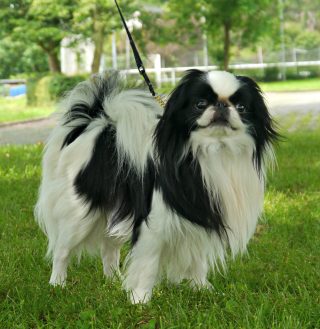
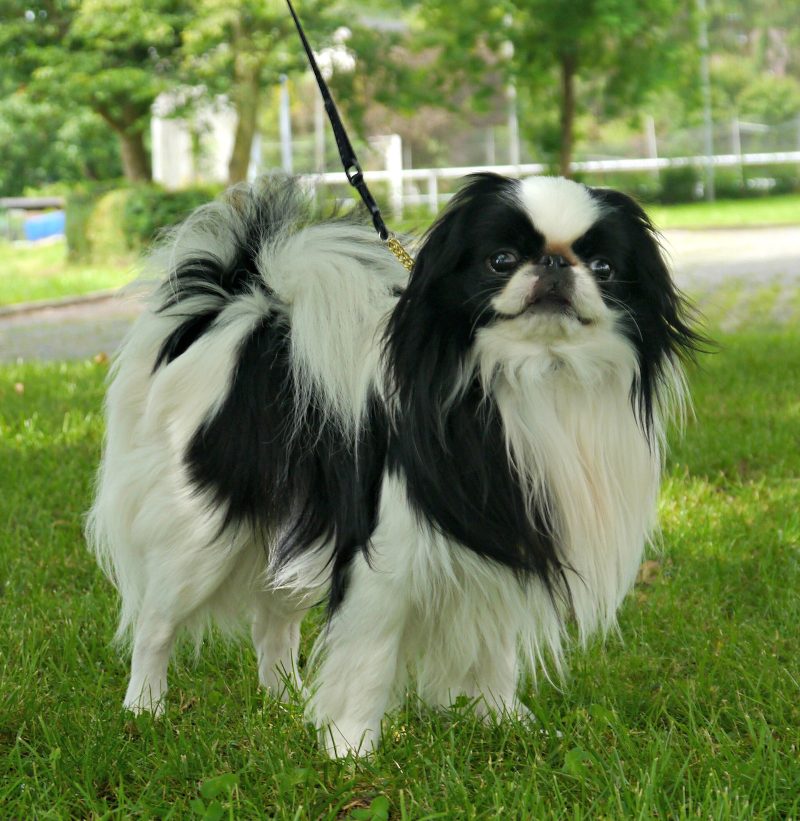
The Chin is a small, square, fine-boned dog standing about 8 to 11 inches and weighing 7 to 11 pounds. The head is large for the body and rounded, with a very short, broad muzzle, a wide-set pair of large, dark, slightly protruding eyes and a distinctive hint of white showing in the inner corners that gives the breed its look of mild astonishment. Small V-shaped ears hang forward, draped in long fringe. The body is compact with a level back, and the plumed tail arches over to lie along the spine.
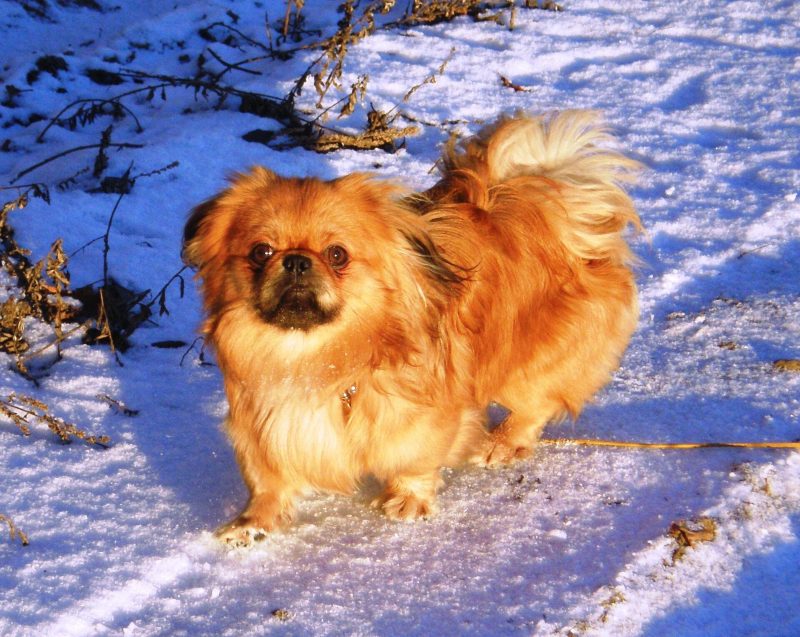
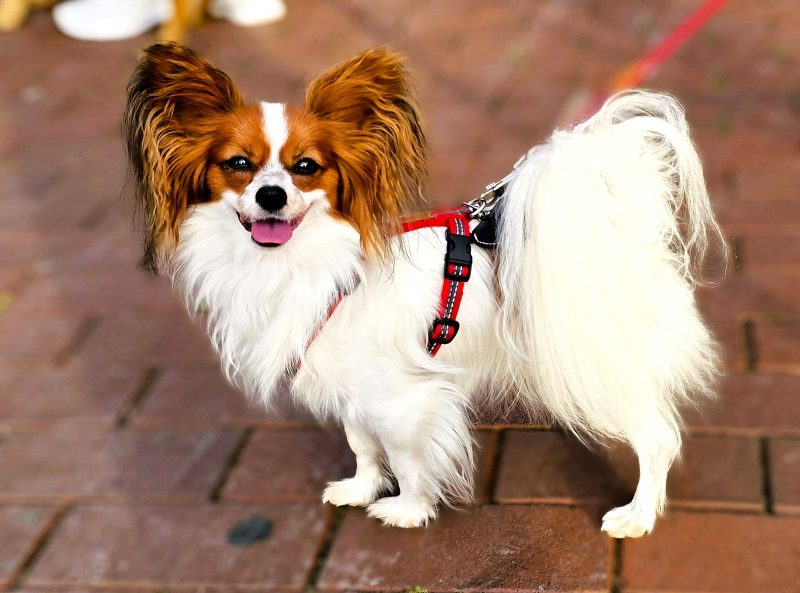
The coat is a single layer, silky, straight and long, forming a ruff around the neck, feathering on the ears, legs and tail, and a tidy, short face. Colors are black and white, red and white (red covering everything from pale lemon to deep sable) and black and white with tan points. Compared with the Pekingese, the Chin stands taller on straighter legs, has a thinner single coat and a lighter, more upright carriage; next to a Papillon, it has the flat face and the parti-colored coat.
Temperament & Personality
Chin people describe their dogs as cat-like, and they mean it: Chin climb to high perches, groom themselves with their paws, bat at toys and move with a light, careful step. They are gentle, affectionate and deeply attached to their household, often choosing one person as their favorite while staying friendly with the rest. With strangers they are polite but reserved, sizing up newcomers before granting approval. They will alert to a knock with a bark or two, but they are not yappy.
Indoors a Chin is calm, content to nap on a lap or watch from the sofa back; its bursts of play are short and comical, including the "Chin spin," a quick twirl on the hind legs when excited. They are generally good with other dogs and cats and do well in pairs. They are too delicate for boisterous toddlers but fine with calm older children. Sensitivity is the keynote: they wilt under harsh words and can be anxious if left alone too long.
Exercise & Activity
This is a low-to-moderate energy breed that is happy with about 30 minutes of activity a day. A couple of short walks, a game of fetch down a hallway and some play with a favorite toy cover its needs; the Chin is a companion, not an athlete, and will not thrive as a jogging partner. Mental enrichment counts: a puzzle feeder, a few minutes of trick training or a scent game indoors keeps the mind busy.
Heat is the serious limit. The short muzzle makes the Chin inefficient at cooling itself, so in warm or humid weather confine exercise to early morning and evening, keep walks short and watch for noisy breathing, drooling or lagging behind, which mean stop and cool down. Use a harness rather than a collar to keep pressure off the airway. Cold, damp days are fine with a sweater. A bored Chin is more likely to get clingy or sulky than destructive.
About 30 minutes a day of walks and indoor play
No exercise in heat; harness, not collar
Short training games for mental stimulation
Training
Chin are bright and observant and learn routines quickly, but they are not eager-to-please workers in the retriever mold. They train best with soft voices, tiny treats and short, cheerful sessions that end before they lose interest. Scolding achieves nothing except a dog that hides behind the sofa. Many Chin learn tricks readily because they enjoy the attention, and some compete in rally and obedience at the small-dog level.
Housetraining is the common sticking point, as with most toy breeds: small bladders, a dislike of wet grass and owners who do not notice tiny accidents all slow progress. A strict schedule, a crate or pen and generous rewards for going outside solve it in time, and many owners add an indoor pad option for bad weather. Socialize puppies early and gently so their natural reserve does not become shyness, and let them meet calm dogs, new surfaces and household noises. Teach them to settle alone for short periods from the start to head off separation distress.
Grooming & Care
For a long-coated breed, the Chin is pleasantly low-fuss. The single coat has no woolly undercoat to mat, so a thorough brushing and combing two or three times a week keeps it tangle-free, with attention to the ear fringes, the ruff, behind the elbows and the trousers. Shedding is moderate and year-round. Bathe about once a month or when dirty, using a gentle dog shampoo and drying the coat fully. No trimming is needed beyond tidying the feet and the hair around the hygiene area.
The face needs daily care: wipe the skin folds beside the nose and under the eyes with a damp cloth and dry them to prevent staining and irritation, and check the prominent eyes for redness or squinting, because they are easily scratched. Clean the ears every couple of weeks, trim nails every three to four weeks and brush the teeth daily, since the crowded mouth of a flat-faced toy breed is prone to periodontal disease.
Brush and comb 2 to 3 times a week
Daily face-fold wipe and eye check
Daily tooth brushing; nails monthly
Health
Japanese Chin typically live 10 to 12 years and are reasonably sound for a toy breed, but several inherited conditions deserve attention. The flat face brings brachycephalic airway syndrome: snoring, snorting and a real risk of overheating, worsened by excess weight. Luxating patellas, where the kneecap slips out of its groove, are common in the breed. The large eyes are prone to cataracts, corneal scratches, entropion and extra eyelashes. Heart murmurs from mitral valve degeneration can begin in middle age. The breed also carries GM2 gangliosidosis, a rare, fatal inherited storage disease that appears in young dogs; a DNA test identifies carriers so breeders can avoid producing affected puppies.
The Japanese Chin Club of America recommends that breeding dogs have a patella evaluation, a cardiac exam, an ophthalmologist eye exam and the GM2 DNA test, with results registered with the OFA. Ask any breeder for these. For your own dog, keep it lean, schedule annual exams with a stethoscope check of the heart, and ask your vet about any breathing noise, limping, eye discharge or wobbliness, especially in a dog under two.
Nutrition
Chin eat small amounts, so quality and routine matter more than quantity. Choose a complete small-breed food for the right life stage: a small-breed puppy formula with its higher energy density until about 12 months, then an adult food. Puppies and very small adults can be prone to low blood sugar if they go too long without eating, so feed puppies three or four times a day and adults two or three smaller meals rather than one large one. Measure portions and adjust to body condition; you should feel the ribs easily under a thin layer.
Obesity is a particular hazard for a flat-faced breed because it makes breathing harder, so keep treats to around a tenth of daily calories and skip table scraps. Kibble sized for small mouths is easier to chew and helps with tartar. Fresh water should always be available. Supplements are rarely needed on a complete diet; if your Chin has a sensitive stomach, dull coat or weight problem, ask your vet before changing anything.
Living With This Breed
The Chin is close to the ideal apartment dog: small, clean, quiet and content with modest exercise. It travels easily and adapts to houses, condos and retirement homes alike. A climate-controlled home is important, since heat and humidity are dangerous for it, and it should never be left in a car in warm weather. Expect it to claim high ground on furniture; provide a safe way down, because jumps from heights can injure a seven-pound dog.
It is a good match for singles, couples, seniors and families with older, gentle children, and it generally lives peacefully with cats and other small dogs. It does not do well left alone all day and may be happier with a canine companion. For a pet sitter or daycare, note that the Chin needs shade and rest in warm weather, a harness on walks, no rough play with large dogs, and a daily wipe of the face folds. A calm, quiet environment suits it far better than a busy one.
Excellent for apartments and quiet homes
Keep cool; heat is a medical risk
Fragile: supervise around small children and big dogs
Interesting Facts
Japanese nobles reportedly kept the tiniest Chin in ornamental cages like songbirds and carried them in kimono sleeves.
Japanese tradition set the Chin apart from ordinary dogs, or inu, treating it as a distinct kind of companion animal.
Commodore Perry's return from Japan in the 1850s brought the first Chin to the West; Queen Victoria received a pair.
Queen Alexandra, wife of Edward VII, was painted and photographed with her Chin and did more than anyone to make the breed fashionable in Europe.
Many Chin perform the "Chin spin," twirling on their hind legs when happy, and some "sing" with a rising warble when excited.
The AKC called the breed the Japanese Spaniel for nearly ninety years, from 1888 until the name became Japanese Chin in 1977.
Breeds similar to the Japanese Chin
What Japanese Chin owners say
Real pets, photos, stories and tips from the SitterNation community — separate from the editorial guide above.
Log in to add your pet, photos, stories and tips.
Meet Japanese Chins on SitterNation
No Japanese Chins have joined yet. Owners can show their pet here from the pet's profile.
Japanese Chin community photos
No Japanese Chins photos yet — be the first to share one.
Stories from Japanese Chin owners
No stories yet. What is life with yours really like?
Tips from Japanese Chin owners
No tips yet. One practical thing that works for you is enough.
Ask Japanese Chin owners
No questions yet. Ask the people who live with the breed.