Typical tendencies
Energy level
Calm at home with short bursts of play.
Good with children
Gentle and tolerant around children.
Good with other dogs
Gets along with known, polite dogs.
Trainability
Picks up cues with steady, short sessions.
Shedding
Noticeable, with heavier seasonal blows.
Apartment friendly
Needs space and a garden to be happy.
More traits
Exercise needs
Adaptability
Grooming needs
Drooling
Intelligence
Family friendly
Good with cats
Friendly with strangers
Sociability
Protectiveness
Prey drive
Overview
The Mastiff, often called the English or Old English Mastiff, is one of the heaviest dogs in the world and one of the calmest. Behind the enormous head and the serious expression is a patient, affectionate homebody that wants to lie across a doorway and keep an eye on its family. Its sheer presence deters intruders; it rarely needs to do anything else.
The breed suits owners with a house, a modest yard, a tolerance for drool and the budget for a dog that eats, medicates and boards at giant-breed prices. It is gentle with children it knows and relaxed with other pets, but it is aloof with strangers and must be well socialized because of its size. Lifespan is short, typically 6 to 10 years, and the heartbreak of that is part of the deal. If you want a quiet, devoted, low-energy guardian and can manage the logistics, few dogs are more rewarding.
History & Origin
Huge, broad-headed dogs were already established in Britain when Julius Caesar landed in 55 BC, and the Romans were impressed enough to ship some home to fight in the arena. Through the Middle Ages mastiffs guarded estates and hunted boar and wolves; in the late 1100s Henry II ordered them "lawed", with toes removed, to keep them from poaching royal game. The most famous origin legend dates to the Battle of Agincourt in 1415, when Sir Peers Legh's Mastiff is said to have stood over her wounded master for hours; her descendants became the Lyme Hall line that anchored the modern breed.
Bull and bear baiting kept big dogs in demand until the sports were banned in 1835, and Victorian fanciers then reshaped the Mastiff into a show dog. The American Kennel Club recognized it in 1885, and the Mastiff Club of America was founded in 1929. Food rationing in two world wars nearly erased the breed in Britain, and postwar breeders rebuilt it largely from North American stock. It remains a vulnerable native breed in the UK.
Appearance
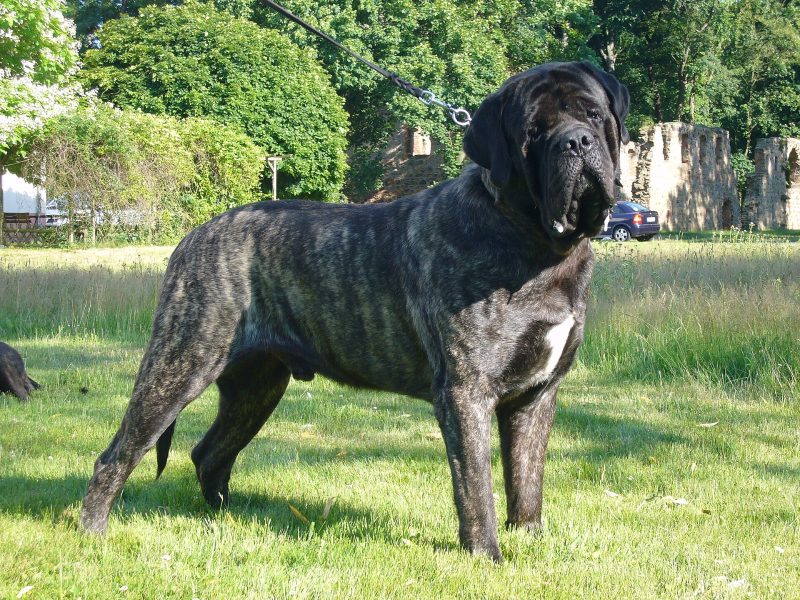
Everything about the Mastiff is massive and rectangular. Males stand at least 30 inches at the shoulder and commonly weigh 160 to 230 pounds; females are 27.5 inches and up, usually 120 to 170 pounds. The head is broad and square with a short, blunt muzzle, a pronounced stop, heavy flews and a wrinkled forehead that smooths out when the dog relaxes. Small, dark V-shaped ears hang close to the cheeks, and the eyes are dark and set wide apart, giving an expression of calm appraisal rather than menace.
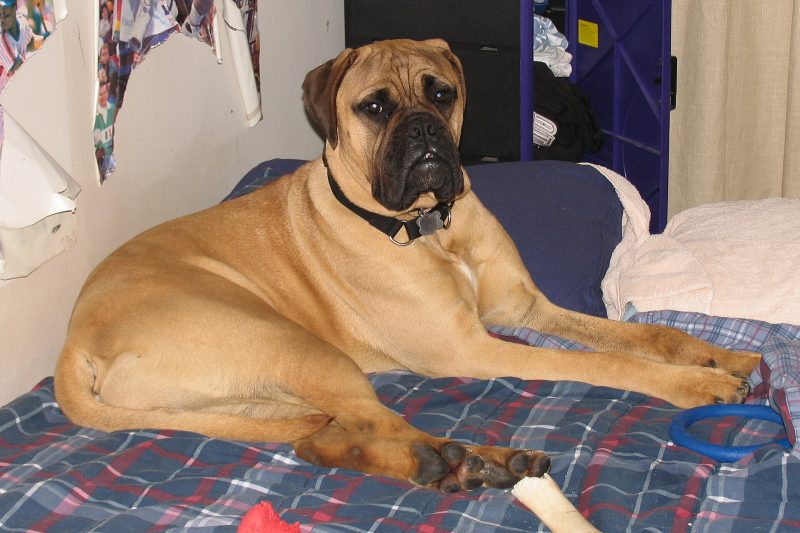
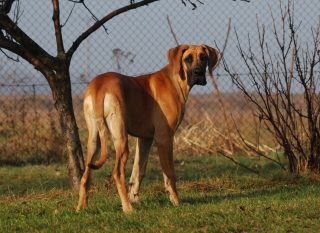
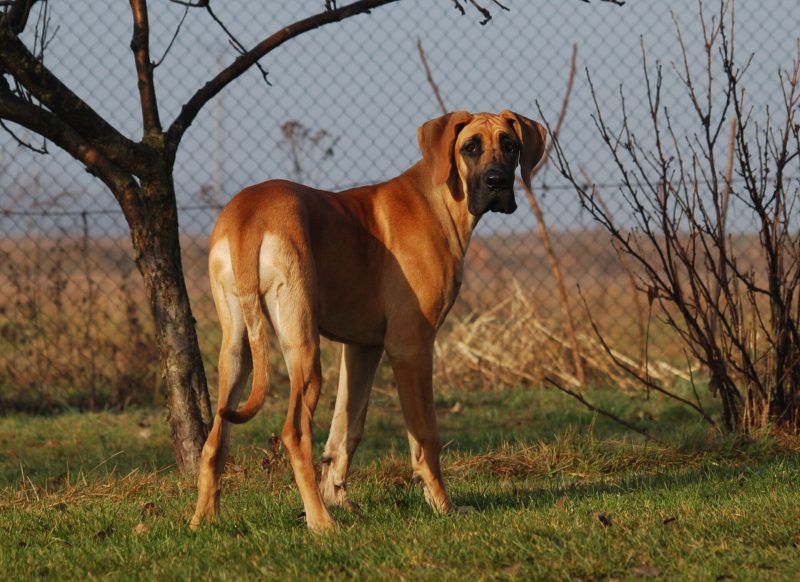
The body is deep, wide and heavily boned, with a straight tail carried low. The coat is short, straight and coarse over a dense undercoat. Colors are fawn, apricot and brindle, always with a black mask, ears and eye rims. A Bullmastiff is smaller, squarer and more compact; a Neapolitan Mastiff has far heavier wrinkling and loose skin; a Great Dane is taller, leaner and longer in the muzzle.
Temperament & Personality
The Mastiff's defining trait is dignified calm. Indoors it is quiet, slow-moving and content to sleep for much of the day, often with its head resting on someone's foot. It is deeply attached to its family and tends to follow one or two people from room to room, but it shows affection by leaning rather than bouncing. Barking is rare; a Mastiff that barks usually has a reason.
With strangers the breed is naturally reserved and watchful. It will place itself between its people and a visitor and wait to see how things develop; outright aggression is not typical in a well-bred, well-socialized dog, but the protective instinct is real and needs early guidance. Mastiffs are generally patient with children they know and tolerant of other dogs and cats, though a 200-pound dog can knock a toddler over by turning around. Some are sensitive and dislike raised voices or household conflict.
Exercise & Activity
Mastiffs need daily exercise but not much of it: 30 to 60 minutes of walking at an easy pace, split into two outings, suits most adults. They enjoy a slow ramble with plenty of sniffing, a short game in the yard and, in cooler weather, a longer hike at a walking pace. They are poor running partners and overheat quickly in warm weather, so summer walks belong in the early morning or evening with water on hand.
Puppy exercise needs real restraint. The breed grows for two to three years, and repeated jumping, stairs or long forced walks before the growth plates close contribute to joint problems later. Free play on soft ground is the safest outlet. Mental work such as nose games, scent trails and light obedience keeps an adult content.
A bored Mastiff chews heavily and may lean on doors until they give.
Avoid exercise for an hour either side of meals to lower bloat risk.
Training
Mastiffs are willing learners with a stubborn streak, and the stakes are higher than with most breeds because an untrained adult outweighs most of the people it lives with. Start the day the puppy comes home: loose-leash walking, a reliable recall, sit and down, and especially a solid "off" and "wait" before the dog is big enough to make those requests optional. Reward-based training with food and calm praise works; harsh handling produces a dog that shuts down or digs in, and the breed remembers rough treatment.
Socialization is the other priority. Expose the puppy steadily to visitors, children, other dogs, traffic and handling, so the adult's natural reserve settles into polite indifference rather than suspicion. Keep sessions short, because Mastiffs tire of repetition and respond poorly to drilling. Many enjoy carting, tracking and rally once grown. If protective behavior toward guests appears, work with a trainer early rather than hoping it fades.
Grooming & Care
The short coat is easy: a weekly once-over with a rubber curry or bristle brush removes dead hair and dirt, with daily brushing for the week or two in spring and fall when the undercoat sheds in earnest. Bathe only every couple of months or when the dog finds something to roll in. What takes real attention is everything that comes with a big, loose-lipped head.
Drool is constant and increases after drinking, eating or excitement; keep towels by the water bowl and expect to wipe walls. Facial wrinkles and the folds of the flews should be wiped and dried daily to prevent sore, smelly skin. The hanging ears trap moisture and need a weekly check and cleaning as required.
Trim nails every two to three weeks; heavy dogs wear nails unevenly and overgrown nails distort the feet.
Brush teeth several times a week.
Check elbows and hocks for calluses and pressure sores, and provide thick bedding.
Health
Giant size shortens life and shapes the Mastiff's health problems. Hip and elbow dysplasia are common, and responsible breeders screen with OFA or PennHIP hip evaluations and OFA elbow evaluations at two years or older. Gastric dilatation-volvulus, or bloat, is a life-threatening emergency in any deep-chested breed; ask your vet about preventive gastropexy and know the signs of a distended, painful abdomen and unproductive retching. Cardiac disease, including cardiomyopathy, is screened with an OFA cardiac exam, and hypothyroidism is checked by blood panel.
Eye conditions include progressive retinal atrophy, which has a DNA test, plus entropion and ectropion. Cystinuria, which causes urinary stones in affected males, is tested by DNA or urine screening. Osteosarcoma and other cancers, cruciate ligament tears and degenerative myelopathy appear more often than in smaller breeds. The Mastiff Club of America's core screening list is hips, elbows, eyes and heart, with thyroid and cystinuria strongly encouraged. Typical lifespan is 6 to 10 years.
Nutrition
Feeding a Mastiff well is mostly about pacing growth and preventing bloat. Puppies should eat a large- or giant-breed growth formula with controlled calcium and calories, because rapid growth in a dog destined to weigh 200 pounds stresses developing joints and is linked to orthopedic disease. A lean, slightly slow-growing puppy becomes a sounder adult, and the final size is set by genetics, not by extra food. Ask your vet when to move to adult food; many Mastiffs stay on a growth diet until 18 to 24 months.
Adults need surprisingly moderate amounts for their size, and obesity is common because the breed is so sedentary. Feed two or three measured meals a day rather than one large one, use a slow-feeder bowl, skip elevated feeders unless your vet recommends one, and keep an hour of quiet before and after meals. Monitor body condition by feel; a waist should be visible under the coat. Budget for large food bills.
Living With This Breed
A Mastiff needs a house with room to turn around and a yard it can potter in, though it will not use a big one; apartment life is impractical mostly because of stairs, elevators and the dog's footprint. It must live indoors with the family and does best in cool climates or air-conditioned homes. Mastiffs tolerate time alone better than many breeds as long as the routine is predictable, but they are devoted and sulk when ignored.
They are good with respectful children and most other pets. Drool, snoring and the occasional cleared coffee table are facts of life. Furniture, cars and crates all need to be giant-sized.
Sitters and walkers must be physically able to control the dog on leash and should meet it in advance so its reserve with strangers is already settled.
Note bloat precautions and any joint medication in the care sheet.
Daycare suits few Mastiffs; a calm in-home sitter usually suits them better.
Interesting Facts
Zorba, an English Mastiff from London, was recorded in 1989 at 343 pounds and over eight feet from nose to tail, the heaviest dog ever measured by Guinness.
Tradition holds that a Mastiff sailed on the Mayflower in 1620 alongside a spaniel, which would make it one of the first European dogs in New England.
The Lyme Hall Mastiffs were kept by the Legh family in Cheshire for more than five centuries, one of the longest documented breeding lines of any dog.
The breed's name may come from the Old French mastin or the Anglo-Saxon masty, meaning powerful; nobody is certain.
Mastiffs are so sedentary that many owners describe them as giant cats; a healthy adult happily sleeps away most of the day.
Despite the name, the Mastiff has almost nothing to do with the Tibetan Mastiff, which is a different breed from a different continent.
Breeds similar to the Mastiff
What Mastiff owners say
Real pets, photos, stories and tips from the SitterNation community — separate from the editorial guide above.
Log in to add your pet, photos, stories and tips.
Meet Mastiffs on SitterNation
No Mastiffs have joined yet. Owners can show their pet here from the pet's profile.
Mastiff community photos
No Mastiffs photos yet — be the first to share one.
Stories from Mastiff owners
No stories yet. What is life with yours really like?
Tips from Mastiff owners
No tips yet. One practical thing that works for you is enough.
Ask Mastiff owners
No questions yet. Ask the people who live with the breed.