Typical tendencies
Energy level
Calm at home with short bursts of play.
Good with children
Gentle and tolerant around children.
Good with other dogs
Selective; careful introductions needed.
Trainability
Picks up cues with steady, short sessions.
Shedding
Noticeable, with heavier seasonal blows.
Apartment friendly
Fine in a flat if exercise is kept up.
More traits
Exercise needs
Adaptability
Grooming needs
Drooling
Intelligence
Family friendly
Good with cats
Friendly with strangers
Sociability
Protectiveness
Prey drive
Overview
The Bullmastiff was designed in Victorian England to do one job quietly: find a poacher in the dark, knock him down and hold him until the gamekeeper arrived. The modern dog is a calm, confident, deeply loyal guardian that spends most of its day lying somewhere it can watch the door. It is affectionate with its family, tolerant of children it knows, naturally suspicious of strangers and far less demanding of exercise than its size suggests.
It suits experienced owners with a house, a solid fence and the confidence to train and socialize a dog that will outweigh most adults. It is a poor fit for first-time owners, for homes with several other dogs, especially of the same sex, or for anyone who cannot handle drool, snoring and a lifespan of only 7 to 9 years. For the right person it is one of the most devoted and least fussy large guardians there is.
History & Origin
In the mid-1800s England's great estates were plagued by poachers, who faced harsh penalties if caught and were therefore willing to fight. Gamekeepers needed a dog fast enough to run a man down, strong enough to pin him and steady enough not to maul him. The Mastiff was too slow and the Bulldog of the day too small and too fierce, so keepers crossed them, settling on a mix of roughly 60 percent Mastiff and 40 percent Bulldog. Dark brindle coats were preferred because they disappeared in the woods at night, which gave the breed its nickname, the Gamekeeper's Night Dog.
As poaching declined, keepers competed over whose dogs were best, and the type moved into the show ring. The Kennel Club recognized the Bullmastiff in 1924, requiring four generations of pure breeding, the AKC followed in 1933, and the FCI accepted the breed in 1955. The American Bullmastiff Association is the breed's parent club in the United States. In the 1920s the De Beers company shipped Bullmastiffs to South Africa to guard its diamond mines, and John D. Rockefeller imported them to patrol his New York estate.
Appearance
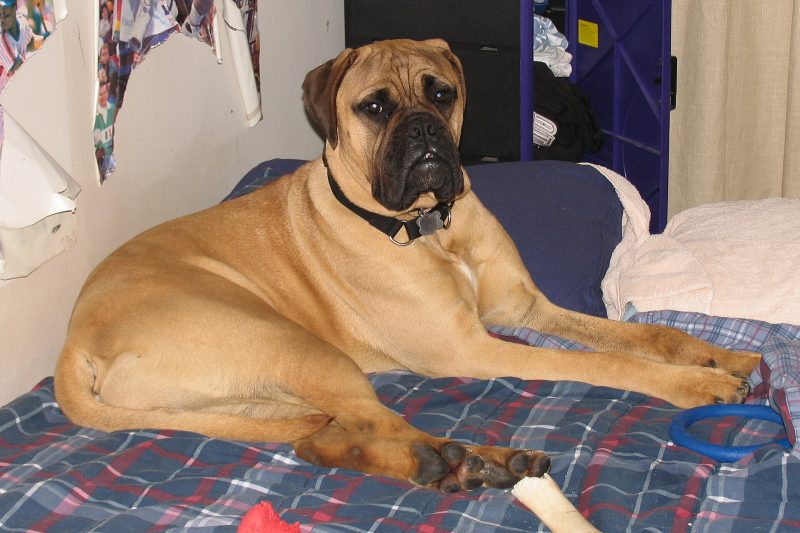
The Bullmastiff is a large, powerfully built dog that is nearly square in outline and gives an impression of compact strength rather than bulk. Males stand 25 to 27 inches and weigh 110 to 130 pounds; females are 24 to 26 inches and 100 to 120 pounds. The skull is large and square, wrinkling when the dog is alert, with a broad, deep, blunt muzzle about a third the length of the head. The ears are V-shaped, set high and wide, and lie close to the cheeks. The eyes are dark and medium-sized. The body is deep and wide with a level back, heavy bone and a tail that reaches the hocks.
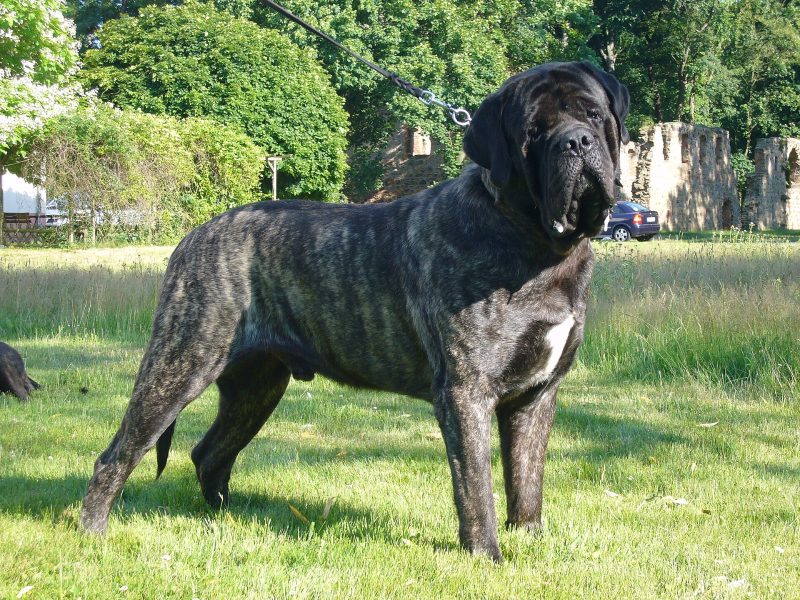
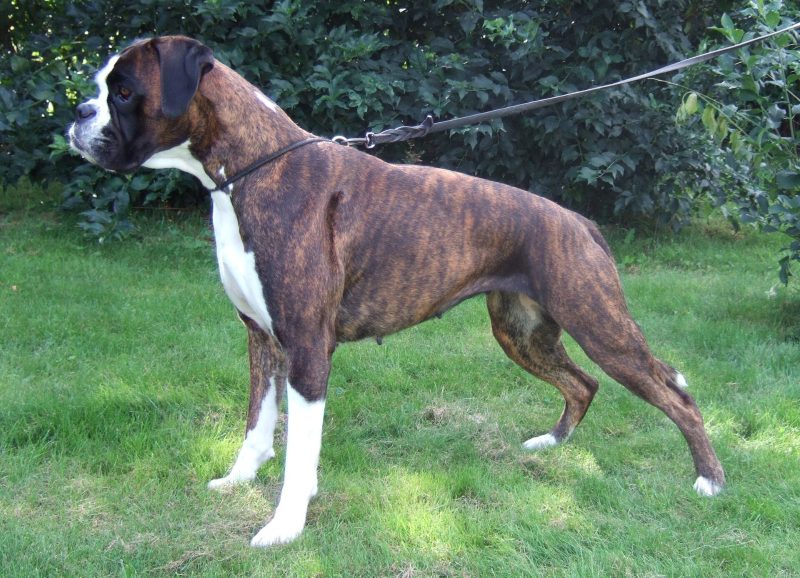
The coat is short, dense and weather-resistant, lying flat. Colors are fawn, red and brindle in any shade, always with a black mask that fades toward the eyes; a small white spot on the chest is allowed. Compared with a Mastiff it is smaller, squarer and more athletic; next to a Boxer it is far heavier with a less upturned face; next to a Cane Corso it is broader in skull and shorter in muzzle.
Temperament & Personality
The Bullmastiff is calm, confident and watchful. At home it is a quiet, affectionate presence that wants to be near its people, often lying across a doorway so nothing gets past unnoticed. It rarely barks without reason and tends to deal with intruders by blocking and holding rather than biting, exactly as it was bred to do. With family it is gentle and patient, and most are tolerant of children they live with, though a dog this heavy can knock a toddler flat by turning around.
With strangers it is reserved and will put itself between a visitor and its family until told otherwise; thorough socialization keeps that instinct sensible. It can be strong-willed and has a long memory for unfair treatment. Same-sex aggression toward other dogs is common, and unfamiliar dogs entering its territory may be met with force, so multi-dog households need care. Cats and other pets raised with it are usually accepted. Energy is low to moderate; this is a thinker, not a sprinter.
Exercise & Activity
Bullmastiffs need moderate daily exercise: a couple of brisk walks totaling 45 minutes to an hour, plus some play or a short training session. They enjoy long rambles at a walking pace and will cheerfully hike on a cool day, but they are not jogging or cycling partners, and their heavy build and short muzzle make them overheat quickly. In warm weather walk early and late, carry water and watch for heavy panting. Many enjoy tracking, scent work, carting, rally and even agility at a sedate pace.
Puppies grow fast and need their exercise limited to free play on soft ground and short lead walks until around 18 months, since jumping, stairs and long forced marches strain developing joints. Mental work such as nose games and obedience tires an adult more efficiently than mileage.
Boredom shows as chewing, digging and door-guarding that becomes pushy.
A secure fence matters more for keeping others out than for keeping the dog in.
Training
Training a Bullmastiff is not optional, because an untrained adult can simply decide not to move. Start the day the puppy arrives with leash manners, sit, down, wait at doors and a reliable "off", and keep practicing them through the strong-willed adolescent phase. Reward-based training with food and calm praise works; the breed is sensitive underneath its stoic exterior and responds to harshness by digging in. Keep sessions short and varied, and be consistent across the household, since a Bullmastiff will notice who enforces the rules.
Socialization is the priority. Take the puppy to classes and expose it steadily to visitors, children, other dogs and busy places so its guarding instinct develops judgment rather than suspicion. Teach it that guests you welcome are acceptable. Pulling on leash, body-blocking and leaning are the usual sticking points. Many Bullmastiffs do well in obedience, rally, tracking and therapy work, and a well-trained one is a remarkably easy dog to live with.
Grooming & Care
The short coat is one of the easiest to maintain. A weekly going-over with a rubber curry or bristle brush removes dead hair and dirt and spreads the skin oils; shedding is moderate year-round and heavier in spring and fall, when a few extra sessions help. Bathe only when needed, every couple of months or after a roll in something foul.
The real work is the face. Wipe the facial wrinkles and the folds around the muzzle daily and dry them well, since trapped moisture leads to infection. Drool is constant and heavy; keep towels at hand. Check the hanging ears weekly for redness or odor, trim nails every few weeks because long nails change the gait of a heavy dog, and brush the teeth regularly.
Watch for callouses on the elbows and provide soft bedding.
Unusual hair loss or dull coat can signal thyroid or allergy problems; ask your vet.
Health
The Bullmastiff's typical lifespan is 7 to 9 years, and its health concerns are largely those of a heavy, fast-growing breed. Hip and elbow dysplasia occur at high rates, so breeders should show OFA or PennHIP hip and OFA elbow evaluations on both parents. The parent club's recommended screening also includes a cardiac exam, because subaortic stenosis and cardiomyopathy appear in the breed; a thyroid panel for hypothyroidism; and an eye exam by a veterinary ophthalmologist for entropion, ectropion and progressive retinal atrophy, for which a DNA test exists.
Cancer is a leading cause of death, with lymphoma, mast cell tumors, osteosarcoma and hemangiosarcoma all reported more often than average. Bloat is a constant risk in this deep-chested breed; learn the signs of a swollen abdomen and unproductive retching and treat them as an emergency. Other issues include cystinuria and other kidney disease, cruciate ligament tears, panosteitis in growing puppies and allergies. Ask your vet about weight, joint care and annual bloodwork from middle age.
Nutrition
Feeding a Bullmastiff well means keeping it lean through a rapid, prolonged growth period. Puppies should eat a large-breed growth formula or, as many breeders prefer, an adult food, in three or four small meals a day, so they grow slowly and steadily rather than fast and heavy; ask your vet to help you judge the right rate. Adults do best on two measured meals a day of a complete diet, with portions scaled to a low-to-moderate activity level that is easy to overestimate.
Bloat precautions apply: no vigorous exercise for an hour before or after eating, no gulping huge meals, and ask your vet whether a slow-feed bowl or a preventive gastropexy makes sense for your dog. Extra weight is hard on hips, elbows and heart and shortens an already short life, so keep ribs easy to feel. Treats and table scraps add up fast on a dog that is persuasive and tall enough to reach the counter.
Living With This Breed
A Bullmastiff is a surprisingly good housedog: quiet, clean-coated and content to sleep most of the day. It needs space to lie down and turn around and a securely fenced yard, but not acreage; apartments can work for a calm adult with daily walks, though stairs are hard on joints. Cool and temperate climates suit it; hot ones require air conditioning. It wants to be with its people and tolerates a few hours alone once mature.
It is patient with its own children and should be supervised with small ones because of size. Visiting children, strangers and other dogs need managed introductions. Drool reaches surprising heights on walls and guests. Snoring is loud.
For sitters and daycare staff:
Meet the dog with the owner present before the first solo visit.
Avoid group play with unfamiliar dogs, particularly of the same sex.
Keep walks short and shaded in heat; carry water.
Know the signs of bloat and the nearest emergency clinic.
Interesting Facts
The breed's recipe was roughly 60 percent Mastiff and 40 percent Bulldog, and early gamekeepers favored dark brindle because it vanished in the woods at night.
The nickname Gamekeeper's Night Dog describes the job precisely: find the poacher, knock him down and hold him without biting.
In 1928 the De Beers company imported Bullmastiffs to South Africa to guard its diamond mines.
John D. Rockefeller brought Bullmastiffs to America in the 1920s to patrol his Kykuit estate in New York.
A Bullmastiff named Swagger served for several seasons as the live mascot of the Cleveland Browns, continuing the breed's long association with guarding things people value.
The Kennel Club admitted the breed in 1924 only for dogs with four generations of pure Bullmastiff ancestry, which fixed the type remarkably quickly.
Breeds similar to the Bullmastiff
What Bullmastiff owners say
Real pets, photos, stories and tips from the SitterNation community — separate from the editorial guide above.
Log in to add your pet, photos, stories and tips.
Meet Bullmastiffs on SitterNation
No Bullmastiffs have joined yet. Owners can show their pet here from the pet's profile.
Bullmastiff community photos
No Bullmastiffs photos yet — be the first to share one.
Stories from Bullmastiff owners
No stories yet. What is life with yours really like?
Tips from Bullmastiff owners
No tips yet. One practical thing that works for you is enough.
Ask Bullmastiff owners
No questions yet. Ask the people who live with the breed.