Typical tendencies
Energy level
Needs a real outlet most days.
Good with children
Fine with calm, respectful older kids.
Good with other dogs
Gets along with known, polite dogs.
Trainability
Quick to learn and keen to please.
Shedding
A light scatter, easy to keep up with.
Apartment friendly
A natural fit for city living.
More traits
Exercise needs
Adaptability
Grooming needs
Drooling
Intelligence
Family friendly
Good with cats
Friendly with strangers
Sociability
Protectiveness
Prey drive
Overview
The Toy Fox Terrier is an American original: a 3.5-to-7-pound dog with the sleek coat and big upright ears of a toy and the nerve, speed and sense of humor of the Smooth Fox Terrier it descends from. It is bright enough to learn a trick in a few tries, bold enough to challenge a dog ten times its size and affectionate enough to spend the evening under a blanket on your lap. Owners get a true terrier that happens to fit in a handbag.
The breed suits apartments and houses alike, needs only moderate exercise and almost no grooming, and lives a long 13 to 15 years. It is less suited to homes with toddlers, who can hurt a dog this small, and to owners who want a quiet dog, since the Toy Fox announces everything. For singles, couples, seniors and families with older children who want a clever, portable, long-lived companion with real personality, it is hard to beat.
History & Origin
Smooth Fox Terriers were popular farm and family dogs in the United States in the early 1900s, and the smallest puppies in a litter, which weighed around seven pounds, turned out to be good ratters and unusually sweet-natured. Farmers bred the small ones to each other, and traveling circuses used them as trick dogs. To fix the size and smooth the temperament, breeders crossed in Chihuahuas, Toy Manchester Terriers and, according to the parent club, Italian Greyhounds. The United Kennel Club had registered these dogs as Smooth Fox Terriers since 1912 and began registering the Toy Fox Terrier under its own name on February 24, 1936.
A request for AKC recognition in 1915 was turned down, and for most of the century the breed was a UKC dog and a popular non-AKC companion. The American Toy Fox Terrier Club formed in the early 1990s and pursued AKC recognition: the breed entered the Miscellaneous class in 2000, gained AKC registration in 2001 and joined the Toy Group on January 1, 2003. It remains an American breed, recognized by the AKC and UKC but not by the FCI.
Appearance
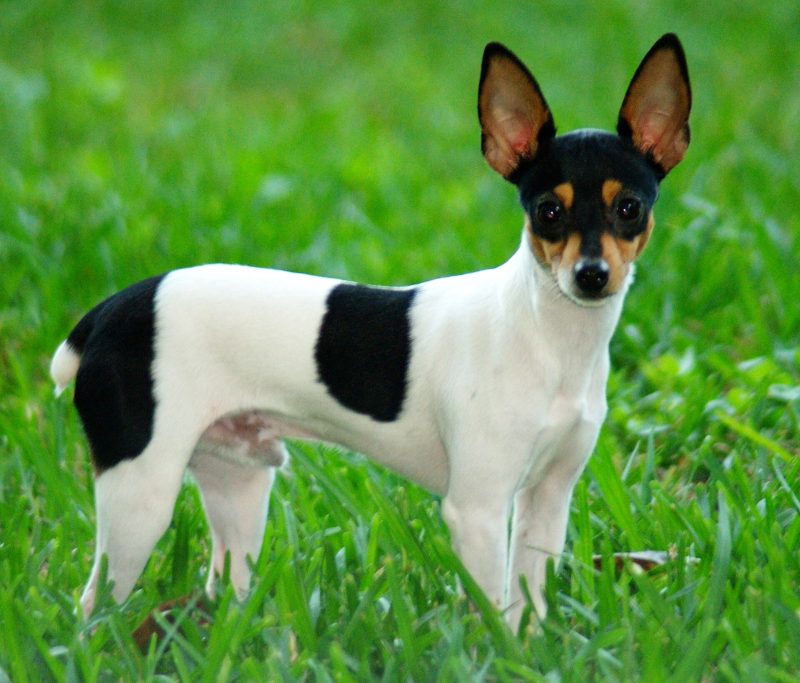
A Toy Fox Terrier is a small, square, elegant dog that looks like a Smooth Fox Terrier seen through the wrong end of a telescope. Height is 8.5 to 11.5 inches at the shoulder and weight 3.5 to 7 pounds, with a short, strong back, a deep chest for the size and a tail set high and carried up. The head is the breed's signature: a slightly rounded skull, a tapering muzzle, dark round eyes and large, pointed ears that stand straight up and seem to take up most of the head. The expression is alert, intelligent and faintly amused.
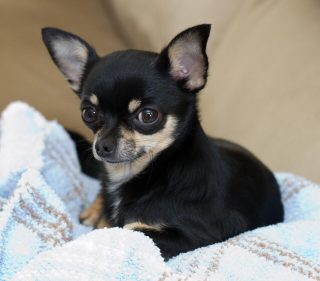
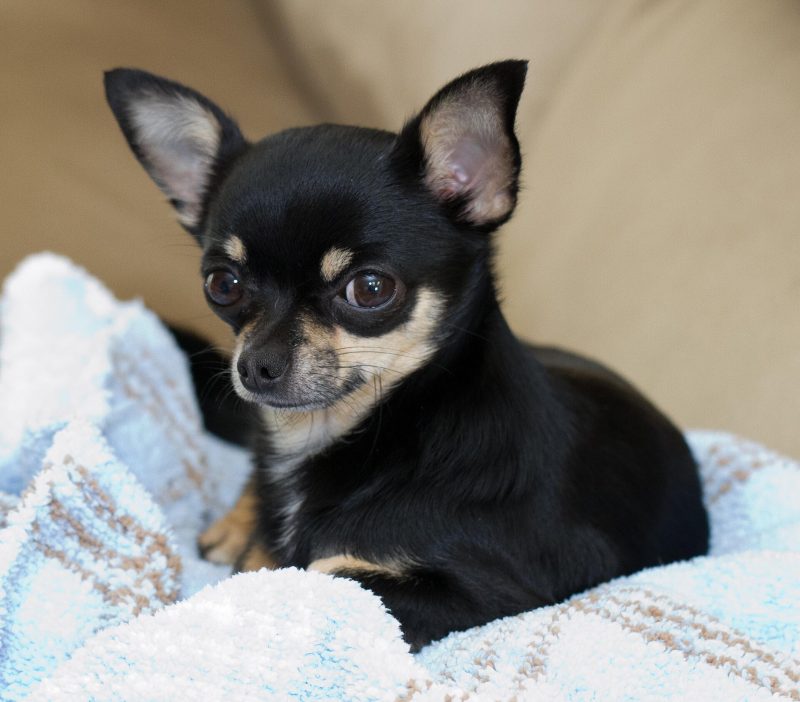
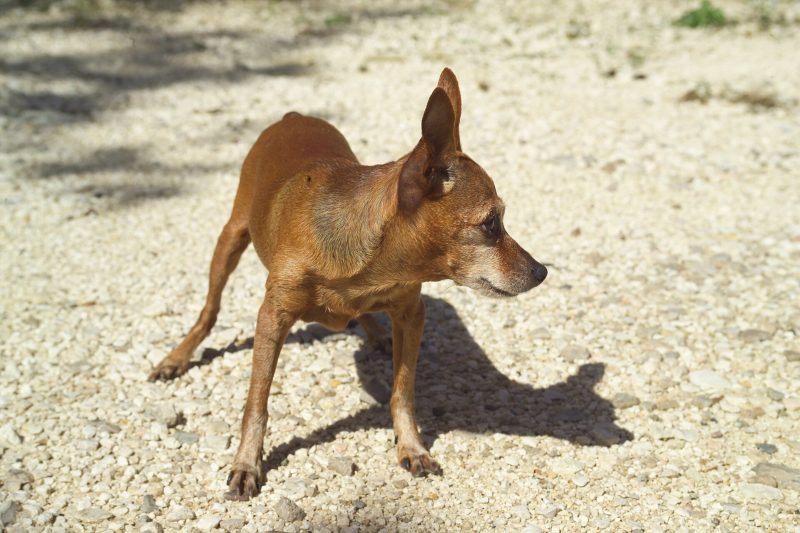
The coat is short, fine and satiny, a single layer that lies close and shines. The body is predominantly white, and the head is colored: tricolor is white with a black head and tan points, white and tan, white and black, and white, chocolate and tan are the other patterns. A Chihuahua has a rounder skull and comes in any color; a Miniature Pinscher is solid red or black-and-tan; a Rat Terrier is larger and leggier. A tiny white dog with a colored head and enormous ears is a Toy Fox.
Temperament & Personality
The parent club describes the Toy Fox Terrier as intelligent, courageous and animated, and adds that it tends to dominate any situation it is in, which is a polite way of saying it has no idea how small it is. Toy Foxes are devoted to their people, often to one person in particular, and want to be in a lap, on a shoulder or under the covers. They are playful throughout life, curious about everything and quick to learn, with a lively sense of humor.
With strangers they are alert and vocal, settling once introduced. With children they are best with older kids who handle them carefully; a dropped or stepped-on seven-pound dog is seriously hurt, and the breed will defend itself. With other dogs most are sociable, though they will stand up to much larger dogs without hesitation and need supervision. Prey drive is real, and small pets such as hamsters and birds are at risk; cats raised with them are usually fine. Indoors an exercised Toy Fox is a cheerful, cuddly companion.
Exercise & Activity
Toy Fox Terriers are energetic but small, and their needs are easy to meet: 30 to 60 minutes a day of walks, indoor games and play covers it, and much of that can happen in a living room. Fetch down a hallway, tug, hide-and-seek with treats and trick training all count, and the breed shines in agility, obedience, rally and flyball, where its speed and eagerness to learn stand out. A short daily walk still matters for sniffing and socialization.
Cold is the limit. The single coat gives little insulation, and a Toy Fox needs a sweater or coat in chilly weather and should not be left outdoors in winter. Heat is better tolerated but shade and water still matter. Keep the dog on leash or in a fenced yard outdoors, because the terrier reflex to chase is intact.
Boredom shows up as barking, chewing and digging in the houseplants.
Several short play sessions beat one long walk for this breed.
Training
Toy Fox Terriers learn fast and love to show off, which is why their ancestors worked in circuses; a new trick often takes a few repetitions. They train best with tiny food rewards, toys and praise in short, lively sessions, and they lose interest if a lesson drags on. The breed is known for house-training more easily than many toys, though a consistent schedule and a small dog's small bladder both need attention, and a litter box or pad can help in bad weather.
The sticking points are barking, which needs a quiet cue early, and the big-dog attitude, which needs socialization with calm, friendly dogs so confidence does not become reactivity. Resist carrying the dog everywhere; a Toy Fox that walks into new situations on its own feet grows up braver. Teach a solid leave-it and recall, since the chase reflex is strong. Many Toy Foxes earn trick titles and compete in agility, and some work as hearing dogs and seizure-alert dogs, a measure of how trainable the breed is.
Grooming & Care
The Toy Fox Terrier is close to wash-and-wear. A quick weekly rubdown with a soft brush or a hound glove removes dead hair and keeps the satiny coat shining; shedding is light but constant, and the white hairs show on dark fabric. Bathe every month or two or when dirty, using a gentle shampoo, and dry the dog promptly since it chills easily. The breed dislikes being wet, so keep baths short and warm.
Teeth are the main grooming job. Small dogs are prone to tartar, gum disease and early tooth loss, so brush several times a week and ask your vet about professional cleanings. Trim nails every few weeks; a dog this small does little to wear them down. The erect ears need only a weekly look and the occasional wipe, and tear staining around the eyes can be cleaned with a damp cloth.
Keep a sweater by the door for cold-weather walks.
Check the skin during brushing; the fine coat makes bumps easy to spot.
Health
Toy Fox Terriers are generally healthy and live 13 to 15 years, and the parent club has done unusual work in identifying and testing for the breed's inherited problems. Luxating patellas, in which the kneecap slips out of its groove and causes a skipping gait, are the most common orthopedic issue and are checked by a veterinary exam. Legg-Calve-Perthes disease, a loss of blood supply to the head of the femur in young dogs, causes hind-leg lameness and has no screening test. Three conditions have DNA tests: congenital hypothyroidism with goiter, which affects puppies; primary lens luxation, which can lead to glaucoma; and spinocerebellar ataxia, a progressive loss of coordination. Von Willebrand disease, a clotting disorder, and demodectic mange are also reported, and dental disease is common.
The American Toy Fox Terrier Club asks breeders for an OFA patella evaluation and the DNA tests for hypothyroidism with goiter, lens luxation and ataxia, and many add degenerative myelopathy. A skipping or hopping gait, a red or cloudy eye or unusual bleeding after a nail trim should prompt a call to your vet. Keep the dog lean, since obesity worsens joint problems.
Nutrition
A Toy Fox Terrier eats very little, which makes it cheap to feed and easy to overfeed, since a few extra treats are a large share of a seven-pound dog's daily calories. Feed a complete diet formulated for small or toy breeds, with a kibble size the dog can chew comfortably, measure meals with a kitchen scale rather than a cup and adjust to body condition; you should feel the ribs easily and see a waist. Adults do well on two meals a day. Puppies should eat three or four small meals, because very small puppies can develop low blood sugar if they go too long without food; ask your vet about signs to watch for.
Use part of the daily ration as training rewards and keep table scraps off the menu, both for weight and because this breed begs with real skill. Dental health benefits from a diet and chew routine suited to small mouths. Fresh water should always be available. Seniors may need fewer calories; ask your vet before changing diets or adding supplements.
Living With This Breed
The Toy Fox Terrier is one of the easiest breeds to house. It thrives in apartments and small homes, needs no yard, travels well and is happy in a warm climate; cold climates require sweaters, short winter walks and an indoor toileting plan on bitter days. The breed is good with older, careful children and most dogs, needs supervision around large dogs because of its fearlessness, and is a risk to small pets. Barking is the main consideration in close quarters, so start a quiet cue early.
Time alone is tolerated reasonably for a few hours, but the breed bonds closely and prefers company; a bored Toy Fox barks and chews. It should never live outdoors. For sitters and daycare staff, the key points are the fragility, the big-dog attitude and the cold sensitivity.
Watch doors and feet; a tiny dog underfoot gets hurt.
Separate from boisterous large dogs at play.
Bring the sweater and expect a lap dog in the evening.
Interesting Facts
Toy Fox Terriers worked as trick dogs in traveling American circuses in the early 1900s, which is why they still learn tricks so readily.
The United Kennel Club registered the breed under its own name on February 24, 1936, nearly seventy years before the AKC placed it in the Toy Group in 2003.
The AKC standard notes that the breed seems to know the latest in its household's television entertainment, a line fanciers quote with a straight face.
Several Toy Fox Terriers have worked as hearing dogs and seizure-alert dogs, jobs usually filled by much larger breeds.
The breed is also called the American Toy Terrier or Amertoy, and it is one of the few toy breeds developed entirely in the United States.
Despite the name, the Toy Fox Terrier was never used on foxes; its working past is rats in the barn and tricks in the ring.
Breeds similar to the Toy Fox Terrier
What Toy Fox Terrier owners say
Real pets, photos, stories and tips from the SitterNation community — separate from the editorial guide above.
Log in to add your pet, photos, stories and tips.
Meet Toy Fox Terriers on SitterNation
No Toy Fox Terriers have joined yet. Owners can show their pet here from the pet's profile.
Toy Fox Terrier community photos
No Toy Fox Terriers photos yet — be the first to share one.
Stories from Toy Fox Terrier owners
No stories yet. What is life with yours really like?
Tips from Toy Fox Terrier owners
No tips yet. One practical thing that works for you is enough.
Ask Toy Fox Terrier owners
No questions yet. Ask the people who live with the breed.