Typical tendencies
Energy level
Always on; boredom turns into mischief.
Good with children
Gentle and tolerant around children.
Good with other dogs
Enjoys most canine company.
Trainability
Lives for the lesson; a trainer's dream.
Shedding
Noticeable, with heavier seasonal blows.
Apartment friendly
Can manage in a flat with plenty of outings.
More traits
Exercise needs
Adaptability
Grooming needs
Drooling
Intelligence
Family friendly
Good with cats
Friendly with strangers
Sociability
Protectiveness
Prey drive
Overview
The Nova Scotia Duck Tolling Retriever, or Toller, is the smallest of the retrievers and one of the most intense: a fox-red Canadian gundog bred to dance along a shoreline until curious ducks drift within range, then fetch them from cold water. Males stand 18 to 21 inches and weigh 45 to 51 pounds, females 17 to 20 inches and 37 to 43 pounds, and most live 12 to 14 years. Tollers are quick, agile, clever and devoted, and they are at their best with a job, whether that is hunting, agility, dock diving or a long daily game of fetch. They suit active, outdoorsy owners who want a trainable partner and can give it real work most days. They are a poor match for sedentary homes, first-time owners who expect a small Golden Retriever, or anyone bothered by the breed's famous high-pitched scream of excitement.
History & Origin
The Toller was developed in the early 1800s by fishermen and farmers around Yarmouth County in southwestern Nova Scotia, who needed a dog that could lure, or toll, waterfowl and then retrieve in icy water. Tolling itself was already old: Europeans had used small decoy dogs to draw ducks into nets since the Renaissance, and American sporting journals described toling, with one l, in the mid-1800s. No early breeding records survive, but retriever-type dogs were the base, with farm collie and spaniel probably mixed in, and the result was known as the Little River Duck Dog or Yarmouth Toller. Hap Smith, a breeder and promoter active from 1885 to 1920, did much to keep the strain going. The Canadian Kennel Club recognized the breed in 1945. By 1973 it was reported close to extinction as a pure breed, and American fanciers began importing dogs in the late 1970s; the Nova Scotia Duck Tolling Retriever Club (USA) was founded in 1984. The AKC admitted the breed to its Miscellaneous Class in 2001 and to the Sporting Group on July 1, 2003.
Appearance
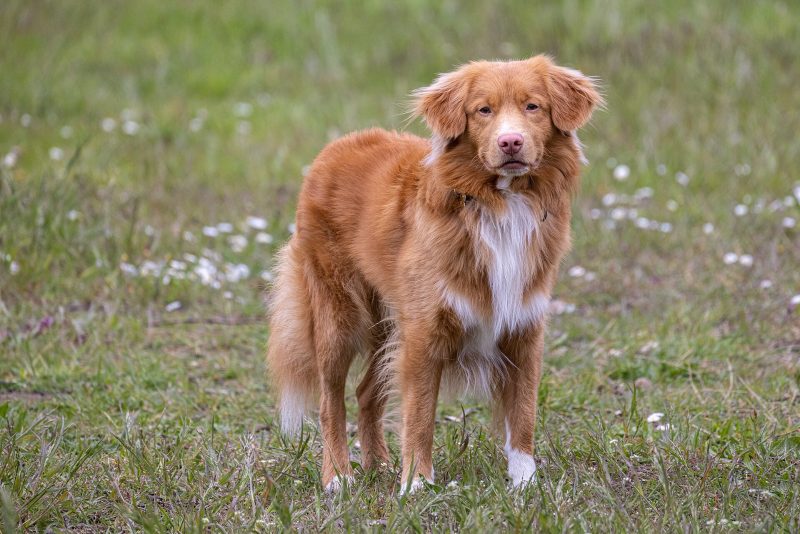
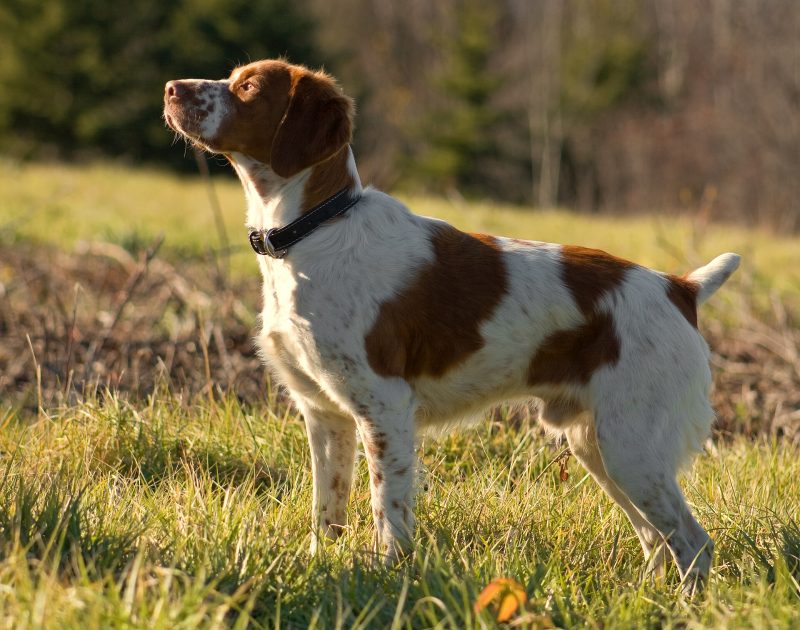
A Toller looks like a small, compact Golden Retriever that has been dipped in red paint and given a fox's alertness. It is medium-sized and slightly longer than tall, athletic rather than heavy, with a wedge-shaped head, almond eyes that range from amber to brown, and triangular ears set high and carried back. The tail is well feathered and carried in a lively curve when the dog is moving. The double coat is water-repellent, medium in length with moderate feathering on the tail, legs, chest and ears, and sometimes a slight wave on the back. Color runs from orange-red through copper to deep red, usually with white on the feet, chest, tail tip or as a blaze, and the nose and lips are flesh-colored or black to match the coat. Next to a Golden the Toller is noticeably smaller, redder and sharper in outline, and next to a Brittany it has a longer, heavier coat and a full feathered tail.
Temperament & Personality
Tollers are bright, busy and intensely focused, with an off switch that works only after their needs are met. They are affectionate and loyal to their family, playful with children who can keep up with them and generally good with other dogs. With strangers they are polite but reserved, often watching for a while before engaging, and they are alert enough to bark when something is off without being noisy dogs. The breed's signature is the Toller scream, a high-pitched yelp of excitement that erupts when a ball or a boat appears. Prey drive is moderate; cats raised with the dog are usually fine, but squirrels and birds will be chased. Tollers are sensitive and do not take harsh treatment well, and they can become anxious or destructive if under-exercised or left alone too long. Expect a dog that wants to be included, watches you constantly and is never quite as tired as you are.
Exercise & Activity
A Toller needs at least 60 to 90 minutes of vigorous exercise a day, ideally including retrieving and water. Fetch is the breed's reason for living, and swimming, dock diving, hunting, hiking, jogging and canicross all suit it. Tollers shine in agility, flyball, obedience, rally, field trials and scent work, and a dog that trains in one sport is far easier to live with. Mental work is as important as mileage; a quick retrieve session plus a training game beats a long boring walk. The coat handles cold and wet water well, and summer heat calls for swimming or early-morning exercise.
Daily retrieving, ideally into water, keeps a Toller sane
Boredom shows as pacing, barking, screaming and chewing
Sitters should bring a ball and expect a dog that does not quit
Training
Tollers are quick, clever and eager, but they are not pushovers; they want a reason to work and get bored by drill. Short, varied, reward-based sessions with food, toys and especially retrieves hold their attention, while harsh corrections make them shut down or avoid you. Socialize early and widely so that the breed's natural reserve with strangers stays polite rather than shy. Teach a calm settle and impulse control around balls and water, and introduce a quiet cue before the scream becomes a habit. Recall is usually good if trained with retrieves, though squirrels and birds test it. Tollers excel in advanced obedience, hunt tests, agility and tricks, and a dog with a sport to learn is a happier housemate. Sitters should keep sessions playful and avoid repetitive commands, which this breed tunes out.
Grooming & Care
The Toller's water-repellent double coat is fairly easy to maintain. Brush once or twice a week, with extra attention behind the ears, in the feathering and under the collar where mats form, and daily during the spring and fall shedding seasons when the undercoat comes out in handfuls. Bathe only when the dog is dirty or smells of pond, because frequent washing strips the coat's natural oils. Trim the hair between the paw pads so the dog does not skid on floors, and tidy the feathering if you wish, but never shave a double coat. Dry and clean the ears after swimming to prevent infections. Trim nails every two to three weeks and brush teeth several times a week.
Weekly brushing, daily during seasonal sheds
Ears cleaned after every swim
Expect red hair on everything twice a year
Health
Tollers are generally healthy and typically live 12 to 14 years, but a small founding population means several inherited conditions are known and tested for. The parent club's health registry requires a hip evaluation, an eye examination by a veterinary ophthalmologist and a DNA test for progressive retinal atrophy, and breeders commonly add elbow, patella and cardiac exams plus DNA tests for collie eye anomaly, degenerative myelopathy, cleft palate, juvenile Addison's disease, degenerative encephalopathy, cardiac laminopathy and a cerebellar degeneration and myositis complex. Immune-mediated disease is the breed's particular concern: Addison's disease, in which the adrenal glands fail, is more common in Tollers than in most breeds and may appear as vague lethargy, vomiting and weakness in a young adult, and steroid-responsive meningitis and autoimmune thyroiditis also occur. Hip and elbow dysplasia are seen as in other retrievers. Ask your vet about any unexplained lethargy, neck pain, fever or night blindness, and ask breeders for OFA results and DNA test reports.
Nutrition
Feed a complete and balanced diet for an active medium breed, in two measured meals a day for adults and three or four for puppies. Tollers are athletes and burn plenty of calories in work, but they are also efficient eaters that gain weight when activity drops, so adjust portions with the season and keep treats within a tenth of daily intake. You should see a defined waist and feel ribs easily under the coat. Dogs that compete or hunt hard may need more food on working days; ask your vet about performance diets rather than guessing. Avoid heavy exercise right before or after meals. Dogs diagnosed with Addison's disease or thyroid problems have specific feeding considerations that belong to their veterinarian. Sitters should follow the owner's portions, keep water available after retrieving sessions and be aware that a Toller will happily eat anything it finds on a lakeshore.
Living With This Breed
A Toller can adapt to an apartment or small home only if its owner is genuinely committed to daily outdoor work; otherwise a house with a fenced yard and nearby water is a far better fit. It lives indoors with its family and tolerates a few hours alone once trained, provided it has been exercised first. Tollers are good with active children, fine with other dogs and usually fine with cats they grow up with. The breed sheds seasonally and is not a quiet dog when excited, which neighbors may notice. The coat suits cold, wet climates well, and the dog needs water and shade in summer.
Sitters: plan for a long fetch session or swim, not just a walk
Expect the scream at the sight of a ball; it is excitement, not distress
Daycare and dog walkers who offer play groups or hikes suit this breed well
Interesting Facts
To toll means to lure, and the Toller does it by playing along the shore so that curious ducks swim toward the hunter's blind.
The breed's excited, high-pitched yelp is known as the Toller scream and is a well-known feature of the breed.
The Nova Scotia Duck Tolling Retriever has the longest name of any breed in the AKC Stud Book.
Tollers were called Little River Duck Dogs and Yarmouth Tollers before the Canadian Kennel Club recognized them in 1945.
The Dutch Kooikerhondje does similar decoy work, luring ducks into the netted pipes of traditional duck traps.
The breed was feared close to extinction in 1973, and American imports in the late 1970s helped rebuild it.
Breeds similar to the Nova Scotia Duck Tolling Retriever

What Nova Scotia Duck Tolling Retriever owners say
Real pets, photos, stories and tips from the SitterNation community — separate from the editorial guide above.
Log in to add your pet, photos, stories and tips.
Meet Nova Scotia Duck Tolling Retrievers on SitterNation
No Nova Scotia Duck Tolling Retrievers have joined yet. Owners can show their pet here from the pet's profile.
Nova Scotia Duck Tolling Retriever community photos
No Nova Scotia Duck Tolling Retrievers photos yet — be the first to share one.
Stories from Nova Scotia Duck Tolling Retriever owners
No stories yet. What is life with yours really like?
Tips from Nova Scotia Duck Tolling Retriever owners
No tips yet. One practical thing that works for you is enough.
Ask Nova Scotia Duck Tolling Retriever owners
No questions yet. Ask the people who live with the breed.